 When buyers ask me to quote a sliding gate roller, they often begin with the wheel diameter and the target price.
Those two details are useful, but they are not enough for me to recommend a suitable product.
Before discussing the final material, bearing, shaft, bracket, or manufacturing process, I need to understand the gate weight, track profile, working environment, installation method, and required quantity.
Two rollers can have the same outside diameter but use different grooves, bearings, materials, wall thicknesses, shafts, and support structures. They may look interchangeable in a photograph but perform very differently after installation.
Quick answer: Premium Sliding Gate Rollers & Accessories should be evaluated as a complete system. The roller groove must match the track, while the wheel material, bearing, shaft, bracket, and installation structure must suit the load and operating environment. Price alone cannot confirm whether a roller is suitable.
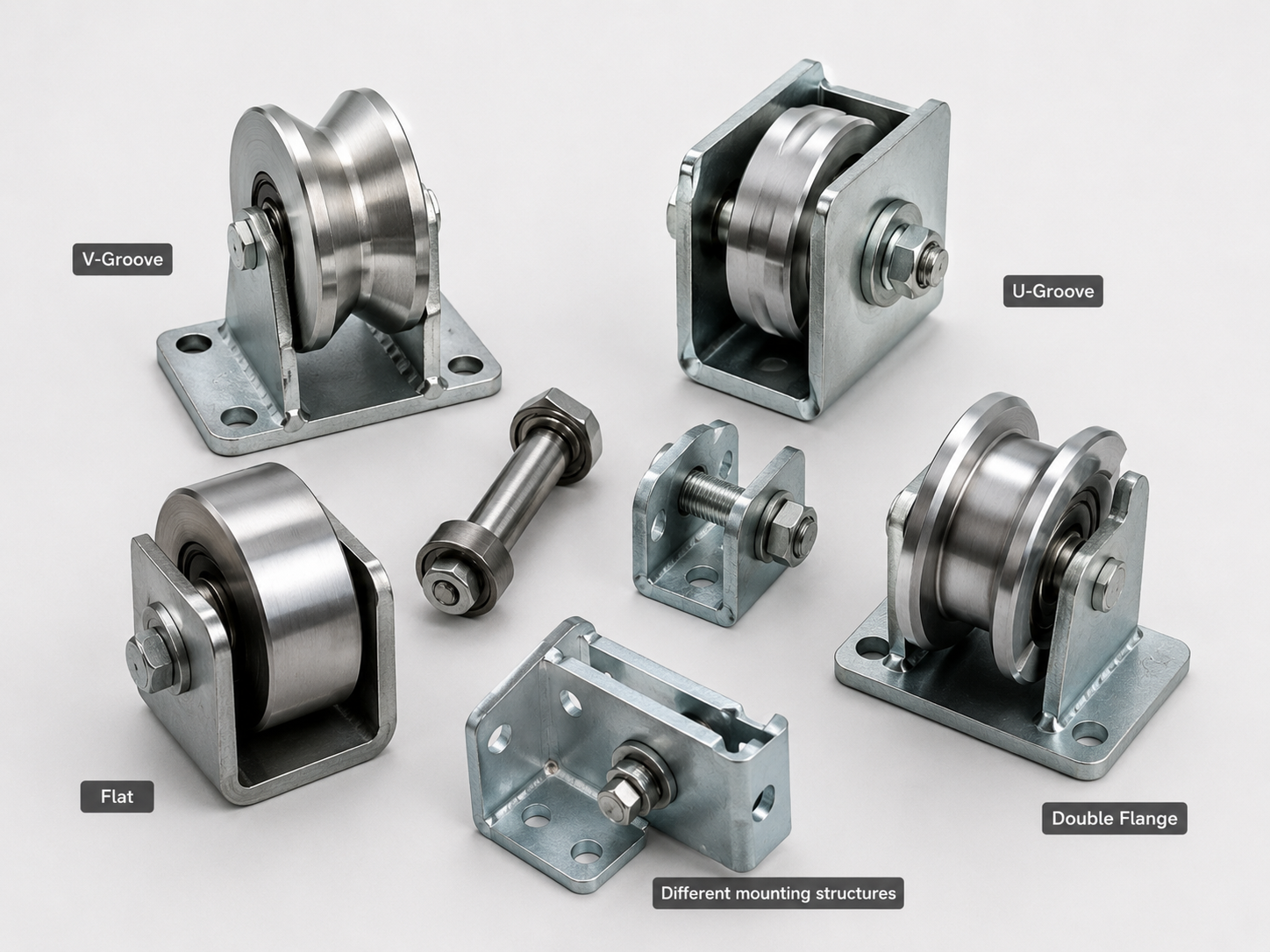
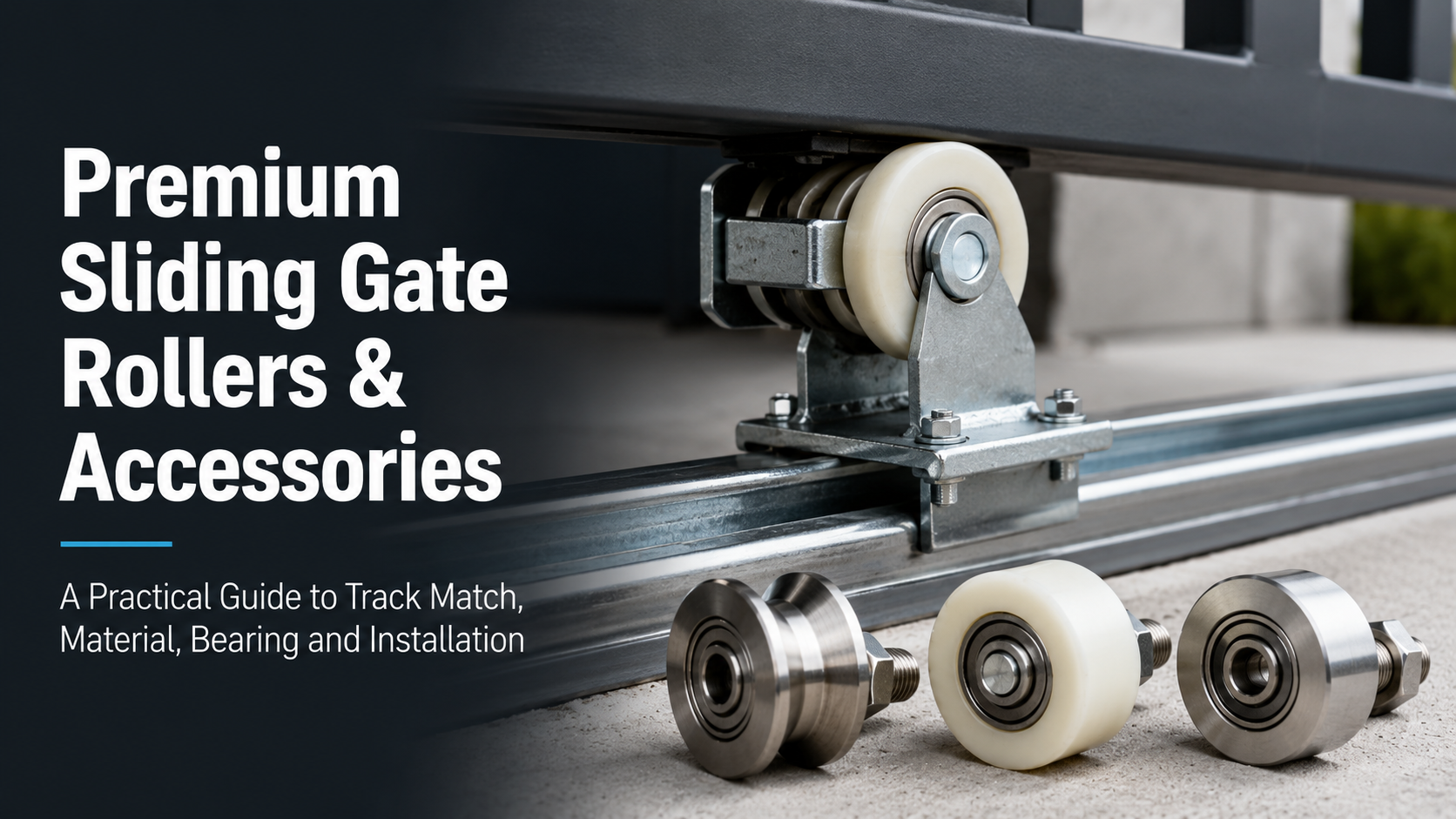
Different roller profiles and mounting structures are designed for different tracks, loads, and installation methods.
What Makes a Sliding Gate Roller Premium?
I do not define a premium roller by price, appearance, or one material name.
A stainless steel roller is not automatically premium if its groove does not match the track. A large bearing is not automatically better if it leaves insufficient material around the bearing. A thick bracket cannot solve a problem caused by incorrect alignment.
For me, a premium sliding gate roller must meet the requirements of the complete application.
| Evaluation point | What should be confirmed |
|---|---|
| Track compatibility | The groove matches the track angle, radius, width, and contact position |
| Dimensional consistency | Outside diameter, groove dimensions, bore, and installation height remain stable |
| Smooth rotation | The bearing rotates without obvious roughness, sticking, or abnormal resistance |
| Suitable wheel material | The material suits the load, noise, wear, moisture, and temperature requirements |
| Suitable bearing | The bearing size, fit, and protection suit the operating conditions |
| Strong load path | The shaft and bracket transfer the load without excessive deformation |
| Environmental protection | Bearings and exposed metal parts are protected against the actual environment |
| Repeatable production | Mass-produced parts follow the approved dimensions and structure |
A premium roller does not need to use the most expensive option in every position.
It needs to use the correct combination of materials, dimensions, and manufacturing processes.
Why Is the Complete Structure More Important Than One Component?
The wheel does not work independently.
The gate load passes through several connected parts:
Gate frame → bracket → shaft → bearing → roller body → track
If one part is unsuitable, improving another part may not solve the problem.
For example:
- A strong wheel can still fail inside a weak bracket.
- A high-quality bearing can still be damaged by an incorrect shaft fit.
- A wear-resistant material can still perform poorly on a mismatched track.
- A corrosion-resistant shaft cannot protect an unsuitable open bearing from water and contamination.
This is why I evaluate the assembly instead of judging the wheel from its appearance.
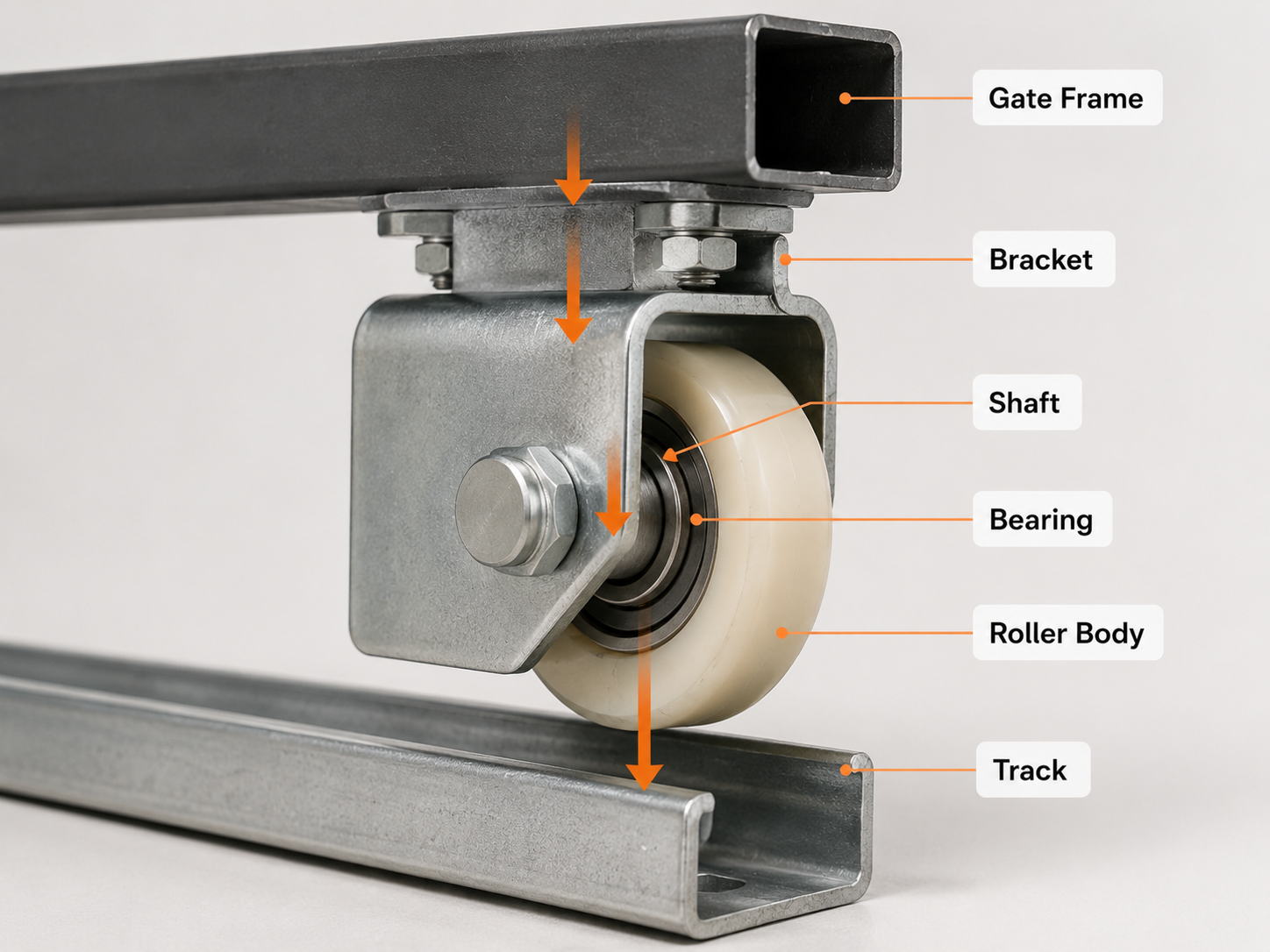
The complete load path should be considered when selecting a wheel, bearing, shaft, and bracket.
What Information Should Buyers Provide Before Selection?
Before I recommend a roller, I normally ask for five essential pieces of information:
- Gate or door weight
- Track profile and dimensions
- Working environment
- Installation method
- Required quantity
Without these details, I may be able to find a visually similar roller, but I cannot confirm whether it will work correctly.
| Required information | Why I need it |
|---|---|
| Total gate or door weight | Helps evaluate the wheel, bearing, shaft, and bracket structure |
| Number of supporting rollers | Affects how the load may be distributed |
| Track cross-section | Determines whether a V, U, flat, flanged, or custom groove is required |
| Track angle, radius, or width | Determines the detailed groove dimensions |
| Manual or motorized operation | Helps evaluate starting, stopping, and operating frequency |
| Opening frequency | Influences wear and bearing requirements |
| Indoor or outdoor use | Influences material, sealing, and corrosion protection |
| Dust, water, or chemicals | Influences bearing protection and material selection |
| Installation method | Determines whether a shaft, bolt, bracket, or adjustable assembly is required |
| Available installation space | Limits wheel width, shaft length, and assembly height |
| Required quantity | Affects whether an existing mold, machining, or new tooling is practical |
| Drawing or physical sample | Allows the critical dimensions and fit to be checked |
Why Is Gate Weight Alone Not Enough?
The total gate weight is important, but it does not describe the complete operating condition.
The actual load carried by each roller can also be affected by:
- The number of rollers;
- The distance between the rollers;
- The stiffness of the gate frame;
- The level and straightness of the track;
- Differences in roller installation height;
- Bracket adjustment;
- Debris on the track;
- Starting and stopping forces;
- Long-term wear or deformation.
For this reason, I do not automatically divide the total weight equally between the rollers and treat that result as the final design load.
If two rollers are installed at slightly different heights, one roller may carry more of the gate weight than the other.
What Should Buyers Send When They Do Not Have a Drawing?
When a technical drawing is unavailable, I usually ask for:
- Clear photographs from several angles;
- A ruler or caliper shown beside the product;
- The wheel outside diameter;
- Total wheel width;
- Groove width and depth;
- Bearing bore or shaft diameter;
- Overall installation height;
- A cross-sectional drawing of the track;
- The old roller or complete assembly, when possible.
A physical sample is often more useful than a product photograph because it allows the hidden dimensions and assembly relationships to be measured.
Why Does the Track Profile Matter More Than Wheel Diameter?
Outside diameter is the dimension customers provide most frequently.
However, it only tells me how large the wheel is. It does not tell me how the wheel contacts the track.
I also need to confirm:
- Groove width;
- Groove depth;
- V-groove angle;
- U-groove radius;
- Bottom clearance;
- Total wheel width;
- Flange spacing;
- Bearing position;
- Installation height.
A roller can have the correct outside diameter and still be unsuitable for the track.
How Should a V-Groove Roller Match the Track?
A V-groove roller should match the angle and dimensions of the raised track.
If the groove angle is too narrow, too wide, or positioned incorrectly, the roller may contact only a small area near the edge of the track.
Possible consequences include:
- Concentrated contact;
- Uneven groove wear;
- Increased rolling resistance;
- Noise or vibration;
- Unstable guidance;
- Damage to the wheel or track surface.
The groove angle should therefore be confirmed from the track cross-section rather than estimated from an exterior photograph.
How Should a U-Groove Roller Match the Track?
A U-groove bearing roller is generally considered for a round, curved, or tube-style track.
The groove radius, width, and depth should be evaluated together with the track diameter.
If the groove is too shallow, the roller may not provide sufficient guidance.
If the groove is too deep, the bottom of the groove may contact the track before the intended curved surfaces engage correctly.
When Is a Flat Roller Appropriate?
A flat roller requires a flat running surface and another method of controlling lateral movement.
Side guidance may come from:
- Separate guide rollers;
- Wheel flanges;
- A guided bracket;
- The gate-frame structure;
- A channel-shaped track.
Replacing a grooved wheel with a flat wheel changes the guidance method, even when the two wheels have the same outside diameter.
When Is a Double-Flange Roller Appropriate?
A double-flange roller can help maintain its position around a defined rail or guide section.
However, the flange spacing and side clearance must be controlled.
Too little clearance may create side friction. Too much clearance may allow excessive movement or unstable tracking.
| Roller profile | Critical dimensions | Common selection risk |
|---|---|---|
| V-groove | Groove angle, width, and depth | Edge contact caused by a mismatched angle |
| U-groove | Track diameter, groove radius, and clearance | Poor guidance or unintended bottom contact |
| Flat roller | Running width and lateral guidance | Uncontrolled sideways movement |
| Double-flange roller | Rail width and flange clearance | Side friction or excessive lateral play |
| Custom groove | Complete track cross-section | Visual matching without dimensional confirmation |
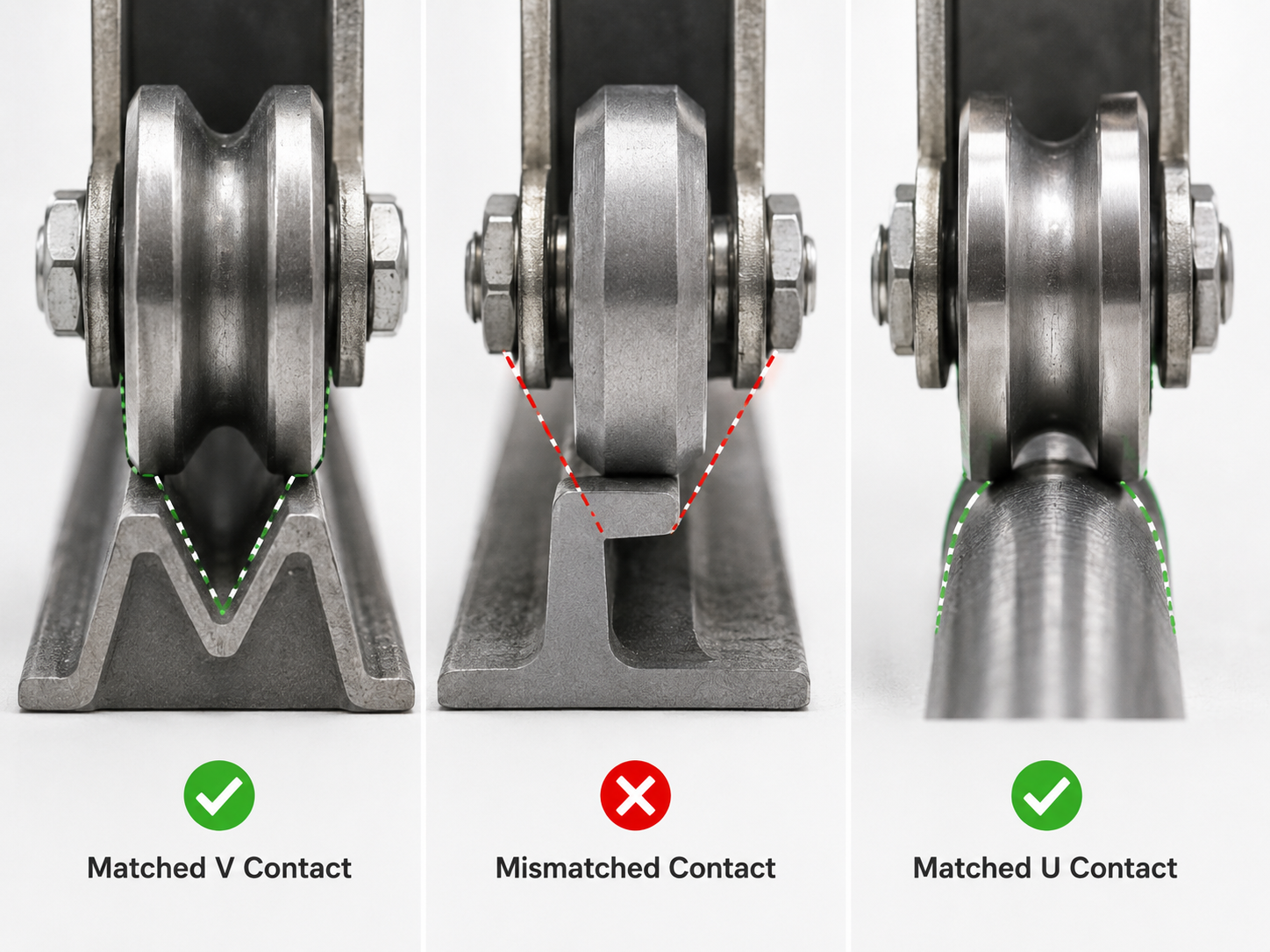
A matched groove distributes contact as intended, while a mismatched groove can concentrate the load near an edge.
How Do Gate Weight and Installation Affect the Roller?
A sliding gate roller must carry the load while maintaining correct contact with the track.
I therefore look beyond the wheel diameter and ask how the roller is installed.
Can Two Rollers Be Assumed to Carry Equal Loads?
Not always.
In a perfect theoretical installation, the load may be distributed evenly. In a real installation, the distribution can change because of:
- An uneven track;
- Gate-frame deflection;
- Different roller heights;
- Bracket deformation;
- Manufacturing tolerances;
- Loose fasteners;
- Track contamination;
- Wear over time.
If one roller is installed slightly lower than another, it can carry a larger share of the load.
The selected structure should therefore include a reasonable margin instead of operating exactly at a theoretical limit.
Why Does a Motorized Gate Need Additional Attention?
A motorized gate repeatedly starts, stops, and reverses.
These operating conditions are different from a stationary vertical load.
Frequent movement may expose weaknesses in:
- Bearing fit;
- Shaft rigidity;
- Bracket alignment;
- Fastener security;
- Groove contact;
- Wheel material;
- Track joints.
I therefore ask whether the gate is manual or motorized and how often it opens each day.
Why Does the Distance Between the Rollers Matter?
The roller spacing affects how the gate frame transfers its load.
A longer or less rigid gate may introduce additional bending and alignment problems. The wheel itself may be strong enough, but the installation may still allow the gate to lean, twist, or load one roller more heavily.
The complete gate structure should therefore be considered together with the roller arrangement.
Why Should the Shaft Be Evaluated Separately?
The shaft supports the bearing and connects the wheel to the bracket or gate frame.
Important shaft details include:
- Diameter;
- Unsupported length;
- Material;
- Heat treatment, when required;
- Thread size;
- Shoulder position;
- Surface treatment;
- Fit with the bearing bore.
A small increase in wheel size does not compensate for a shaft that is too thin or insufficiently supported.
Which Roller Material Should Be Selected?
There is no single best material for every sliding gate.
I select the material according to the application rather than using the most expensive material by default.
Important factors include:
- Load;
- Impact;
- Noise;
- Track wear;
- Moisture;
- Temperature;
- Chemicals;
- Dimensional tolerance;
- Operating frequency;
- Required service conditions.
| Material | Why I may consider it | What must still be checked |
|---|---|---|
| POM/acetal | Sliding performance, wear resistance, and dimensional stability | Load, temperature, wall thickness, and UV exposure |
| PA/nylon | Toughness, abrasion resistance, and impact performance | Moisture absorption and dimensional change |
| POK | Wear, impact, and selected chemical environments | Exact grade, temperature, processing, and long-term conditions |
| PU or rubber coating | Noise and vibration reduction | Hardness, bonding, deformation, oil, and temperature |
| Carbon steel | Rigidity and structural strength | Corrosion protection, noise, and track wear |
| Stainless steel | Moisture and corrosion resistance | Grade, machining, bearing structure, and cost |
When Do I Consider POM?
POM is often considered when smooth movement, wear resistance, low moisture absorption, and dimensional stability are important.
Material suppliers describe POM as having useful sliding properties, wear resistance, low moisture absorption, and good dimensional stability. However, those material properties do not replace structural evaluation. The wheel still needs sufficient wall thickness, a suitable bearing fit, and dimensions appropriate for the load and environment.
When Do I Consider Nylon?
Nylon can provide useful toughness, impact resistance, abrasion resistance, and low-friction behavior.
However, the exact nylon grade matters. PA66 absorbs moisture, which can affect dimensions and mechanical behavior. This should be considered when the wheel has a close bearing fit or a tightly controlled groove profile.
When Do I Consider POK?
I may consider POK when the application requires a different balance of wear, impact, or chemical resistance.
However, I do not treat “POK” as a complete specification. The exact material grade, operating temperature, load, molding conditions, and contact environment still need to be confirmed.
When Do I Consider a Rubber- or PU-Coated Roller?
A rubber- or PU-coated roller may be useful when noise reduction, vibration control, or softer contact with the track is important.
Before selecting it, I need to know:
- Required hardness;
- Load;
- Operating temperature;
- Oil or chemical exposure;
- Bonding method;
- Acceptable deformation;
- Required dimensional accuracy.
A softer coating can reduce noise, but excessive deformation may increase resistance or change the installation height.
Should an Outdoor Gate Always Use a Metal Wheel?
No.
A metal wheel may provide high rigidity, but it can also create more direct contact noise and track wear, depending on the track.
In some outdoor applications, an engineering-plastic wheel with a suitable bearing, corrosion-resistant shaft, and protected bracket may be appropriate.
In other applications, stainless steel or another metal wheel may be necessary.
I evaluate the complete combination:
- Wheel material;
- Bearing material and protection;
- Shaft material;
- Bracket material;
- Surface treatment;
- Water exposure;
- Dust and sand;
- Cleaning or maintenance conditions.
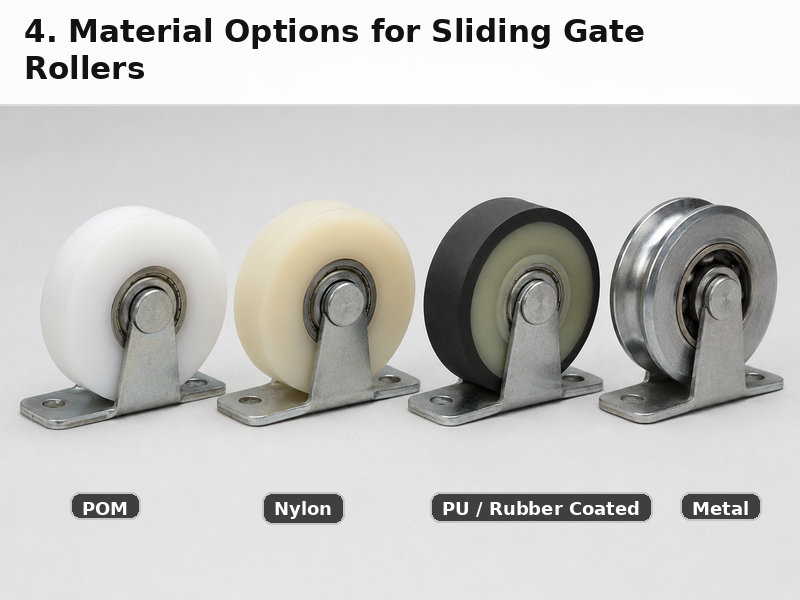
Material selection should follow the actual load, environment, noise requirement, and track structure.
Why Can Same-Size Rollers Perform Differently?
Two rollers with the same outside diameter may have very different internal structures.
The visible diameter does not show:
- Bearing outside diameter;
- Bearing width;
- One-bearing or two-bearing construction;
- Shielded or sealed protection;
- Plastic grade;
- Wheel-wall thickness;
- Bearing fit;
- Shaft diameter;
- Bracket thickness;
- Molding or machining process;
- Surface treatment.
| Hidden difference | Why it matters |
|---|---|
| Bearing size | Changes the internal support and available wheel material |
| Bearing width | Changes the support area and assembly structure |
| Bearing protection | Affects resistance to contamination and moisture |
| Plastic grade | Affects wear, impact, and dimensional behavior |
| Wheel-wall thickness | Affects stiffness and deformation risk |
| Bearing-to-wheel fit | Affects concentricity and loosening risk |
| Shaft diameter | Affects deflection and installation stability |
| Bracket structure | Affects alignment and load transfer |
| Manufacturing process | Affects dimensions, finish, and cost |
Bearings support and guide moving components while transmitting forces. In a sliding gate roller, the bearing should therefore be treated as part of the load-carrying structure rather than as an unimportant hidden component.
Why Is a Larger Bearing Not Always Better?
Assume the wheel outside diameter must remain unchanged.
If the bearing outside diameter becomes larger, the surrounding wheel material becomes thinner.
That may reduce the material available between:
- The bearing and the bottom of the groove;
- The bearing and the outside surface;
- The bearing and the wheel sidewall.
For this reason, I evaluate the following dimensions together:
- Wheel outside diameter;
- Bearing outside diameter;
- Bearing width;
- Groove depth;
- Wheel width;
- Remaining material thickness.
The correct bearing is not simply the largest bearing that physically fits inside the wheel.
A plastic-coated bearing roller must be designed so that the bearing, molded material, and groove structure work together.
Why Does the Bearing Fit Matter?
The bearing fit affects how securely the bearing is held inside the wheel and how the assembly rotates.
If the fit is too loose, the bearing may move relative to the roller body.
If the fit is too tight, the assembly process may damage the wheel or affect bearing operation.
The correct fit also depends on:
- Bearing dimensions;
- Plastic shrinkage;
- Molding temperature;
- Material moisture;
- Wheel geometry;
- Assembly method;
- Operating temperature.
Why Does Concentricity Matter?
The groove and bearing bore should rotate around the same center within the agreed tolerance.
Poor concentricity can cause:
- Visible radial movement;
- Repeated vertical movement of the gate;
- Vibration;
- Noise;
- Uneven contact;
- Uneven groove wear.
This is one reason why outside diameter alone cannot describe the quality of a roller.
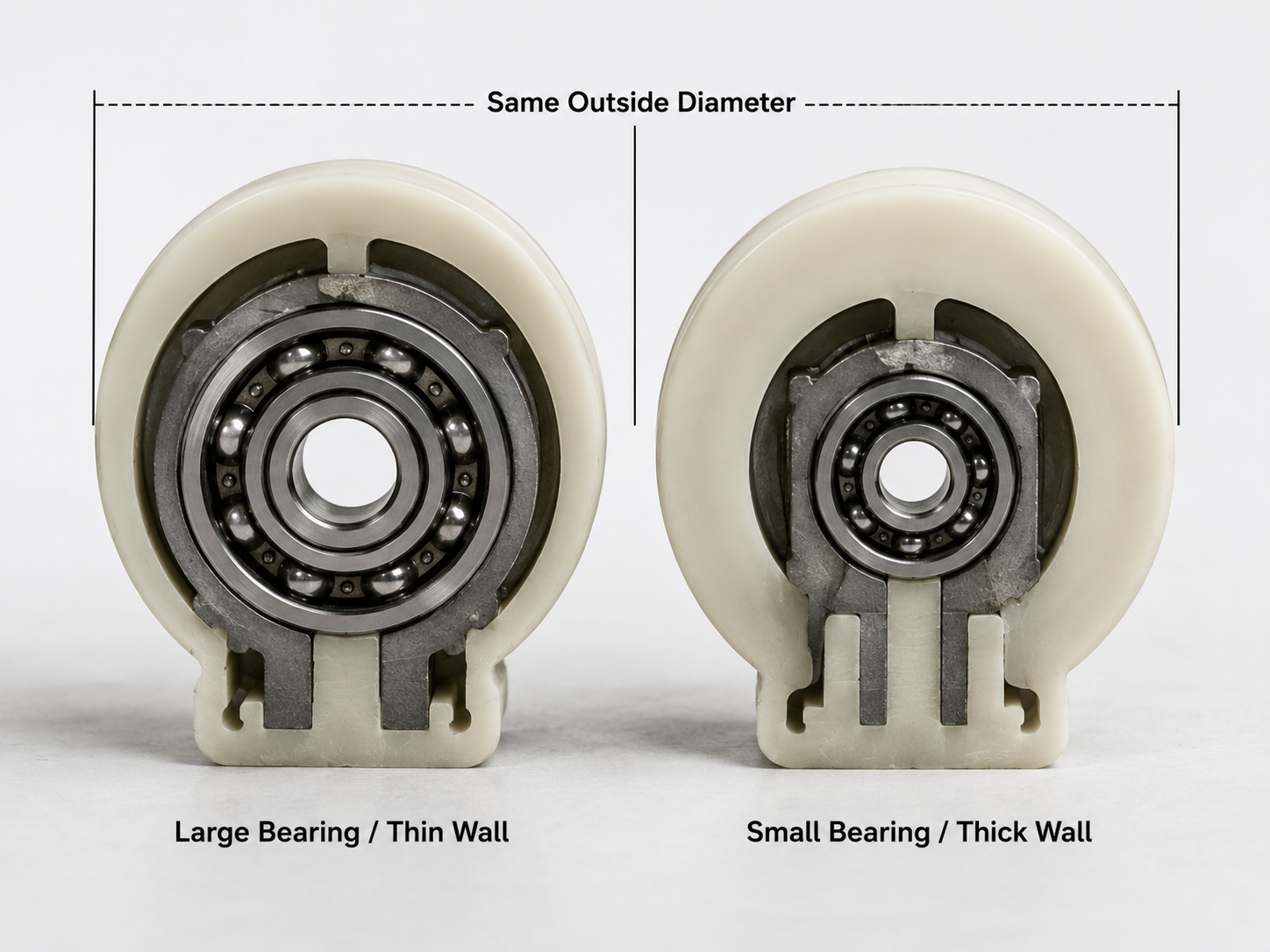
The same outside diameter can conceal major differences in bearing size, wall thickness, fit, and shaft structure.
Which Sliding Gate Accessories Affect Performance?
Sliding gate accessories are not only optional items around the wheel.
The shaft, bracket, washers, fasteners, and adjustment structure can determine whether the roller stays correctly positioned.
| Component | Main function | Common risk |
|---|---|---|
| Shaft or threaded bolt | Supports the bearing and connects the wheel | Bending, poor fit, or incorrect thread |
| Spacer or washer | Controls axial position and clearance | Excessive movement or side friction |
| Stamped bracket | Holds the shaft and transfers the load | Deformation or misalignment |
| Adjustable bracket | Allows installation-height correction | Loosening or insufficient adjustment range |
| Fasteners | Secure the assembly to the gate | Loosening under repeated operation |
| Guide roller | Controls lateral gate movement | Incorrect clearance or guide position |
Why Does the Bracket Matter?
A strong roller installed in a weak bracket is still a weak assembly.
The bracket affects:
- Roller alignment;
- Shaft support;
- Installation height;
- Side clearance;
- Adjustment range;
- Load transfer into the gate frame.
An adjustable roller assembly may help compensate for small installation differences.
However, adjustment cannot permanently correct:
- A severely uneven track;
- A twisted gate frame;
- An incorrect roller groove;
- A deformed mounting plate;
- Insufficient structural support.
When Should the Wheel, Shaft, and Bracket Be Developed Together?
I normally consider developing the complete assembly together when:
- The standard shaft does not fit the gate frame;
- The installation height is restricted;
- The bracket requires adjustment;
- The roller must be installed inside a narrow channel;
- The original assembly uses non-standard holes or threads;
- The customer wants a ready-to-install component;
- Several tolerances affect the final wheel position.
When a standard part cannot match the existing structure, the roller, shaft, and stamped bracket may need to be developed from a drawing or physical sample.
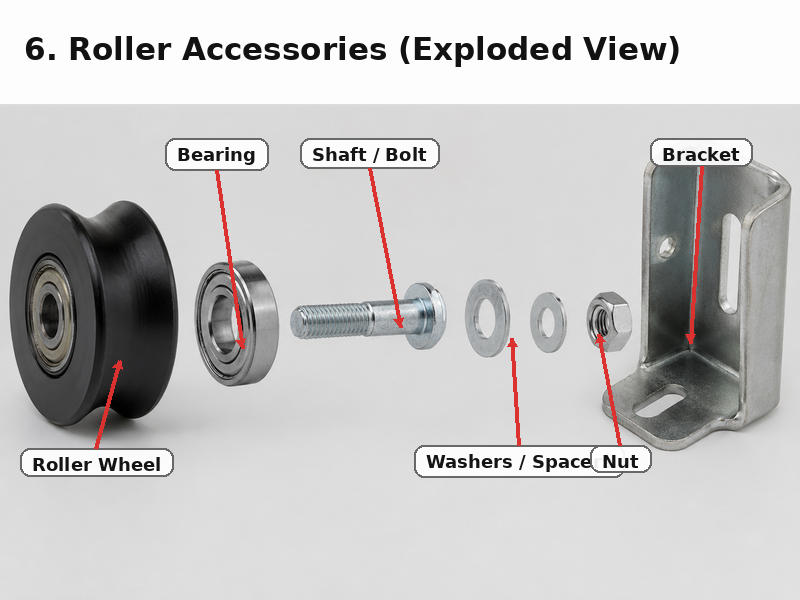
The roller, shaft, fasteners, and bracket should be evaluated as one assembly.
What Did a Real Customer Inquiry Teach Me?
One real inquiry showed why I do not quote a sliding roller from the outside diameter alone.
The customer initially provided only the required wheel diameter and asked for a price.
The missing information included:
- Gate or door weight;
- Track profile;
- Track width;
- Groove dimensions;
- Working environment;
- Installation method;
- Required quantity.
I could have selected the nearest existing roller and sent a low price immediately.
However, that price would only have described a product that looked similar. It would not have confirmed that the product could work correctly in the customer’s system.
I therefore asked the customer to confirm:
- The moving gate or door weight;
- The track cross-section and dimensions;
- Whether the application was indoor or outdoor;
- How the roller would be installed;
- The expected order quantity.
What Technical Risks Were Still Unknown?
The outside diameter could have been correct while the roller still had:
- An incorrect groove angle;
- An incorrect groove width;
- An unsuitable bearing;
- Insufficient wheel-wall thickness;
- An incompatible shaft;
- An unsuitable material;
- An incorrect installation height.
I did not finalize the material, manufacturing process, or quotation until those points could be reviewed.
This was not a field-failure story or a completed customer success case.
The professional value was that the risk was identified before an incorrect sample or mold entered production.
What I learned: A fast quotation is not always a professional quotation. When the application information is incomplete, asking for more technical details is more responsible than guessing.
Why Is This Case Important for Buyers?
A low quotation based on incomplete information may later require:
- Another sample;
- A different bearing;
- A modified groove;
- A new shaft;
- A new bracket;
- Additional machining;
- A new mold.
Confirming the application first can prevent these repeated costs.
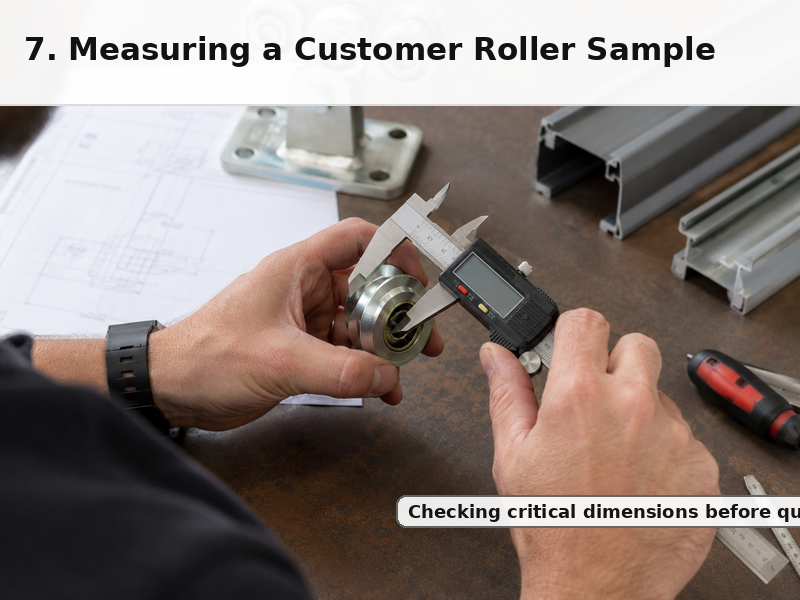
Critical dimensions should be measured before selecting an existing mold, machining process, or new tooling plan.
What Causes Sliding Gate Rollers to Fail Early?
When a roller fails, the visible wheel is often blamed first.
However, the root cause may come from the track, bearing, shaft, bracket, or installation.
| Observed problem | Possible cause | What I would inspect |
|---|---|---|
| One side of the groove wears faster | Misalignment or mismatched track contact | Groove geometry and roller position |
| Gate becomes difficult to move | Bearing damage, debris, or excessive load | Bearing rotation and track cleanliness |
| Roller becomes noisy | Contamination, wear, or poor contact | Bearing, groove, and track surface |
| Wheel moves sideways | Incorrect clearance or insufficient guidance | Flanges, guide rollers, and bracket position |
| Bracket bends | Insufficient strength or impact | Material, thickness, geometry, and mounting |
| Metal components rust | Unsuitable material or surface protection | Water exposure and coating condition |
| Plastic wheel deforms | Unsuitable material, temperature, or structure | Material grade, wall thickness, and load |
| One roller fails before the others | Uneven load distribution | Track level and installation height |
How Can Contamination Damage the System?
Ground-track gates can collect:
- Sand;
- Stones;
- Leaves;
- Mud;
- Metal particles;
- Water.
These materials can interrupt the contact between the wheel and the track. They can also create repeated impacts or enter insufficiently protected bearing areas.
Bearing failure guidance identifies contamination, incorrect mounting, excessive loading, and misalignment as important contributors to premature damage.
Why Does Incorrect Mounting Matter?
A bearing can be damaged during assembly when force is applied through the wrong ring or transmitted through the rolling elements.
Incorrect fits or mounting methods can also create unwanted stress, rough operation, or reduced service life.
For a sliding roller assembly, I therefore check:
- How the bearing is pressed into the wheel;
- How the shaft enters the bearing;
- Where assembly force is applied;
- Whether the bearing is supported correctly;
- Whether the shaft and bore dimensions match;
- Whether the bracket creates misalignment.
What Should Be Inspected During Maintenance?
The inspection frequency depends on the environment and operating frequency, but the following points are useful:
- Track cleanliness;
- Track level and straightness;
- Fastener tightness;
- Abnormal noise;
- Groove wear;
- Corrosion;
- Bracket deformation;
- Side movement;
- Bearing roughness;
- Changes in operating resistance.
A well-manufactured roller cannot permanently compensate for a contaminated, damaged, or incorrectly aligned track.
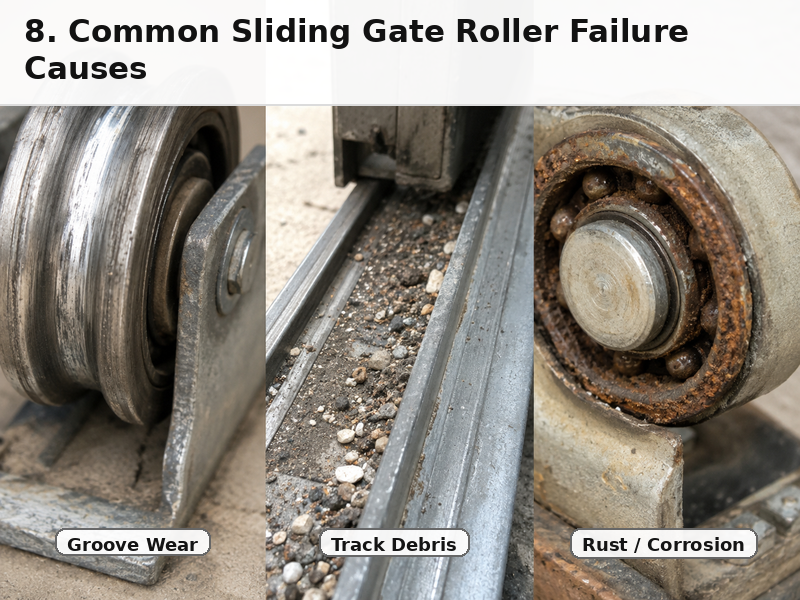
Failure analysis should include the track, bearing, shaft, and bracket rather than only the visible wheel.
How Should Buyers Compare Quotations?
When two suppliers provide different prices, buyers should first confirm whether the technical scope is the same.
A unit price cannot be compared correctly when one quotation includes a different material, bearing, shaft, or bracket.
| Quotation detail | Question to ask |
|---|---|
| Wheel material | Is the exact material or grade specified? |
| Bearing | What size, material, and protection are included? |
| Wheel dimensions | Are the angle, radius, width, and depth confirmed? |
| Shaft | What diameter, material, thread, and surface treatment are included? |
| Bracket | What material, thickness, and adjustment design are included? |
| Manufacturing process | Is the wheel molded, machined, coated, or assembled? |
| Tooling | Is new tooling required and quoted separately? |
| Inspection | Which dimensions and functions will be checked? |
| Sample approval | Will mass production follow an approved sample? |
| Packaging | Will the bearing and finished surfaces be protected? |
Why Should Buyers Not Compare Price Alone?
Different applications require different materials and manufacturing methods.
A roller intended for a light indoor manual gate may not need the same structure as a roller used for:
- A heavy motorized gate;
- An outdoor coastal installation;
- A dusty industrial environment;
- A frequently operated entrance;
- A non-standard track;
- A narrow custom bracket.
A lower-priced roller is not automatically poor quality.
It may simply be designed for a different application.
The real risk appears when the technical differences are not understood.
Why Can the Lowest Quotation Cost More Later?
An unsuitable roller can create additional costs through:
- Reworking the bracket;
- Replacing the shaft;
- Modifying the track;
- Producing another sample;
- Opening another mold;
- Replacing worn rollers;
- Delaying installation;
- Handling customer complaints.
My recommendation is to compare the technical structure first and the unit price second.
What Should Be Included in a Sliding Gate Roller RFQ?
A professional RFQ does not need to be long.
It needs to describe the application clearly enough for the supplier to avoid guessing.
| RFQ item | Information to provide |
|---|---|
| Application | Sliding gate, industrial door, equipment, or another system |
| Gate or door weight | |
| Gate dimensions | |
| Number of supporting rollers | |
| Track profile | V, U, round, flat, flanged, or custom |
| Track dimensions | |
| Wheel outside diameter | |
| Total wheel width | |
| Groove width | |
| Groove depth, radius, or angle | |
| Installation method | Shaft, bolt, bracket, or adjustable assembly |
| Available installation space | |
| Operating environment | Indoor, outdoor, wet, dusty, coastal, or chemical |
| Operation | Manual or motorized |
| Opening frequency | |
| Preferred material | |
| Required quantity | |
| Drawing available | Yes/No |
| Roller sample available | Yes/No |
| Track sample available | Yes/No |
| Special inspection requirements |
Which Documents Are Most Helpful?
The most useful documents normally include:
- A dimensional drawing of the roller;
- A cross-sectional drawing of the track;
- A drawing showing the roller installed in the gate;
- A 3D model, when available;
- Clear sample photographs;
- A short application video;
- Material or test requirements.
A track cross-section with dimensions is usually more useful than several exterior photographs.
When Should Buyers Send a Physical Track Sample?
A track sample may be necessary when:
- The groove is non-standard;
- The track is worn;
- The track radius is difficult to measure;
- The old wheel is damaged;
- The contact position is unclear;
- The drawing and sample do not match;
- The installation requires very little clearance.
Testing the wheel against the actual track can reduce uncertainty before tooling or mass production.
What Should Buyers Remember Before Ordering?
Do not begin the selection process by asking:
“Which roller is the cheapest?”
Begin by asking:
“Which roller correctly matches my gate weight, track, environment, and installation?”
Once these conditions are clear, the suitable solution may be:
- An existing standard roller;
- An existing roller with secondary machining;
- A different bearing structure;
- A custom injection-molded roller;
- A metal roller;
- A custom shaft;
- A stamped bracket;
- An adjustable roller assembly.
The correct solution is not automatically the most expensive one.
It is the solution that can be manufactured consistently and operate normally under the confirmed conditions.
What Questions Do Buyers Frequently Ask?
Can I Select a Sliding Gate Roller by Outside Diameter?
No. Outside diameter should be checked together with the groove profile, wheel width, bearing, shaft, installation height, and track dimensions.
Is a V-Groove Roller Better Than a U-Groove Roller?
Neither profile is universally better. The correct choice depends on the track geometry. The groove should match the track angle, radius, width, and intended contact position.
Are Plastic Rollers Only Suitable for Light Gates?
Not necessarily. Suitability depends on the material grade, wheel dimensions, bearing, shaft, roller quantity, bracket, and operating conditions.
The word “plastic” alone is not enough to determine whether a roller is suitable.
Is Stainless Steel Always the Best Choice for an Outdoor Gate?
No. Outdoor selection should consider the wheel, bearing, shaft, bracket, and surface protection as one system.
Stainless steel may be suitable for certain components, but it does not automatically solve groove mismatch, contamination, poor alignment, or an unsuitable bearing.
Why Does a Supplier Need the Gate Weight?
The gate weight helps the supplier evaluate the wheel structure, bearing, shaft, bracket, and number of supporting rollers.
It still needs to be considered together with the track, installation, and operating conditions.
Can an Existing Roller Be Modified Instead of Opening a New Mold?
Sometimes.
Small changes may be possible through machining or an existing-tool modification, depending on:
- The original wheel structure;
- Remaining wall thickness;
- Bearing position;
- Groove depth;
- Required tolerance;
- Quantity.
Major changes to the outside diameter, bearing size, or complete groove profile usually require a new evaluation.
Can the Groove Width Be Machined After Molding?
In some structures, a small groove-width adjustment may be possible.
However, I first need to check:
- Remaining wall thickness;
- Bearing position;
- Groove depth;
- Material;
- Required tolerance;
- Whether machining will expose or weaken the bearing area.
Can the Wheel Outside Diameter Be Changed?
A small diameter reduction may sometimes be possible through machining.
Increasing the outside diameter normally cannot be achieved without changing the mold or manufacturing process.
Can the Internal Bearing Be Replaced with Another Model?
Sometimes, but it should not be treated as a simple substitution.
Changing the bearing can affect:
- Bore size;
- Outside diameter;
- Bearing width;
- Wheel-wall thickness;
- Shaft diameter;
- Installation width;
- Mold structure;
- Final load path.
When Should I Send a Physical Roller Sample?
A physical sample is useful when:
- No drawing is available;
- The roller is non-standard;
- The groove is difficult to measure;
- The shaft and bracket are integrated;
- The installation height is critical;
- The sample has several hidden dimensions.
Should I Send the Track with the Roller Sample?
Yes, when the contact relationship cannot be confirmed accurately from a drawing.
A short track section allows the groove fit, clearance, and contact position to be evaluated directly.
What Information Is Needed for a Technical Evaluation?
Provide the gate weight, track cross-section, installation method, working environment, and expected quantity.
You can request a technical evaluation after preparing these details.
Who Wrote This Guide?
Shirley Ying works directly with international buyers on customized sliding rollers, plastic-coated bearing rollers, shafts, and stamped brackets.
Her daily work includes reviewing customer drawings, measuring physical samples, confirming track dimensions, and coordinating material, tooling, and production evaluations with the manufacturing team.
This article is based on real RFQ reviews, sample evaluations, and practical manufacturing discussions. Customer-identifying details have been removed.