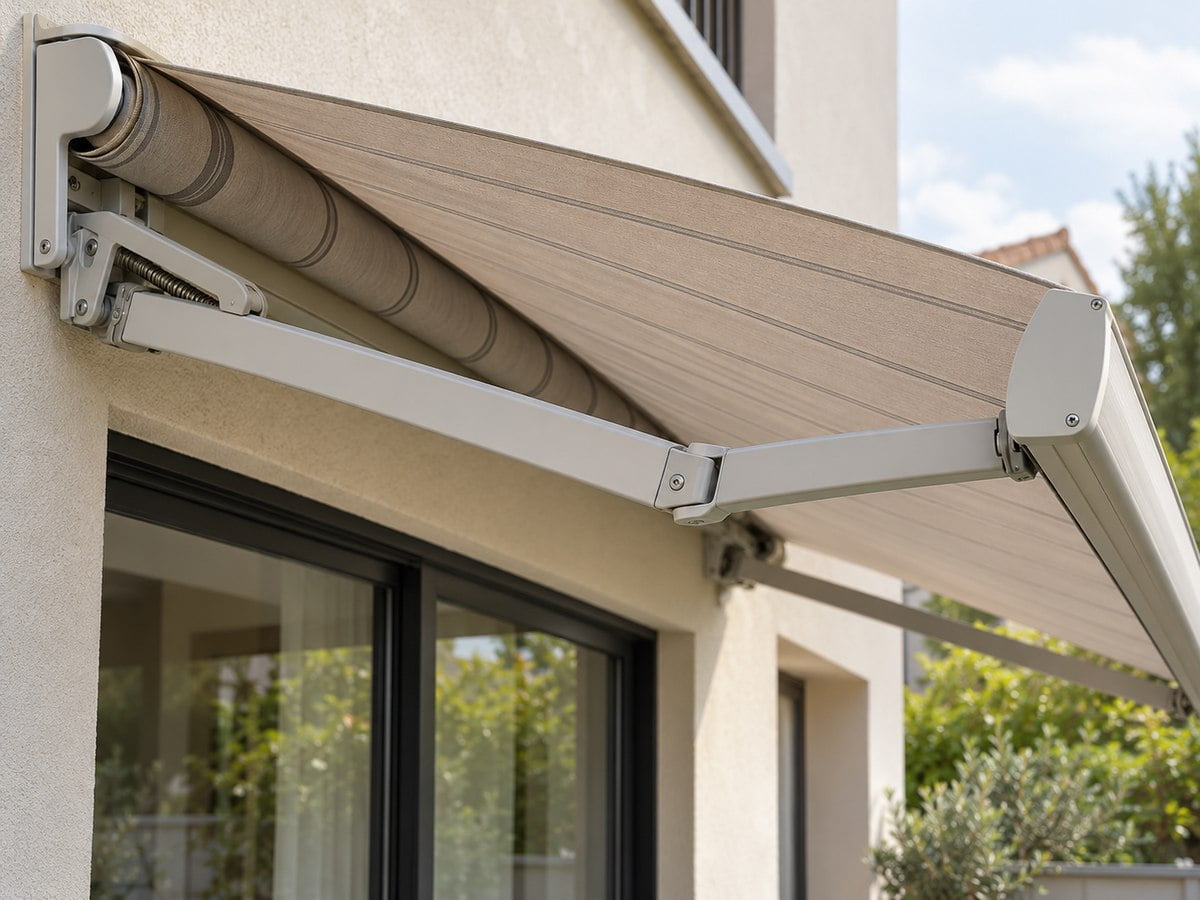
Retractable awnings extend when a drive turns the fabric roller tube or moves a guided carrier, depending on the system design. In a common folding-arm patio awning, a hand crank or motor rotates the tube, fabric unwinds, and tensioned articulated arms move the front bar outward while keeping the canopy taut. Reversing the drive winds the fabric back onto the tube and draws the arms closed. Track-guided canopies work differently: rollers or carriages travel along fixed side rails. The distinction matters because guide rollers support and guide a moving carriage; they do not normally wind the fabric in a conventional folding-arm awning. Sunair’s technical overview of lateral-arm awnings describes the roller-tube and spring-arm sequence.
How does a folding-arm awning extend?
The drive lets fabric unwind while articulated arms open and carry the front bar outward.
A typical wall-mounted lateral-arm awning has a fabric roller tube at the wall, a front bar at the outer edge, and two or more folding arms between the support structure and front bar. The fabric is attached to both the roller tube and front bar. A hand crank and gearbox or a motor turns the tube, allowing fabric to pay out as the arms articulate open.
Spring tension in many folding-arm designs helps hold the arms outward and keeps the fabric under tension during extension. The arms do not simply pull the fabric like a loose curtain: their movement, the tube rotation and the front bar are coordinated as one mechanism. A torsion or support bar and mounting brackets transfer the system’s reactions to the building structure. Exact arm and spring arrangements vary by model. Perfecta’s component guide identifies the roller tube, spring-loaded arms, front bar and torsion bar as distinct parts of its retractable awning designs.
What happens when the awning retracts?
The drive reverses the tube or carrier movement, the fabric gathers back, and the arms fold toward the wall.
On a roller-tube awning, reverse rotation winds the fabric onto the tube. As the front bar moves inward, the articulated arms fold at their joints. Their spring tension remains part of the force balance, so the drive must be designed for the awning’s fabric, arm arrangement and motion. When fully closed, the front bar may meet a hood or cassette that encloses some or all of the fabric and mechanism.
The word “retractable” covers different designs. Some manual RV awnings use a torsion spring in a drive head, while powered versions may rotate the roll tube with a motor; support-arm and control details differ by model. This is why an awning’s owner or engineering documentation should be used for model-specific operation. Lippert’s awning component reference explicitly notes that manual, electric and hybrid configurations do not all use the same parts.
How do manual and motorised awnings move?
Both operate the same broad fabric-and-support system, but the input that turns or moves it differs.
| System | User input | Main motion | Design detail to confirm |
|---|---|---|---|
| Manual roller-tube awning | Hand crank, gearbox or pull strap, depending on model | The tube rotates and the arms open or fold as fabric is paid out or wound in | Drive-head arrangement and any spring assistance |
| Motorised roller-tube awning | Switch, remote or controller | A motor drives the tube in the opening or closing direction | Motor/drive compatibility, travel limits and controls |
| Track-guided canopy or screen | Manual or powered drive, depending on the product | Carriers or front bars travel along side rails; fabric may slide, fold or gather | Rail alignment, carriage geometry and the method that pulls the carrier |
This comparison is about the mechanism, not a universal specification. A motorised awning is not necessarily a track-guided system: many motorised patio awnings still use a roller tube and folding arms. Likewise, a track-guided canopy may use small rollers at its carriages while relying on a separate belt, cable, shaft or motor to produce movement.
How does a track-guided awning move?
Its moving edge or fabric carriers follow fixed side rails, rather than swinging outward on wall-mounted folding arms.
In a track-guided canopy, the rail defines the travel path. A front bar or intermediate carriage is connected to the canopy and moves along the rail as the system opens or closes. Rollers in the carriage can support movement and maintain the intended contact with the track; their profile must suit the rail or guided element. The fabric-handling method varies: some systems roll fabric, while others use sliding or folding fabric sections.
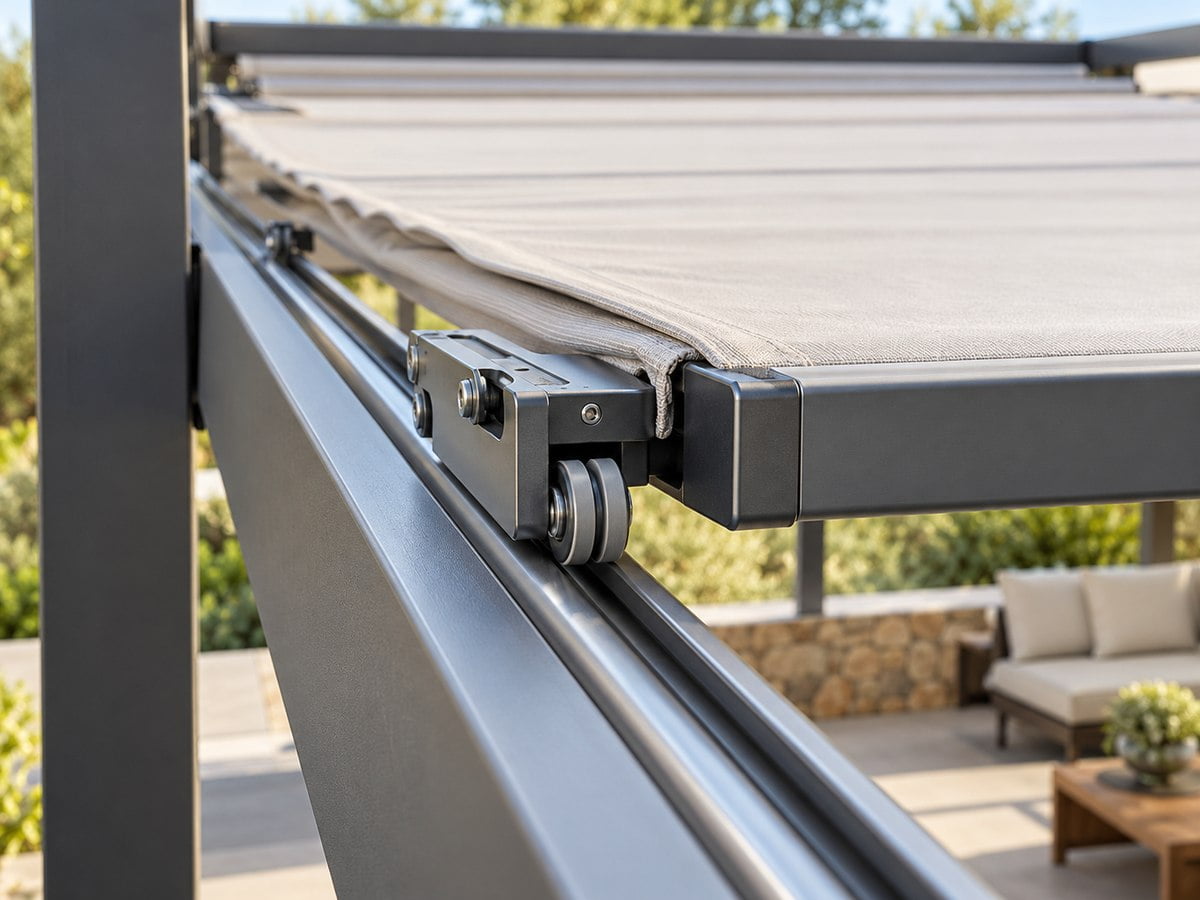
This distinction also changes what an OEM should inspect. A folding-arm design centres on the roller tube, arm joints, spring tension and front-bar alignment. A guided design adds rail cross-section, carriage fit, wheel profile, spacing, track straightness and end-of-travel constraints. These parts must be considered as one motion system.
Where do bearing rollers fit into an awning system?
Bearing rollers are relevant when the awning or shade system uses a guided carriage; they are not a substitute for the fabric roller tube or folding arms.
A bearing roller combines a rotating bearing core with an outer wheel profile that contacts a rail, cord, tube or track. In a track-guided outdoor shade, a correctly matched roller can help a carriage travel along the defined path. A U-groove wheel, for example, is intended to guide a compatible round rail, cord or tubular track; groove radius and width must match the mating geometry.
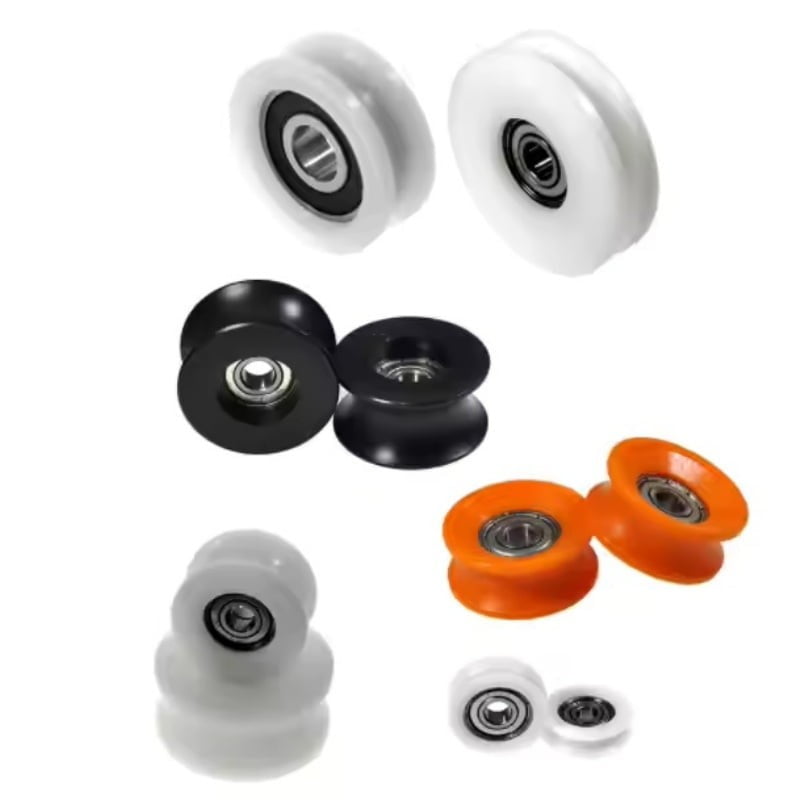
HUNE lists U-groove bearing rollers for retractable awnings and outdoor shade systems and describes the wheels as guides for round rails, cords, cables, ropes and tubular tracks. That application is relevant to a track-guided mechanism. It should not be read as saying that a standard folding-arm patio awning uses these wheels to roll its fabric. See the broader sliding rollers with bearings range for other track profiles and mounting designs.
What affects smooth, even awning movement?
The drive, fabric, support geometry and guiding surfaces must stay aligned through the full travel.
For a folding-arm awning, the roller tube and front bar need to remain aligned, and the arm joints must move through their intended range without interference. Uneven fabric winding can affect how the canopy closes. The selected drive must suit the model and its moving assembly; no single motor or arm specification applies to every awning.
For track-guided systems, verify that the rails are parallel and installed to the intended geometry, that each wheel sits correctly on its mating surface, and that the carriage has suitable clearance throughout its travel. Dirt, corrosion, water exposure, temperature changes and repeated cycling can also affect materials, bearings and clearances. Where the product is exposed outdoors, the component specification should account for the actual environment rather than relying on the generic label “weather-resistant.”
For a custom roller, HUNE’s material and process guide explains why bearing closure, track contact, load, duty cycle and environmental exposure need to be reviewed together.
What should an OEM specify for an awning roller?
Send the mating rail and carriage details along with the roller dimensions, bearing and operating conditions.
For a track-guided awning or outdoor screen project, a useful supplier enquiry includes:
- The rail or track cross-section, including its contact surface and any curve or joint.
- Roller outside diameter, total width, groove profile, groove radius or flange spacing.
- Bearing bore or bearing reference, closure type if required, shaft or stud size, and retention method.
- How many rollers support or guide each carriage, where they are mounted, and the direction of load.
- The intended movement path, speed, cycle frequency and expected service life.
- Exposure to water, dust, UV, salt, cleaning agents or temperature variation.
- Prototype quantity, production quantity, dimensional inspection requirements and approval process.
A dimensioned drawing is best; a physical track sample, roller sample or assembly photo can help resolve geometry that is difficult to communicate with a part name alone. Ask the supplier to confirm the wheel-to-track fit and the complete carriage arrangement before approving a production sample. HUNE develops bearing rollers and roller components from drawings, samples and mating-track information; the company does not present these components as complete awning systems.
Frequently asked questions
Do retractable awnings always use folding arms?
No. Many wall-mounted patio awnings use articulated folding arms, but track-guided canopies and screens move a front bar or carriers along side rails. RV awnings also use several manual, powered and hybrid configurations.
Does the roller tube pull the awning out?
The roller tube rotates to release or collect fabric. In a common lateral-arm design, the arms and their tensioning system also contribute to moving and supporting the front bar as fabric pays out. The details depend on the specific awning mechanism.
Are guide rollers what retract the fabric?
Usually not. In a track-guided system, rollers guide or support a carriage along a rail. A separate drive method moves the carriage, and the fabric may roll, slide, fold or gather depending on the system.
Can the same bearing roller fit every awning track?
No. Track profile, groove geometry, wheel width, bearing and mounting dimensions must match. A similar-looking roller may contact the rail in the wrong place or provide inadequate guidance, so buyers should confirm fit using the actual track or a drawing.
Practical recommendation for OEM buyers
First identify the awning architecture: roller tube with folding arms, track-guided canopy, or another model-specific arrangement. Then specify the complete motion path and mating geometry before selecting individual rollers or bearings. For a track-guided project, send the rail section, roller or carriage drawing, load direction, movement cycle and outdoor environment to HUNE’s engineering and sales team so the relevant roller profile and bearing arrangement can be reviewed against the application.
Sources and verification
- Sunair Awnings, Technical FAQs — lateral-arm awning motion, spring tension and manual or motor operation.
- Perfecta Awnings, Technically Speaking — roller tube, spring-loaded arms, torsion bar and front-bar components.
- Lippert, RV Awning Parts Diagrams & Definitions — component and manual/electric/hybrid differences for RV awnings.
- HUNE, U-Groove Bearing Nylon Sliding Rollers — product materials, groove purpose and stated application areas.