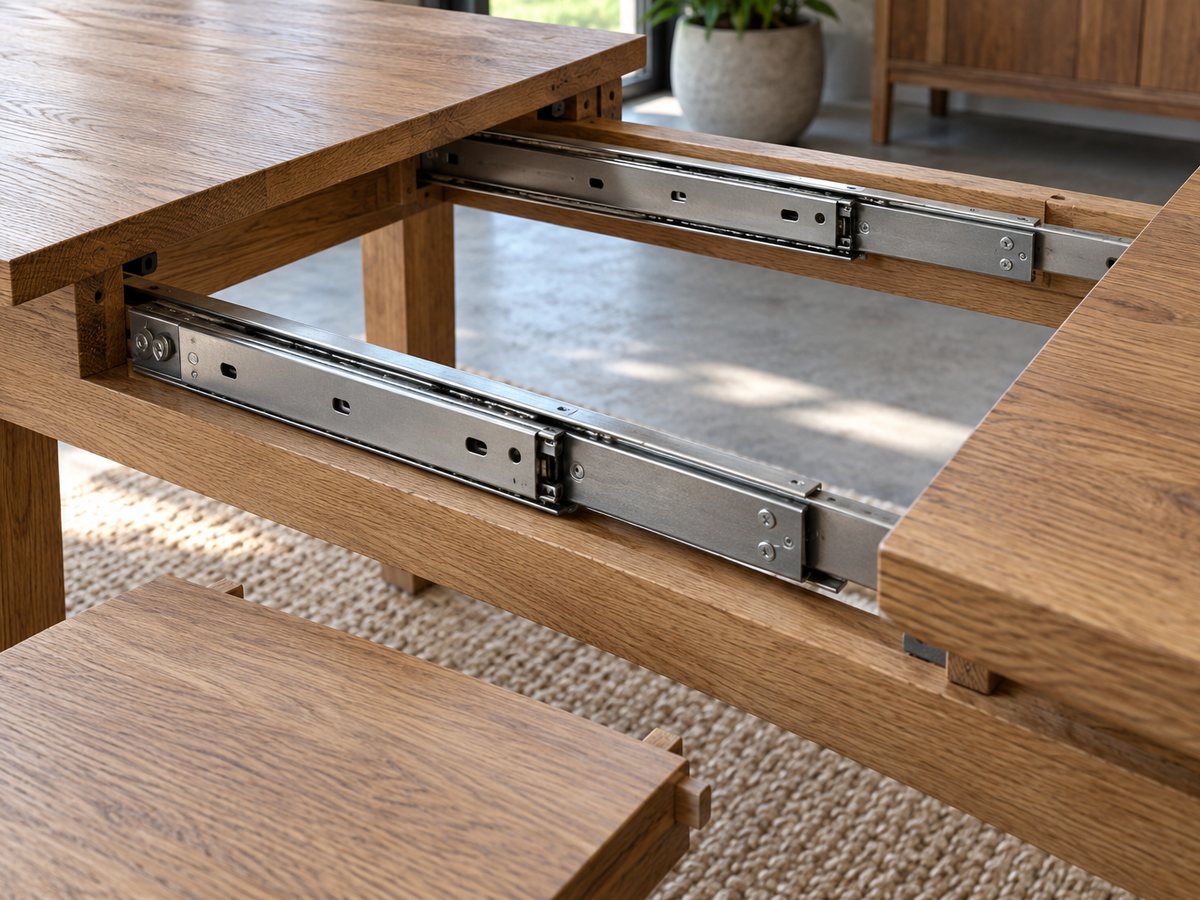
An extendable dining table opens smoothly when its moving top sections are supported and guided along a compatible path, with the extension hardware keeping them aligned as they separate. Depending on the design, that path may use telescopic runners, sliding guides, rolling elements, or a linked mechanism that moves both halves together. The extension leaf then fills the gap or unfolds from beneath the top.
The key is the whole mechanism: runners or rails, their mounting points, the table frame, any rollers or bearings, and the leaf all need to work as one system. A bearing can reduce resistance inside a roller, but it cannot compensate for misaligned runners, a flexible frame, poor track fit or an overloaded extension.
What moves when an extendable dining table opens?
The tabletop halves or supporting frames move along guides; the leaf is a separate part of the extension sequence.
In a common centre-opening table, the top is divided into two moving sections. The user pulls them apart, creating a central gap. A loose leaf is placed in that gap, or an integrated leaf is lifted or unfolded from its storage position. Other designs move a side section, rotate a top, or use a linkage to coordinate several parts.
The runners are attached to the moving sections and the table structure. Their job is to control the travel path and support the moving assembly. Some designs use telescopic metal slides with bearing elements; others use purpose-built table-extension guides, linkages, or rollers running on a track. These are not interchangeable mechanisms. The correct description depends on the hardware actually used in the product.
For a self-storing “butterfly” leaf, the opening motion may include a hinge or linkage that lets the folded leaf rotate or rise into place. A table with separate leaves instead requires the user to place each leaf after creating enough space. In both cases, smooth runner travel and accurate leaf support are separate requirements: a table can slide easily yet still have an uneven surface if the leaf sits too high or low.
How do runners and synchronisation keep the two halves aligned?
The guides define the path, while a synchronising linkage can make both sides travel together.
A pair of runners mounted on opposite sides of a table can support the top as it opens. If the left and right sides move independently, the user must pull them evenly, and differences in friction or frame alignment can make one side lead. A synchronised design connects the moving halves through gears, cables, bars or another linkage so that movement on one side drives the other. The exact linkage varies by mechanism.
Manufacturers of extension-table fittings describe systems that combine telescopic runners with synchronised movement. For example, Hettich presents a table-extension fitting with synchronised movement and telescopic runners, while Evomet describes extendable-table guides and mechanisms based on sliding guides and frames. These examples show why “the slide” may be only one part of the product’s motion system.
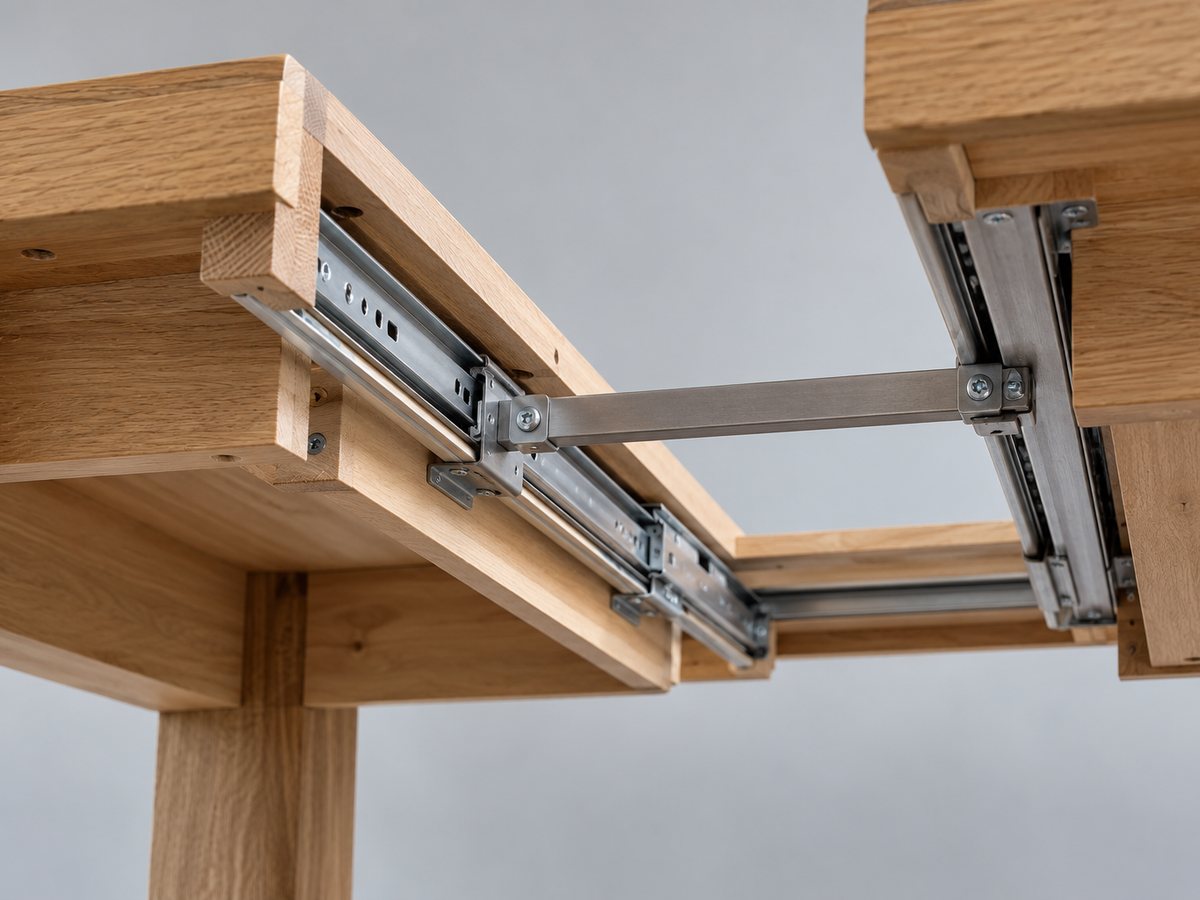
Smooth, even travel depends on functional geometry. The two guides need to remain parallel through their working stroke; their mounting heights and distances from the table centreline must match the approved design. The moving sections also need adequate stiffness so that pulling at one edge does not twist the frame and bind the opposite guide.
A synchroniser can help coordinate motion, but it cannot correct a badly positioned runner or a weak mounting structure. The table frame must hold the guides in the intended relationship under the moving top and leaf loads. End stops and locks, where used, also need to engage without forcing the user to pull or push the tabletop out of alignment.
Where can rollers and bearings be used?
A roller can guide a table component when the design uses a compatible track; it does not replace every extension slide.
Some furniture mechanisms use small wheels or guide rollers to support or position a moving section. In such a design, the wheel’s running profile must match the rail or track: a V-groove needs the intended V-shaped rail, while a U-groove is suited to a compatible round rail or cord. Clearance must allow the wheel to roll without excessive side play, while avoiding a fit so tight that small alignment variation causes binding.
The bearing supports rotation inside a bearing-integrated roller. The outer wheel contacts the guide surface. Selecting either part alone is insufficient: the wheel diameter and width, groove geometry, bearing bore, axle or stud, mounting bracket and rail section all influence fit and movement.
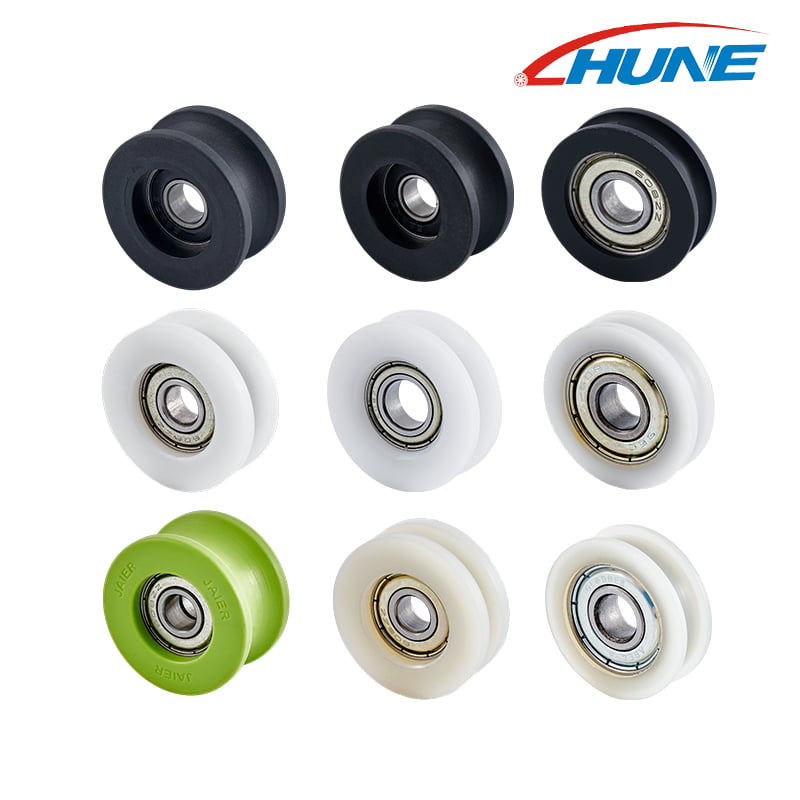
HUNE’s product range includes bearing-integrated rollers with plastic running surfaces and different guide profiles. These can be considered for OEM projects that use a separate wheel-on-track guide, subject to checking the actual table mechanism and mating geometry. They are not a complete dining-table extension fitting, and they should not be presented as a direct substitute for a telescopic table runner. See the U-groove bearing roller product information and the broader sliding rollers with bearing range.
What design factors make an extension feel smooth?
Smoothness comes from matched geometry, stable support and controlled contact across the full stroke.
For a furniture OEM, these checks are more useful than choosing a component by bearing label alone:
- Parallelism and mounting position: Opposing guides must hold the moving top on the intended path. Small angular or height differences can create skew and uneven friction.
- Support span and frame stiffness: The runner spacing, attachment points and frame section must resist twisting when the top is pulled from one side or supported in the extended position.
- Load and overhang: The mechanism carries the moving tabletop and extension leaf, with the load distribution changing as the table opens. Evaluate the complete assembly under the intended loading conditions rather than relying on a wheel or bearing’s standalone rating.
- Travel and stops: The guide length must accommodate the required opening stroke. Stops, detents or locks should locate the sections without an abrupt impact or forced alignment.
- Mating profile and clearance: A wheel or runner must fit its rail and mounting space. Too much lateral clearance can let the top wander; too little can make movement sensitive to tolerances or frame distortion.
- Contact materials and finish: Wheel material, rail finish and lubrication requirements affect noise, wear and resistance. The choice should reflect the actual contact pair and duty cycle.
- Leaf support and surface height: The extension leaf needs its own support and retention. Even runner motion does not guarantee a flush tabletop if the leaf supports or locating features are poorly positioned.
Accuride’s specialty-slide catalogue, for instance, lists a two-way slide intended for dining or entertainment bars and notes steel ball bearings as one feature. That is an example of a specific slide product, not a universal specification for all extendable tables. OEMs should use the fitting manufacturer’s instructions and validate the entire table design.
Why can an extendable table feel uneven or difficult to open?
Uneven movement usually points to a system-level mismatch, not just a “bad bearing.”
A table may feel heavy if the moving mass is high for the selected mechanism, if the runner arrangement creates excessive friction, or if the table structure flexes under an off-centre pull. A top that shifts sideways can indicate that the guides or frame do not constrain movement consistently. A leaf that sits proud or low points to its support and locating geometry rather than necessarily to the runners.
Noise can come from several interfaces: a loose fastener, a roller on an incompatible rail, a dry or rough sliding contact, or a synchronisation element working under side load. It is better to identify which interface creates the resistance before changing the wheel or bearing. A replacement roller with a different diameter or groove may make alignment worse even if its bearing feels freer by hand.
For testing, evaluate opening force and alignment across the full travel, both with and without the extension leaf where the design permits. Repeat tests with the production-representative frame and top, because a bench test of a loose slide will not reveal every structural deflection or mounting issue. Define the acceptance method and duty cycle for the project; do not assume an unverified force or life figure.
What should OEM buyers include in an enquiry?
Send the mechanism context and interfaces, not just a photo of the wheel.
A useful supplier enquiry should include:
- A drawing or sample of the complete extension assembly, including fixed and moving members.
- The table’s closed and open dimensions, required travel, and the type and position of the extension leaf.
- The table-top and frame materials, approximate moving mass, support locations and intended load distribution.
- A cross-section of each rail or track, plus the roller profile and contact dimensions if the design uses separate guide wheels.
- Functional dimensions such as wheel outside diameter, width, groove radius or angle, bearing bore, axle or stud size, bracket position and mounting-hole locations.
- Whether the two sides move independently or are synchronised, and details of any stops, locks or leaf-lifting linkage.
- Expected operating frequency, indoor or outdoor environment, noise expectations and any cleaning or corrosion requirements.
- The production volume, required sample quantity, target validation plan and drawing revision.
If the component is a wheel-on-track guide, share the mating track section and movement direction. A supplier can then review wheel profile, material, bearing and mounting structure together. HUNE’s bearing-roller product range is relevant when a project needs a customised rolling guide component; the complete table-extension mechanism still needs to be designed and validated by the furniture-system team.
Frequently asked questions
Do all extendable dining tables use ball-bearing slides?
No. Some use telescopic slides with ball-bearing elements, while others use table-specific guides, linkages or other sliding and rolling arrangements. Check the actual mechanism specification.
What makes an extendable dining table open with one smooth pull?
A well-matched guide system, stable frame, suitable support spacing and, where used, a synchronising linkage can help the moving sections travel evenly. The extension leaf and its supports must also align with the tabletop.
Are guide rollers the same as table-extension slides?
No. A guide roller is a wheel component that follows a compatible rail or track. A table-extension slide is a larger mechanism that may include rails, rolling elements, stops and mounting features. One roller is not a drop-in replacement for a complete slide.
Can a plastic bearing roller be used in an extendable dining table?
It may be considered where the design calls for a plastic wheel running on a compatible guide surface. The wheel profile, material, bearing, axle, load, frame stiffness and travel geometry should be checked together in the actual assembly.
Need a custom guide roller for a furniture mechanism?
HUNE manufactures sliding rollers and bearing-integrated guide wheels for OEM applications. If your table design uses a separate roller-on-track guide, send the assembly drawing, rail cross-section, required travel, load context and expected production quantity so the component can be assessed against the real mating geometry. Use the HUNE contact page to submit your enquiry.
SOURCES & VERIFICATION NOTES
- Hettich, “Table Extension Fitting”: describes synchronised movement and telescopic runners in a table-extension fitting. https://www.hettich.com/en-in/indiawood-2026-trend-exhibits/table-extension-fitting
- Evomet, “Guides and Mechanisms for Extendable Tables”: describes table mechanisms using sliding guides and different base arrangements. https://www.evomet.it/en
- Accuride, “Specialty Slides” catalogue, page 47: includes a two-way travel slide application for dining or entertainment bars and a steel ball-bearing feature. https://www.accuride.com/media/pdf/ac_ch-product-catalog_v3_0625_.pdf
- HUNE, “U-Groove Bearing Nylon Sliding Rollers”: product page lists the roller structure, materials, profile guidance and furniture applications. https://sliding-roller.com/product/u-groove-bearing-sliding-rollers/
- HUNE, “Sliding Rollers with Bearing”: product range and customization context. https://sliding-roller.com/product_types/sliding-rollers-with-bearing/
QUALITY REVIEW
- Search intent: answered directly in the opening, then explained mechanism types, smoothness factors, roller/bearing roles and OEM enquiry inputs.
- SEO/GEO: focused title and first-paragraph answer; related terms used naturally; concise definitions and four FAQs.
- E-E-A-T and accuracy: mechanism-specific claims are tied to cited manufacturer sources. No universal load, cycle, tolerance or opening-force claims are asserted.
- Commercial alignment: HUNE is presented as a source of roller components, not complete dining-table extension slides. Compatibility is explicitly conditional on actual rail geometry and system validation.
- Internal links: HUNE product pages and contact page only; no competitor pages used as internal links.
- Remaining company verification: confirm the exact roller model/material and test acceptance criteria for any application before making a production recommendation.
STRUCTURED DATA RECOMMENDATION Use Article schema for the post with the published author and dates supplied by the website. Keep FAQ answers visible on the page; only add FAQPage markup if it matches the site's current structured-data policy.