POM and POK can both be considered for bearing rollers, but neither material is automatically the better choice for every design. POM is an established engineering plastic with good sliding, friction and wear properties. Hyosung reports that its POKETONE material offers excellent wear resistance and can outperform POM, but that statement applies to its material range and should be checked against the exact grades and test conditions. Moisture behaviour and load performance also depend on the resin grade, roller geometry, bearing, track and operating environment. For an OEM project, compare the complete roller system and validate the selected grade in the intended application. Asahi Kasei’s POM information;Hyosung’s POKETONE properties
What are POM and POK?
They are different engineering-plastic families, and each family includes grades with different properties.
POM, or polyoxymethylene, is also known as acetal or polyacetal. It is used in moving parts where sliding behaviour, friction, wear and dimensional characteristics matter. POM is available in homopolymer and copolymer forms, as well as modified grades, so a comparison should identify which type is being considered. Asahi Kasei’s TENAC overview
POK refers to polyketone engineering plastics. Commercial POK products also come in different grades and formulations. Hyosung’s POKETONE portfolio, for example, includes general-purpose, reinforced and wear-oriented options. Those grades should not be treated as interchangeable. Hyosung POKETONE grade information
For a custom roller, the useful comparison is therefore not simply “POM versus POK”. It is specific POM grade versus specific POK grade, in the same roller geometry and application.
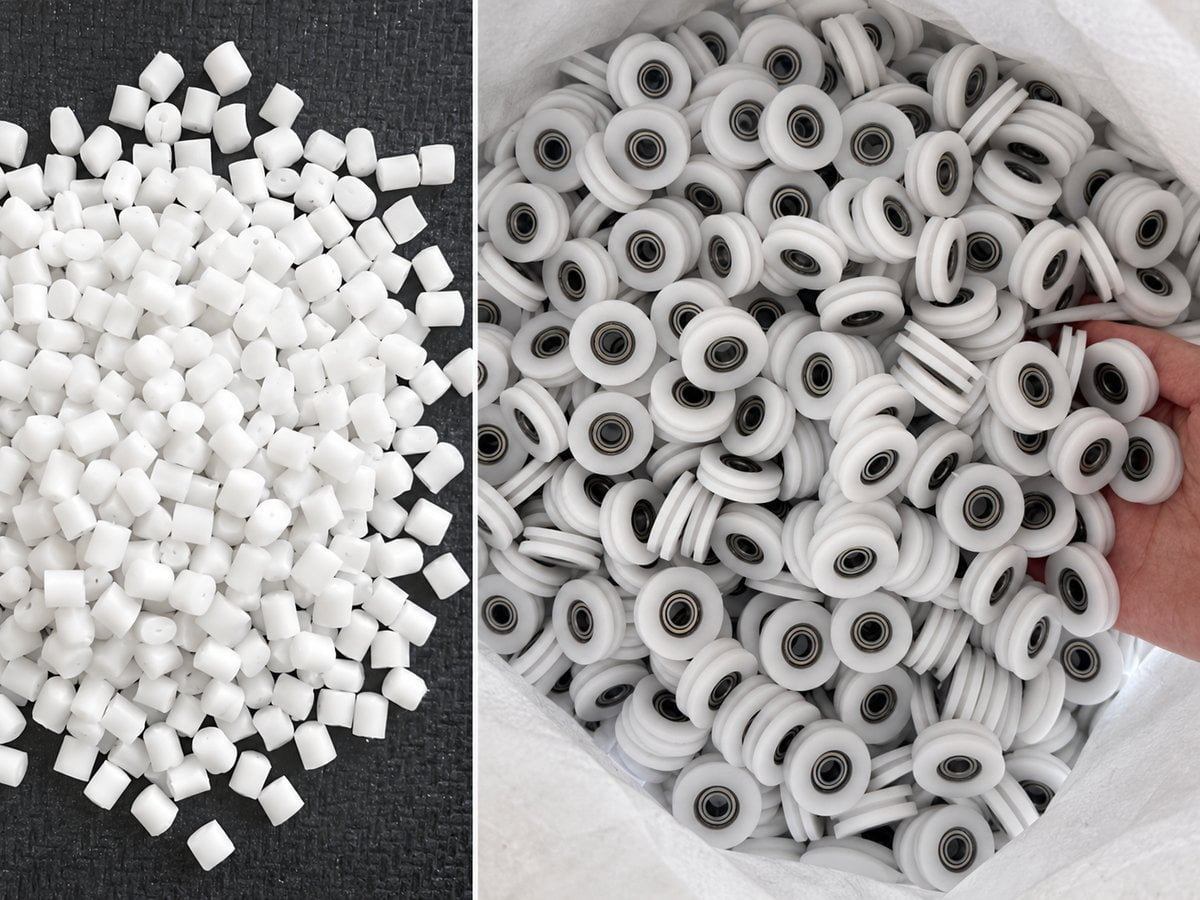
POM vs POK at a glance
The material name alone cannot predict finished roller performance. Use this table to frame a grade-level comparison, then verify the result against the real track and operating conditions.
| Selection factor | POM | POK | What an OEM should verify |
|---|---|---|---|
| Wear and friction | Established sliding properties; performance varies by grade and mating surface | Hyosung reports strong wear performance for POKETONE, including an advantage over POM | Exact resin grades, counterface, contact pressure, speed, lubrication and test method |
| Moisture | POM suppliers document water absorption and dimensional behaviour by grade | HUNE describes POK as having low moisture absorption; confirm the exact resin data | Water absorption method, humidity or immersion conditions, and dimensional change |
| Load | Grade data and roller geometry determine the result; long-term deformation matters | Grade data and roller geometry determine the result; do not infer a load rating from the polymer family | Compressive properties, creep, impact, wall thickness, bearing and support arrangement |
| Roller-system fit | Often considered for low-friction, dimensionally stable roller bodies | May be considered when wear, toughness or moisture conditions support it | Track profile, bearing retention, tolerances and sample performance |
Asahi Kasei’s technical material treats friction and wear, water absorption, mechanical properties and long-term behaviour as separate property areas. That is a useful reminder that “POM” or “POK” is not a complete engineering specification; the resin grade and test method matter. Asahi Kasei POM technical handbook;Global Polyacetal’s POM physical-properties guide
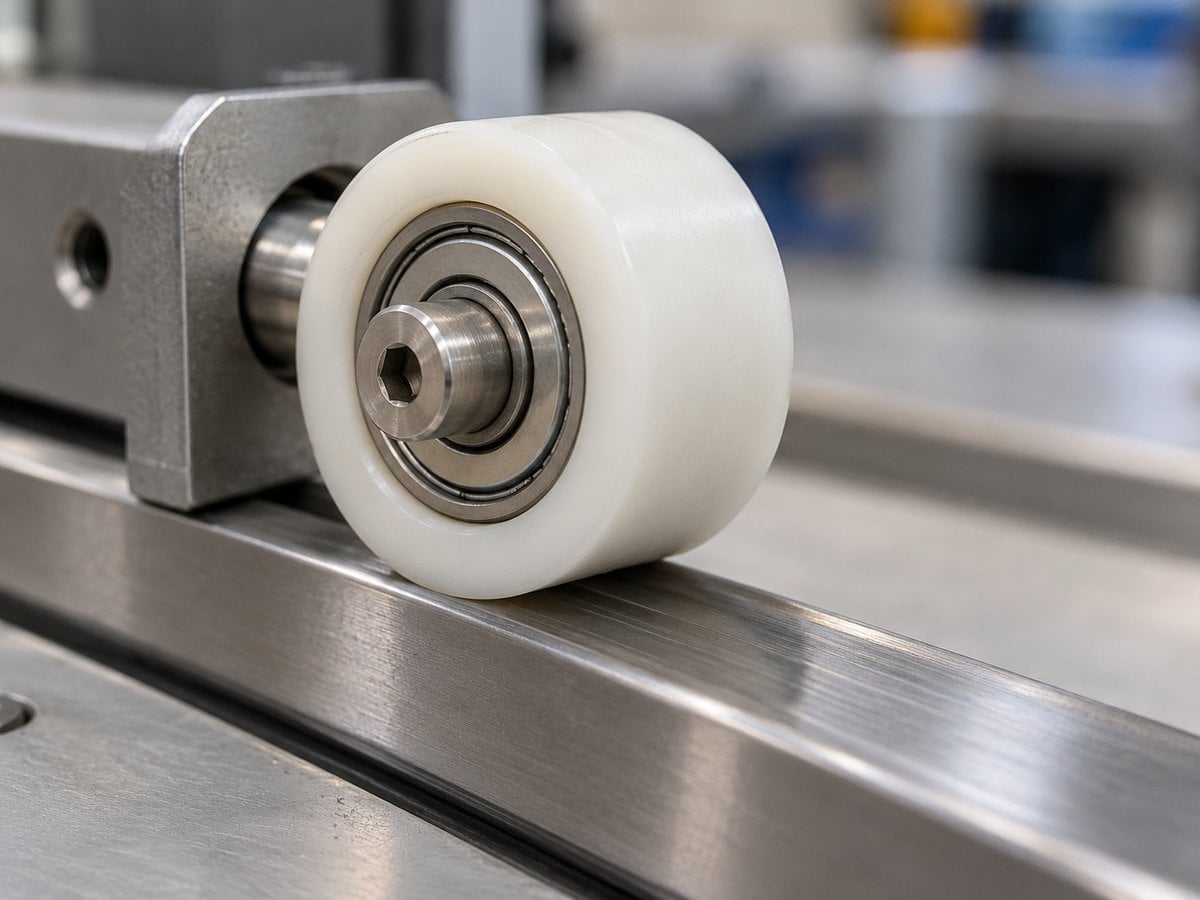
Wear resistance and friction
POK may be worth evaluating for demanding wear conditions, but verify the claimed advantage using comparable grades and test conditions.
Hyosung states that POKETONE has excellent wear resistance and can perform better than POM. This makes POK a relevant candidate for repeated-contact parts, but the claim should be treated as material-family guidance rather than a guaranteed result for every POK roller. Hyosung POKETONE properties
Wear in a roller depends on more than the polymer. The mating track material and finish, contact area, load, speed, duty cycle, contamination and lubrication can all affect the outcome. A roller that runs against a rough or misaligned track may wear differently from one tested against a smooth, correctly aligned profile.
For an OEM comparison, ask for wear data that identifies the resin grade, counterface, load or contact pressure, speed, test duration and method. If those details differ, the results may not support a direct POM-versus-POK conclusion.
Moisture and dimensional stability
Do not assume that one material has better dimensional stability in every wet or humid environment. Compare grade-specific data under relevant conditions.
HUNE’s material guide describes POK as having low moisture absorption, while POM suppliers also document water absorption and dimensional behaviour as grade-specific properties. These references support considering both materials for dimensionally sensitive parts, but they do not establish a universal ranking between all POM and POK grades. HUNE material and process guide;Global Polyacetal POM physical-properties guide
For a roller, dimensional change can affect more than the wheel’s outside diameter. It can influence groove fit, clearance to the track, bearing-seat retention and the way the wheel tracks under load. If the product will see washdown, prolonged humidity or changing temperatures, specify the actual exposure conditions and request data for the resin grade under those conditions.
Water absorption and resistance to hydrolysis are also different properties. A material’s low moisture uptake should not, by itself, be taken as proof of suitability for every chemical or water-exposure condition.
Load capacity: why material alone cannot decide
The load rating belongs to the roller assembly and its operating conditions, not to the polymer name in isolation.
In a bearing roller, load passes through several interfaces: the track contacts the polymer wheel, the wheel transfers force to the bearing’s outer race, and the bearing transfers it through the rolling elements to the inner race and shaft or mounting structure. The bracket, axle, bearing fit and wheel geometry also affect the assembly.
The polymer wheel may be limited by local contact pressure, deformation, impact or long-term creep. The bearing may have a different load limit, and a poor fit or unsuitable track can affect service life even when the polymer grade itself is appropriate. Asahi Kasei’s POM guidance treats creep and long-term loading as separate considerations, reinforcing why short-term strength alone is not enough for a continuously loaded component. Asahi Kasei TENAC technical handbook
I would compare POM and POK using the same wheel dimensions, bearing, track, applied load, speed and duty cycle. If one material is tested in a different geometry or against a different track, the result may describe the test setup more than the material choice.
How OEMs can choose between POM and POK
Shortlist materials from the application requirements, then validate the finished roller.
POM is a reasonable candidate when its grade data matches the required sliding behaviour, dimensional requirements, environment and production design. POK is worth comparing when wear, repeated movement, impact or moisture exposure are key concerns and the selected grade has relevant supporting data. Neither statement replaces application testing.
For a bearing roller, the wheel material is only one design choice. HUNE’s product information describes roller constructions that combine a plastic outer wheel with a bearing, and its material guide notes that performance depends on the grade, geometry, fit and operating conditions. HUNE’s bearing-roller materials guide;U-groove bearing roller product details;bearing rollers with bearings
Before releasing a design, compare sample rollers for:
- Wheel dimensions, groove profile and track fit
- Bearing rotation, runout and retention
- Deformation under the expected load
- Wear and noise over the expected movement cycle
- Performance in the actual temperature and moisture environment
What information should an OEM send to a roller supplier?
A useful RFQ describes the assembly and how it operates, not just the requested polymer.
Send the supplier the roller drawing or a sample, along with:
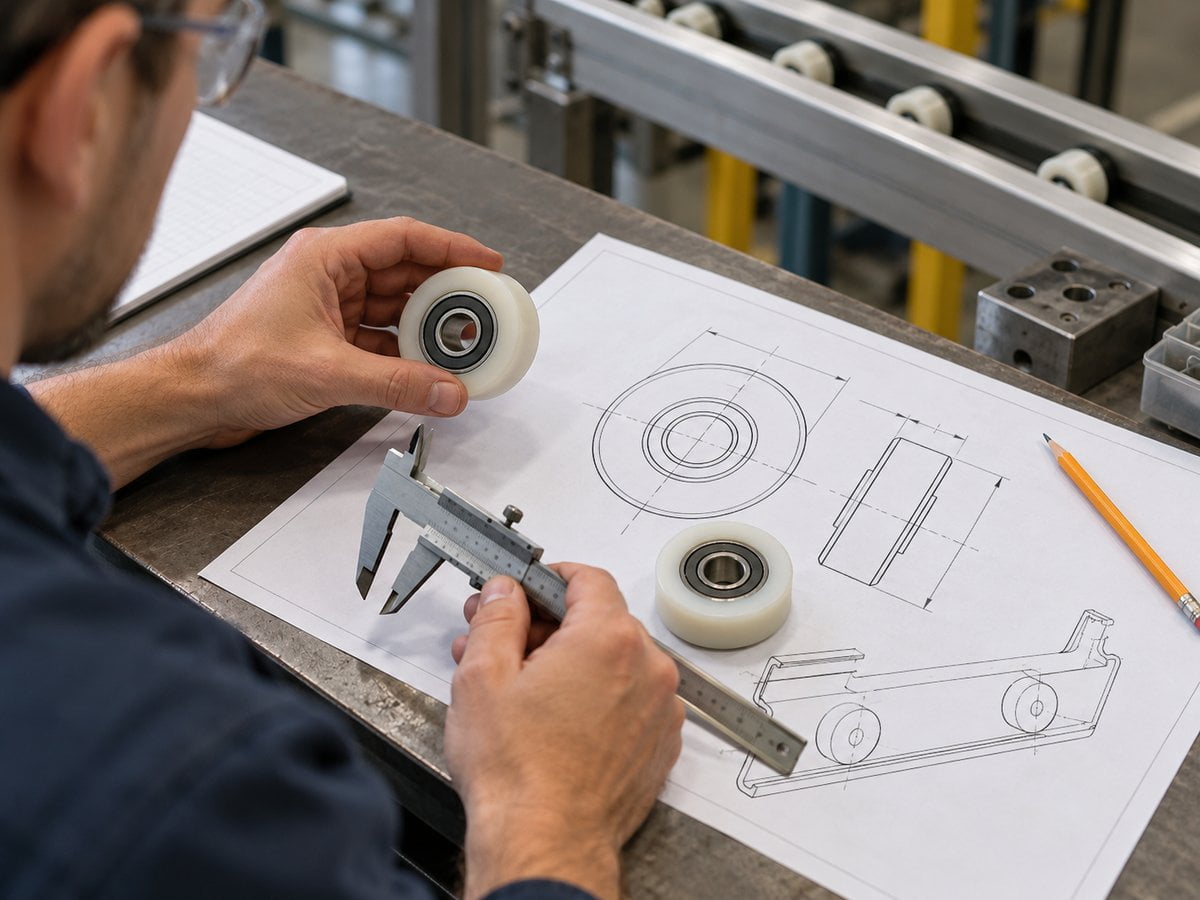
- Track profile, material, surface finish and alignment
- Required roller dimensions, groove geometry and tolerances
- Bearing size or designation, shaft and mounting details
- Radial and axial loads, including shock or impact
- Speed, movement distance, operating hours and cycle frequency
- Temperature, humidity, water, cleaning agents or other exposure
- Noise, service-life and inspection requirements
- Whether POM and POK samples should be compared in the same design
If you are evaluating a custom roller, HUNE’s bearing-roller material and manufacturing guide describes the relevant choices across the bearing, polymer wheel, fit and assembly. The U-groove bearing roller range is one example of a product where the wheel profile and bearing work together.
Frequently asked questions
Does POK always wear better than POM?
No universal conclusion follows from the material names alone. Hyosung reports better wear resistance for its POKETONE compared with POM, but an OEM should check the specific grade, test method, mating surface and operating conditions before applying that comparison to a roller.
Which material absorbs less moisture, POM or POK?
The answer should be based on data for the exact grades being considered and the same test conditions. Available company and supplier references describe both material families as having low moisture-related behaviour, but they do not establish a universal ranking across all grades.
Can POK replace POM in an existing roller design?
Possibly, but a resin substitution can affect moulding, shrinkage, bearing retention, dimensions, wear, track interaction and cost. Validate samples in the existing geometry and confirm the supplier can provide the selected grade consistently.
Is roller load capacity determined by the plastic wheel?
No. The wheel, bearing, shaft, bracket, contact geometry, fit and track all contribute to the roller system’s performance. Confirm the complete assembly under the expected load and operating cycle.
Practical recommendation for OEM buyers
Choose by grade and system performance, not by a broad claim that one polymer is always superior. Start with the load, track, environment and duty cycle; compare POM and POK grade data that uses relevant test conditions; then validate the complete roller assembly with the actual mating track. Include the drawing or sample and operating requirements in the RFQ so the supplier can assess the wheel, bearing and fit together.