
Furniture casters use different wheel materials because no single tread works best on every floor and in every duty. A softer rubber or elastomer tread can absorb more vibration and feel quieter, while a harder nylon wheel can reduce rolling resistance and suit applications that prioritise easy movement and wear resistance. Polyurethane often offers a middle ground, but the exact compound, hardness, wheel geometry and floor finish matter. Buyers should select the complete wheel-and-caster assembly around load, floor protection, noise, movement effort and environment—not choose by material name alone. The Institute of Caster and Wheel Manufacturers (ICWM), part of MHI, lists load, floor condition, environment, shock, noise, speed and duration among the factors that influence wheel selection.
What does the wheel material change?
The tread material changes how the caster contacts the floor, affecting movement feel, noise, floor interaction and wear.
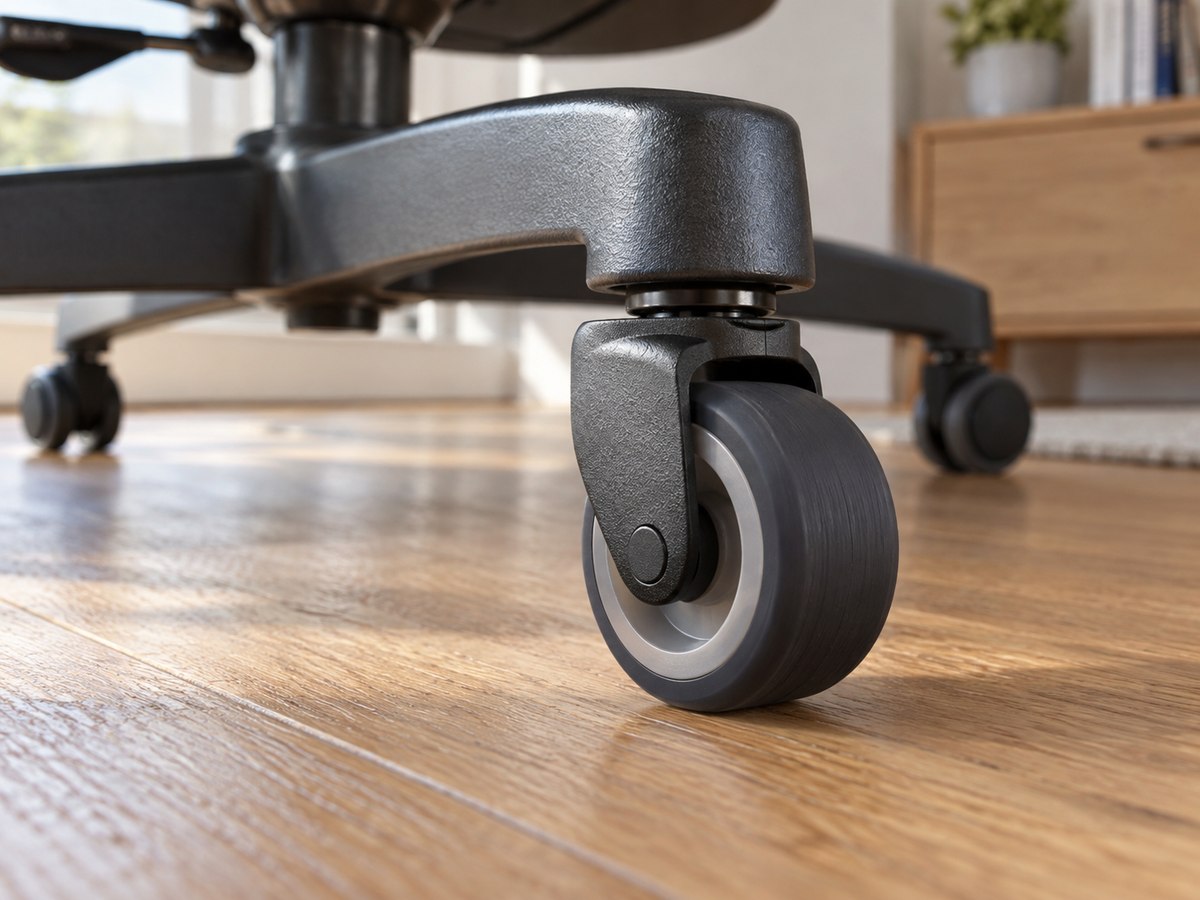
A furniture caster is a small assembly, not just a wheel. Its wheel may have a tread or tyre around a hub or core, a wheel bearing or bushing around the axle, and a fork that swivels beneath the furniture. Material choice mainly changes the wheel’s contact surface, but the core, bearing, wheel diameter, tread width, hardness and caster geometry also affect behaviour.
A soft tread can deform more around small floor irregularities, while a hard tread tends to retain its shape and roll with less deformation. This trade-off affects starting and rolling effort, sound and floor contact. YUEI’s caster-material guide notes that wheel material and floor surface affect starting, rolling and swivel resistance, and that softer rubber or elastomer materials can have greater resistance than more rigid materials. MHI/ICWM’s selection guide also asks buyers to consider load, floor condition, moisture, temperature, chemicals, shock, noise and duty duration.
How do common furniture caster materials compare?
Choose by the performance trade-off the furniture needs, then confirm the specific grade and caster construction.
| Wheel tread material | Typical design direction | Potential fit | Check before approval |
|---|---|---|---|
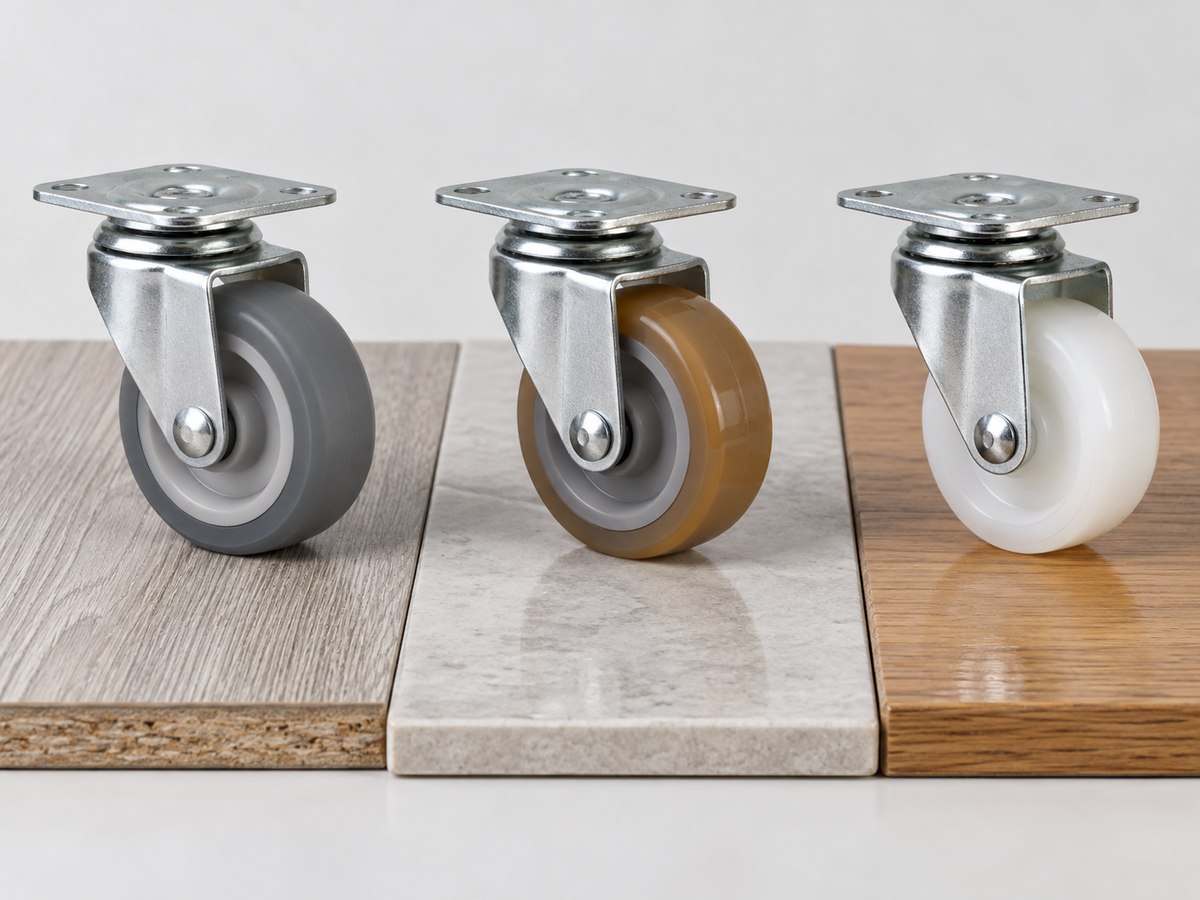
| Rubber or thermoplastic elastomer (TPE/TPR) | More compliant contact, often useful for reducing impact and rolling noise | Furniture that moves over joints or where quiet contact matters | Rolling effort, compression under long-term load, floor marking and compound compatibility |
| Polyurethane (PU/TPU) | A tunable balance of wear resistance, resilience and floor contact | Furniture needing repeated movement with a controlled tread and floor interface | Exact formulation, hardness, bond to the core, floor finish, load and temperature |
| Nylon or polyamide | Harder wheel surface with low deformation and easy rolling in suitable designs | Applications prioritising movement efficiency and wear resistance on compatible floors | Noise and vibration, floor sensitivity, impact, moisture effects and wheel-bearing fit |
| Polypropylene or other plastics | Lightweight moulded wheel construction for selected light-duty designs | Cost- or weight-sensitive furniture where the specified grade meets the duty | Load, creep, impact, floor contact, temperature and expected cycle frequency |
These are broad material-family tendencies, not guaranteed ratings for every wheel. Blickle’s catalogue shows that complete wheels combine different tread and centre materials—for example, polyurethane treads bonded to nylon centres—and evaluates them across properties such as noise, floor preservation, rolling resistance, wear and temperature. YUEI also cautions that its material comparisons are general guidance and that product conditions and environment affect the result.
Why do furniture makers use soft, medium and hard wheel materials?
Different floors, noise targets and load conditions create different priorities.
A chair used on a finished wood floor may need a tread selected to reduce the risk of marking and limit harsh contact. A mobile storage cabinet may prioritise low rolling effort under its expected load. A piece of furniture used on tile, carpet or mixed flooring has a different contact problem again. In each case, the result depends on wheel diameter and width, tread hardness, load distribution and the condition of the floor—not material alone.
Softer rubber and elastomer treads can absorb more vibration and accommodate minor irregularities, but greater deformation can increase rolling effort. Harder nylon or polyamide wheels can roll efficiently on suitable floors but may transmit more sound or impact on hard surfaces. Polyurethane formulations cover a wide range: the compound and wheel-centre construction determine how the wheel behaves. Blickle’s wheel guide reports material-specific differences in noise, floor preservation, rolling resistance and wear, illustrating why “PU” or “nylon” is not a complete specification.
What should furniture OEMs consider beyond material?
Wheel material is one choice within a system that includes the floor, load, caster assembly and use cycle.
For a furniture caster programme, buyers and engineers should check:
- Loaded mass and load distribution: include the furniture and its contents, and account for the way load is shared across casters when floors are uneven.
- Floor type and finish: specify hardwood, laminate, tile, carpet, coated concrete or mixed surfaces, plus any marking or scratch constraints.
- Movement pattern: describe how often the product moves, whether it pivots in place, and whether it crosses joints or thresholds.
- Noise and user effort: set priorities for quietness, easy starting, rolling and turning.
- Wheel geometry: confirm diameter, tread width, profile, hub construction and ground clearance.
- Caster hardware: define swivel or fixed configuration, fork and mounting dimensions, wheel axle, bearing or bushing and any brake requirement.
- Environment: state exposure to moisture, cleaning agents, oils, temperature or outdoor conditions.
- Validation: agree a representative floor and loaded prototype for checking movement, noise, marking and wear before production approval.
The bearing and swivel mechanism still matter. A well-chosen tread cannot compensate for an unsuitable bearing, a weak fork or a mounting interface that does not match the furniture. MHI/ICWM’s guidance treats caster selection as a combination of wheel, load, operating conditions and equipment requirements rather than an isolated material decision.
How are casters different from furniture track rollers?
A caster rolls furniture across a floor; a track roller guides a panel or carriage along a defined rail.
A swivel caster turns beneath a chair, cabinet or cart so the furniture can change direction across the floor. A furniture track roller follows a rail and usually constrains the panel to a set path, such as a sliding wardrobe or cabinet door. They serve different functions and should not be specified interchangeably.
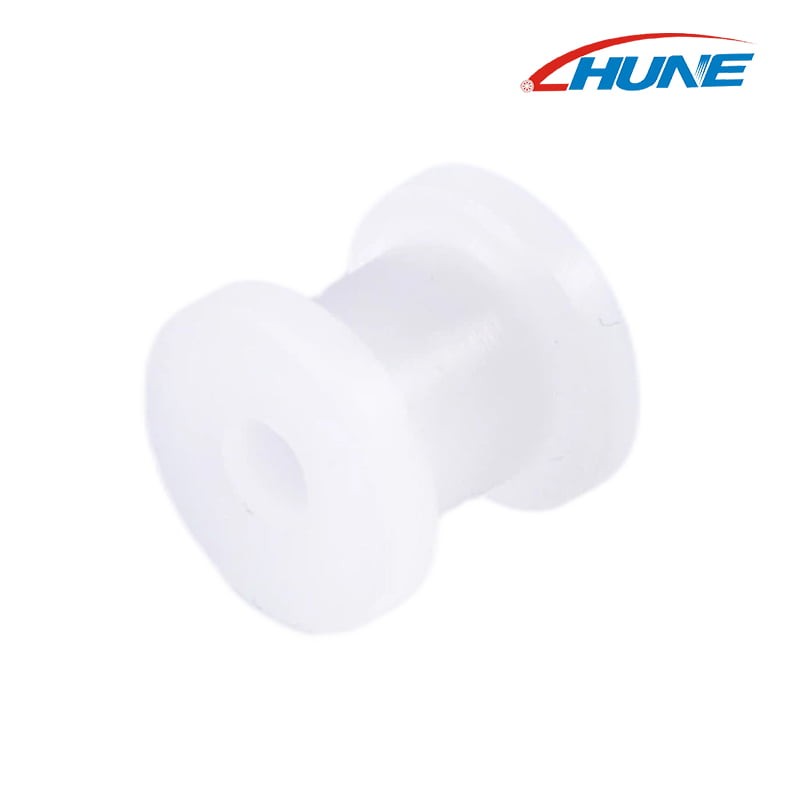
HUNE’s double-flange nylon guide roller is a bearing-free plastic roller for compatible light-duty sliding guides; it is not a complete floor caster. For track-based furniture, compare the rail and wheel profile with the sliding roller and bearing range. HUNE also offers polyurethane-coated bearing rollers for specified guided-motion applications. Each link refers to HUNE’s track rollers, not swivel furniture caster assemblies.
What should buyers include in a caster wheel RFQ?
Describe the furniture, loaded use and floor first, then specify the caster interface and wheel material.
A useful RFQ should include the furniture type, estimated loaded mass, number and placement of casters, target floor surfaces, wheel diameter and width, mounting method, swivel or fixed requirement, noise and marking expectations, movement frequency and operating environment. If replacing an existing wheel, provide a sample or drawing that shows the hub, axle, fork clearance and mounting interface.
For a custom wheel, state whether the tread is a single material or bonded to a separate wheel centre, and specify any hardness, colour, non-marking or chemical-resistance requirements that are critical to the project. Ask the caster supplier to confirm the material grade, load data and compatibility with the intended floor. For furniture using a sliding track rather than floor casters, send the rail cross-section and roller mounting drawing to HUNE through its contact page for a separate guide-roller review.
Frequently asked questions
Which caster wheel material is quietest for furniture?
A softer rubber or elastomer tread is often selected when noise and vibration matter, but the quietest result depends on the specific compound, wheel size, bearing, load and floor. Validate the complete caster on the intended surface.
Are nylon caster wheels suitable for wood floors?
They can be used in some applications, but a hard nylon tread may not suit every floor finish or noise target. Confirm floor sensitivity, load and wheel design with the caster supplier, and evaluate a loaded sample on the actual surface.
Is polyurethane always better than rubber for furniture casters?
No. Polyurethane covers many formulations and may offer a useful balance of wear and floor contact, while rubber or elastomer may be preferred for a more compliant tread. Select by the actual floor, load, movement and environment rather than by a universal ranking.
Are furniture casters the same as sliding-door rollers?
No. Casters let furniture roll and swivel across a floor. Sliding-door rollers run against a track to guide a panel along a defined path. Their wheels, mounts and motion requirements differ.
Practical recommendation for furniture OEMs
Start with the floor and loaded use case, then compare candidate treads in the complete caster assembly. Confirm wheel geometry, hub, bearing, fork and mounting dimensions, and evaluate sound, movement effort and floor contact on a representative sample. If the furniture uses a track-guided panel instead of floor casters, specify a guide roller as a separate component and provide the mating rail geometry.
Sources and verification
- MHI and Institute of Caster and Wheel Manufacturers, Casters, Wheels, and Accessories Guide 101 — selection factors for casters and wheels.
- Blickle, Wheel Series Guide — wheel-centre and tread materials, with comparisons for noise, floor preservation, rolling resistance, wear and temperature.
- YUEI, Wheel Material and Characteristics — general material traits and the effect of wheel/floor pairing on rolling and swivel resistance.
- HUNE, Double-Flange Nylon Plastic Roller for Sliding Systems — product construction and stated furniture track applications.