

In a sectional garage door, rollers and tracks work together to guide the door panels through a controlled path. Each roller wheel is attached to a stem or carrier connected to a panel hinge or fixture; the wheel runs inside a track that changes from vertical, through a curved transition, to horizontal overhead. As the door opens, the rollers follow that path while the hinges let adjacent panels change angle. The track guides and supports the roller path, but the rollers do not lift the door: springs and cables counterbalance much of the door weight, while the opener or a person supplies movement. Clopay’s garage-door glossary defines the track as the guide for the roller wheels and distinguishes the vertical and horizontal sections.
What parts make up a sectional garage door’s roller and track system?
The roller connects each moving panel to a shaped track, while hinges let the panels articulate along the path.
A typical sectional overhead door includes several linked components:
| Component | Role in movement |
|---|---|
| Roller wheel | Rotates as it travels along the track and limits sliding contact |
| Roller stem or carrier | Holds the wheel in position relative to a panel hinge or fixture |
| Hinges and panel fixtures | Join door sections and support roller locations, allowing adjacent panels to change angle |
| Vertical, curved and horizontal track | Defines the door’s route from the closed position to the overhead position |
| Counterbalance springs, cables and drums | Help balance the door’s weight and transfer lifting force |
| Opener and trolley, if fitted | Apply motion to the door through the opener arm and attachment point |
The exact hardware varies with door type, track arrangement and manufacturer. The article focuses on sectional garage doors; one-piece tilt-up doors and rolling shutters use different motion systems. Clopay’s component guide identifies rollers, hinges, tracks, springs and cables as separate components with different functions.
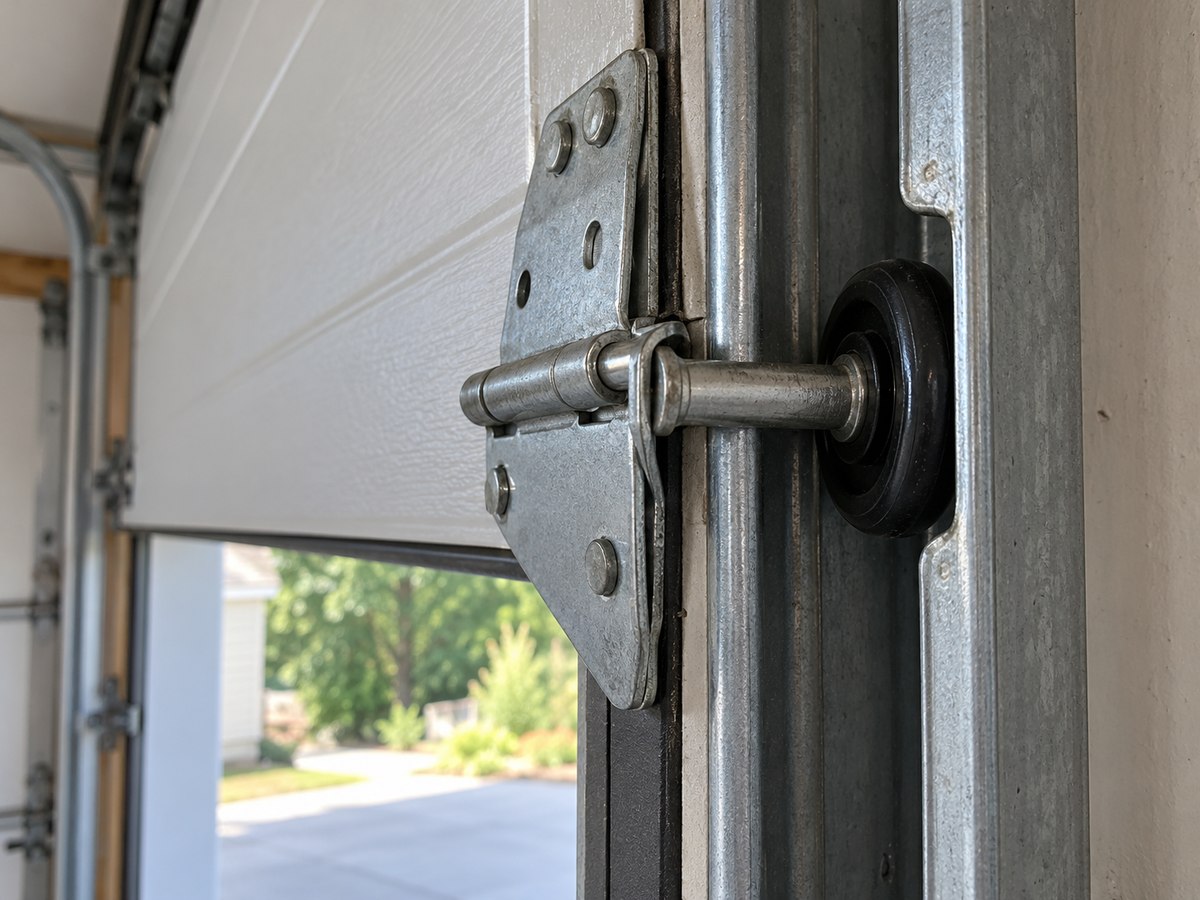
How do rollers follow the track as the door opens?
The wheel follows the track profile, and the panel hinges accommodate the change from vertical travel to overhead travel.
When closed, the door sections stand in the vertical tracks. During opening, the rollers near the top of the door reach the curved track radius first. The connected panels begin to turn toward the ceiling, and the wheels pass through the curve into the horizontal tracks. The remaining rollers follow in sequence as the door rises. At full opening, the sections are supported along the overhead track path.
This motion is possible because the track is not one straight channel: its vertical, curved and horizontal portions form a continuous route, while hinges connect panels that must pivot relative to one another. The roller wheel turns at the track contact; the stem and mounting hardware hold it in the correct position for that section of travel. Clopay’s glossary describes the horizontal track as including a curved section and notes that the door rests in the vertical track when closed and is suspended from the horizontal track when open.
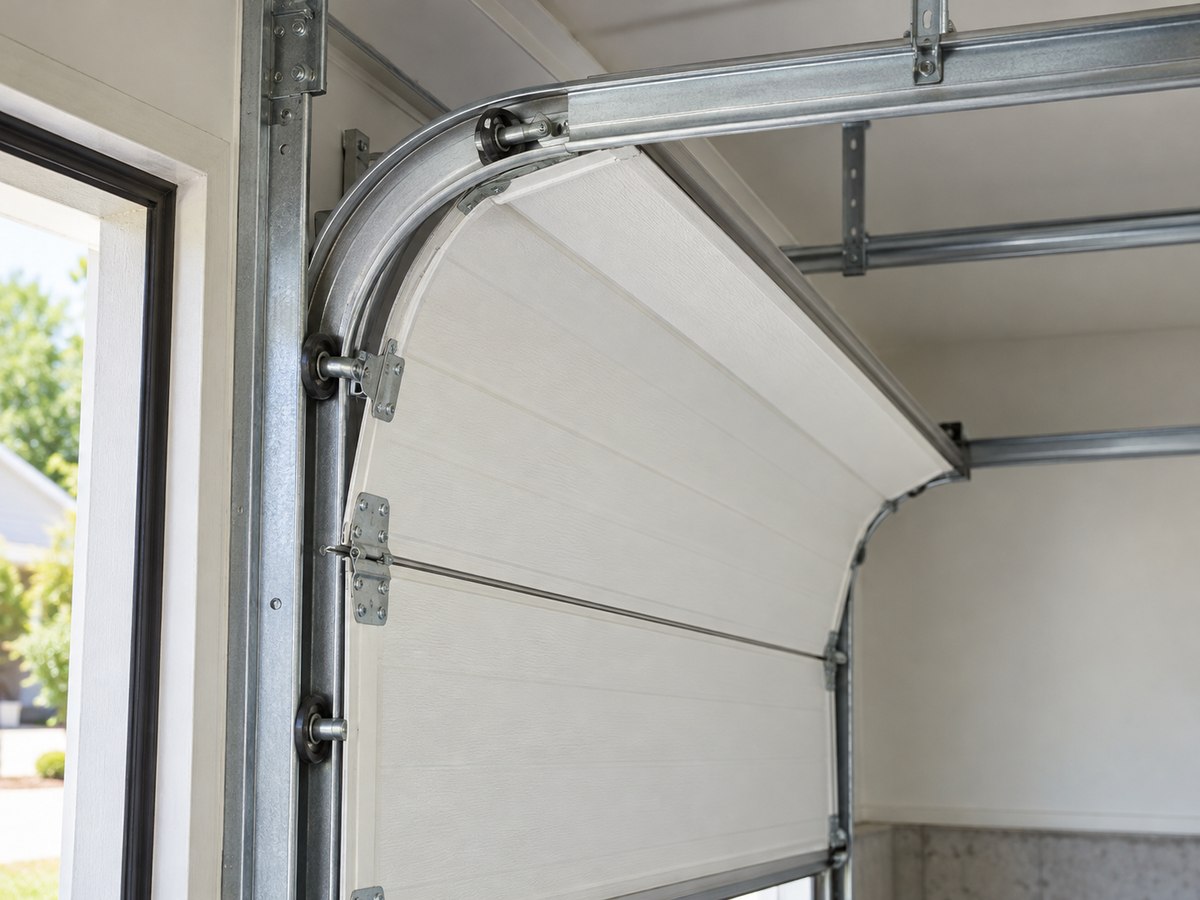
What does the track do that the roller cannot?
The track sets the path and constrains sideways movement; the roller provides the rotating contact that follows it.
A roller alone cannot determine where a sectional door should go. The track constrains the wheel’s route and keeps the panels moving through the opening geometry. The roller, in turn, allows movement along that path without the panel hardware sliding directly against the full track surface. The stem, hinge and track shape must all be compatible: a wheel may rotate freely yet still bind or sit poorly if its position or the track profile is wrong.
The side tracks also keep the door aligned as it moves. Differences in track layout, headroom and lift geometry change the path, so the roller position and panel hardware must suit the specified system. This is a system-level fit question rather than a matter of selecting a wheel by outside diameter alone.
Do rollers lift the garage door?
No. The rollers guide the door along the track; the spring-and-cable counterbalance helps offset its weight.
The counterbalance assembly converts spring torque into lifting force through the shaft, drums and cables. The rollers keep the door on its intended route as this force moves it. The opener, when present, also supplies movement through its drive and door-arm connection. These functions should not be confused: a low-friction roller can support smooth travel, but it does not replace a correctly designed counterbalance system. Clopay’s glossary describes the torsion spring counterbalance assembly as converting spring torque into lifting force.
How do roller material and bearing design affect movement?
Wheel construction influences rolling feel and noise, but the track, stem, bearing and door setup also matter.
Garage door roller assemblies may use steel or polymer wheels, with bearing arrangements varying by product. Clopay notes that steel rollers tend to be noisier than nylon rollers, while also identifying track misalignment and door-section alignment as possible contributors to noise. That is a system observation, not a universal ranking: wheel design, bearing condition, track contact and the rest of the door assembly all affect the result.
For OEM design, distinguish the wheel material from the bearing or bushing inside the wheel. Also specify the stem or axle, retainer, hinge interface and track geometry. A polymer outer wheel on a bearing is a different construction from a solid plastic guide wheel without an internal bearing, even if both are casually called “rollers.”
A bearing-integrated guide roller can serve a compatible track-guided mechanism, but it is not automatically interchangeable with a sectional garage-door roller assembly.
Many sectional garage-door rollers use a stem or carrier that mounts into a hinge or door fixture and a wheel that travels inside a formed track. A U-groove or flanged guide roller may instead be designed around a round rail, cable, tube or a different track profile. Before matching parts, compare the actual contact geometry, mounting interface and motion path.
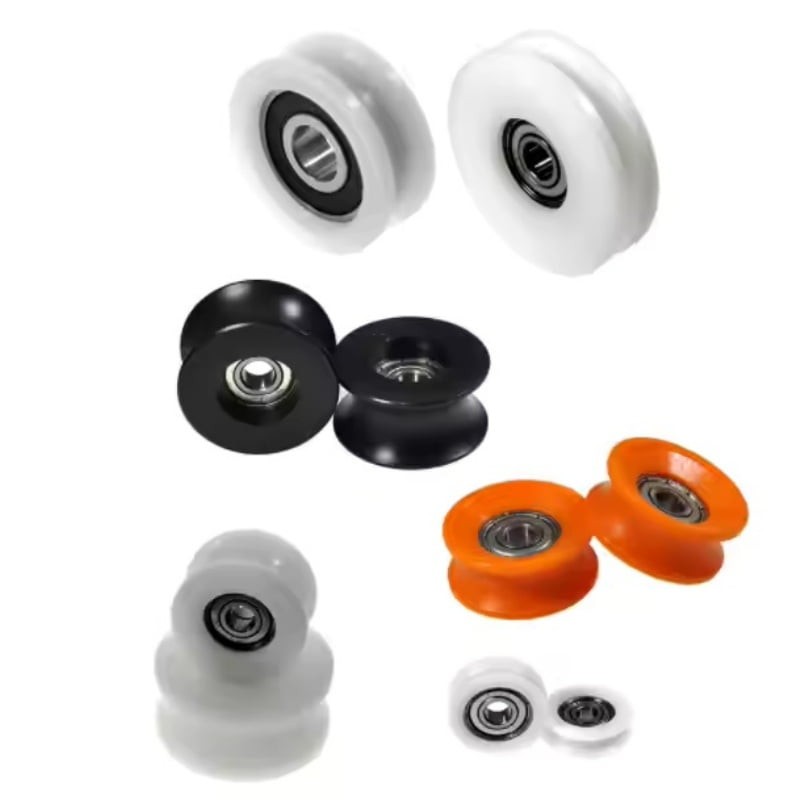
HUNE’s U-groove bearing rollers are listed for guiding compatible round rails, cords, cables, ropes and tubular tracks. HUNE’s broader sliding rollers with bearings range includes other profiles and mountings. These are relevant examples of track-guided roller components; they are not presented as standard sectional garage-door rollers or complete garage-door hardware.
What should an OEM specify for a garage-door roller and track?
Provide the roller mounting interface and track section together, then describe the door’s movement and duty.
A useful product-development brief should include:
- Track cross-section and the vertical-to-horizontal transition profile.
- Roller wheel diameter, width, running profile and material.
- Stem or axle diameter, length, offset and retention details.
- Hinge or carrier drawing showing how the roller mounts to the panel.
- Door type, panel layout, counterbalance arrangement and operating cycle.
- Expected environment, including moisture, temperature, dust and corrosion exposure.
- Noise targets, expected service life, sample quantity and production volume.
- Required fit, dimensional checks and approval criteria for the sample assembly.
A drawing of the roller alone may miss the critical interface. Include the track section, hinge or carrier, and the path the roller must follow. For adjacent guided-motion products, HUNE can review bearing roller material and construction options against the mating geometry; send drawings and application details through the HUNE contact page.
Frequently asked questions
Why does a garage door track curve near the ceiling?
The curved portion lets the sectional door transition from vertical movement to horizontal overhead travel. The panel hinges allow connected sections to change angle while the rollers follow the track radius.
Are the rollers responsible for lifting the door?
No. Rollers guide the door along the track. The spring, shaft, drum and cable counterbalance system helps offset the door weight, and the opener or user supplies motion.
Are all garage door rollers ball-bearing rollers?
No. Roller assemblies differ by wheel material, bearing or bushing arrangement, stem and mounting design. Select against the specified door and track system rather than assuming one construction fits every model.
Can a U-groove bearing roller replace a garage door roller?
Not by name alone. A U-groove wheel is intended for a compatible round rail, cord or tube. A sectional-door roller must match its track, stem, hinge or carrier interface and travel path. Check the actual geometry before treating the parts as substitutes.
Practical recommendation for OEM buyers
Review the roller, mounting hardware, door panels and track as one assembly. Confirm the wheel’s path through the curved transition, the stem-to-hinge interface, and the counterbalance and opener arrangement. For a custom roller project, send the track section and mounting drawing with the expected cycle and environment so the supplier can assess the real mating geometry.
Sources and verification
- Clopay, Garage Door Components — component functions, roller materials and system considerations.
- Clopay, Residential Garage Door Glossary — track, roller, hinge, curved radius and counterbalance definitions.
- HUNE, U-Groove Bearing Nylon Sliding Rollers — current product structure and stated guided applications.