
Greenhouse shade screens do not all run on rigid guide tracks. In many horizontal roof systems, parallel cables support the fabric while a gearmotor moves the leading edge through a cable-and-drum, rack-and-pinion or chain drive. A track-guided design works differently: a carriage or guide roller attached to the leading bar follows a fixed profile, keeping the screen edge aligned as the fabric opens and gathers. Vertical sidewall screens may instead roll around a tube or use pulley-and-cable lifts. So the track, roller, drive transmission and fabric support share the job, but the roller does not necessarily power the screen. To understand a particular system, identify which part carries the screen, which part moves it, and which part controls lateral tracking.
What movement systems do greenhouse shade screens use?
The layout determines whether the screen slides on wires, follows a rigid track or rolls around a tube.
A greenhouse shade screen is a system of fabric, support structure, drive components and controls. For overhead curtains, a leading-edge tube or bar pulls the fabric across the growing area. Support wires carry the fabric between greenhouse trusses; a gearmotor and transmission move the leading edge. UMass Extension describes common cable-and-drum, push-pull rack-and-pinion, and chain-and-cable drive arrangements for energy and shade screens. The fabric may rest on support cables or hang from sliding hooks, depending on the layout. UMass Extension’s system guide explains these drive options and how support arrangements vary.
| Screen layout | Typical movement | Where tracks or rollers may fit |
|---|---|---|
| Horizontal overhead curtain | A drive pulls or pushes the leading edge across support wires; the fabric gathers or folds at the open end. | Support wires usually carry the fabric. A guide roller or carriage may be used at a moving edge or in a specific track-guided design. |
| Vertical sidewall screen | The fabric rolls around a tube or is raised by pulleys and cables. | Guides may control the edge or bottom bar, but a rigid track is not universal. |
| Track-guided screen | A motor, cable or push-pull transmission moves a bar or carriage along a fixed path. | Rollers follow the track to constrain the moving edge; the fabric and frame still need their own support and tension design. |
This distinction matters for sourcing. A greenhouse may have bearings in a motor gearbox, rollers in an edge guide, pulleys in a cable lift, or no track rollers at all. Identifying the moving interface first prevents specifying a guide wheel for a drive function it was never designed to perform.
How does a track-guided shade screen travel?
The drive supplies motion while the guide track controls the path.
In a track-guided arrangement, the screen’s leading bar or edge carriage connects to a drive. Depending on the design, a gearmotor can pull a cable, rotate a shaft, or move a rack or chain. Guide rollers attached to the bar or carriage roll along a stationary rail. Their job is to keep the moving edge aligned, resist unwanted lateral movement and reduce rubbing at the guide interface.
The screen fabric is supported separately, often by parallel wires or a frame. As the drive moves the leading edge, fabric extends across the bay or gathers behind it. The edge attachment, support spacing and gathering arrangement determine whether the material remains flat and folds consistently. The track guides the carriage; it does not automatically carry the entire fabric load.
Image placement — after this section:
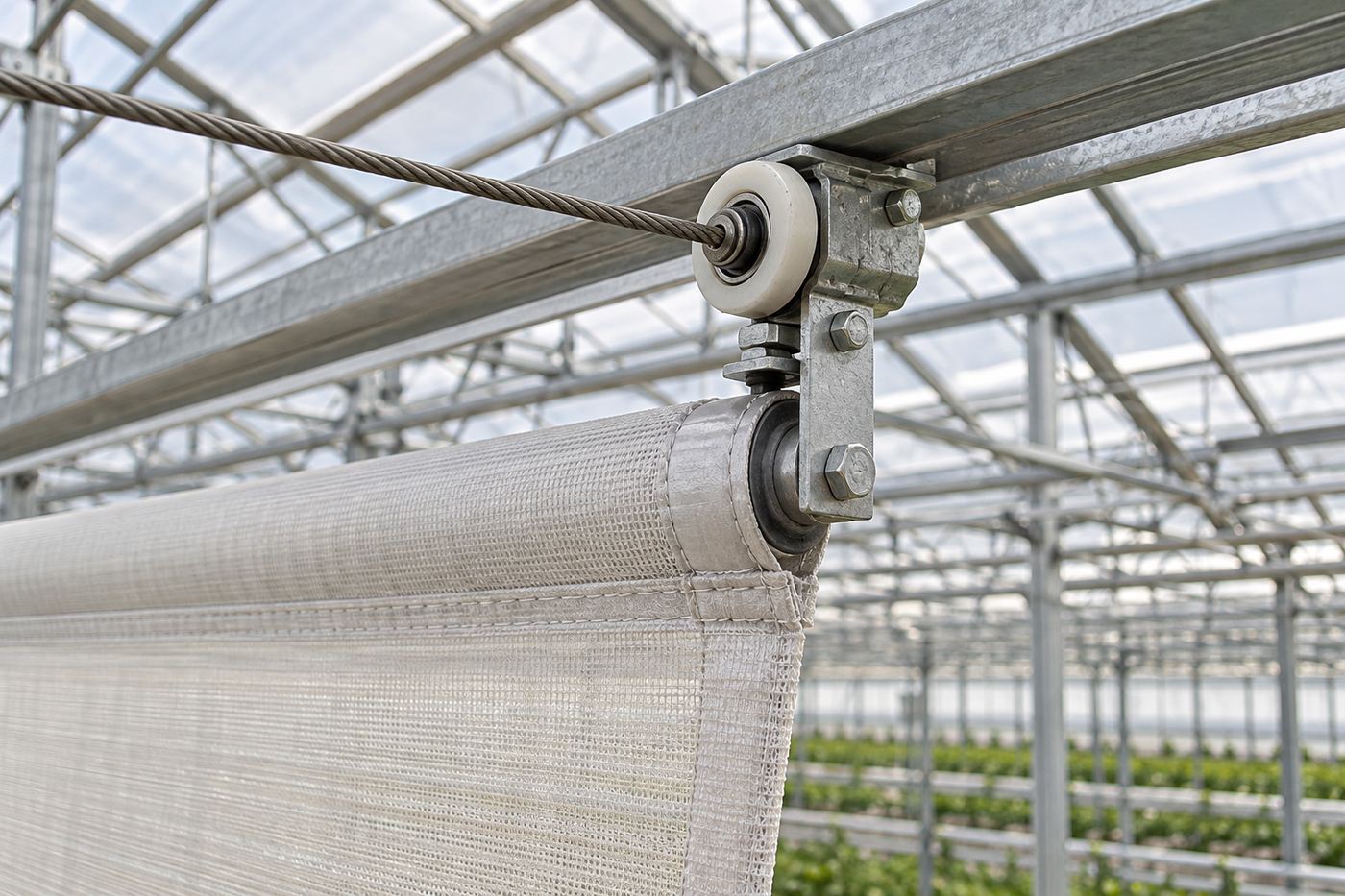 Illustrative close-up: a guide roller follows a track while the screen fabric and leading edge remain supported by the wider system.
A roller with an integrated bearing can reduce rotational resistance at a guided contact point, but its running profile must match the rail. A U-groove roller, for example, is intended for a compatible round rail, cable or tube; a flat or flanged wheel has a different contact pattern. The groove radius, width, depth, wheel diameter, bearing bore and mounting structure all affect fit. HUNE’s U-groove bearing rollers are one component type that OEMs can evaluate for compatible round guides; actual suitability depends on the greenhouse system’s load, environment and geometry.
What happens as the screen opens and closes?
A controlled drive moves the leading edge through a defined stroke, and the fabric follows its support layout.
A typical motorized cycle has four mechanical stages:
- A controller commands the gearmotor to move in the opening or closing direction.
- The drive transmission pulls or pushes the leading edge, bar or connected carriage.
- Support wires, tracks or hooks constrain the fabric and moving edge according to the selected system.
- A limit or position-control arrangement stops the travel at the intended end point.
The exact control method differs by equipment. A cable-and-drum drive winds or pays out cable; rack-and-pinion systems translate rotation into linear movement; chain-and-cable layouts transmit force through chains and cables. UMass Extension describes these as separate common screen drive approaches. USDA Natural Resources Conservation Service guidance also treats the greenhouse shade screen as a coordinated mechanical system of drive motor, screen material, support cables and controls, and calls for project-specific edge-seal details. NRCS greenhouse screen specification.
Image placement — after this section:
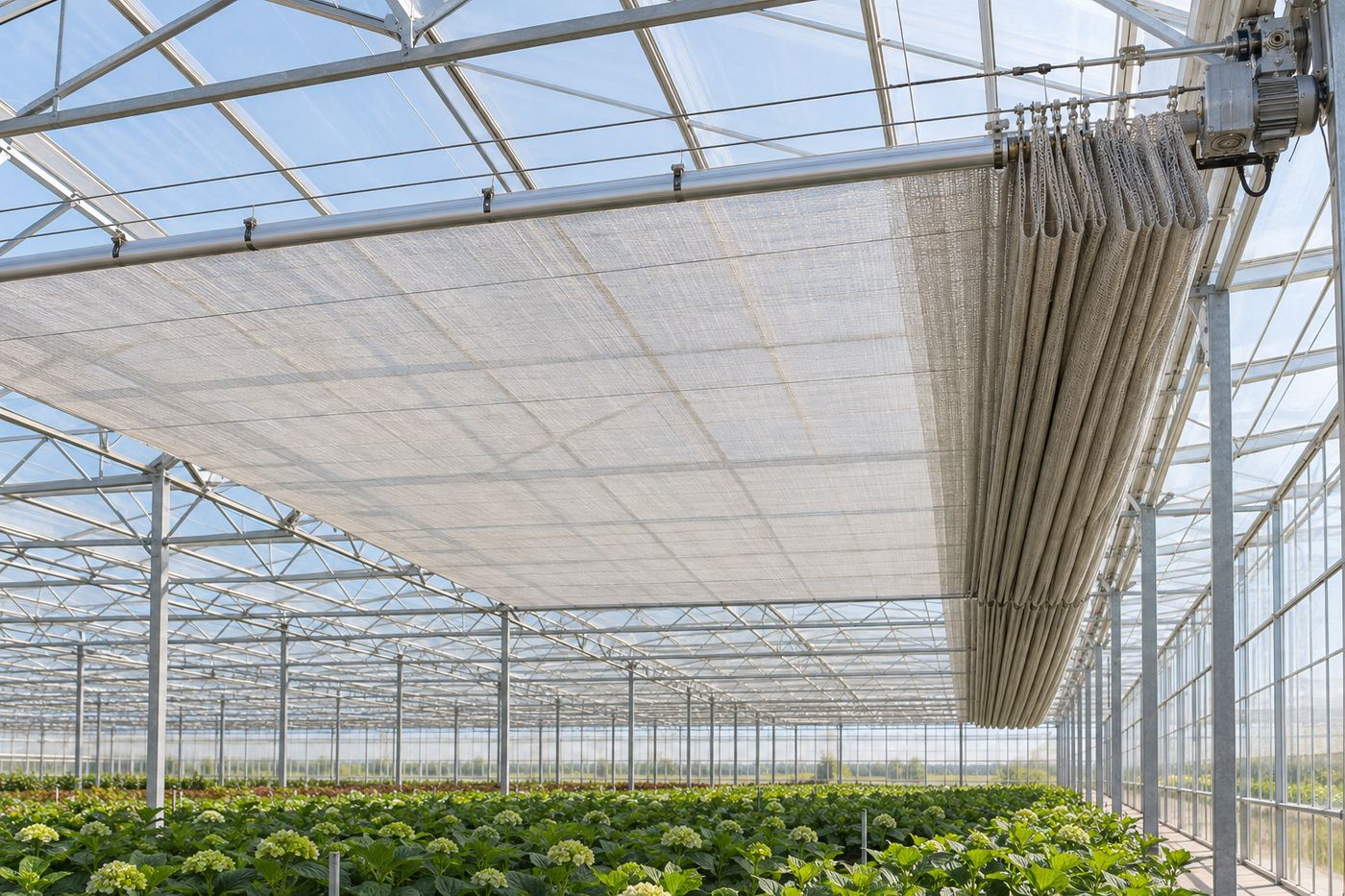 An overhead curtain system shows why fabric support, the drive and edge guidance should be specified together.
What makes greenhouse guide tracks and rollers work reliably?
Alignment, edge tension and the growing environment all affect travel.
A track and roller can guide an edge accurately only if the mating geometry is correct and the structure stays aligned over the full travel. A narrow or mismatched groove may rub or bind; a loose fit can allow lateral play. Uneven track spacing, misaligned mounting points or frame deflection can make the leading bar skew, putting extra side load on one carriage.
Greenhouses also expose hardware to humidity, condensation, fertilizers, cleaning agents, dust and temperature variation. For outdoor or wet locations, the buyer should confirm corrosion resistance, bearing closure, lubricant compatibility and wheel material with the supplier. Screen contact points and hems need consideration too: a roller does not prevent fabric wear where the cloth rubs on a support wire or sharp edge.
The screen’s function affects the design. A shade curtain, heat-retention screen and blackout screen can have different fabrics, edge seals and desired closure. NRCS guidance distinguishes these purposes and calls out moisture handling and perimeter sealing. It is a reference specification rather than a substitute for the design criteria of an individual greenhouse.
What should an OEM send when sourcing screen guide rollers?
Send the rail section, moving-part drawing and real operating conditions—not just a wheel diameter.
For a custom roller or guide assembly, provide:
- A cross-section drawing or sample of the guide rail, cable or round tube.
- Roller outside diameter, width, groove profile, groove radius or flange spacing.
- Bearing bore or bearing reference, shaft/stud dimensions and retention method.
- Moving bar or carriage dimensions, roller spacing and available installation envelope.
- Screen type, span, travel length, support method and drive type.
- Expected moving load and its direction, movement speed, operating frequency and stopping behavior.
- Exposure to condensation, humidity, chemicals, dust, UV, outdoor weather or washdown.
- Annual quantity, sample requirements and the checks needed for approval.
For a multi-component project, HUNE’s sliding rollers with bearings include multiple wheel profiles and mounting designs. A supplier can review the roller-to-guide fit and component construction; the greenhouse OEM remains responsible for validating the complete screen system, including fabric support, drive coordination, structure and controls. HUNE’s OEM manufacturing process outlines the drawing- and sample-based review route.
Frequently asked questions
Do greenhouse shade screens always move on guide tracks?
No. Many overhead greenhouse screens use support cables with a cable-and-drum, rack-and-pinion or chain-and-cable drive. Some systems use rigid guide tracks or rollers to control the moving edge; others use support wires, hooks, pulleys or roller tubes.
What does a guide roller do in a greenhouse screen system?
A guide roller follows a compatible rail or profile to constrain a moving edge or carriage and reduce sliding contact. It does not necessarily drive the screen or support all of the fabric weight.
Can a U-groove roller run on a greenhouse guide cable?
Only if the roller’s groove matches the cable or round guide and the assembly is designed for the actual load and environment. Check the groove radius and width, bearing and shaft fit, and corrosion or moisture requirements.
What causes a greenhouse shade screen to move unevenly?
Potential causes include uneven fabric tension, a skewed leading bar, track misalignment, inconsistent support spacing, a drive imbalance or added drag from contact and contamination. The relevant checks depend on whether the screen is cable-driven, rack-driven, tube-rolled or track-guided.
How should an OEM validate a custom guide roller?
Test the roller in the intended rail or guide with the real mounting arrangement and representative travel. Review tracking, free movement, side play, contact marks, noise and repeatability across the full stroke before approving the production sample.
Practical recommendation
Choose the motion architecture before choosing the roller. Confirm whether the screen slides on support wires, rolls around a tube, or uses a track-guided carriage. Then specify the drive, support, guide profile and edge behavior together. If a bearing roller is part of the design, approve it against the actual rail or cable sample and greenhouse operating conditions before repeat production.