
Are ball bearing drawer slides always better than plastic roller slides? Can a lower-cost roller system provide quieter movement? Why do two drawer rollers with the same outside diameter perform differently after installation?
Furniture manufacturers and hardware buyers often compare these systems by price alone. This creates risk because they use different movement structures.
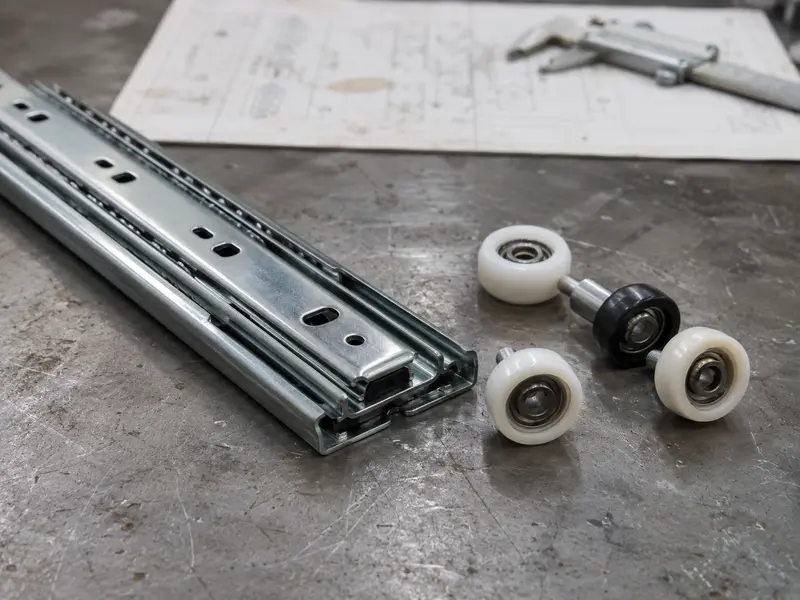
Ball bearing drawer slides use rows of steel balls between formed metal rails. Plastic roller slides use one or more plastic wheels that roll along a rail. Ball bearing slides often support more extension and load options. Plastic roller slides can provide a simpler structure, lower contact noise and better cost control in suitable applications.
The right choice depends on the drawer, load, movement, installation space, noise target and expected order volume.
Our factory produces bearings, plastic-coated bearing rollers, rubber-coated rollers, shafts and sliding hardware components. We do not manufacture complete ball bearing drawer slides. This guide explains the difference from a roller and component manufacturing view.
What Does This Guide Cover?
This article focuses on company purchasing and OEM production. It does not provide DIY repair or cabinet installation instructions.
How Do Ball Bearing Drawer Slides Work?
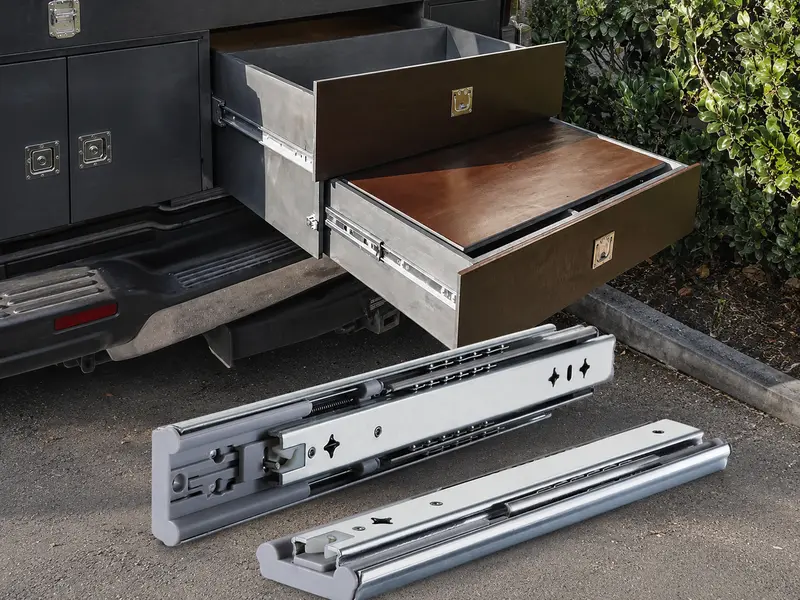
Ball bearing drawer slides place rows of steel balls between two or three formed metal rail members. The balls roll inside the rail raceways as the drawer opens and closes.
A typical telescopic ball bearing slide contains:
- An outer rail fixed to the cabinet
- An inner rail fixed to the drawer
- An intermediate rail in many full-extension models
- Steel balls
- Ball retainers
- Formed raceways
- Lubricating grease
- Travel stops
- A release lever on some models
- A soft-close unit on selected models
The steel balls reduce direct sliding contact between the rails. The ball retainers keep the balls separated and guide their position.
The steel balls cannot create smooth movement by themselves. The result also depends on:
- Rail straightness
- Raceway shape
- Ball size
- Internal clearance
- Grease type and quantity
- Rail overlap
- Installation alignment
- Drawer width
- Load position
A bent rail or inaccurate cabinet can make a good loose sample feel tight after installation.
How Do Plastic Roller Drawer Slides Work?
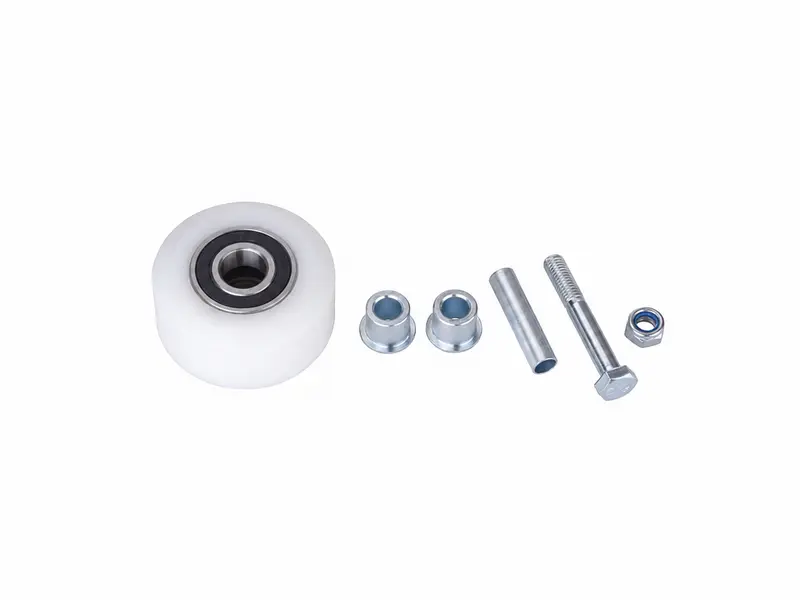
Plastic roller drawer slides use a plastic wheel that rotates on an axle, rivet or bearing while it follows a formed rail.
A basic roller slide usually contains:
- A cabinet-side rail
- A drawer-side rail
- One or more plastic rollers
- A steel axle, rivet or pin
- A plain bore or bearing
- Travel stops
- Mounting holes
- A surface coating on the metal rails
The wheel carries or guides the moving rail. Its outside surface contacts the track directly.
The roller may use:
- A plain plastic bore
- A plastic wheel on a metal pin
- A plastic-coated miniature bearing
- A plastic wheel with a separate bush
- A moulded wheel and shaft assembly
These structures can look similar in a product photo. Their movement, cost and service conditions can still differ.
A plain-bore wheel uses sliding contact between the wheel bore and axle. A plastic-coated bearing roller contains a complete bearing inside the plastic outer layer. The bearing reduces friction around the shaft, while the plastic outer surface contacts the rail.
What Is the Main Difference Between the Two Systems?
Ball bearing slides use loose steel balls between telescopic rails. Roller slides use separate wheels that rotate on shafts or bearings.
| Comparison point | Ball bearing drawer slide | Plastic roller drawer slide |
|---|---|---|
| Rolling element | Rows of steel balls | One or more plastic wheels |
| Supporting structure | Formed telescopic rails | Wheel, axle and formed rail |
| Common extension | Partial, full or over-travel | Partial extension is common |
| Contact material | Steel ball against metal raceway | Plastic wheel against metal rail |
| Contact sound | Metal rolling sound may be present | Plastic contact can be quieter |
| Lubrication | Grease inside the raceway | Depends on bore, shaft or bearing |
| Installation sensitivity | Rail clearance and alignment matter | Wheel and rail alignment matter |
| Cost structure | More components and assembly steps | Often simpler |
| Replacement | Complete slide is often replaced | A roller may be replaceable in some designs |
| Custom component potential | Mainly controlled by slide manufacturer | Wheel, bearing, shaft and bracket can be customised |
A roller drawer slide is not a low-quality version of a ball bearing slide. It is a different structure.
The buyer should compare the final application instead of assuming that one system is always better.
Which System Provides the Required Extension?
Ball bearing drawer slides usually provide more extension options. Plastic roller slides often use a simpler partial-extension structure.
| Extension type | Meaning | Typical purchasing consideration |
|---|---|---|
| Partial extension | Part of the drawer stays inside the cabinet | Lower cost and simpler movement |
| Full extension | Most or all of the drawer becomes accessible | Better access to the rear |
| Over-travel | The drawer moves beyond the cabinet front | Useful below worktops or wide cabinet fronts |
| Two-way travel | The slide moves in two directions | Used in selected equipment applications |
A three-member ball bearing slide often supports full extension. Buyers should still confirm the actual travel because the number of rail members does not guarantee one extension ratio.
Plastic roller systems commonly suit applications that do not need full rear access. Examples include:
- Light furniture drawers
- Storage cabinets
- Wardrobes
- Office furniture
- Keyboard trays
- Cost-controlled furniture systems
The application should decide the extension. Full extension adds value only if the user needs that access.
Which System Is Quieter?
Plastic roller slides can provide softer contact sound, but the material name alone cannot guarantee quiet movement.
A plastic wheel separates the metal rail from direct metal rolling contact. This can reduce high-frequency contact noise.
However, noise can still come from:
- An uneven rail
- Wheel runout
- Excessive shaft clearance
- A loose rivet
- A hard plastic grade
- Poor bearing rotation
- Wheel deformation
- An incorrect track profile
- Cabinet misalignment
- Drawer movement at the end stop
Ball bearing slides can also move quietly when the rails, balls, clearance and grease are well controlled.
| Noise factor | Ball bearing slide | Plastic roller slide |
|---|---|---|
| Rolling contact | Steel against metal raceway | Plastic against metal rail |
| Lubrication | Grease affects contact sound | Bearing or axle condition matters |
| Clearance | Excess clearance can cause rattling | Shaft clearance can cause wobble |
| Rail condition | Bends and burrs affect movement | Rough rail surfaces affect the wheel |
| End stop | Can create metal impact | Can still create impact noise |
| Installation | Parallel rails are required | Correct wheel alignment is required |
Buyers should define a sample test instead of requesting a “silent” product. Record the drawer size, load, movement speed and acceptable sound level.
How Should Buyers Compare Load Performance?
A claimed load rating has little value without its test conditions.
Ball bearing slides are available in many load classes. Plastic roller slides are often used for light or moderate drawer systems. These are general market patterns, not universal limits.
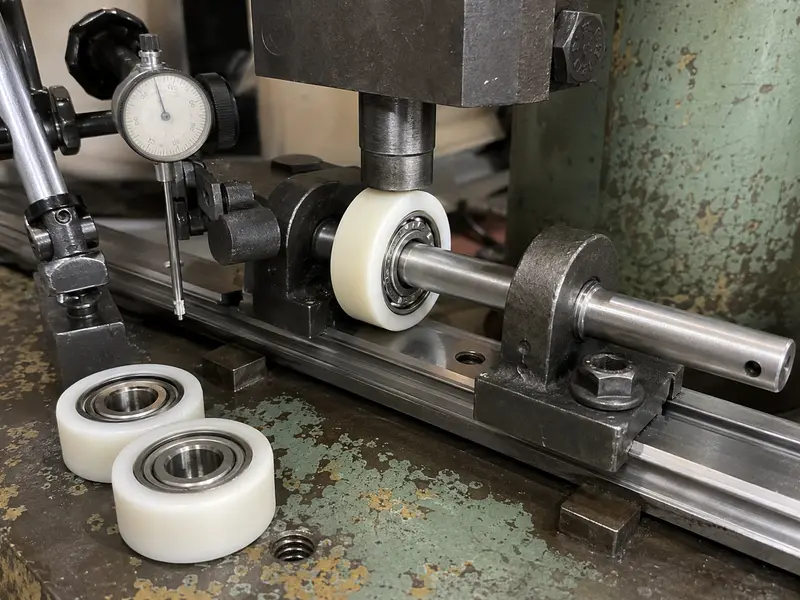
A plastic-coated bearing roller can also carry a significant radial load in the correct structure. The completed drawer system may still be limited by the rail, shaft, bracket, plastic wall thickness or cabinet.
Ask the supplier or system designer:
| Load question | Why it matters |
|---|---|
| Is the rating for one slide or one pair? | Suppliers may use different rating bases |
| What slide length was tested? | Length changes leverage and rail engagement |
| What drawer width was used? | Wide drawers can increase side movement |
| Was the load centred? | Uneven loading changes the force |
| Was the drawer fully extended? | Full extension creates a different load condition |
| Was the test static or cyclic? | Holding weight differs from repeated movement |
| How many cycles were completed? | Usage frequency affects the test |
| What counted as a failure? | Movement, noise and deformation limits may differ |
| Which mounting direction was used? | Mounting direction changes the load path |
Do not choose a drawer roller by bearing capacity alone. The outer plastic layer, shaft, rail and installation can become the limiting parts.
Which Plastic Material Should a Drawer Roller Use?
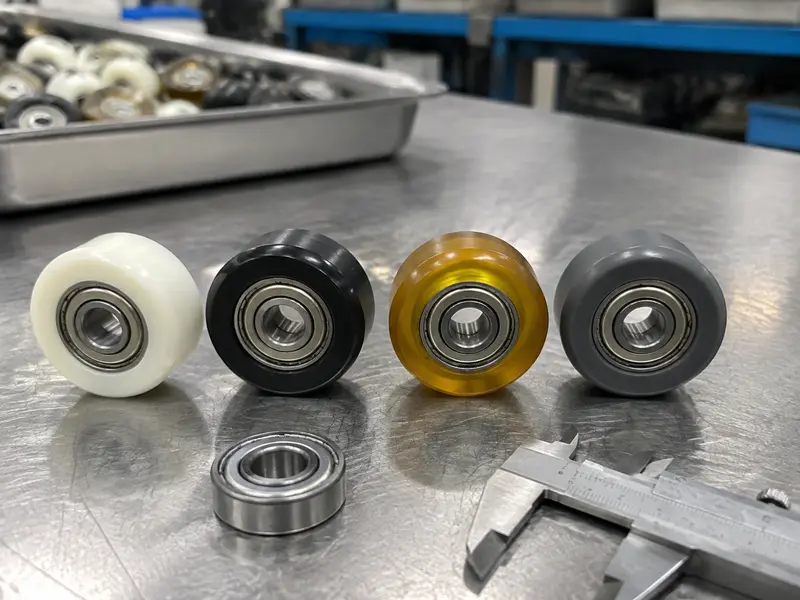
The buyer should choose the roller material by load, noise, wear, moisture, temperature, chemical contact and price.
“Nylon” and “plastic” do not describe one fixed performance level. The exact grade and production process matter.
| Material | Main reasons to assess it | Points to confirm |
|---|---|---|
| POM | Stable dimensions, smooth surface and low moisture absorption | UV exposure, impact and temperature |
| PA or nylon | Wear resistance and strength in suitable grades | Moisture absorption and dimensional change |
| PA66 | Higher temperature and wear potential than some general nylon grades | Moisture conditioning and exact grade |
| POK | Wear resistance and chemical performance in suitable applications | Availability, cost and approved grade |
| PPSU | Heat and chemical resistance for selected applications | Higher material cost and friction target |
| PU | Softer contact, grip and lower contact noise | Hardness, deformation and bonding |
| Rubber | Soft contact and vibration reduction | Ageing, compression and rolling resistance |
POM is a common option for plastic-coated bearing rollers because it provides a smooth running surface and stable dimensions in many indoor applications.
PA66 can suit projects that need higher wear resistance, but moisture can affect its dimensions. The buyer should test the finished roller under the real working conditions.
PU and rubber can reduce hard contact noise. Their softer surfaces can also increase deformation and rolling resistance.
No material provides the lowest noise, highest load, longest life and lowest cost at the same time.
What Affects the Performance of a Plastic-Coated Bearing Roller?
The bearing is only one part of a plastic-coated roller. The outer material, moulding accuracy, wall thickness and shaft fit also affect movement.
From our production experience, I check:
- Bearing model and dimensions
- Bearing seal or shield
- Bearing rotation
- Plastic material and grade
- Plastic wall thickness
- Wheel outside diameter
- Wheel width
- Groove profile
- Moulding concentricity
- Bearing position
- Shaft fit
- Side clearance
- Surface defects
Poor concentricity can make the wheel rise and fall during rotation. Incorrect bearing fit can compress the bearing ring or allow movement between the bearing and plastic.
An outer layer that is too thin may not provide enough support. A very thick section can create moulding shrinkage and dimensional variation.
The buyer should define the finished roller, not only the bearing number.
| Specification | What the buyer should confirm |
|---|---|
| Bearing | Model, seal, internal requirement and approved source |
| Outer material | Exact grade, colour and recycled-content rule |
| Dimensions | Bore, outside diameter, width and groove |
| Tolerances | Critical fit and running dimensions |
| Concentricity | Maximum permitted wheel runout |
| Shaft | Diameter, material, tolerance and retention |
| Environment | Moisture, dust, chemicals and temperature |
| Inspection | Dimensions, rotation, appearance and batch records |
What Causes Noise, Wobble and Early Wear?
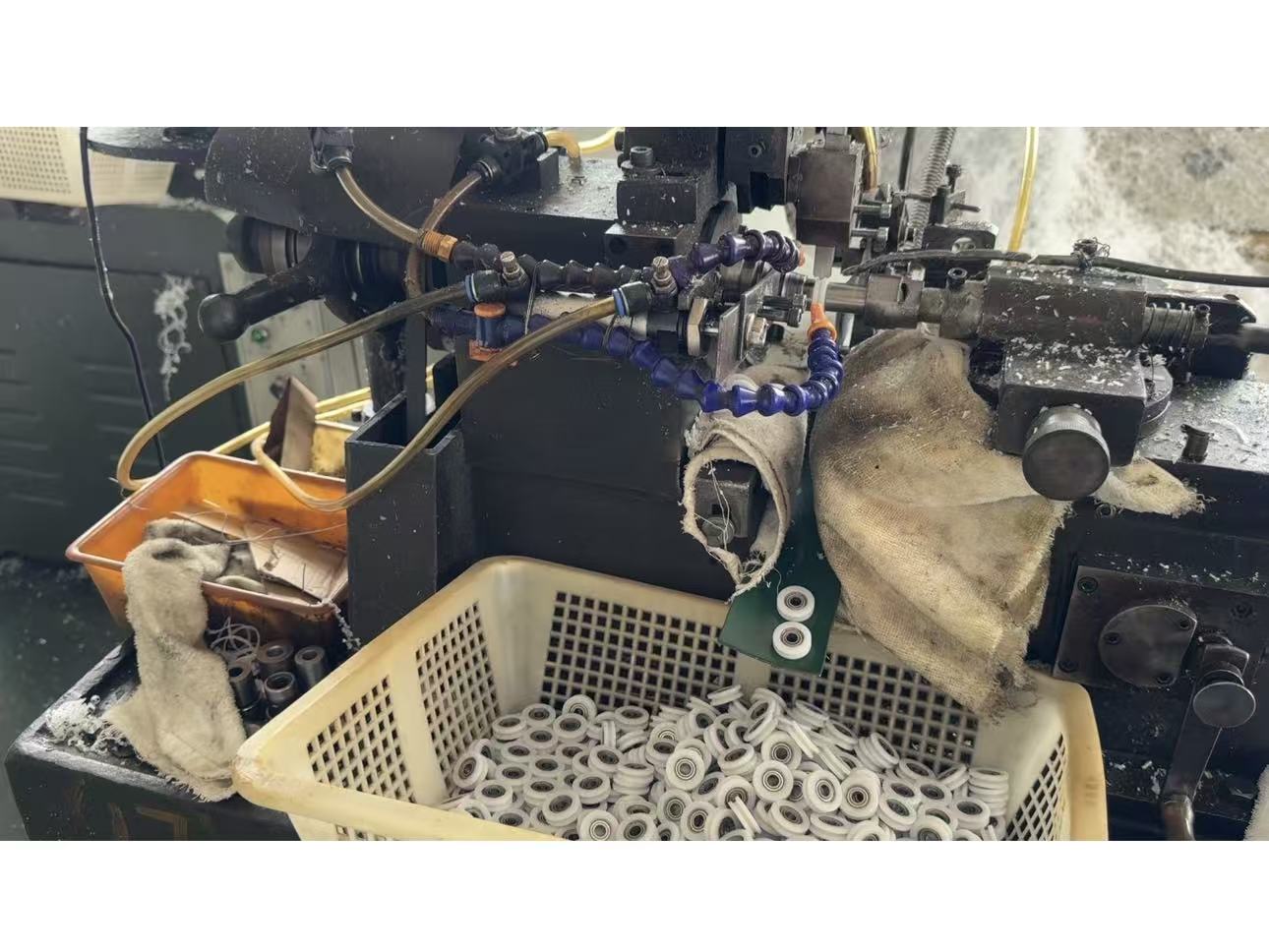
Most roller complaints involve more than one component. Buyers should inspect the wheel, bearing, shaft, rail and installation together.
| Reported problem | Possible cause | What to inspect |
|---|---|---|
| Wheel wobble | Wheel runout, loose shaft or poor bearing fit | Concentricity, bore and shaft clearance |
| High starting force | Tight bearing fit, seal drag or misalignment | Loose roller and installed assembly |
| Repeated clicking | Surface defect, damaged bearing or rail joint | Full wheel surface and rail |
| Side rubbing | Incorrect wheel width or bracket clearance | Wheel position and side space |
| Flat area on wheel | Excess load, unsuitable material or long static load | Material, load and storage |
| Early groove wear | Wrong track profile or uneven loading | Wheel and rail cross-sections |
| Loose movement | Excess shaft clearance or worn bore | Axle, bore, rivet and bracket |
| Roller cracking | Impact, low temperature or unsuitable material | Environment and material grade |
| Corrosion | Inadequate bearing seal or shaft finish | Bearing, shaft and moisture exposure |
| Batch differences | Material or process change | Approved sample and change records |
A loose hand test cannot confirm the installed system. The buyer should test the roller inside the actual or representative drawer assembly.
When Should Buyers Choose a Custom Drawer Slide Roller?
A custom roller is useful when an existing wheel cannot meet the required dimensions, material, bearing, shaft or rail profile.
Custom requirements may include:
- A special outside diameter
- A specific wheel width
- A flat, U-shaped, V-shaped or rounded running surface
- A selected miniature bearing
- A plain bore or bearing structure
- A custom material grade
- A specific colour
- A custom shaft or rivet
- A stamped bracket
- Controlled wheel runout
- Private-label packaging
We first compare a new enquiry with our existing moulds. An existing roller can reduce tooling cost and sample time if the critical dimensions match.
A close size does not always require a new mould. Secondary machining can adjust the width or groove of some rollers. This approach must still meet the required tolerance and surface condition.
New tooling can provide better control when the buyer has:
- A unique structure
- Stable annual demand
- Strict dimensions
- A fixed bearing specification
- Repeat-order requirements
- A complete drawing or approved sample
| Sourcing route | Suitable condition | Main buyer check |
|---|---|---|
| Existing roller | Dimensions and structure already match | Confirm the installed sample |
| Existing roller with machining | Small dimensional adjustment is possible | Confirm tolerance and repeatability |
| New mould | Unique profile or stable demand | Confirm tooling and sample terms |
| Complete assembly | Wheel, shaft and bracket must work together | Test the complete unit |
What Does a Real Roller Enquiry Teach Buyers?
A real enquiry shows why buyers should compare all critical dimensions before opening a new mould.
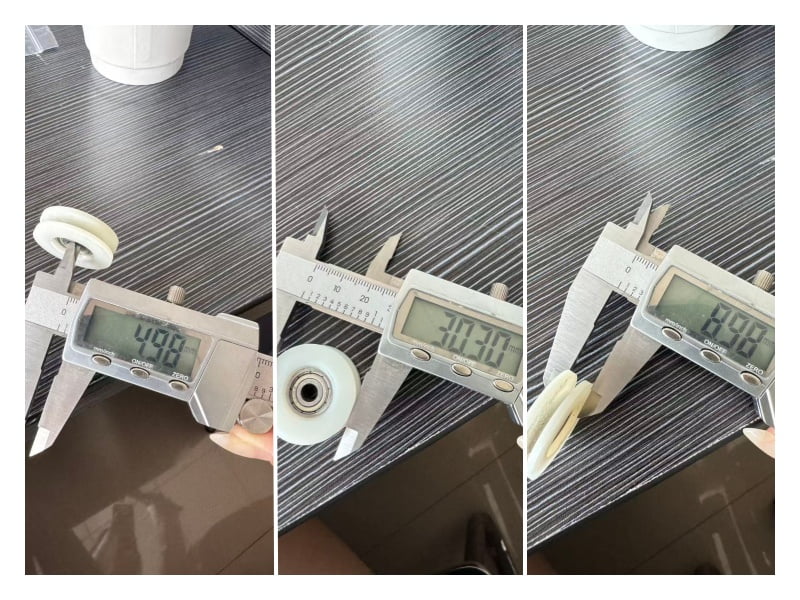
A customer required a U-groove roller with dimensions of 5 × 30 × 10 mm. The first number referred to the bore, the second to the outside diameter and the third to the total width.
We had an existing 5 × 30 × 9 mm roller. The customer confirmed that the 1 mm width difference did not affect the installation. However, the groove width still needed to match the mating part.
We reviewed the existing wheel and arranged secondary machining to adjust the groove width to 5 mm.
This option helped the customer avoid immediate tooling cost. It was only workable because the customer confirmed:
- The bearing bore
- The outside diameter
- The accepted total width
- The required groove width
- The installation structure
- The sample test
The lesson also applies to drawer slide rollers. A visually similar wheel may still have a different bearing, width, groove or shaft fit.
An existing mould can reduce cost. It should not replace technical confirmation.
What Should Buyers Test Before Bulk Production?
Buyers should test the roller or slide as part of the actual drawer and cabinet system.
Our factory can inspect production-related features of a plastic-coated bearing roller:
- Bearing model
- Bore size
- Outside diameter
- Width
- Groove dimensions
- Bearing position
- Wheel runout
- Basic rotation
- Surface appearance
- Shaft dimensions
- Bracket dimensions
- Packaging and labels
The buyer should approve application performance.
| Test stage | Buyer question |
|---|---|
| Visual inspection | Is the wheel free from cracks, burrs and obvious moulding defects? |
| Dimensional inspection | Do the bore, diameter, width and groove match the drawing? |
| Rotation check | Does the wheel rotate without a tight point? |
| Shaft-fit check | Does the wheel fit the approved shaft or rivet? |
| Rail-fit check | Does the wheel contact the rail correctly? |
| Installed movement | Does the drawer move through the full required travel? |
| Clearance check | Does the drawer remain stable without side rubbing? |
| Load check | Does the assembly pass the buyer’s defined load? |
| Noise check | Does the sound meet the product target? |
| Cycle check | Does the assembly pass the required opening cycles? |
| Environment check | Does the material suit temperature, moisture and contamination? |
| Repeat-order check | Does bulk production match the signed sample? |
The buyer should define the load, movement speed, test cycles and pass criteria.
Avoid approving phrases such as “high load” or “long life” without a test method.
How Should Buyers Assess a Plastic Roller Manufacturer?
Buyers should assess whether the manufacturer can control the bearing, material, moulding, shaft and repeat production.
| Supplier area | Question to ask | Why it matters |
|---|---|---|
| Bearing supply | Is the bearing model and source recorded? | Prevents hidden bearing changes |
| Material | Is the exact plastic grade controlled? | Affects dimensions, wear and noise |
| Injection moulding | How is bearing position controlled? | Affects wheel runout |
| Mould condition | How are groove and wheel dimensions maintained? | Affects rail contact |
| Shaft production | Can the shaft tolerance remain stable? | Affects rotation and wobble |
| Stamping | Can the bracket position and thickness stay consistent? | Affects alignment |
| Inspection | Are critical dimensions and rotation checked? | Creates an approval standard |
| Sample control | Is there a signed reference sample? | Supports repeat production |
| Change control | Must the buyer approve material or process changes? | Protects future orders |
| Packaging | How are wheels and shafts protected? | Prevents contamination and damage |
Our production covers miniature bearings, injection moulding, plastic and rubber coating, shaft processing, stamping and assembly.
This allows us to review the roller as a complete component. The furniture or hardware company should still approve the final rail and drawer system.
What Should a B2B Enquiry Include?
A clear enquiry should define the wheel, bearing, shaft, rail, application and purchasing plan.
| Information group | Details to provide |
|---|---|
| Application | Drawer, cabinet, wardrobe, door or equipment |
| Wheel | Outside diameter, width and running profile |
| Bearing or bore | Model, bore size, seal and quantity |
| Material | POM, PA, PA66, POK, PPSU, PU or another grade |
| Shaft | Diameter, length, material and retention |
| Rail | Cross-section, material and contact position |
| Installation | Bracket, available space and load direction |
| Performance | Load, speed, noise target and usage frequency |
| Environment | Temperature, moisture, dust and chemicals |
| Testing | Load, cycles and acceptance criteria |
| Quantity | Samples, first order and annual demand |
| Packaging | Bulk, individual, barcode or private label |
| Commercial | Target price, trade term and delivery date |
Send a drawing or physical sample where possible.
If no drawing is available, send:
- Product photos from several angles
- Manual dimensions
- Rail cross-section
- Installation photos
- Movement video
- Current product sample
- Current complaint
- Expected annual quantity
We can then compare an existing mould, secondary machining and new-tooling options.
Which System Should Your Company Choose?
Choose ball bearing drawer slides when the application needs the extension, structure and performance available from a complete telescopic slide. Choose plastic roller slides when a simpler and potentially quieter wheel-based structure meets the approved load and travel.
| Buyer priority | Option to assess first |
|---|---|
| Full extension | Ball bearing drawer slide |
| Over-travel | Ball bearing drawer slide |
| Heavy equipment drawer | Rated ball bearing slide or tested heavy-duty system |
| Simple furniture drawer | Plastic roller slide |
| Lower contact noise | Plastic roller slide |
| Cost-controlled structure | Plastic roller slide |
| Replaceable wheel component | Custom plastic roller |
| Custom wheel material | Plastic-coated bearing roller |
| Custom shaft or bracket | OEM roller assembly |
| High repeat-order control | Either system with signed specifications |
Do not ask only:
Are ball bearing drawer slides better?
Ask:
Which movement structure meets our required load, extension, noise, installation and cost targets?
That question creates a more useful comparison.
Do You Need a Custom Plastic-Coated Bearing Roller?
We do not manufacture complete ball bearing drawer slides. We manufacture the rolling components used in wheel-based furniture, door and equipment systems.
Our production scope includes:
- Plastic-coated bearing rollers
- Rubber-coated bearing rollers
- Plain-bore plastic wheels
- POM, PA66, POK, PPSU and PU rollers
- Custom grooves and running surfaces
- Shafts, pins and rivets
- Stamped brackets
- Sliding roller assemblies
- OEM and ODM parts based on drawings or samples
We first check whether an existing mould can match the project. If it cannot, we can assess secondary machining or new tooling.
View Sliding Rollers with Bearing