
Is the hardest roller material always the safest choice for a heavy sliding door? Should you pay more for POK, PPSU or stainless steel? Can a quiet PU wheel carry the same load as a harder POM sliding roller?
These questions often appear in the enquiries I review.
Many buyers start with one material name. Some ask for nylon because they think nylon is stronger. Others ask for metal because the door is heavy. Some buyers request the most expensive plastic because they want a premium product.
A material name cannot answer the complete purchasing question.
The best roller material for heavy duty sliding door hardware is the material that matches the door load, wheel structure, bearing, shaft, bracket, track, environment and noise target.
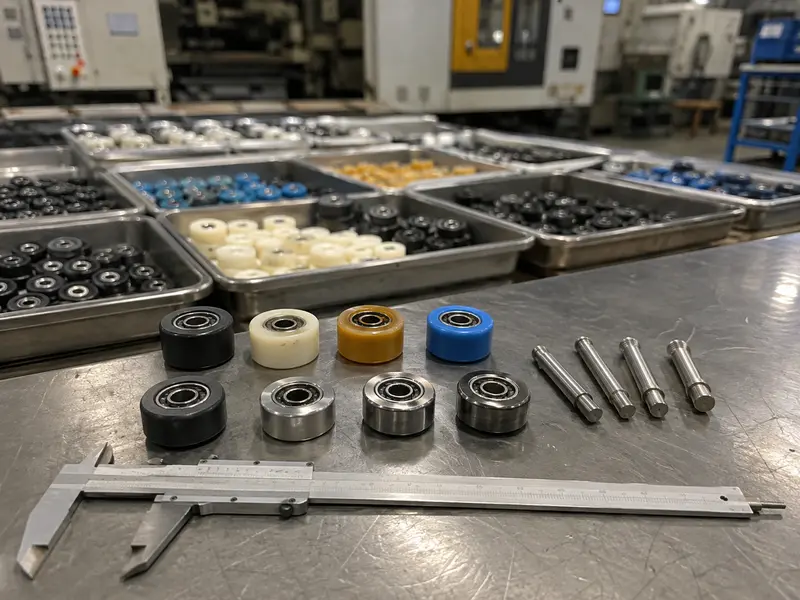
POM and engineering nylon are common choices for heavy-duty plastic rollers. PU and rubber can support quieter contact and track protection. Metal wheels may suit some high-load systems, but they can increase noise and track wear. POK and PPSU can serve special requirements, but a higher material price does not guarantee a better sliding door roller.
I prefer to assess the complete assembly before I recommend a material.
What Does This Heavy Duty Sliding Door Hardware Guide Cover?
This guide explains how B2B buyers can compare roller materials, bearing structures, tracks, environments, samples and repeat-production risks.
It is written for:
- Sliding door system manufacturers
- Door and window hardware buyers
- Importers and distributors
- Building hardware wholesalers
- OEM and ODM sourcing teams
- Project purchasing departments
This guide does not provide a universal load rating. The buyer’s qualified technical team should approve the final door system and test conditions.
Which Roller Material Is Best for Heavy Duty Sliding Door Hardware?
No single roller material is best for every heavy-duty sliding door. POM, nylon, POK, PPSU, PU, rubber and metal serve different purchasing targets.
The following table gives buyers a practical starting point.
| Roller material | Why buyers assess it | Main purchasing risk | Buyers should confirm |
|---|---|---|---|
| POM | Smooth movement, controlled dimensions and established use in mechanical parts | The material name may hide grade or recycled-content differences | Grade, wall thickness, bearing fit, temperature and load |
| PA66 or nylon | Wear resistance, stiffness and impact tolerance in suitable grades | Moisture and temperature can affect the finished part | Exact grade, additives, reinforcement and environment |
| POK | Balance of stiffness and toughness for selected structures | Buyers may treat it as an automatic upgrade | Grade, moulding design, wheel thickness and sample performance |
| PPSU | Special heat, appearance or environmental requirements | High material cost may add no value in a normal application | Temperature, friction, track and business volume |
| PU | Softer contact, cushioning and quieter movement | Compression and rolling resistance can increase | Hardness, thickness, bonding and static load |
| Rubber | Grip, vibration control and track protection | Ageing, deformation and coating separation can occur | Rubber grade, hardness, bonding and environment |
| Carbon steel | High stiffness and lower metal cost | Corrosion, noise and track wear | Finish, lubrication, track material and maintenance |
| Stainless steel | Corrosion resistance with a suitable grade | High cost and hard wheel-to-track contact | Stainless grade, bearing, shaft and track |
| Brass or copper alloy | Appearance and corrosion requirements in selected systems | Material cost and wear behaviour | Alloy, load, track contact and annual volume |
The buyer should not use this table as a ranking. Each option still needs an application test.
Why Does the Outer Roller Material Not Decide Load Capacity Alone?
The finished roller assembly carries the load. The outer material is one part of that assembly.
A typical sliding door roller contains:
- An outer wheel or coating
- One or two bearings
- A shaft, rivet, bolt or pin
- A stamped or machined bracket
- A housing or adjustment structure
- A matching track
A thick POM wheel with a suitable bearing may work better than a metal wheel with an undersized shaft. A double-bearing roller may control movement better in one housing, but two bearings do not automatically double the load rating.
Load distribution also matters. A door with four wheels may not place exactly 25% of its weight on each wheel. Frame movement, track alignment, bracket position and installation tolerance can shift the load.
| Assembly point | Why it affects heavy-duty performance |
|---|---|
| Wheel diameter | Changes track contact, clearance and available material thickness |
| Wheel width | Changes contact area and bracket space |
| Bearing size | Affects rotation, shaft size and internal load support |
| Bearing quantity | Changes support width and assembly structure |
| Shaft | Transfers load between the bearing and bracket |
| Bracket | Controls wheel position and alignment |
| Track profile | Controls the wheel contact point |
| Installation | Can create uneven load or side force |
| Door frame | Can deflect and move load between rollers |
For company purchasing, the better question is:
Which wheel, bearing, shaft, bracket and track combination can pass our approved test?
Is POM Suitable for a Heavy Duty Sliding Roller?
POM is a practical starting material for many heavy-duty sliding roller projects, but the finished structure must support the required load.
We often use POM for plastic-coated bearing rollers because it can provide a smooth running surface and controlled moulded dimensions. The official Delrin POM material guide also identifies low friction, wear resistance and dimensional stability as common POM characteristics.
That information does not prove that every POM wheel can carry every heavy door.
Before I recommend a POM sliding roller, I check:
- Door weight
- Number of load-bearing wheels
- Wheel diameter and width
- Plastic wall thickness
- Bearing size
- Shaft fit
- Track profile
- Travel frequency
- Indoor or outdoor use
- Working temperature
- Noise target
The exact grade also matters. Virgin material, modified grades, glass-filled material and recycled content can produce different finished parts.
A quotation that states only “POM wheel” leaves several questions unanswered.
| POM purchasing point | Question to ask the supplier |
|---|---|
| Material source | Is the agreed grade recorded? |
| Recycled content | Can the supplier change it without approval? |
| Colour | Does colour identify the grade or only the pigment? |
| Wall thickness | Is there enough material around the bearing? |
| Bearing fit | Can moulding pressure affect bearing rotation? |
| Concentricity | Is the plastic centred around the bearing? |
| Batch control | Will repeat orders use the approved material? |
POM can also support a quieter sliding feel than direct metal-to-metal contact. The buyer should confirm that result on the actual track.
When Should Buyers Choose a Nylon Sliding Door Roller?
Buyers should assess PA66 or another nylon grade when the project needs a different balance of wear resistance, stiffness and impact behaviour.
“Nylon” is not a complete specification. PA6, PA66, reinforced nylon and modified nylon do not produce the same finished roller.
BASF describes unreinforced PA66 as a material with stiffness, abrasion resistance, heat resistance and hardness. BASF also explains that humidity can affect the properties and dimensional stability of PA-based components. Buyers can review the company’s Ultramid polyamide information for the grade-level differences.
This matters in sliding door hardware.
A nylon roller may work in the sample stage but change after moisture exposure if the grade and structure do not suit the application. A reinforced grade may increase stiffness, but it may also change the running surface, moulding behaviour and track contact.
Buyers should confirm:
- PA6, PA66 or another polyamide
- Reinforcement type and percentage
- Moisture exposure
- Working temperature
- Low-temperature conditions
- Wheel thickness
- Bearing fit
- Track material
- Noise requirement
- Approved colour and additives
POM and nylon should not appear as interchangeable names on a purchase order.
When Do POK and PPSU Rollers Make Sense?
POK and PPSU can serve specific sliding door projects, but buyers should select them for a clear reason.
When Can a POK Sliding Roller Fit the Project?
We use POK in selected sliding roller and door hardware assemblies. A buyer may assess it where the wheel needs a particular balance between stiffness, repeated movement and impact behaviour.
I still need the complete application information before I confirm it.
A POK wheel cannot correct:
- A bearing that is too small
- A shaft with too much clearance
- A weak bracket
- A groove that does not match the track
- Poor installation alignment
- An unsupported load claim
POK also costs more than some standard plastics. The buyer should compare the added cost with a clear performance target.
When Can a PPSU Roller Fit the Project?
PPSU may suit a project with special heat, humidity, chemical or appearance requirements. Syensqo lists heat and chemical resistance among the properties of its Radel PPSU grades.
These general properties do not make PPSU the default choice for every heavy door.
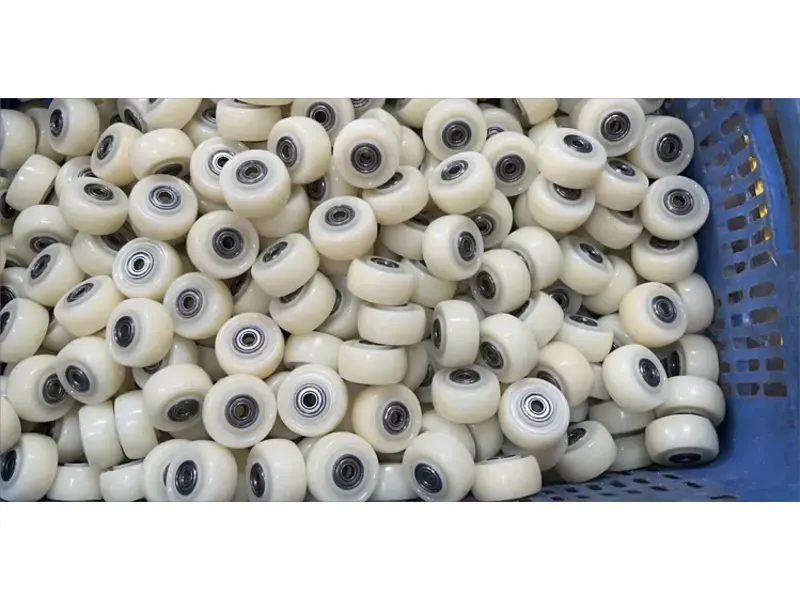
PPSU amber wheels also have a distinct appearance. Some door hardware buyers select them for product positioning. The buyer should still review friction, noise, track contact and price.
| Question | Why it matters |
|---|---|
| Does the application need the material property? | A higher material cost needs a clear reason |
| Does the track suit the running surface? | Material and track contact affect movement |
| Can the existing mould process the grade? | Different materials need different production control |
| Does the buyer need a special colour? | Colour alone does not confirm material |
| Can annual demand support the material and tooling cost? | A workable sample may still be commercially unsuitable |
Are PU and Rubber Rollers Better for Quiet Sliding Doors?
PU and rubber can reduce hard contact and vibration, but softer material can also deform under load.
Buyers often ask for a rubber-coated bearing pulley after receiving a noise complaint. The coating may help, but I first check whether the noise comes from the wheel surface.
Noise can also come from:
- A damaged bearing
- A rough track
- A mismatched groove
- A loose shaft
- A tilted bracket
- Wheel runout
- Uneven load
- Dirt inside the track
PU and rubber have different grades and hardness levels. Covestro’s published TPU data shows that hardness, rebound and compression values change across grades. This supports a practical point: “PU roller” is not a complete specification. Buyers can review the available values in a Covestro TPU product example.
| PU or rubber point | Why the buyer should define it |
|---|---|
| Hardness | Changes contact, deformation and rolling feel |
| Coating thickness | Affects cushioning and available load space |
| Bonding | A weak bond can separate from the metal or plastic core |
| Static load | A soft wheel may develop a temporary or lasting flat area |
| Track surface | Rough tracks can damage the coating |
| Temperature | Heat or cold can change the running behaviour |
| Chemicals | Cleaning agents and oils may affect the material |
| Colour | Pigments and compounds may change the agreed material |
A quieter wheel is not always the best heavy-duty wheel. A buyer may need to balance sound, starting force, deformation and track protection.
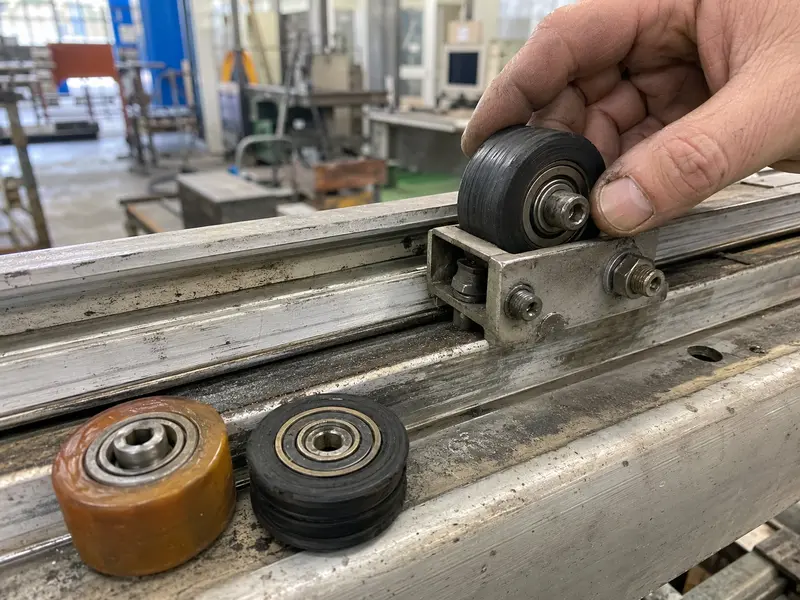
When Should Heavy Duty Sliding Door Hardware Use Metal Rollers?
Metal rollers may suit systems that need high stiffness and can accept harder track contact.
Common metal options include:
- Carbon steel
- Bearing steel
- Stainless steel
- Brass or copper alloy
- Cast iron in some larger systems
A metal roller does not automatically create a safer door system. It may increase noise, track wear and product weight. Carbon steel can also corrode if the finish and environment do not match.
Stainless steel can support wet, coastal or outdoor applications. The buyer must still define the grade. The bearing, shaft, fasteners and bracket also need suitable corrosion protection.
Brass wheels may suit selected architectural hardware where appearance and corrosion behaviour matter. Buyers should check load, wear and track contact before approving the material.
| Metal roller option | Possible reason to use it | Main points to check |
|---|---|---|
| Carbon steel | High stiffness and cost control | Corrosion, finish, noise and lubrication |
| Bearing steel | Wear and rolling-contact requirements in suitable structures | Corrosion, heat treatment and track contact |
| Stainless steel | Wet or corrosive environment | Grade, bearing material, shaft and cost |
| Brass or copper alloy | Appearance or project-specific corrosion needs | Load, wear, noise and price |
| Cast iron | Large wheel body in suitable industrial systems | Weight, corrosion, track and bore design |
Metal can be the correct choice. It can also add cost without solving the real problem.
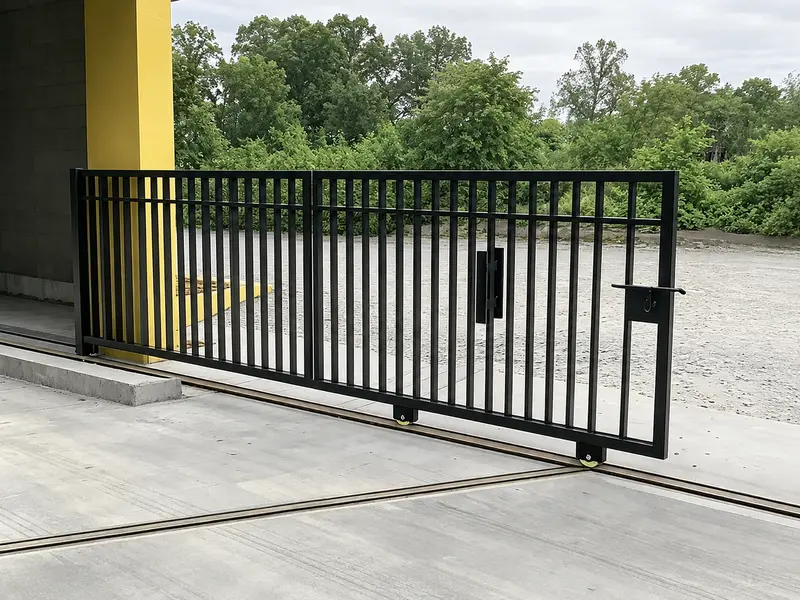
How Does the Bearing Pulley Structure Affect Material Selection?
The bearing pulley structure can affect smoothness, load support and repeatability as much as the outer wheel material.
A buyer may choose an expensive outer material and then use an unsuitable bearing. This creates an unbalanced specification.
The bearing review should include:
| Bearing point | Required information |
|---|---|
| Bearing type | Ball bearing, bush or plain bore |
| Bearing quantity | One bearing or two bearings |
| Dimensions | Bore, outside diameter and width |
| Closure | Open, shielded or sealed |
| Shaft fit | Shaft diameter, tolerance and retention |
| Lubrication | Standard grease or project requirement |
| Environment | Water, dust, salt and cleaning chemicals |
| Supplier control | Approved bearing source or agreed performance level |
A sealed bearing does not protect the full roller assembly. Water can still affect the shaft, bracket or fasteners.
Does a Double-Bearing Roller Always Carry More Load?
No.
Two bearings can increase support width in a suitable wheel structure. The final result still depends on:
- Bearing spacing
- Wheel body thickness
- Shaft strength
- Bracket support
- Track contact
- Installation
- Door load distribution
The buyer should test the complete assembly rather than multiply a bearing catalogue rating by two.
How Does the Operating Environment Change the Roller Material?
The operating environment can change the correct material combination even when the door weight stays the same.
A heavy indoor wardrobe door and a heavy coastal sliding door may use different wheel, bearing and bracket combinations.
| Environment | Possible material direction | Other parts to confirm |
|---|---|---|
| Dry indoor use | POM, nylon, POK or another approved plastic | Bearing, noise, track and cycle target |
| Quiet residential or hotel use | POM, PU or rubber-coated roller | Hardness, deformation and track condition |
| Shower door or humid area | Plastic running surface with sealed bearing and corrosion-resistant shaft | Bracket, fasteners and cleaning chemicals |
| Outdoor sliding door | UV and weather-suitable material | Water protection, temperature and track debris |
| Coastal area | Stainless components may be required | Exact stainless grade, seals and salt exposure |
| Cold climate | Grade with suitable low-temperature behaviour | Impact, track ice, lubricant and sample test |
| High-temperature area | Heat-suitable engineering material | Bearing grease, bracket and actual temperature |
| Industrial dusty area | Wear-suitable wheel and sealed bearing | Debris, maintenance and track cleaning |
Plastic can age after long UV exposure. Some grades can also become less suitable under low temperatures. Buyers should state the actual environment instead of writing only “outdoor use”.
What Do Real Sliding Roller Enquiries Teach Buyers?
Real enquiries show that the buyer’s first material request often changes after we review the door, track and assembly.
What Did an 80 kg Cold-Climate Sliding Sash Enquiry Show?
We reviewed an enquiry for a heavy sliding sash used in a cold northern climate. The buyer supplied an approximate sash weight of 80 kg.
The weight was useful, but it did not confirm the roller material.
I still needed to understand:
- How many rollers carried the sash
- How the housing supported each wheel
- Which bearing fitted the wheel
- Whether the system faced low temperatures
- Which track contacted the wheel
- How the buyer planned to test the sample
The main risk was not a simple choice between POM and nylon. The main risk was approving a material without checking low-temperature conditions and the complete load path.
We did not use a universal statement such as:
This plastic always carries an 80 kg sash.
The buyer’s team needed to test the complete roller and housing inside the actual system.
What Did a White Nylon Upper Roller Enquiry Show?
A customer asked us to assess a white nylon double-wheel upper roller for an aluminium sliding door system.
The word “heavy duty” described the complete door. It did not mean that every roller carried the door weight.
The upper roller mainly guided and stabilised the door. The lower rollers carried most of the vertical load. This difference changed the selection discussion.
We reviewed:
- The function of the upper roller
- Wheel diameter
- Housing dimensions
- Track clearance
- Nylon grade
- Shaft position
- Required colour
- Sample and annual quantities
This case shows why a buyer must identify whether a wheel carries load or controls direction.
What Did a Near-Match Existing Mould Enquiry Show?
Another customer required a U-groove roller with dimensions close to an existing product.
The required size was 5 × 30 × 10 mm. Our existing structure was close to 5 × 30 × 9 mm. The customer accepted the width difference after reviewing the assembly. We then used secondary machining to adjust the groove width.
The useful decision was not “choose the strongest material”.
The useful decision was:
- Confirm whether the existing wheel could fit.
- Check whether machining could produce the groove.
- Approve the sample on the customer’s track.
- Avoid new tooling if the existing structure met the requirement.
Material, dimensions and track profile had to work together.
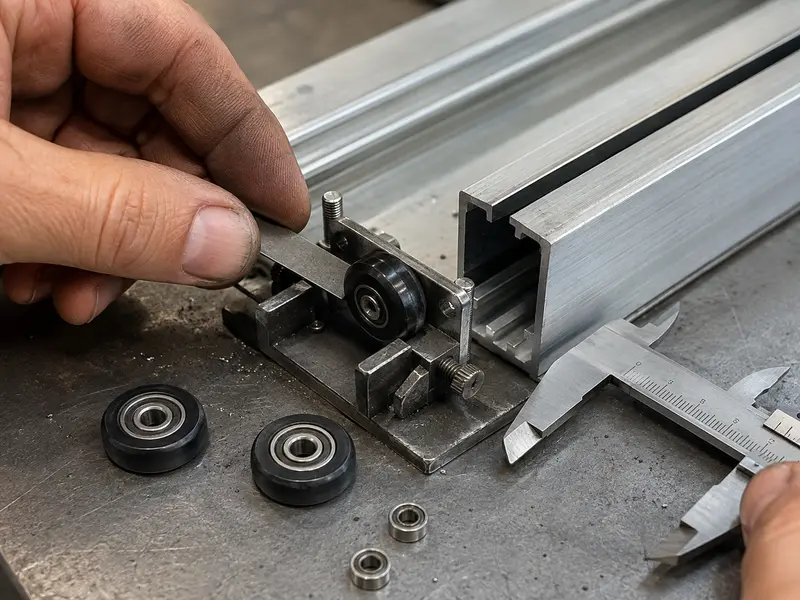
What Mistakes Increase Heavy Duty Roller Purchasing Risk?
The most common purchasing mistakes separate the material from the finished sliding system.
| Buyer mistake | Possible result | Better action |
|---|---|---|
| Choosing the hardest material | More noise or track wear | Define load, sound and track targets |
| Comparing material by price only | Hidden grade and quality differences | Compare an approved specification |
| Providing only wheel diameter | Wrong groove, bearing or housing | Send a cross-section drawing |
| Providing only door weight | Incorrect load assumption | Confirm wheel quantity and position |
| Ignoring moisture and temperature | Deformation, corrosion or material change | State the full environment |
| Assuming two bearings double capacity | Oversized performance claim | Test the finished assembly |
| Using a sealed bearing with a carbon steel shaft in a wet area | Shaft or bracket corrosion | Review every exposed metal part |
| Changing plastic grade after sample approval | Different colour, weight or performance | Use written change control |
| Approving a loose wheel only | Failure after installation | Test wheel, shaft, bracket and track together |
| Selecting the highest-priced material | Unnecessary product cost | Link cost to a clear requirement |
A low unit price can also hide:
- Recycled material changes
- Uncontrolled bearing sources
- Thin coating
- Poor concentricity
- Loose shaft tolerances
- Weak bracket material
- Limited inspection
- Poor packaging protection
Company buyers should compare controlled samples and signed specifications.
What Should Buyers Test Before Bulk Production?
Buyers should test the complete sliding roller assembly under defined application conditions.
Our factory can inspect production-related items. The buyer should approve the application result.
| Test area | Factory-side check | Buyer-side application check |
|---|---|---|
| Material | Approved grade and colour | Suitability for the real environment |
| Dimensions | Diameter, width, groove and bore | Fit with the door and track |
| Bearing | Position, rotation and visible closure | Movement under the specified load |
| Shaft | Diameter, tolerance and retention | Assembly security |
| Bracket | Dimensions and wheel position | Alignment inside the door system |
| Concentricity | Wheel runout | Vibration and sliding feel |
| Track contact | Profile comparison | Full-travel movement |
| Noise | Basic rotation or fixture test | Acceptable sound in the final product |
| Load | Agreed component test if specified | Complete door-system load test |
| Endurance | Agreed production test if specified | Required cycle and environment test |
| Supply | Match with drawing and sample | Repeat-order approval |
The buyer should define:
- Test load
- Door travel
- Movement speed
- Cycle count
- Temperature
- Water or dust exposure
- Noise limit
- Acceptable deformation
- Inspection method
- Pass and fail criteria
Without these conditions, “heavy duty” has no measurable purchasing meaning.
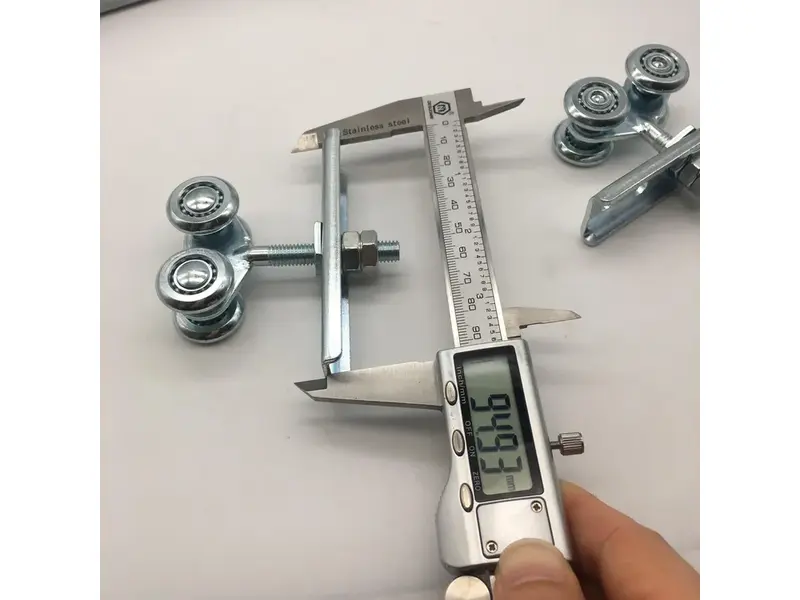
How Should Buyers Assess a Sliding Door Hardware Factory?
Buyers should assess whether the factory can control the complete roller assembly and repeat the approved product.
A material certificate alone cannot confirm wheel quality. Production control also affects the result.
I suggest that buyers ask the following questions:
| Factory area | Question to ask |
|---|---|
| Material control | Does the factory record the approved plastic or rubber grade? |
| Bearing assembly | How does the factory check bearing fit and rotation? |
| Injection moulding | How does the factory control centring, shrinkage and coverage? |
| Rubber or PU coating | How does the factory control hardness, thickness and bonding? |
| Machining | Can the factory machine the approved groove and shaft tolerance? |
| Metal stamping | Can the factory keep the bracket position consistent? |
| Existing moulds | Can an available mould reduce tooling cost? |
| OEM support | Can the factory review drawings and physical samples? |
| Inspection | Which dimensions and functions appear on the report? |
| Change control | Must the buyer approve a material or process change? |
| Packaging | How are wheels and machined grooves protected? |
| Repeat supply | Can the factory keep the approved structure across orders? |
Our production covers plastic coating, rubber coating, bearing assembly, injection moulding, shaft processing and metal stamping. This allows us to review the wheel, bearing, shaft and bracket together.
We also keep existing moulds for different plastic-coated bearings and sliding rollers. An existing mould can reduce tooling cost if the dimensions and application match.
You can review our sliding rollers with bearing and OEM and ODM process before sending a new drawing.
What Information Should an OEM Enquiry Include?
A clear OEM enquiry should define the door, roller, bearing, track, environment and purchasing plan.
| Information group | Details to provide |
|---|---|
| Application | Sliding door, window, shower door, wardrobe or industrial door |
| Door | Panel weight, width, height and frame material |
| Wheel arrangement | Number and position of load-bearing and guide rollers |
| Wheel | Diameter, width, groove, material and colour |
| Bearing pulley | Bearing model, quantity, seal and bore |
| Shaft | Diameter, material, tolerance and retention |
| Bracket | Drawing, thickness, material and finish |
| Track | Profile, width, material and surface |
| Environment | Indoor, outdoor, water, dust, salt, UV and temperature |
| Movement | Travel, speed and daily frequency |
| Performance | Load, noise, smoothness and service target |
| Testing | Method, cycle count and acceptance criteria |
| Quantity | Samples, first order and annual demand |
| Tooling | Existing mould, machining or new mould |
| Packaging | Neutral packing, private label and carton marks |
| Supply control | Inspection report, batch marking and change approval |
Send a drawing if one is available.
If you do not have a complete drawing, send:
- Photos from several angles
- A physical roller sample
- A track sample
- Manual dimensions
- A bracket or shaft sample
- Installation photos
- A short operating video
- A description of the current problem
These details help a sliding door hardware factory assess the real project instead of guessing from a product photo.
What Is the Final Roller Material Checklist?
A B2B buyer should approve the roller material as one part of a complete and repeatable supply specification.
Use this order:
- Confirm the weight of one moving door panel.
- Confirm which rollers carry the load.
- Record the number and position of the rollers.
- Measure the wheel diameter, width and groove.
- Provide the track cross-section.
- Confirm the bearing size and quantity.
- Check the shaft, bracket and housing.
- Record movement frequency and travel.
- Define indoor or outdoor conditions.
- Record water, dust, salt, UV and temperature exposure.
- Define noise and sliding-feel targets.
- Compare POM, nylon, POK, PPSU, PU, rubber and metal options.
- Select the complete material combination.
- Compare existing moulds, machining and new tooling.
- Produce a controlled sample.
- Test the sample in the complete door system.
- Sign the drawing and material specification.
- Confirm inspection, packaging and change control.
- Approve bulk production only after the sample passes.
Do not ask only:
Which material is strongest?
Ask:
Which material, bearing and roller structure can meet our approved test and remain consistent in repeat production?
That question creates a better purchasing decision.
Do You Need a Bearing Pulley or Sliding Roller for a Heavy Door Project?
Send us your door information, roller drawing, physical sample, track profile and expected order quantity. We will first check the application and available production routes.
We can review:
- POM, nylon, POK and PPSU wheels
- PU and rubber-coated rollers
- Metal wheels
- Single-bearing rollers
- Double-bearing rollers
- Custom shafts
- Stamped brackets
- Existing moulds
- Secondary machining
- New mould development
- Complete OEM sliding roller assemblies
Our production review covers manufacturing feasibility, dimensions, material control and repeat production. Your qualified door-system team should approve the final structure and application performance.
View Sliding Rollers with Bearing