A bearing pulley may appear to be a simple wheel. In a fitness machine, however, it works as part of a complete cable transmission system.
The pulley guides the cable, changes its direction and helps transfer the user’s force to the weight stack or resistance mechanism. Its groove must retain the cable without pinching it. Its wheel material must resist repeated contact without damaging the cable coating. Its bearing must rotate smoothly after assembly. The bracket and axle must also keep the wheel aligned.
A standard door or furniture roller should not automatically be used in this application. Fitness equipment creates different movement patterns, safety considerations and wear risks.
At HUNE, Zhejiang Huaneng Micro Bearing Co., Ltd., we manufacture plastic-coated bearings, bearing wheels, injection-moulded pulleys and customised roller assemblies. When an equipment manufacturer asks us to develop a bearing pulley, we need more than the outside diameter.
We need to understand the cable, load path, pulley position, operating frequency and complete installation.
This guide explains what fitness equipment manufacturers and OEM procurement teams should confirm before approving a pulley for a cable-operated machine.
Where Are Bearing Pulleys Used in Fitness Equipment?
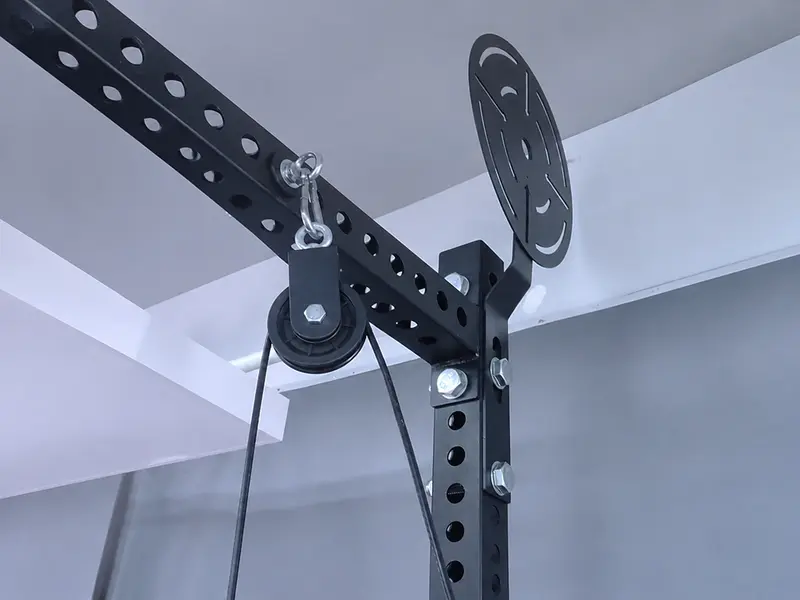
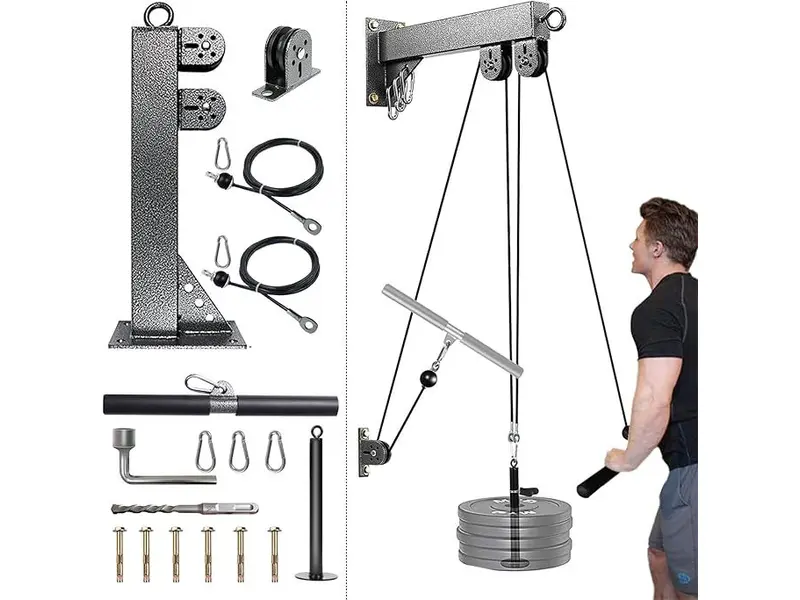
Cable-operated fitness machines often use several pulleys within one assembly. Each position may have a different function.
Typical applications include:
- Lat pulldown machines
- Seated rowing machines
- Functional trainers
- Cable crossover machines
- Compact home training machines
- Weight-stack equipment
- Cable-based rehabilitation equipment
- Cable tensioning mechanisms
A fixed pulley normally changes the cable direction. A moving pulley can form part of the resistance ratio. A guide pulley controls the cable route. A tensioning pulley helps maintain cable position as the mechanism moves.
These positions do not always require the same wheel.
For example, a pulley near the user handle may experience a large change in cable direction. A pulley inside a weight stack may run through a more controlled path. A tensioning wheel may carry a lower operating load but experience continuous contact.
The equipment designer should therefore identify every pulley position separately.
| Pulley position | Main function | Important purchasing concern |
|---|---|---|
| Direction-changing pulley | Redirects the cable | Groove geometry and side alignment |
| Weight-stack pulley | Transfers movement to the resistance system | Load path, bearing and axle strength |
| Moving pulley | Moves with the cable assembly | Weight, retention and bracket stability |
| Guide pulley | Maintains the intended cable route | Flange height and lateral clearance |
| Tensioning pulley | Controls cable position or slack | Surface wear and consistent rotation |
A manufacturer should not approve one pulley for every position only because all positions use the same cable diameter.
Why Is a Standard Roller Specification Insufficient?
Many enquiries begin with a short description such as:
We need a nylon pulley with a bearing, 90 mm outside diameter.
This information may be enough for an initial product search. It is not enough for production approval.
The outside diameter does not define:
- Cable diameter
- Cable coating
- Groove radius
- Groove depth
- Flange height
- Bearing size
- Bearing seal
- Axle fit
- Bracket clearance
- Cable entry angle
- Working load
- Shock load
- Operating frequency
- Indoor environmental conditions
- Required testing standard
Two pulleys with the same outside diameter can interact with a cable in very different ways.
A shallow groove may allow the cable to leave the wheel when the cable approaches at an angle. A narrow groove may pinch or abrade a coated cable. A very deep groove may retain the cable but create contact near the flange when alignment is poor.
The internal bearing also does not define the capacity of the finished assembly. The plastic wheel, bearing fit, axle, bracket and mounting structure can each become the limiting component.
For this reason, we treat a fitness equipment pulley as an assembly rather than a catalogue bearing surrounded by plastic.
What Information Should a Buyer Provide?
A useful request for quotation should describe the complete operating relationship.
1. Equipment Type
Tell the supplier whether the pulley will be used in a commercial strength machine, home trainer, rehabilitation device or another system.
The equipment classification can affect usage frequency, user access and the applicable safety requirements.
The current ISO 20957-1:2024 standard specifies general safety requirements and test methods for indoor stationary training equipment. Equipment manufacturers should identify the standards and market requirements that apply to their complete product.
A component supplier should not claim that a pulley makes the complete machine compliant. Final compliance depends on the equipment design, installation and validation.
2. Pulley Position
Provide an assembly drawing or mark the pulley position in the cable routing diagram.
We need to know whether the wheel:
- Remains fixed
- Moves with the cable
- Changes the direction significantly
- Works as a guide
- Maintains tension
- Runs close to another component
The same machine may require several pulley structures.
3. Cable Specification
Provide the actual cable information, including:
- Steel cable outside diameter
- Diameter including the plastic coating
- Cable construction, if relevant
- Coating material
- Minimum permitted bend radius from the cable supplier
- Surface hardness or special finish
- Cable supplier’s groove recommendations
- Connector dimensions that may pass near the pulley
The groove should be designed around the actual finished cable, not only the steel core.
4. Load Information
The buyer should provide:
- Maximum cable tension
- Normal operating tension
- Resistance-stack configuration
- Mechanical ratio
- Number of supporting pulleys
- Direction of force
- Possible shock or sudden release
- Required safety factor
- Target service life or cycle requirement
The selected weight on the machine is not automatically equal to the load on each pulley.
Cable routing and mechanical advantage change the forces within the system. Dynamic movement, sudden release and poor alignment can also increase local loading.
The equipment engineer should calculate the load at each pulley position.
5. Installation Structure
Useful dimensions include:
- Axle diameter
- Axle material
- Distance between bracket plates
- Bracket thickness
- Bearing position
- Permitted axial movement
- Bolt or shaft retention method
- Available installation space
- Required wheel width
- Cable entry and exit angles
A section drawing is often more useful than a front-view photograph.
6. Operating Conditions
Confirm:
- Indoor or outdoor use
- Commercial or domestic use
- Expected daily frequency
- Dust and perspiration exposure
- Cleaning chemicals
- Temperature range
- Required noise level
- Permitted maintenance
- Storage and transport conditions
These conditions affect the bearing seal, metal material and outer-wheel compound.
How Should a Bearing Pulley Groove Match the Cable?
The groove controls how the wheel contacts and guides the cable.
It should support the cable across an appropriate contact area. It should not squeeze the coating. It should also provide enough retention for the expected cable angle.
Groove Width
A groove that is too narrow can pinch the cable and concentrate pressure on its coating.
A groove that is too wide may provide poor lateral control. The cable can move from side to side, especially when the bracket and cable route are not aligned.
The buyer should define the finished cable diameter and its acceptable tolerance. We should not select the groove from a nominal cable description alone.
Groove Depth
A deeper groove provides more lateral retention, but depth alone does not solve alignment problems.
If the cable enters the pulley at an excessive side angle, it may contact the flange continuously. That contact can create:
- Friction
- Noise
- Cable-coating wear
- Wheel-flange wear
- Additional bearing load
- Unstable cable movement
The pulley should guide the cable. It should not compensate for an incorrectly positioned bracket.
Groove Radius
The base of the groove should support the cable without creating a sharp contact line.
The correct relationship depends on the cable construction, coating and supplier recommendations. The equipment manufacturer should provide the minimum bend requirement and any specified groove profile.
A larger pulley diameter generally reduces cable bending compared with a smaller pulley, but diameter cannot be selected independently. Available space, movement ratio, inertia, bracket design and complete-machine requirements also matter.
Flange Profile
The flange should help retain the cable during normal operation. It should not become the primary running surface.
We recommend checking the contact marks after sample testing. Continuous marking on one flange usually indicates an alignment, clearance or cable-entry problem.
| Groove condition | Possible result | Point to review |
|---|---|---|
| Groove too narrow | Cable coating is pinched or marked | Finished cable diameter and tolerance |
| Groove too wide | Lateral movement and noise | Groove width and bracket alignment |
| Groove too shallow | Cable may leave the intended path | Entry angle and retention requirement |
| Groove too deep | Cable may rub against the flange | Alignment and groove transition |
| Sharp groove transition | Local coating damage | Radius and mould finish |
| Incorrect pulley diameter | Excessive cable bending | Cable supplier’s minimum bend requirement |
Which Wheel Material Should Be Considered?
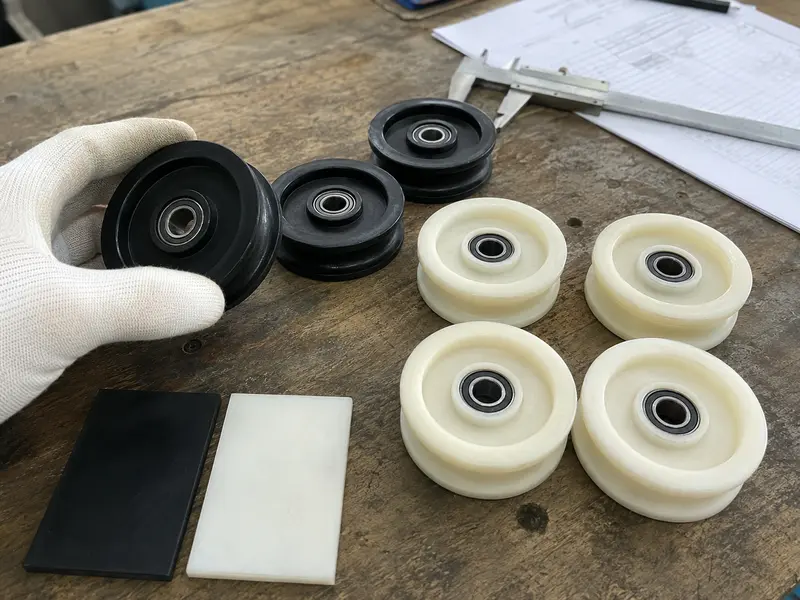
Fitness equipment pulleys often use injection-moulded engineering plastics because they can provide controlled geometry, lower operating noise and a cable-friendly contact surface.
However, “nylon pulley” is not a complete material specification.
The supplier should know the exact resin grade, additives, colour requirements and whether recycled material is permitted.
POM
POM can provide:
- Good dimensional stability
- Low friction
- Consistent moulded surfaces
- Good wear behaviour in suitable applications
- Lower moisture absorption than some nylon grades
It can be considered when stable groove dimensions and smooth movement are important.
The final choice still depends on load, wall thickness, impact, cable contact and environmental requirements.
PA or Nylon
Nylon materials can provide useful toughness and wear resistance. Their properties vary by grade, moisture condition and reinforcement.
A buyer should not approve “PA” or “nylon” without identifying the grade.
Moisture absorption may change dimensions and mechanical behaviour. Glass-fibre reinforcement can increase stiffness, but exposed fibres or an unsuitable surface condition may not be desirable where the wheel contacts a coated cable.
POK
POK can be considered for applications that require wear resistance, impact performance and stable repeated movement.
It is not automatically the correct choice for every gym pulley. The supplier still needs to evaluate moulding structure, cable contact and commercial availability.
Rubber or Elastomeric Contact Layers
A rubber-coated wheel can reduce contact noise and protect a mating surface in some applications. However, it may create more rolling resistance, heat or deformation.
Rubber compounds also vary in hardness, wear resistance and bonding performance.
A rubber bearing roller should not replace a rigid grooved pulley without functional testing.
Material Comparison
| Material option | Potential benefit | Purchasing concern |
|---|---|---|
| POM | Stable dimensions and low-friction surface | Grade, impact requirement and wall design |
| PA/nylon | Toughness and wear resistance | Moisture absorption and exact grade |
| Reinforced plastic | Higher stiffness in some designs | Cable-contact surface and moulding direction |
| POK | Wear and impact potential | Grade availability and validation |
| Rubber-coated wheel | Noise reduction and surface protection | Deformation, heat and bond durability |
| Metal wheel | High structural rigidity | Noise, corrosion and possible cable damage |
The equipment manufacturer should approve the material after testing it with the real cable.
A harder material is not always a better pulley material. Excessive surface hardness or an unsuitable groove finish may transfer wear to the cable.
How Should the Bearing Be Selected?
The bearing must support repeated rotation while installed inside the moulded wheel.
The approval specification should include:
- Bearing series
- Bore, outside diameter and width
- Ring and ball material
- Open, shielded or sealed structure
- Lubrication requirement
- Internal clearance, when relevant
- Permitted radial and axial play
- Bearing quantity per pulley
- Fit between the bearing and plastic wheel
- Fit between the bearing and axle
Sealed Bearings
A sealed bearing can help reduce the entry of dust and contamination. It may be suitable for equipment used in gyms, workshops or other indoor environments.
The seal also affects rotational resistance. The equipment manufacturer should evaluate the assembled pulley rather than judging the loose bearing by hand.
Carbon Steel, Bearing Steel and Stainless Steel
We commonly discuss three bearing-material directions with customers:
- High-carbon steel bearings for cost-controlled general applications
- Bearing-steel bearings where stronger bearing performance is required
- Stainless steel bearings where corrosion resistance is more important
The final selection depends on load, environment, service expectations and cost.
The materials can look similar from the outside. Therefore, the purchase specification and inspection documents should identify the bearing material clearly.
One Bearing or Two Bearings?
A wider pulley may use two bearings to improve support and control the wheel position. However, two bearings do not automatically double the permitted assembly load.
The axle, bearing spacing, plastic structure and bracket alignment determine whether the additional bearing provides a practical benefit.
Poor alignment between two bearings can also increase resistance.
Bearing Rating Is Not Pulley Rating
ISO 281:2007 describes methods for calculating dynamic load ratings and rating life for rolling bearings. It also states that the calculation does not cover every failure mechanism, including wear and corrosion.
The bearing calculation does not establish the capacity of the finished plastic pulley assembly.
The completed component may instead be limited by:
- Plastic creep
- Hub cracking
- Bearing movement inside the wheel
- Axle bending
- Bracket deformation
- Flange wear
- Cable misalignment
- Contamination
- Shock loading
The buyer should therefore request a rating and test method for the complete assembly, not copy the internal bearing’s catalogue value into the pulley specification.
Why Do Axle and Bracket Alignment Matter?
The bearing can only rotate correctly when the supporting structure keeps it aligned.
If the bracket plates are not parallel, tightening the axle may compress or tilt the assembly. If the gap between the bracket and wheel is too large, the pulley may move sideways. If the axle is undersized, the bearing may move on the shaft rather than rotate internally.
Common installation risks include:
- Bent bracket plates
- Incorrect spacer width
- Excessive bolt torque
- Missing spacer sleeves
- Axle diameter outside tolerance
- Wheel rubbing against the bracket
- Cable approaching from the side
- Misaligned inlet and outlet pulleys
A sample test should use the intended axle, spacers and bracket.
Testing only the loose wheel cannot identify these assembly problems.
What Commonly Causes Cable and Pulley Wear?
Wear does not always mean that the plastic compound is unsuitable.
The inspection should identify where the damage starts.
Cable Wear Near One Flange
This often indicates side loading or an incorrect cable-entry angle.
Possible causes include:
- Pulley bracket installed off-centre
- Adjacent pulley in the wrong position
- Excessive lateral clearance
- Frame deformation
- Cable connector pulling from one side
Changing to a harder wheel may not solve this problem.
Groove Polishing at the Bottom
Some polishing can show the normal contact path. Uneven or highly localised polishing may indicate poor groove contact.
The engineering team should compare the wear pattern on all pulleys in the same machine.
Bearing Noise
Bearing noise can result from:
- Contamination
- Excessive press fit
- Axle misalignment
- Side loading
- Incorrect lubrication
- Damaged bearing seals
- Wheel-to-bracket contact
The buyer should locate the noise source before replacing the bearing specification.
Hub Cracking
Cracks near the bearing seat may relate to:
- Excessive interference
- Insufficient plastic wall thickness
- Sharp internal transitions
- Moulding stress
- Impact during bearing installation
- Unexpected shock load
Increasing the outside diameter without reviewing the hub structure may not correct the root cause.
Cable-Coating Damage
Possible causes include:
- Rough groove surface
- Mould flash
- Sharp groove edges
- Groove too narrow
- Excessive side contact
- Incorrect wheel material
- Contamination trapped in the groove
- Pulley diameter below the cable requirement
| Observed problem | Likely areas to inspect first |
|---|---|
| Cable rubs one flange | Bracket and cable alignment |
| Wheel turns heavily | Bearing fit, axle torque and side contact |
| Pulley becomes noisy | Bearing, bracket, groove contamination and cable route |
| Hub develops cracks | Interference fit, wall thickness and moulding stress |
| Cable coating is cut | Groove surface, width and edge transition |
| Bearing moves in the hub | Bearing-seat tolerance and retention method |
| Wheel moves sideways | Spacer, bracket gap and axle location |
A Real Material-Selection Case From Another Equipment Industry
The following case involved food equipment, not fitness equipment. We include it because it demonstrates why the supplier must know the actual application before confirming a pulley material.
A UK equipment customer asked us to manufacture a plastic-coated bearing component for food-related machinery. The customer required an FDA-grade POM outer material.
The general shape could have been manufactured from a standard industrial POM grade. However, visual similarity was not enough. The application introduced a specific material requirement.
We treated the requested FDA-grade POM as part of the product specification and quotation rather than replacing it with our default material.
Information Provided by the Customer
The customer confirmed:
- The component was intended for food equipment
- The outer material needed to be POM
- A suitable food-contact material grade was required
- The bearing and outer wheel formed one finished component
Our Engineering and Purchasing Judgement
The application changed the procurement requirement.
The customer was not buying only a wheel with the correct dimensions. The customer needed a controlled combination of geometry, material and bearing assembly.
We therefore could not approve the product based on colour or appearance. The agreed material grade had to remain connected to the sample and future production specification.
Relevance to Fitness Equipment Buyers
A gym pulley does not normally require the same food-contact material.
The purchasing principle is still relevant:
The supplier cannot select the correct compound if the application requirement remains hidden.
For fitness equipment, the relevant requirement may involve:
- Cable-coating compatibility
- Wear resistance
- Indoor chemical exposure
- Noise
- Commercial-use frequency
- Colour consistency
- Material traceability
- Restrictions on recycled material
The buyer should place these requirements on the drawing, purchase specification or approved sample record.
A broad label such as “nylon” does not provide enough control for repeat orders.
How Should Bearing Pulley Samples Be Tested?
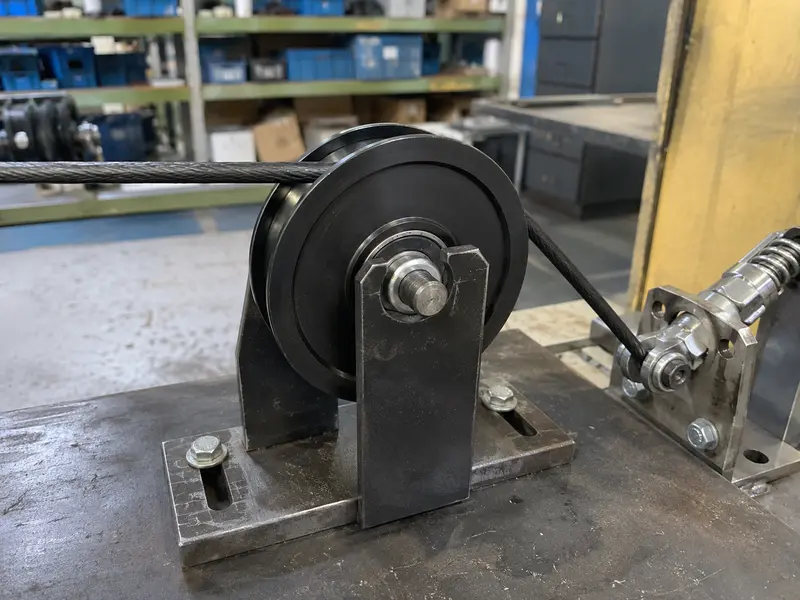
A pulley sample should be tested in the intended assembly.
A short hand-rotation check is useful, but it cannot represent the actual cable route or load.
1. Dimensional Inspection
Check:
- Outside diameter
- Overall width
- Groove width
- Groove depth
- Groove radius
- Bearing position
- Bearing bore
- Hub width
- Flange thickness
- Axial clearance in the bracket
The drawing should identify which dimensions are critical to function.
2. Cable Fit Inspection
Place the real production cable in the groove.
Confirm:
- The cable sits in the intended contact area
- The coating is not pinched
- The cable does not rest on a sharp edge
- The flange provides sufficient retention
- The connector does not interfere with the wheel or bracket
3. Assembly Rotation
Install the sample with the production axle, spacer and bracket.
Check the wheel before and after the axle is tightened. A change in rotational resistance can reveal spacer or bracket problems.
4. Alignment Test
Run the cable through the complete pulley path.
Observe:
- Entry angle
- Exit angle
- Lateral movement
- Flange contact
- Bracket movement
- Cable twisting
- Noise at each pulley position
5. Representative Load Test
The equipment manufacturer should define a test that reflects the calculated load and the applicable product standard.
The test should include the actual:
- Cable
- Bracket
- Axle
- Spacer
- Mounting structure
- Resistance mechanism
- Movement range
A component supplier can support sample development, but the machine manufacturer remains responsible for validating the complete equipment.
6. Repeated-Movement Test
Repeated movement can reveal problems that a static test misses.
After testing, inspect:
- Groove surface
- Cable coating
- Bearing rotation
- Hub condition
- Axle fit
- Bracket contact
- Material deformation
- Noise changes
Do not describe a pulley as suitable for commercial fitness equipment only because it completed a few manual movements.
7. Retained Sample and Revision Control
Both parties should retain an approved sample.
The approval record should identify:
- Drawing number and revision
- Resin grade
- Bearing specification
- Axle and bracket used for testing
- Cable specification
- Approved dimensions
- Permitted appearance limits
- Test conditions
- Approved deviations
The purchase order should refer to the same revision.
When Is a Custom Mould Necessary?
An existing pulley may be suitable when its groove, bearing, width and installation dimensions already match the application.
Secondary machining may sometimes adjust an accessible feature. However, machining is not suitable when it creates an insufficient wall thickness or an unstable groove surface.
A custom mould should be considered when:
- The cable requires a proprietary groove profile
- The existing outside diameter does not meet the bend requirement
- The bearing size changes the internal hub
- The wheel needs two bearings
- The bracket requires a different overall width
- The flange height must change
- Existing products cannot control lateral movement
- The selected material has different moulding shrinkage
- Annual demand makes repeated machining inefficient
- The buyer needs controlled proprietary geometry
| Development route | Suitable condition | Main limitation |
|---|---|---|
| Existing pulley | Groove, bearing and installation already match | Limited dimensional flexibility |
| Existing pulley with machining | A minor accessible feature needs adjustment | Added processing and wall-thickness limits |
| New injection mould | Geometry or material requires full control | Tooling cost and development time |
| Prototype before moulding | Installation geometry remains uncertain | Prototype behaviour may differ from moulded resin |
| Complete custom assembly | Wheel, axle and bracket must be developed together | More information and validation are required |
Before approving a mould, both parties should freeze the cable diameter, bearing, groove profile and bracket space.
Changing the bearing after the mould is completed can affect the hub wall, wheel width and installation height.
Buyers can review our OEM and ODM roller manufacturing process when comparing an existing product, secondary machining and new tooling.
What Should Be Included in an RFQ?
A complete RFQ helps the supplier provide a meaningful quotation and identify technical risks early.
Recommended RFQ Information
| Category | Required information |
|---|---|
| Equipment | Machine type and pulley position |
| Cable | Core type, finished diameter, coating and bend requirement |
| Load | Normal tension, maximum tension, shock condition and safety factor |
| Movement | Rotation angle, travel distance, speed and expected frequency |
| Wheel | Outside diameter, width, groove and flange dimensions |
| Material | Resin grade, colour, fillers and recycled-material restriction |
| Bearing | Size, seal, material, clearance and quantity |
| Axle | Diameter, material, tolerance and retention method |
| Bracket | Internal gap, plate thickness and alignment |
| Environment | Indoor use, dust, perspiration, cleaning and temperature |
| Compliance | Target market and applicable equipment standards |
| Testing | Required load, cycle, noise and wear assessment |
| Commercial | Prototype quantity, annual demand and target schedule |
Photographs are helpful, but they should not replace a dimensioned drawing.
If the project is based on an existing part, send both the original sample and the installation drawing when possible.
Questions to Ask a Bearing Pulley Supplier
Procurement teams can use the following questions during supplier evaluation:
- Can you manufacture the plastic wheel and assemble the bearing?
- Can you compare the original sample with the drawing?
- Can you identify the exact resin grade rather than using a generic material name?
- Can you control the bearing-seat tolerance after moulding?
- Can you supply different bearing materials and seal structures?
- Can you inspect groove width, depth and profile?
- Can you test the pulley with our actual cable, axle and bracket?
- Can you explain the expected moulding shrinkage?
- Can you identify risks caused by deep grooves or thick wall sections?
- Can you retain an approved production sample?
- How do you control material and drawing revisions?
- Which tests must be completed by the equipment manufacturer?
- Can you provide existing samples before we commit to a new mould?
- What information is still missing from the quotation?
A useful supplier should identify assumptions instead of hiding them.
Final Procurement Checklist
Use this checklist before releasing a bearing pulley for production.
| Approval item | Confirmation question | Status |
|---|---|---|
| Application | Is the equipment type confirmed? | ☐ |
| Position | Is the pulley’s function in the cable route identified? | ☐ |
| Cable | Is the finished cable diameter specified? | ☐ |
| Coating | Is the cable coating material known? | ☐ |
| Bend | Has the cable supplier’s bend requirement been reviewed? | ☐ |
| Load | Has the load at this pulley position been calculated? | ☐ |
| Shock | Have sudden movement and release conditions been considered? | ☐ |
| Groove | Are width, depth, radius and flange dimensions approved? | ☐ |
| Material | Is the exact wheel material grade recorded? | ☐ |
| Bearing | Are size, material and seal type confirmed? | ☐ |
| Axle | Are axle diameter and tolerance controlled? | ☐ |
| Bracket | Is the installed axial clearance defined? | ☐ |
| Alignment | Has the real cable path been checked? | ☐ |
| Noise | Is the acceptable noise condition defined? | ☐ |
| Wear | Have the cable and groove been inspected after testing? | ☐ |
| Compliance | Have applicable equipment standards been identified? | ☐ |
| Sample | Is an approved physical sample retained? | ☐ |
| Revision | Does the purchase order use the approved drawing revision? | ☐ |
| Production | Has the complete machine manufacturer approved release? | ☐ |
Conclusion
A bearing pulley for fitness equipment must be selected as part of the complete cable system.
The buyer should not begin with the outside diameter alone. The supplier needs the real cable diameter, groove requirement, load path, pulley position, axle, bracket and expected operating conditions.
The wheel material should protect the cable while maintaining the required geometry. The bearing should rotate correctly after moulding and assembly. The axle and bracket should keep the wheel aligned. The final machine manufacturer should then validate the complete cable route under representative conditions.
Our food-equipment case showed why the application must remain connected to the material specification. A visually similar standard POM grade could not automatically replace the customer’s requested FDA-grade material. Fitness equipment buyers face the same procurement principle, even though their functional requirements differ.
A clear application specification helps both parties avoid unsuitable materials, incorrect grooves and misleading load assumptions.
If you are sourcing a standard or customised gym equipment pulley, you can send us the cable specification, assembly drawing, pulley position, expected load, bearing requirement and order quantity. We can review whether an existing wheel is suitable or whether the project requires machining, a new mould or a complete custom assembly.