
Are you preparing a door hardware enquiry but unsure which parts belong in the quotation? Are two suppliers using different names for the same component? Could a roller, hinge or guide fit the door but fail to match its load, track or frame?
I see these questions in enquiries from door manufacturers, importers, distributors and OEM sourcing teams.
Many buyers start with visible products such as handles, locks and hinges. Those parts matter, but a complete door also depends on hidden load-bearing, guiding, limiting, sealing and buffering components.
For B2B purchasing, I use this answer:
> The main types of door hardware include operating hardware, load-bearing hardware, sliding and guiding hardware, locking hardware, door-control hardware, limiting hardware, sealing hardware, protective hardware, fixing hardware and decorative hardware. Buyers should match these categories with the door movement, material, weight, track and application.
The better purchasing question is:
> Which hardware combination matches our door movement, load, material, frame, track, environment and repeat-production requirements?
This guide explains how company buyers can classify different types of door hardware before requesting prices or samples. I write from a component manufacturing view, with direct experience in bearing pulleys, sliding rollers, plastic and rubber-coated wheels, injection-moulded parts and related hardware.
I do not replace the buyer’s door-system engineer, security specialist, certification body or installer.
What Does This Door Hardware Guide Cover?
This guide covers door hardware classification, application matching, material selection, enquiry data, sampling risks and supplier assessment for B2B purchasing.
What Does Door Hardware Include?
Door hardware includes every mechanical or decorative component that supports, moves, guides, locks, controls, seals, protects or finishes a door.
The exact list changes with the door system. A hinged entrance door may use hinges, a lever handle, a lock, a closer, a stop, seals and fixing plates. A sliding door may use roller carriages, bearing pulleys, a track, guides, stops, handles and a soft-close unit.
Industry architectural hardware ranges show this wide scope. Architectural hardware categories typically include door furniture, locks, panic bars, hinges, pivots and related accessories. Commercial door hardware systems also include closers, operators, locks, exit devices and access-control components.
These references support a basic sourcing point: “door hardware” is a system category, not one product family.
| Hardware group | Main job | Common examples |
|---|---|---|
| Operating | Allows a user to move the door | Handles, pulls, knobs and push plates |
| Load-bearing | Supports or transfers door weight | Hinges, pivots, hangers and roller carriages |
| Sliding and guiding | Controls the movement path | Sliding rollers, tracks, rails and guides |
| Locking | Holds the door or controls access | Locks, latches, cylinders, bolts and strikes |
| Door control | Controls speed and closing action | Closers, dampers and soft-close units |
| Limiting | Defines travel or end position | Stops, buffers, catches and anti-jump parts |
| Sealing | Controls gaps, water, air or dust | Gaskets, brush seals and thresholds |
| Protective | Reduces impact or surface damage | Kick plates, edge guards and finger guards |
| Fixing | Connects hardware to the door or frame | Brackets, screws, pins, clamps and plates |
| Decorative | Covers or finishes visible areas | Rosettes, caps, covers and trim pieces |
A complete purchasing list should identify each required function. This step helps the buyer find missing parts before sampling begins.
How Should B2B Buyers Classify Door Hardware?
B2B buyers should classify door hardware first by door movement, then by application and function. This order keeps parts from different systems from being compared as direct substitutes.
I normally start with the way the door moves. The movement tells me where the load sits and which components control it.
| Door movement or application | Main hardware combination | Key enquiry inputs |
|---|---|---|
| Hinged door | Hinges, handle, lock, closer and stop | Door weight, leaf size, frame and opening angle |
| Sliding door | Rollers, track, guides, stops and optional damper | Door weight, track profile, carriage and travel |
| Folding door | Hinges, carriers, pivots, guides and track | Panel quantity, weight and folding direction |
| Pivot door | Top and bottom pivots, closer, lock and stop | Door size, weight and pivot position |
| Shower door | Rollers, guides, glass fittings, handle and seals | Glass thickness, moisture and fixing method |
| Furniture door | Small rollers, guides, hinges, catches and soft-close parts | Panel size, weight and cabinet space |
| Industrial sliding system | Heavy rollers, bearings, rail, guides and end stops | Load, cycles, travel and environment |
| Automatic entrance | Operator, rollers, track, sensors and safety parts | Door configuration, controls and qualified approval |
After movement, I check the application. An interior wardrobe and a hotel room divider may both use sliding panels, but their load, use rate, noise target and hardware space can differ.
The third step is function. A buyer should identify which part carries the load, which part guides the door and which part limits movement. A product called a “door wheel” may carry weight in one system and only provide side guidance in another.
What Hardware Do Hinged Doors Use?
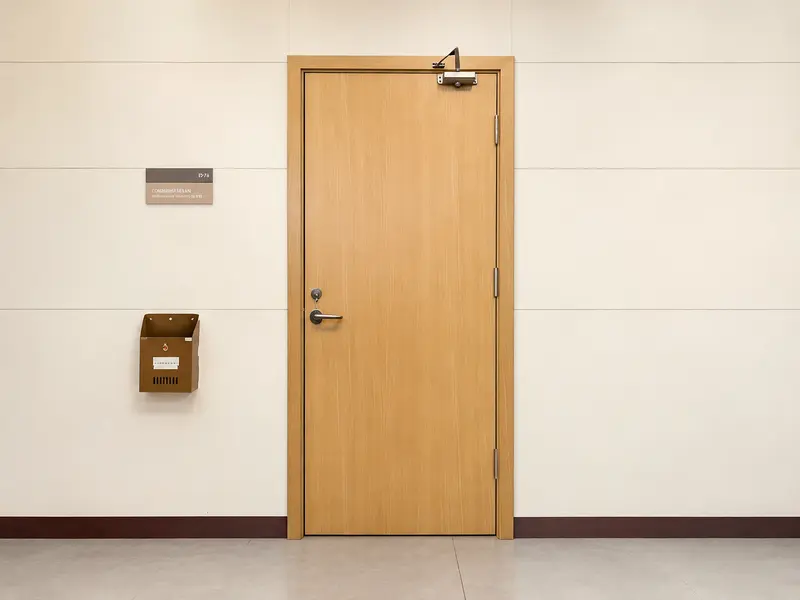
Hinged doors commonly use hinges or pivots, operating hardware, locks or latches, closers, stops, seals and fixing parts. The hardware must match the door leaf, frame, opening direction and required function.
The hinge carries and controls the rotating door leaf. The handle or pull operates the door. The lock or latch controls closure or access. The closer manages the return movement. The stop limits travel.
| Hinged door component | Buyer should specify | Common mismatch risk |
|---|---|---|
| Hinge | Door weight, size, material, quantity and fixing | Sagging, poor clearance or unsuitable screws |
| Pivot | Door size, pivot position and floor or frame structure | Wrong geometry or load transfer |
| Handle or pull | Hole centres, door thickness, finish and hand | Mounting mismatch or finish variation |
| Lock or latch | Backset, handing, cylinder and strike | Door and frame do not align |
| Door closer | Door width, weight, mounting and function | Poor closing action or excessive opening force |
| Door stop | Door travel, contact point and fixing | Door or wall damage |
| Seal or threshold | Gap, exposure and door material | Water, dust or air leakage |
dormakaba’s door closer range shows surface-applied and concealed closer options for different door and frame materials. This supports another B2B rule: a product category can contain several mounting structures, so the category name does not complete the specification.
The buyer’s qualified team should confirm fire, escape, accessibility or security requirements. A component supplier should not infer these requirements from a product photo.
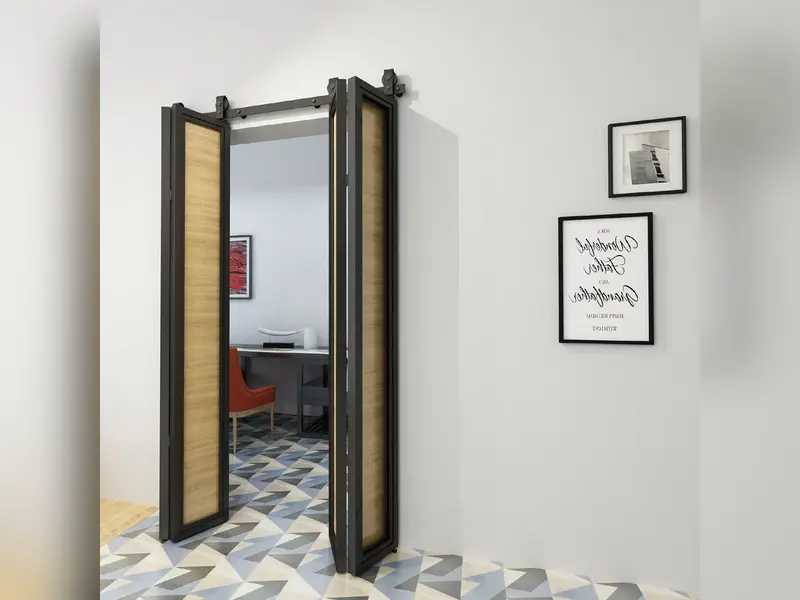
What Hardware Do Sliding Doors Use?
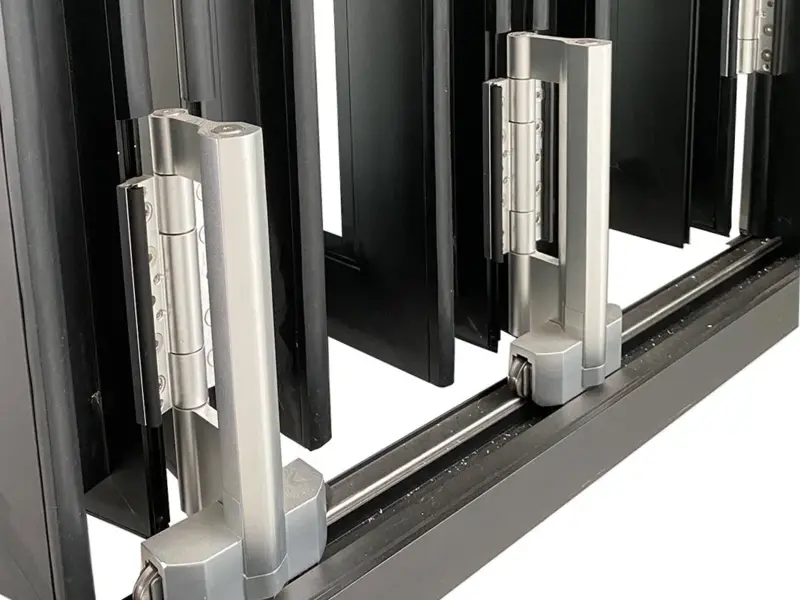
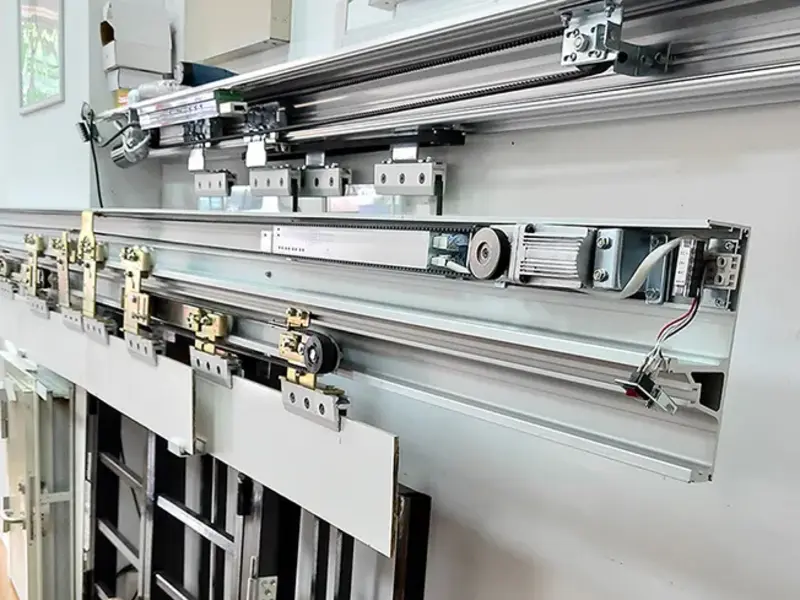
Sliding doors use rollers or hangers, bearings, tracks, guides, shafts, brackets, stops, operating parts and optional soft-close hardware. These components must work as one movement system.
The basic structure changes between top-hung and bottom-running doors.
In a top-hung system, the upper roller carriage usually carries the main load. A bottom guide controls lateral movement. In a bottom-running system, the lower wheels carry the door and the upper guides control direction.
| Sliding door part | Main job | Information to provide |
|---|---|---|
| Roller carriage | Carries the door and holds the wheels | Load, bracket drawing and adjustment range |
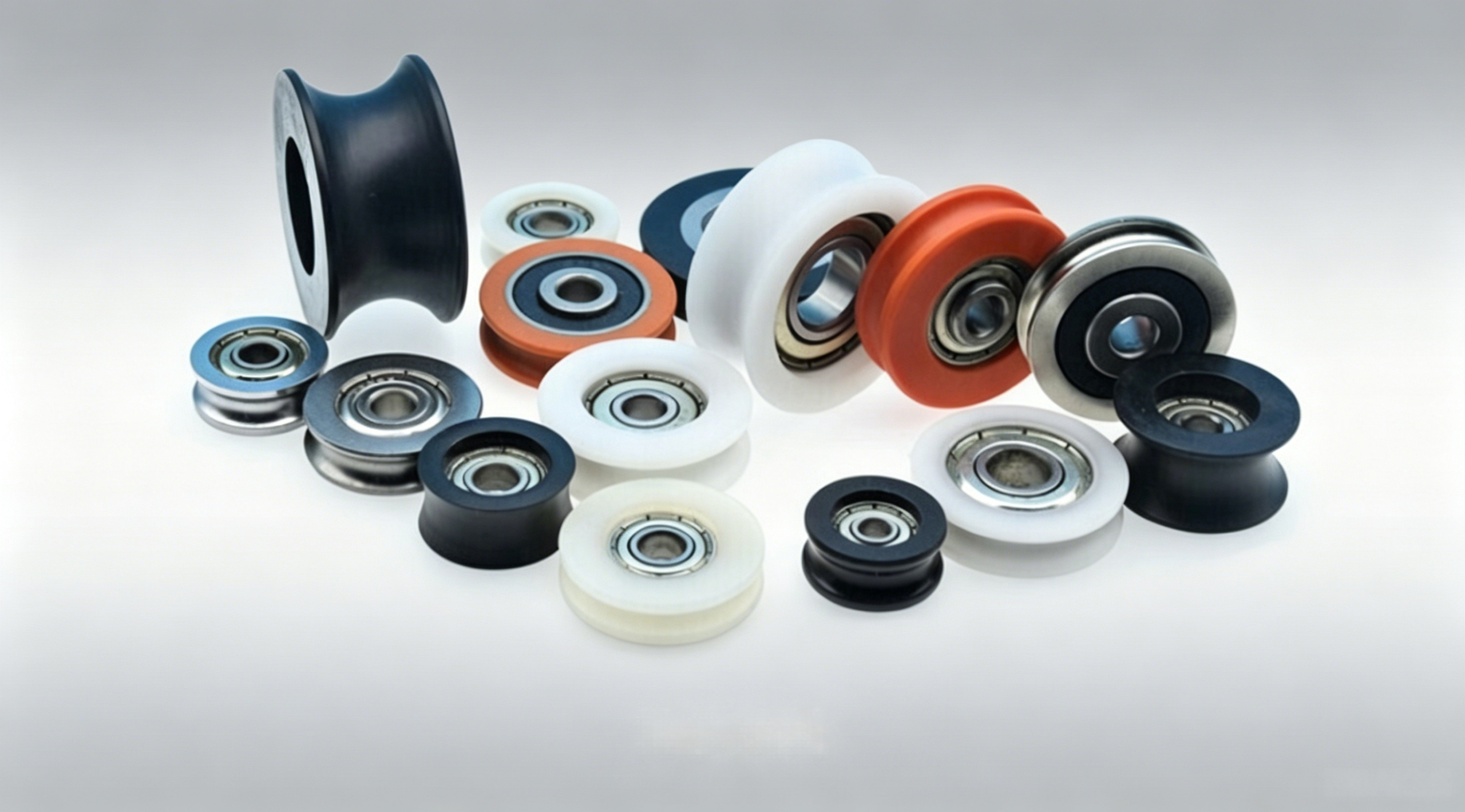
| Bearing pulley | Supports rotation with lower friction | Bearing type, bore, wheel material and shaft |
| Sliding roller | Contacts the track or rail | Diameter, width, groove and material |
| Track or rail | Defines the movement path | Cross-section, material, straightness and joints |
| Guide component | Controls side movement | Position, clearance and guide profile |
| Shaft or pin | Connects the wheel and bracket | Diameter, tolerance, material and retention |
| Stop or buffer | Limits the travel | End position, speed and impact condition |
| Soft-close unit | Controls the final movement | Door load, direction, travel and engagement point |
| Handle or pull | Allows manual operation | Door thickness, hole centres and finish |
Hettich’s sliding door system range separates running, guiding, profile and soft-close functions across different systems. Its product catalogue also lists individual running components, guide components and stops. This confirms that a sliding system contains more than a visible wheel.
From a factory view, I review the bearing, outer wheel, shaft and bracket together. A bearing number can confirm basic boundary dimensions, but it cannot confirm track fit or complete roller capacity.
You can review common structures on our sliding rollers with bearing page.
What Hardware Do Folding and Pivot Doors Use?
Folding doors use hinges, carrier rollers, pivots, tracks and guides, while pivot doors use top and bottom pivots with operating, locking and control hardware.
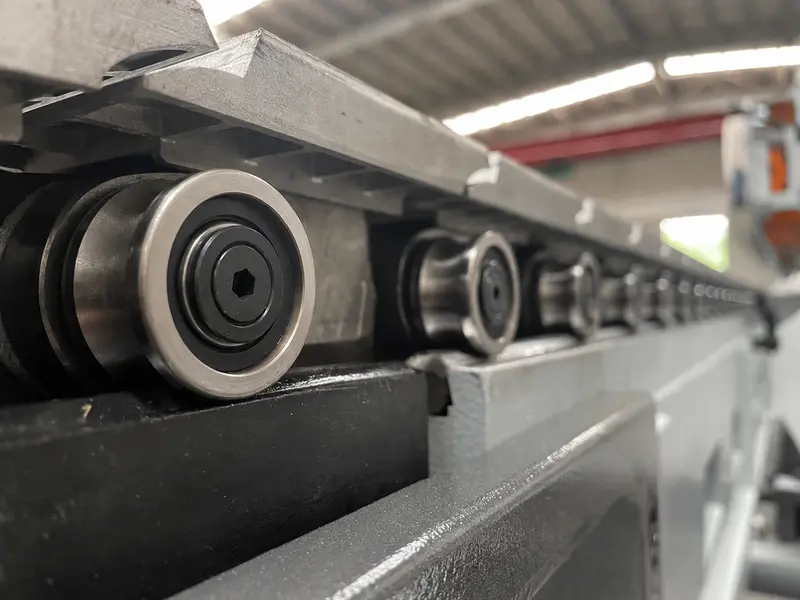
A folding door divides movement across several panels. The joints, carrier positions and guide points must follow the approved system layout. A pivot door rotates around a set point that may sit away from the door edge.
| System | Load-bearing parts | Movement-control parts | Main purchasing risk |
|---|---|---|---|
| Bi-fold door | Hinges, top carrier and bottom pivot | Track, guide and stop | Wrong panel sequence or carrier spacing |
| Multi-panel folding door | Multiple hinges, carriers and pivots | Upper and lower guides | Uneven load across panels |
| Centre pivot door | Top and bottom pivots | Floor spring, closer and stop | Wrong pivot position |
| Offset pivot door | Offset pivot set | Closer, latch and stop | Door and frame geometry mismatch |
Hettich lists sliding and folding systems as separate product groups. This separation reflects a real purchasing difference: folding systems need coordinated panel joints and carrier positions, while a single sliding panel follows one movement path.
A buyer should provide the complete panel layout instead of sending one carrier photo. The full layout shows how many parts carry weight and how the panels connect.
What Hardware Do Shower, Glass and Furniture Doors Use?
Shower, glass and furniture doors use smaller or more specialised hardware that must match glass or panel thickness, fixing method, moisture, available space and door weight.
These systems may use similar product names, but their structures are not interchangeable.
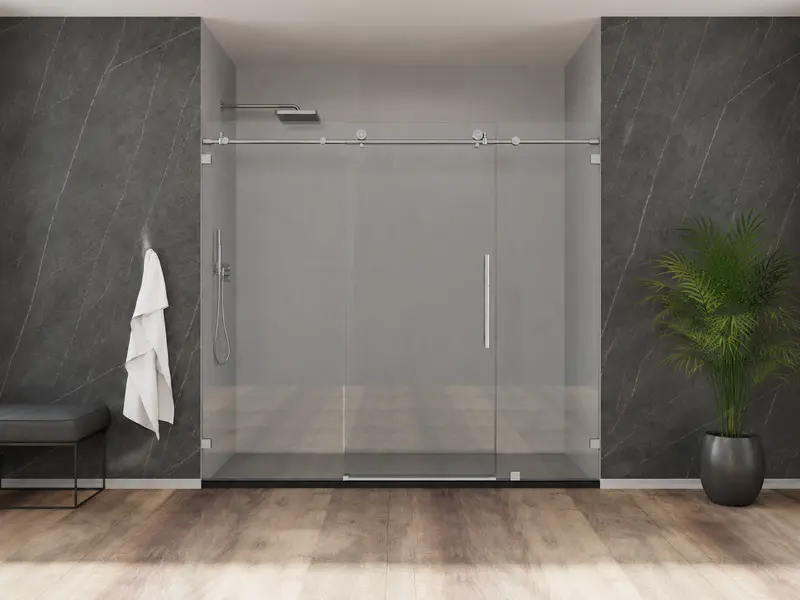
What Hardware Do Shower and Glass Doors Use?
Shower and glass door hardware may include:
- Sliding rollers or hinges
- Glass clamps
- Guide blocks
- Handles or knobs
- Seals
- Stops
- Tracks or support bars
- Anti-jump parts
Moisture changes the material and bearing requirements. Glass thickness and fixing method also affect the roller bolt, gasket, clamp and bracket.
The buyer’s glass-system specialist should approve the drilling, clamp pressure and safety structure. Our role as a component manufacturer is to review production feasibility against the approved drawing or sample.
What Hardware Do Furniture Doors Use?
Furniture and wardrobe doors may use:
- Small roller carriages
- Plastic guide components
- Top and bottom tracks
- Hinges
- Catches
- Stops
- Soft-close units
- Decorative covers
Furniture systems often provide limited installation space. Door width can also affect whether a soft-close unit has enough engagement travel.
| Application | Key selection points | Common issue |
|---|---|---|
| Shower sliding door | Glass thickness, moisture, roller fixing and seal | Corrosion, loose fixing or poor alignment |
| Interior glass door | Door weight, clamp or drilled fixing and track | Wrong hardware-to-glass interface |
| Wardrobe door | Panel weight, width, track and cabinet space | Roller does not fit the profile |
| Furniture cabinet door | Panel thickness, hinge or runner position | Mounting-hole mismatch |
What Hardware Do Industrial Sliding Systems Use?
Industrial sliding systems use load-bearing rollers, bearings, rails, guide wheels, shafts, brackets, end stops and protective components that suit the verified load, travel and operating environment.
Industrial movement may involve larger panels, longer travel, more cycles, dirt, impact or temperature variation. The product still needs a matched system rather than one oversized wheel.
| Industrial input | Question for the buyer |
|---|---|
| Moving load | What is the complete verified moving weight? |
| Wheel quantity | How many wheels carry the load? |
| Load distribution | Can one wheel carry more load than the others? |
| Travel | How far does the door or panel move? |
| Frequency | How many cycles does the system complete? |
| Speed | What speed reaches the wheel and end stop? |
| Track | What are the rail profile, material and joints? |
| Environment | Is there water, dust, salt, oil or temperature variation? |
| Impact | Does the panel strike an end stop or cross track joints? |
| Maintenance | Can the bearing, wheel or guide be replaced? |
A claimed wheel load is one reference value. The finished system can be limited by the shaft, bracket, rail, mounting plate or load distribution.
I can review component drawings, material options and manufacturing consistency. The buyer’s responsible technical team should validate the full industrial structure.
What Are the Main Door Hardware Types by Function?
Functional classification helps buyers identify hidden but important parts and assign clear specifications to each item in a bill of materials.
Product names differ between markets. Functions provide a more stable way to organise an enquiry.
| Function | Typical products | Main specification points |
|---|---|---|
| Open and operate | Handles, pulls, knobs and push plates | Size, hole centres, hand, material and finish |
| Carry load | Hinges, pivots, hangers and roller carriages | Door weight, quantity, position and fixing |
| Slide and guide | Rollers, tracks, rails and guide blocks | Profile, clearance, alignment and travel |
| Lock and retain | Locks, latches, bolts, cylinders and catches | Door type, backset, hand and access need |
| Control movement | Closers, dampers and soft-close parts | Load, speed, direction and closing travel |
| Limit movement | Stops, buffers and anti-jump parts | End position, impact and mounting |
| Seal gaps | Gaskets, brushes, thresholds and bottom seals | Gap, exposure, compression and material |
| Protect surfaces | Kick plates, edge guards and corner parts | Coverage, material and finish |
| Connect parts | Brackets, shafts, pins, screws and clamps | Dimensions, tolerances and retention |
| Finish appearance | Covers, caps, rosettes and trim | Colour, texture and surface consistency |
This method also improves supplier responsibility. A buyer can state which supplier provides the roller, track, guide, bracket and fasteners. The buyer can then define who assembles and tests the complete set.
Why Do a Bearing Pulley and Sliding Roller Matter?
A bearing pulley and sliding roller affect load support, friction, noise, alignment, track contact and replacement frequency in moving door systems.
These products may look like small accessories, but they connect the moving door to its track.
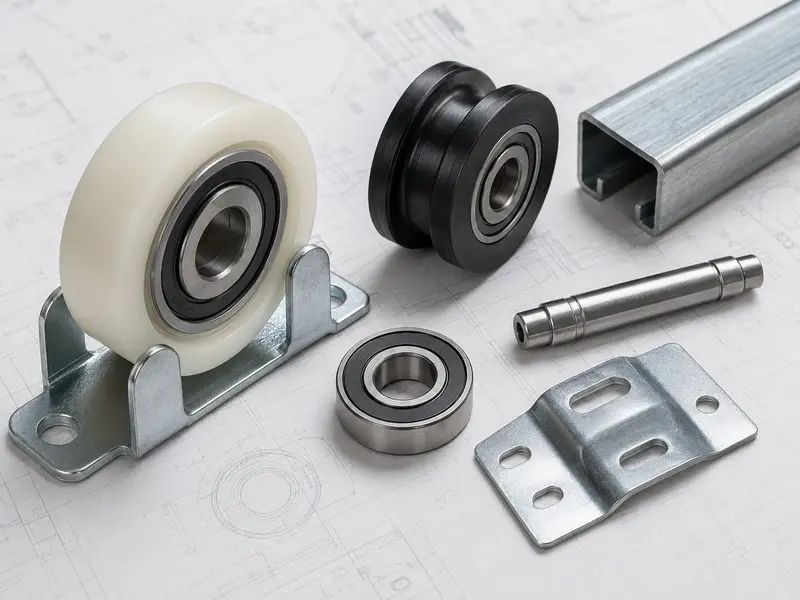
A typical bearing pulley contains:
- A bearing or bush
- A plastic, rubber or metal outer wheel
- A groove or running surface
- A shaft, bolt or pin
- A bracket or carriage
Each part can change the result.
| Component point | Effect on the system |
|---|---|
| Bearing type | Changes rotation, sealing and maintenance needs |
| Wheel material | Changes noise, stiffness, wear and track contact |
| Wheel profile | Determines how the wheel contacts the track |
| Concentricity | Affects vibration and smoothness |
| Shaft fit | Affects play, alignment and rotation |
| Bracket position | Affects load direction and track contact |
| Guide clearance | Affects side movement and binding risk |
SKF states that deep groove ball bearings can accommodate radial and axial loads in both directions and provide low friction. SKF also notes their low-noise and low-vibration characteristics.
This bearing information does not establish the capacity of a completed door roller. The outer wheel, shaft, bracket and track can become the limiting parts.
From our manufacturing side, I check bearing fit, moulding or coating coverage, wheel runout, shaft dimensions and bracket clearance before I review a sample route.
How Should Buyers Select Door Hardware Materials?
Buyers should select door hardware materials by load, wear, corrosion, noise, temperature, appearance, manufacturing process and cost. No single material gives every advantage.
| Material | Reasons to assess it | Points to confirm |
|---|---|---|
| Carbon steel | Stiffness, machining and established production | Coating, corrosion and environment |
| Stainless steel | Moisture and corrosion resistance with a suitable grade | Grade, finish, cost and mating parts |
| Aluminium | Lower weight and profile production | Alloy, wall thickness, finish and deformation |
| Zinc alloy | Detailed cast shapes and decorative finish | Load, plating and impact |
| Brass | Appearance, machining and corrosion resistance | Cost, finish and material requirements |
| POM | Smooth contact and stable moulded dimensions | Grade, load, temperature and UV exposure |
| Nylon | Wear resistance and lower weight | Moisture absorption, grade and deformation |
| Rubber coating | Softer contact and lower contact noise | Hardness, bonding and rolling resistance |
| Plastic-coated bearing | Bearing rotation with a moulded running surface | Concentricity, wall thickness and material grade |
Material family names are not complete specifications. “Nylon”, “POM” and “stainless steel” cover several grades and production conditions.
For repeat orders, the approved drawing or specification should state the agreed grade or performance target. The supplier should not change material without buyer approval.
A hard metal wheel may provide higher stiffness but create more contact noise or track wear. A coated wheel may reduce contact noise but require closer review of temperature, deformation and coating thickness.
What Information Should Buyers Send for a Quotation?
Buyers should send the door type, movement, material, dimensions, weight, hardware position, track or frame drawing, environment, performance target, quantity and customisation needs.
I use the following first-review checklist:
| Information group | Details to provide | Why I need it |
|---|---|---|
| Application | Architectural, furniture, shower, industrial or other | Defines the product context |
| Door movement | Hinged, sliding, folding or pivot | Defines the hardware system |
| Door material | Wood, aluminium, steel, glass or composite | Affects load and fixing |
| Door dimensions | Width, height and thickness | Confirms geometry and space |
| Door weight | Complete moving weight | Supports load review |
| Track or frame | Cross-section, dimensions and material | Confirms contact and mounting fit |
| Hardware position | Top, bottom, side or concealed | Confirms clearance and structure |
| Use | Travel, speed and cycles per day | Guides wear and control review |
| Environment | Indoor, outdoor, moisture, dust, salt and temperature | Guides material and bearing selection |
| Performance | Noise, movement, closing feel and service target | Creates sample checks |
| Finish | Plating, painting, anodising, polishing or colour | Controls appearance and corrosion needs |
| Quantity | Samples, first order and annual demand | Guides existing-mould or tooling decisions |
| Packaging | Neutral, private label, barcode and carton marks | Supports distribution requirements |
A cross-section drawing usually gives more value than one front-view photo.
If the buyer does not have a complete drawing, I ask for:
- Photos from several angles
- A physical sample
- Track or frame samples
- Manual dimensions
- Installation photos
- A short operating video
- A description of the current problem
- Expected annual demand
We can assess component manufacturing feasibility from this information. The buyer’s qualified team should approve the complete door system.
When Do Buyers Need Standard or OEM Door Hardware?
Buyers can use standard hardware when the approved dimensions, material, function and mounting structure match. They need modified or OEM hardware when a standard part cannot meet those requirements.
I first compare the enquiry with existing products and moulds. This route can reduce sample time and initial tooling cost.
| Project condition | Standard product | Modified product | New OEM product |
|---|---|---|---|
| Dimensions and structure match | Best first route | Not required | Not required |
| Bracket position differs | Check adjustment range | Change bracket or holes | Consider for repeat demand |
| Track profile differs | Existing roller may not fit | Change groove or wheel | New mould may be required |
| Material differs | Use an approved standard grade | Change material after testing | Create a controlled specification |
| Small trial order | Lower initial cost | Use if repeatable | Tooling may not suit the volume |
| Stable repeat programme | Suitable after sample approval | Suitable with signed drawing | Supports dedicated production control |
| Complete assembly required | Check the standard set | Combine existing parts | Develop wheel, shaft and bracket together |
OEM work may include:
- Roller diameter or groove
- Bearing type or closure
- Plastic or rubber coating
- Shaft or pin
- Stamped bracket
- Injection-moulded housing
- Adjustment structure
- Material or colour
- Surface finish
- Private-label packaging
Before new tooling starts, both sides should confirm the drawing, critical tolerances, material, sample plan, acceptance method, tool ownership and annual demand.
Our OEM and ODM process explains how drawing review, mould evaluation, sampling and bulk approval connect.
What Causes Door Hardware Samples to Fail?
Door hardware samples often fail because the product does not match the door load, track, frame, mounting space, material, environment or complete assembly.
A sample may look correct and still fail during installation.
| Sample problem | Possible cause | Buyer action |
|---|---|---|
| Mounting holes do not align | Incomplete drawing or different datum | Approve a controlled drawing |
| Roller does not enter the track | Wrong wheel width, groove or carriage height | Compare cross-sections |
| Door moves with high resistance | Poor alignment, bearing drag or track contact | Test the complete assembly |
| Door makes repeated noise | Wheel material, bearing, rough track or loose parts | Inspect the full movement path |
| Hardware corrodes early | Wrong grade, finish damage or environment assumption | Define exposure and material |
| Door stops at the wrong point | Stopper or activator position mismatch | Approve the final travel |
| Repeat sample feels different | Material, bearing or process changed | Use signed samples and change control |
| Packaging damages the finish | Parts contact during transport | Approve packing method |
Official technical support also shows how small specification differences can affect fit. A dormakaba sliding-door support article explains that incorrect rollers for the door thickness can cause doors to hit after hanging. This example supports a broader sourcing rule: door thickness and roller geometry belong in the enquiry.
The final sample should run in the buyer’s door assembly or a representative fixture. A loose component can confirm dimensions and basic movement, but it cannot confirm full system performance.
What Does a Real Sliding Door Hardware Enquiry Teach Buyers?
A real enquiry shows that a product name and front-view photo can identify a hardware category, but they cannot confirm track, load or mounting compatibility.
I received a typical request for a “sliding door roller”. The buyer supplied one photo, an approximate outside diameter and a target quantity.
I could find similar wheels in our existing range, but I still needed:
- Door weight
- Door thickness
- Track cross-section
- Wheel width and groove
- Bearing bore
- Shaft dimensions
- Carriage height
- Roller position
- Operating environment
- Usage frequency
The later drawing showed that the existing wheel diameter was close, but the wheel profile and carriage height did not match the buyer’s track.
We then reviewed three options:
- Check another existing mould with a closer structure.
- Modify the wheel or bracket if the production limits allowed it.
- Develop new tooling if the repeat demand supported it.
The useful result was not a product claim. The extra information prevented both sides from approving a visually similar sample that could not work in the buyer’s system.
The case gives buyers one clear lesson:
> A correct product name starts the enquiry, but the drawing and application data decide whether the part can work.
How Should Buyers Assess a Sliding Door Hardware Factory?
Buyers should assess a sliding door hardware factory by product scope, drawing review, material control, bearing assembly, moulding, hardware processing, inspection and repeat-order control.
A supplier does not need to manufacture every handle, lock, hinge, roller and track. The supplier should clearly state what it makes, what it processes and what it sources.
I suggest asking these questions:
| Factory area | Question to ask | Why it affects purchasing |
|---|---|---|
| Product scope | Which components does the factory make in-house? | Clarifies process responsibility |
| Drawing review | Which dimensions and tolerances are critical? | Creates a shared approval basis |
| Mould library | Can an existing mould match the project? | May reduce time and tooling cost |
| Material control | Is the agreed material grade recorded? | Reduces batch variation |
| Bearing assembly | How are bearing source, fit and rotation checked? | Affects roller movement |
| Injection moulding | How are shrinkage, centring and moulded features controlled? | Affects fit and wheel runout |
| Hardware processing | Can shafts, brackets and holes remain consistent? | Affects assembly alignment |
| Inspection | Which dimensions and functions appear on the report? | Supports sample comparison |
| Change control | Must the buyer approve material or process changes? | Protects repeat orders |
| Packaging | How are finishes, wheels and machined surfaces protected? | Reduces transport damage |
Our production experience covers bearing pulleys, plastic and rubber-coated rollers, sliding rollers, injection-moulded components, bearing assembly and related hardware processing.
This experience allows me to explain component feasibility, material options, sample risks and bulk consistency. It does not make our factory the technical authority for every lock, closer, certified fire-door system or access-control product.
An ISO-based quality process can support records and change control. Buyers should still review the project-specific drawing, signed sample and inspection plan.
What Should an OEM Door Hardware Quotation Include?
An OEM door hardware quotation should define the product, application, material, dimensions, tooling, inspection, packaging, quantity, price basis and delivery terms.
| Quotation item | Required detail |
|---|---|
| Product scope | Loose part, roller with bearing, bracket assembly or complete set |
| Application | Door type and use scenario |
| Door data | Material, dimensions, thickness and weight |
| Track or frame | Drawing, profile and material |
| Component | Dimensions, tolerances and mounting position |
| Bearing | Model, quantity, closure and quality requirement |
| Plastic or rubber | Grade, colour, hardness or performance requirement |
| Metal part | Material, finish and critical dimensions |
| Environment | Indoor, outdoor, moisture, dust, salt and temperature |
| Test | Fit, movement, load, cycles and acceptance method |
| Quantity | Sample, first order and annual demand |
| Tooling | Mould need, ownership, storage and change terms |
| Quality | Drawing report, material record and inspection level |
| Packaging | Neutral or private label, barcode and carton marks |
| Commercial | Currency, trade term and required delivery date |
The quotation should state exactly what the price covers. A loose wheel, a bearing pulley, a shafted roller and a full carriage assembly can appear similar in a small photo but contain different materials and processes.
For a manufacturing review, use our contact page and send your drawing, physical sample, application data and expected quantity.
What Is the Final B2B Door Hardware Checklist?
A B2B buyer should approve each hardware component as part of a door system and part of a controlled supply specification.
Use this order:
- Define the door movement and application.
- Record the door material, dimensions, thickness and weight.
- List each required hardware function.
- Identify which parts carry load and which parts guide movement.
- Confirm the frame, track or rail cross-section.
- Define installation space and mounting points.
- Confirm materials and surface finishes.
- Record usage frequency and environmental exposure.
- Compare standard, modified and OEM routes.
- Confirm what each supplier provides.
- Produce a controlled sample.
- Test the complete door assembly.
- Sign the drawing, material and acceptance specification.
- Confirm inspection, packaging and change control.
Do not ask only:
> What types of door hardware do you sell?
Ask:
> Which hardware combination matches our door movement, load, material, track, environment and repeat-production requirements?
That question helps the supplier prepare a more accurate quotation and helps the buyer avoid incompatible samples.
Do You Need a Bearing Pulley or Sliding Roller for an OEM Door Project?
Send us your component drawing, physical sample, door information, track profile and order plan. We will first check whether an existing product or mould can match the requirement.
If a standard product does not fit, we can review:
- A different bearing or closure
- A plastic or rubber-coated wheel
- A new wheel diameter or groove
- A custom shaft or pin
- A stamped bracket
- An injection-moulded housing
- Secondary machining
- A complete roller assembly
Our review covers manufacturing feasibility, material selection, component dimensions, sampling and repeat-production control. Your qualified door-system team should approve the final system design and application performance.
View Sliding Rollers with Bearing