
Does the door slow down but still rebound? Does the soft-close unit work on a sample door but jam in the customer’s frame? Can your supplier keep the same closing feel across the next production batch?
I hear these questions from sliding door manufacturers, hardware importers and OEM buyers. Many enquiries start with one simple request:
Please quote a soft-close device for this door weight.
Door weight matters, but it is one part of the decision. The damper must work with the sliding roller, bearing pulley, track, activator, guide, stopper and mounting space.
For B2B purchasing, I use this definition:
Soft-close sliding door hardware is a matched set of components that slows a moving door near the end of its travel and guides it into a controlled final position.
The buyer should therefore ask:
Will this soft-close system match our door weight, door width, track, roller carriage, installation space, closing travel and use cycle?
This guide explains how I review that question from a manufacturing and sourcing view. It covers architectural doors, window and door systems, wardrobes and related sliding products. It does not replace the buyer’s system designer, test engineer or installer.
What Does This Soft-Close Sliding Door Hardware Guide Cover?
This guide covers the parts, matching data, performance checks, sample tests and supplier controls that B2B buyers need before they approve soft-close sliding door hardware.
What Is Soft-Close Sliding Door Hardware?
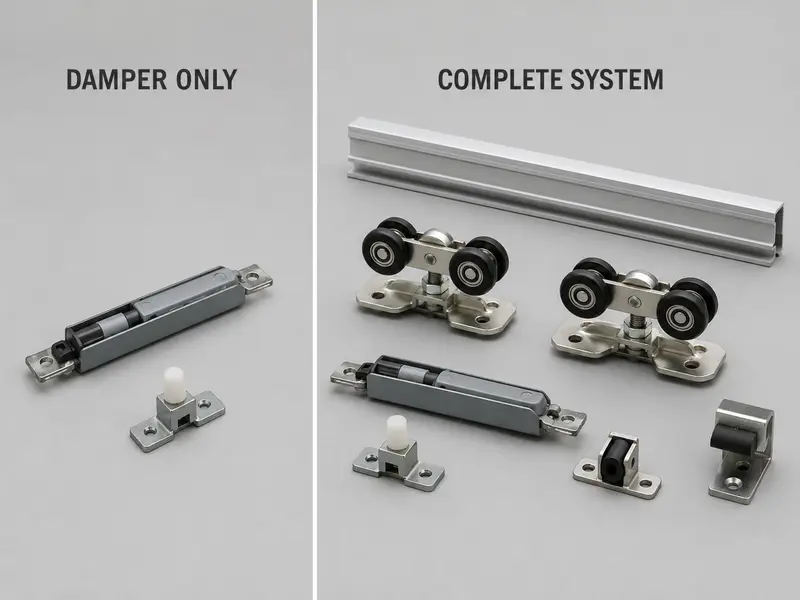
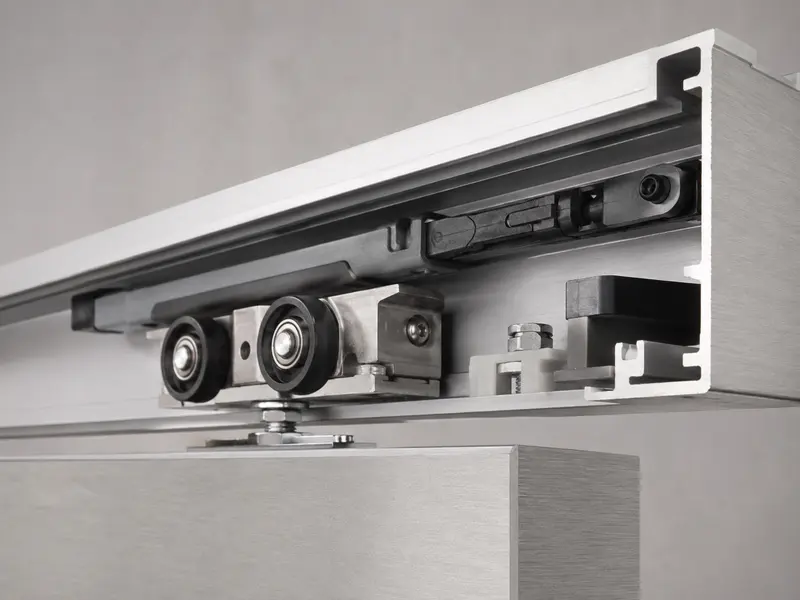
Soft-close sliding door hardware slows the door during the final part of its travel and supports a quiet, controlled close. A complete system usually combines a damper or soft-close unit with rollers, a track, an activator, guides, stops and mounting parts.
The term “soft-close” can refer to one mechanism or a full hardware set. This difference creates confusion in quotations.
A supplier may quote only the damper. Another supplier may quote a carriage with an integrated damper. A third supplier may quote a complete kit with tracks, running components, guides, activators and stops.
Official product sets show this variation. A typical sliding door system kit from a hardware manufacturer may include running components, guide components, activators, end stops and guide bushes, demonstrating that soft-close performance depends on a complete matched assembly rather than a single part.
Another example is a soft and self-closing mechanism set that integrates a release device and stopper, showing how damping, triggering and final positioning functions are often combined into one coordinated system.
These examples support one clear point: buyers must define what the quoted item includes.
I separate the system into three functions:
| Function | Main parts | Buyer’s question |
|---|---|---|
| Carry and move | Bearing pulley, sliding roller, carriage and track | Does the door move freely under the specified load? |
| Detect and control | Activator, catch and soft-close mechanism | Does the unit engage at the correct position and speed? |
| Finish and retain | Pull-in part, stopper, guide and end position | Does the door finish without impact, rebound or drift? |
A door can have a damper and still close badly. Poor rollers, a rough track or a wrong activator position can cancel the benefit of the soft-close unit.
Which Parts Form a Soft-Close Sliding Door System?
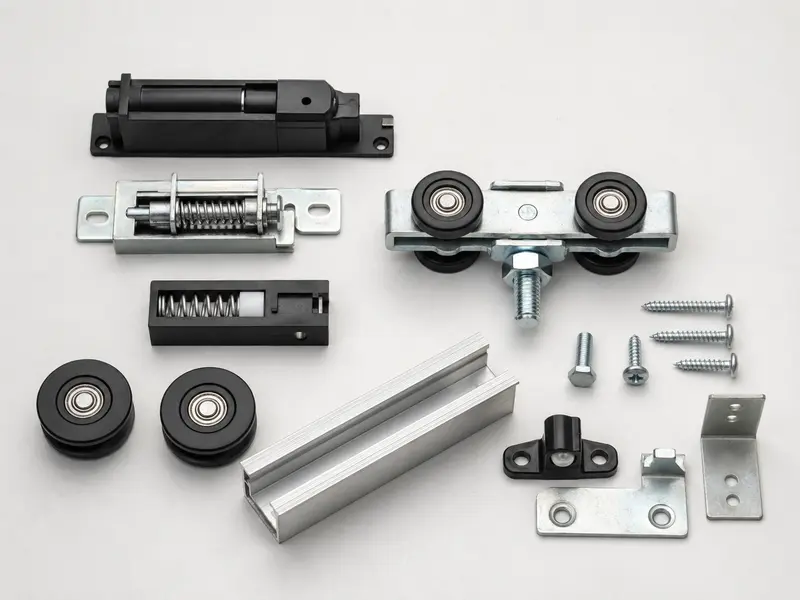
A typical soft-close sliding door system contains a damper, activator, roller carriage, bearing pulley or sliding roller, track, guide, stopper, bracket and fasteners. Some products combine several parts inside one housing.
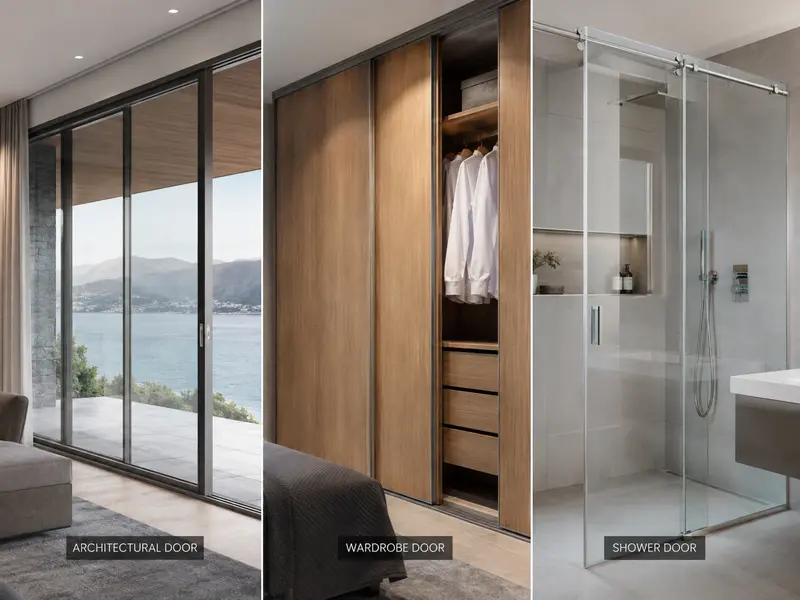
The exact structure changes with the door type. A top-hung architectural door uses a different layout from a bottom-running wardrobe door. A shower door also needs a structure that suits moisture and glass fixing requirements.
| Part | Main job | Sourcing point |
|---|---|---|
| Damper or soft-close unit | Controls speed near the end position | Confirm load range, travel and direction |
| Activator or trigger | Engages the soft-close unit | Confirm position, shape and mounting tolerance |
| Pull-in spring or closing element | Moves the door into the final position | Confirm closing force and final travel |
| Roller carriage | Carries the door and supports adjustment | Confirm load, height adjustment and bracket fit |
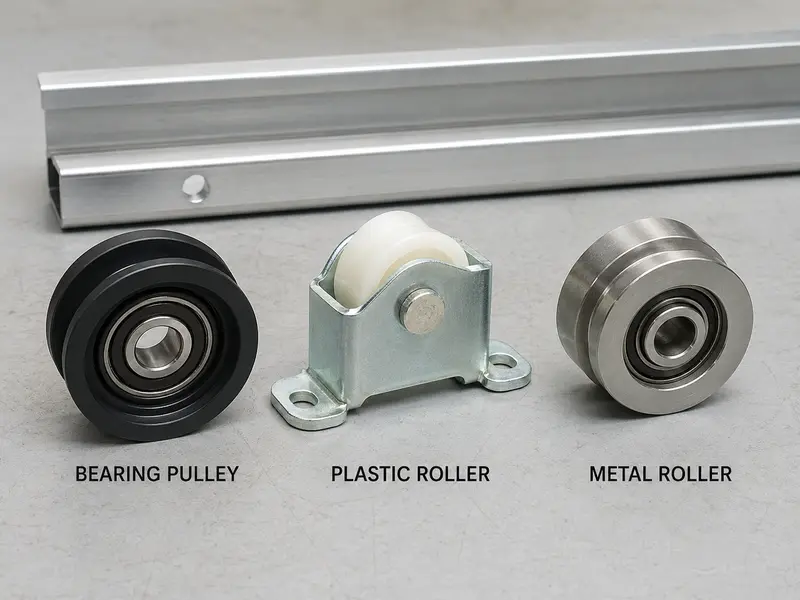
| Bearing pulley | Reduces friction and supports rotation | Confirm bearing, wheel material, groove and shaft |
| Sliding roller | Runs on or inside the track | Confirm diameter, profile, width and concentricity |
| Track | Controls the running path | Confirm profile, straightness, joints and surface |
| Guide | Controls lateral movement | Confirm clearance and door position |
| Stopper | Defines or protects the end position | Confirm location and interaction with soft-close parts |
| Fasteners and bracket | Hold the parts in position | Confirm material, tolerance and repeatability |
The hardware list matters during price comparison. A low quotation may exclude the track, activator, guide or mounting bracket. The missing parts then appear during sampling or assembly.
How Does Soft-Close Sliding Door Hardware Work?
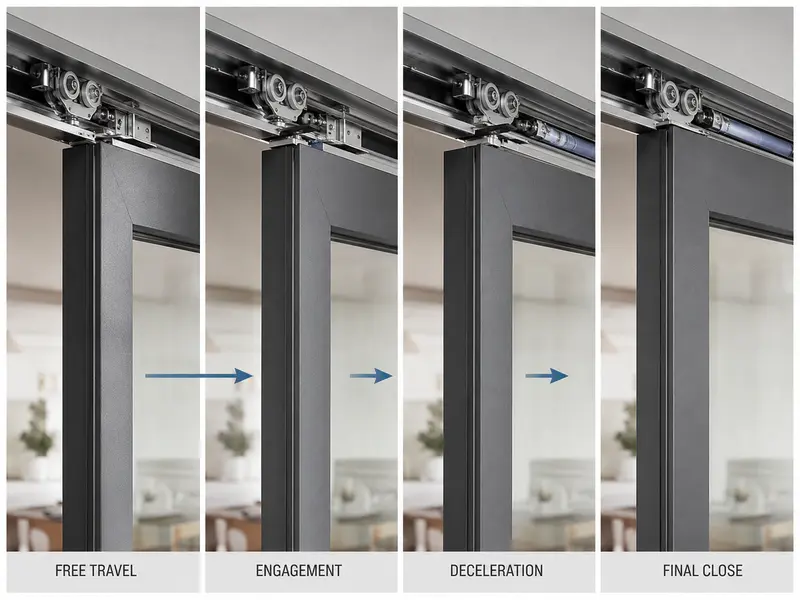
The door moves freely on its rollers, the activator engages the soft-close unit near the end position, the damper reduces speed, and the closing element moves the door into its final position.
The operating sequence usually has four stages:
- The user or drive moves the door along the track.
- The activator reaches the catch point.
- The damper controls the remaining movement.
- The closing element brings the door to the set end position.
Some products place the soft-close unit inside the track. Some integrate it into the roller carriage. Other systems use an external mechanism.
The visible result should include more than slower movement. The door should engage at the expected point, move at an acceptable speed, reach the final position and remain stable.
| Stage | What the buyer should observe | Possible concern |
|---|---|---|
| Free travel | Smooth and even movement | Roller drag, wheel noise or track resistance |
| Engagement | Repeatable contact with the activator | Missed catch, hard click or sudden pull |
| Deceleration | Controlled reduction in speed | Door remains too fast or slows too early |
| Pull-in | Steady movement to the end | Rebound, stall or uneven speed |
| Final position | Door stops at the approved point | Gap, impact, drift or loose retention |
I recommend recording this sequence during sample approval. A short video helps the supplier see the actual issue, but the buyer should also provide the door data and hardware drawing.
Is a Damper the Same as a Complete Soft-Close System?
No. A damper controls movement, but the complete soft-close result also depends on the activator, closing element, rollers, track, guides, stops and mounting position.
Buyers often use “damper” and “soft-close” as if the words mean the same product. The terms can overlap in sales communication, but they should not replace a component list.
The damper can reduce speed. The bearing pulley and sliding roller control the base movement. The activator decides where the soft-close action begins. The pull-in part helps the door reach the final position.
| Item | What it can do | What it cannot confirm alone |
|---|---|---|
| Damper | Reduce speed during a defined stroke | Door load match, smooth rolling or final alignment |
| Activator | Start the soft-close action | Controlled speed or pull-in force |
| Closing element | Pull the door to the end position | Quiet travel or correct track contact |
| Roller system | Carry and move the door | Controlled final closing action |
| Complete matched set | Combine the required functions | Performance without a defined application test |
This distinction also affects warranty discussions.
If the supplier provides only a damper, the buyer must define who approves the roller, track and system performance. If one supplier provides the complete set, the quotation should still state the test conditions and responsibility.
What Is the Difference Between Soft-Close and Self-Close?
Soft-close mainly controls closing speed and impact. Self-close provides force that moves the door into a closed position. Many systems combine both functions, but the terms are not identical.
A product may slow the door without pulling it fully closed. Another product may pull the door closed but provide limited speed control. A combined soft and self-closing mechanism aims to provide both actions.
Häfele lists some Slido products as “soft and self-closing”, while Hettich uses terms such as soft closing, soft opening and soft colliding for different functions.
This wording shows why buyers should compare the actual action and supplied parts, not the feature name alone.
| Term | Main action | Question for the specification |
|---|---|---|
| Soft-close | Reduces speed before the end position | What is the engagement point and closing time? |
| Self-close | Moves the door to the closed position | What force and travel complete the close? |
| Soft-open | Controls movement near the open end | Does the system work in both directions? |
| Soft-collide | Controls contact between moving door panels | Which panel engages and at which position? |
| Stopper | Limits travel or retains a position | Is it a stop, a catch or part of the soft-close set? |
The purchase order should use the supplier’s exact functional description. It should also list the direction, door configuration and quantity of mechanisms per door.
Why Must Soft-Close Hardware Match Door Weight and Width?
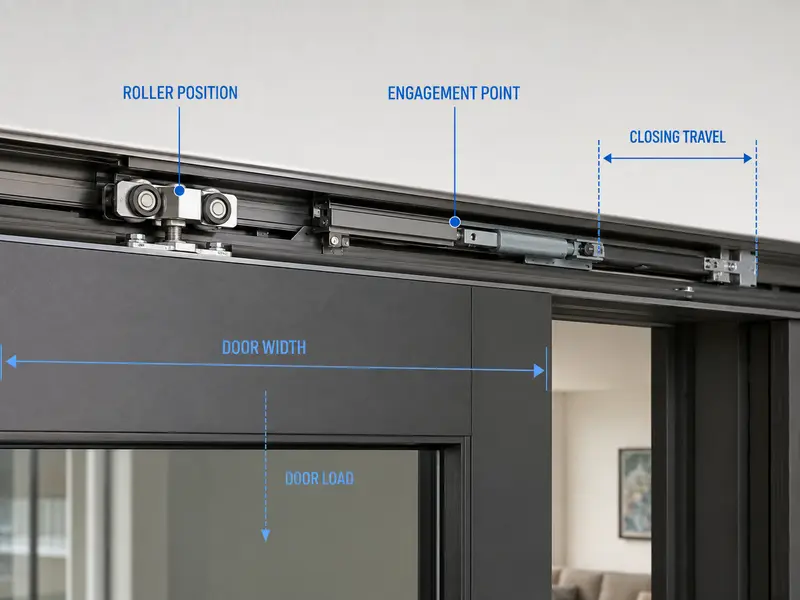
Door weight and door width affect momentum, roller load, available closing travel and mechanism position. A soft-close unit that suits one door may feel weak, harsh or unstable on another door.
Door weight is the first filter, but buyers should not stop there.
Official hardware ranges often connect a mechanism to a stated door weight and a minimum door width. For example, the Hettich SlideLine M product page lists both a maximum door weight and a minimum door width.
This shows that space and geometry can limit a system even if the weight appears suitable.
The following inputs affect the result:
- Total door weight, including glass, panels, handles and attached parts
- Door width and height
- Centre of gravity
- One-door, two-door or telescopic layout
- Top-hung or bottom-running structure
- Number and position of roller carriages
- Closing speed before engagement
- Available damper stroke and closing travel
- Use cycles per day
- Manual or powered movement
| Input | If the value is too low or too small | If the value is too high or too large |
|---|---|---|
| Door weight | Closing force may feel strong | Door may close too fast or fail to control |
| Door width | Mechanism and activator may lack space | Door may create more leverage at the carriage |
| Entry speed | Unit may not engage as expected | Impact, noise or rebound may increase |
| Closing travel | Door may stop before the final point | Hardware may require a different trigger position |
| Opening force | Door may feel too light or unstable | User effort may become unacceptable |
I avoid a universal claim such as “this unit works for every 40 kg door”. The finished result depends on the complete structure and the defined test.
How Do a Bearing Pulley and Sliding Roller Affect Soft-Close Performance?
A bearing pulley and sliding roller control the door’s basic movement. Their friction, concentricity, material, fit and track contact affect the speed and force that reach the soft-close mechanism.
The damper cannot correct a wheel that binds, wobbles or runs on the wrong profile. It also cannot remove noise caused by a rough bearing or damaged track.
Deep groove ball bearings can support radial load and some axial load in both directions.
These are general bearing features, not a load rating for a finished door system.
From a production view, I check these points:
| Bearing pulley or sliding roller point | Why it matters |
|---|---|
| Bearing type and closure | Affects friction, contamination control and movement |
| Wheel diameter | Affects rotation speed, clearance and track-joint response |
| Wheel profile | Controls contact with the track |
| Wheel material | Affects noise, deformation, wear and cost |
| Concentricity | Affects vibration and closing-speed consistency |
| Shaft fit | Affects play, alignment and rotation |
| Carriage spacing | Affects load distribution and door stability |
| Height adjustment | Affects track contact and activator alignment |
One bearing pulley may rotate freely by hand but behave differently under the actual door load. Sample testing should therefore include the roller inside the approved carriage and track.
You can compare common component structures on our sliding rollers with bearing page before you request a custom assembly.
Why Do the Track and Installation Tolerance Matter?
The track and mounting tolerance control roller alignment, activator contact and available clearance. A correct soft-close unit can fail if the track, bracket or trigger position moves outside the approved range.
Track straightness affects rolling resistance. Track profile affects wheel contact. Bracket position affects the height and angle of the carriage. Activator position affects the engagement point.
These variations can stack together in production. A small change in the track, door panel, bracket and fastener hole may create a larger shift at the catch point.
| Tolerance point | Possible result | Buyer control |
|---|---|---|
| Track profile changes | Roller drag or side play | Approve the cross-section drawing |
| Track is not straight | Uneven movement and noise | Define straightness and joint control |
| Carriage height changes | Activator misses or strikes the catch | Define adjustment range and datum |
| Bracket holes shift | Door and mechanism lose alignment | Inspect critical hole positions |
| Door panel thickness changes | Hardware clearance changes | State the approved thickness range |
| Activator position changes | Early, late or missed engagement | Use a location gauge or controlled fixture |
| Fastener loosens | Noise, movement or intermittent action | Confirm retention method and test plan |
This section is a selection reminder, not an installation guide. The buyer’s qualified team should set installation instructions, site tolerances and safety checks.
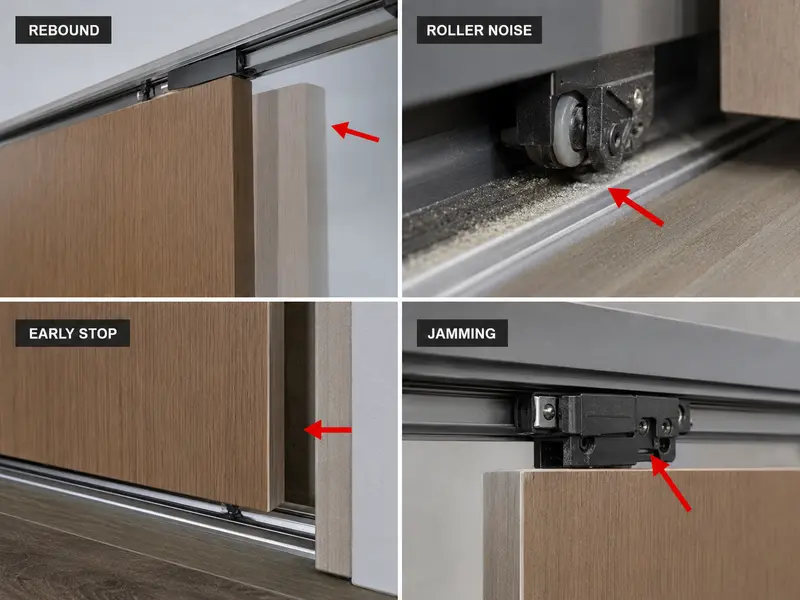
What Causes Noise, Rebound and Jamming?
Noise, rebound and jamming usually come from a mismatch or variation in the full sliding system. Buyers should inspect the damper, activator, roller, bearing, track, guide, stopper and mounting position together.
Replacing the damper first may solve the issue, but it can also hide the real cause.
I ask buyers to record where the problem starts and whether it appears on every unit or only some units.
| Reported problem | Possible cause | What to check |
|---|---|---|
| Door rebounds | High entry speed, wrong load range, weak retention or catch position | Door load, speed, activator and final stop |
| Door stops early | Excess roller friction, low closing force or wrong travel | Roller rotation, track and pull-in distance |
| Hard impact | Mechanism does not engage or engages too late | Activator position and closing direction |
| Door jams | Bent track, poor clearance, loose bracket or damaged carriage | Complete running path and mounting parts |
| Closing speed changes | Load variation, temperature, wear or batch variation | Test conditions and component records |
| Repeated click | Activator, catch, stopper or loose fastener | Engagement point and retention |
| Roller noise | Bearing, wheel material, dirt or track surface | Bearing pulley, sliding roller and track |
| Intermittent soft-close | Tolerance stack or unstable trigger contact | Door position, carriage height and activator |
A hand test on a loose mechanism cannot reproduce every installed force. The approved sample should run in the buyer’s door or a representative fixture.
Which Applications Need Different Soft-Close Hardware?
Architectural doors, aluminium sliding systems, wardrobes, shower doors and furniture doors need different hardware because their load, space, moisture, cycle rate and fixing methods differ.
The system logic stays the same, but the selection inputs change.
| Application | Main buyer priorities | Points to confirm |
|---|---|---|
| Interior architectural door | Smooth feel, noise, load and frequent use | Door weight, track, opening force and cycles |
| Aluminium sliding door system | Compact profile and repeatable assembly | Profile space, carriage height and fasteners |
| Glass sliding door | Clamp or drilled fixing and door safety | Glass thickness, fixing system and qualified approval |
| Hotel or commercial door | Frequent use and complaint control | Cycle test, noise limit and spare-part plan |
| Wardrobe or furniture door | Compact space and cost control | Panel width, weight and track format |
| Shower door | Moisture, corrosion and glass fixing | Materials, seals, drainage and qualified approval |
The same part number should not move between these applications without review. A wardrobe mechanism may fit the weight but lack the mounting structure or environmental protection required for another door.
The Emuca Flow soft-closing system provides an example of a mechanism integrated into a furniture-door carriage.
Architectural systems may place the mechanism and running gear in a different arrangement.
What Should B2B Buyers Test Before Bulk Production?
B2B buyers should test the complete door, track, roller carriage, bearing pulley, soft-close unit, activator, guide and stopper before bulk production. The test should use defined loads, speeds, cycles and acceptance limits.
Our factory can inspect production-related items. These checks may include dimensions, wheel concentricity, bearing fit, moulded-part appearance, bracket positions, basic rotation and assembly consistency.
The buyer should approve application performance under the intended conditions.
| Test area | Approval question |
|---|---|
| Fit | Do all parts fit the approved track, door and mounting space? |
| Free travel | Does the door move smoothly before soft-close engagement? |
| Engagement | Does the activator catch at the approved point every time? |
| Closing speed | Does the door close within the buyer’s accepted range? |
| Final position | Does the door finish without gap, drift or rebound? |
| Noise | Does the full system meet the buyer’s sound target? |
| Opening force | Can the user reopen the door with acceptable effort? |
| Misuse response | What happens after a faster or harder close? |
| Environment | Do moisture, dust and temperature affect the result? |
| Endurance | Does the system pass the stated cycle count and recheck? |
| Batch match | Does production match the signed sample and drawing? |
The test report should state:
- Door weight
- Door width
- Track profile
- Roller set
- Soft-close mechanism
- Closing direction
- Test speed
- Test environment
- Cycle count
- Acceptance result
A statement such as “tested for long life” does not give a buyer a measurable approval rule.
Can a Standard Soft-Close Unit Replace a Custom Design?
A standard soft-close unit can replace a custom design if the load range, stroke, direction, track space, activator, mounting points and roller structure meet the approved specification. A similar size does not confirm a match.
I first compare a new enquiry with existing moulds and assemblies. This route can reduce tooling cost and sample time.
The comparison still needs controlled dimensions and application data.
| Project condition | Standard unit | Modified assembly | New mould or mechanism housing |
|---|---|---|---|
| Load and structure match | Best first route | Not required | Not required |
| Mechanism fits but bracket differs | Check mounting limits | Often practical | Compare with annual demand |
| Track space is slightly different | Check clearance | Housing or activator may change | Needed if space cannot be matched |
| Roller carriage differs | Limited use | New carriage may solve the fit | Consider for stable programmes |
| Small trial quantity | Lower starting cost | Use only if repeatable | Tooling may not suit the volume |
| Stable repeat demand | Good after approval | Good with controlled drawings | May improve supply control |
A machining or moulding change can solve a small fit issue. It cannot correct every load, stroke or performance mismatch.
Before custom work starts, both sides should confirm:
- The complete assembly drawing
- Critical dimensions and tolerances
- Door and track data
- Roller and bearing specification
- Soft-close direction and travel
- Material and colour
- Sample quantity
- Test method and approval responsibility
- Tool ownership and storage
- Annual quantity and change control
Our OEM and ODM process explains how drawing review, mould evaluation, sampling and bulk approval connect.
What Does a Real Soft-Close Enquiry Teach Buyers?
A real enquiry shows that door weight and a product photo rarely provide enough information. Track space, roller-carriage height and activator position can decide whether an existing mechanism will work.
I reviewed an enquiry for a soft-close sliding door set. The buyer supplied a photo, an approximate door weight and an expected order quantity.
The buyer asked for the closest existing product.
I still needed:
- Door width and height
- Track cross-section
- Roller-carriage drawing
- Available installation space
- Activator position
- Required closing travel
- Opening and closing direction
- Daily use estimate
- Current complaint or target result
- Sample and bulk test plan
An existing unit appeared suitable for the stated weight. The later drawing showed a space problem.
The track height and carriage position left too little clearance for the original housing and activator arrangement.
We then compared three routes:
- Use another existing unit with a smaller housing.
- Keep the mechanism but revise the bracket and activator.
- Develop a new housing if the repeat volume supported tooling.
The key result was simple:
Weight compatibility did not guarantee structural compatibility.
The extra drawing data prevented a sample that could slow the door on a bench but could not fit the buyer’s track.
This pattern appears often in export enquiries. A clear cross-section and assembly drawing usually reduce sample revisions more than a long discussion about unit price.
How Should Buyers Assess a Sliding Door Hardware Factory?
Buyers should assess a sliding door hardware factory by drawing review, bearing and roller control, injection moulding, assembly accuracy, sample support, inspection records and repeat-order consistency.
A good first sample does not prove that the next production batch will use the same bearing, plastic grade, spring, bracket or assembly setting.
I suggest asking these questions:
| Factory area | Question to ask | Why it affects purchasing |
|---|---|---|
| Product scope | Does the factory make rollers, bearing pulleys and related parts? | Reduces gaps between component decisions |
| Drawing review | Which dimensions does the factory treat as critical? | Creates a shared approval basis |
| Mould library | Can an existing mould or housing match the project? | May reduce tooling cost and lead time |
| Material control | Does the factory record plastic, metal and elastomer grades? | Limits unapproved batch changes |
| Bearing control | How does the factory confirm source, fit and rotation? | Affects movement and consistency |
| Injection moulding | How does the factory control shrinkage and moulded features? | Affects activator, housing and roller fit |
| Assembly | How are the spring, damper, bracket and fasteners controlled? | Affects closing action and repeatability |
| Inspection | Which dimensions and functions appear on the report? | Supports sample and batch comparison |
| Change control | Must the buyer approve material or process changes? | Protects repeat orders |
| Packaging | How are rollers, tracks and mechanisms separated and protected? | Reduces transit damage and mixing |
Our work includes bearing pulleys, plastic-coated bearing rollers, sliding rollers, injection-moulded sliding parts and related hardware.
This experience helps me review fit, movement, material and repeat-production risks. It does not make me the buyer’s door-system engineer or a laboratory damper specialist.
An ISO-based quality process can support records and control. The buyer should still audit the project drawing, signed sample, inspection plan and change procedure.
What Should an OEM Quotation Include?
An OEM quotation should define the door, track, roller, bearing, soft-close mechanism, mounting parts, test requirements, tooling, packaging, quantity, price basis and delivery terms.
| Quotation item | Required detail |
|---|---|
| Application | Architectural door, aluminium system, wardrobe, shower or other use |
| Door | Material, weight, width, height and thickness |
| Layout | One door, two doors, telescopic, top-hung or bottom-running |
| Track | Cross-section, length, material and available inner space |
| Sliding roller | Diameter, width, profile, material and quantity |
| Bearing pulley | Bearing type, bore, closure, shaft and quality requirement |
| Carriage | Drawing, adjustment range, bracket and fasteners |
| Soft-close unit | Direction, load range, stroke and quantity per door |
| Activator | Shape, position and mounting method |
| Performance | Closing time, noise, rebound and opening-force targets |
| Environment | Indoor, moisture, dust, salt and temperature |
| Test | Load, speed, cycle count and acceptance criteria |
| Quantity | Samples, first order and annual demand |
| Tooling | Mould need, ownership, storage and change terms |
| Quality | Drawing report, material record and inspection level |
| Packaging | Neutral or private label, barcode and carton marks |
| Commercial | Currency, trade term and required delivery date |
The quotation should also state whether the price covers:
- One damper
- One roller carriage
- One complete door set
- A complete set with tracks
- A complete OEM sliding door hardware assembly
These items can look similar in a product photo but have different production content. This single line prevents many later disputes.
For a project review, use our contact page and send the drawing, track profile and expected order quantity.
What Is the Final B2B Selection Checklist?
A B2B buyer should approve soft-close sliding door hardware as one matched system and one controlled supply specification.
Use this order:
- Define the door type, weight, width, height and thickness.
- Confirm the track profile and available installation space.
- Record the roller carriage, bearing pulley and sliding roller structure.
- Define the closing direction, entry speed and closing travel.
- Confirm the soft-close, self-close or combined function.
- Match the mechanism with the door and roller system.
- Check the activator, guide, stopper and mounting points.
- Define noise, rebound, final-position and opening-force targets.
- Record the use frequency and environment.
- Compare a standard unit, modified assembly and new tooling.
- Produce a controlled sample.
- Test the complete door under defined conditions.
- Sign the drawing, material and performance specification.
- Confirm inspection, packaging and change control for repeat orders.
Do not ask only:
Does this hardware have soft-close?
Ask:
Can this damper, activator, bearing pulley, sliding roller and track meet our approved closing test and remain consistent in bulk production?
That question gives the purchasing team a clearer decision basis.
Do You Need Soft-Close Sliding Door Hardware for an OEM Project?
Send us your door data, track cross-section, roller-carriage drawing, soft-close target and order plan. We will first check whether an existing component or mould can match the requirement.
If the existing option does not fit, we can review:
- A different bearing pulley or sliding roller
- A revised plastic or metal bracket
- A new activator position
- A modified roller carriage
- A plastic-coated or injection-moulded part
- A new housing or mould
- A complete OEM roller assembly
Our production review covers manufacturing feasibility, material choice, component dimensions, samples and bulk consistency.
Your qualified door-system team should approve the final structure, safety and application performance.
View Sliding Rollers with Bearing