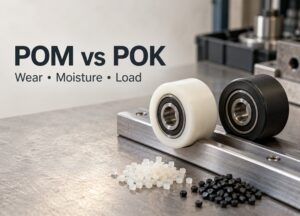
POM is widely used as the outer wheel material in bearing rollers and guide wheels because it combines useful stiffness, dimensional stability, low moisture absorption and good sliding and wear behavior. It can be injection-moulded into flat, grooved or flanged profiles, while a separate steel bearing supports rotation inside the wheel. For material selection, the practical question is often whether a particular POM copolymer (POM-C) or homopolymer (POM-H) grade fits the duty better. POM-C commonly offers a stronger balance for wet or chemically exposed service; POM-H often has an advantage where stiffness and mechanical strength dominate. Neither choice alone determines roller life: the wheel profile, bearing, track, load, speed and temperature must be evaluated as one assembly.
Why is POM used for bearing rollers and guide wheels?
POM offers a practical combination of mechanical stability, sliding behavior and mouldability.
A bearing roller typically combines two different functional parts: an inner bearing that rotates on a shaft or stud, and an outer wheel that contacts the rail, track or product. POM is used for that outer wheel because it is rigid enough to retain a defined profile under many operating conditions, absorbs little moisture compared with many plastics, and has useful wear and sliding properties. Ensinger lists POM applications such as rollers, bearings and slide rails, and describes its low moisture absorption, dimensional stability and wear resistance in its POM material overview.
For an OEM, the material can also be moulded into wheel shapes that would be inconvenient to machine as a one-off part: grooves, flanges, hubs and bearing interfaces. Depending on the product design, the bearing may be overmoulded into the wheel or installed into a separately moulded component. That supports repeatable assemblies when the resin grade, mould design, bearing location and dimensional controls are all specified together.
POM is not itself the rolling bearing. It is the wheel tread or guide surface. The bearing controls the wheel’s rotation; the POM profile controls contact with the track. A good resin choice cannot compensate for a mismatched groove, unsuitable bearing fit or poorly aligned rail.
Image placement — after this section:
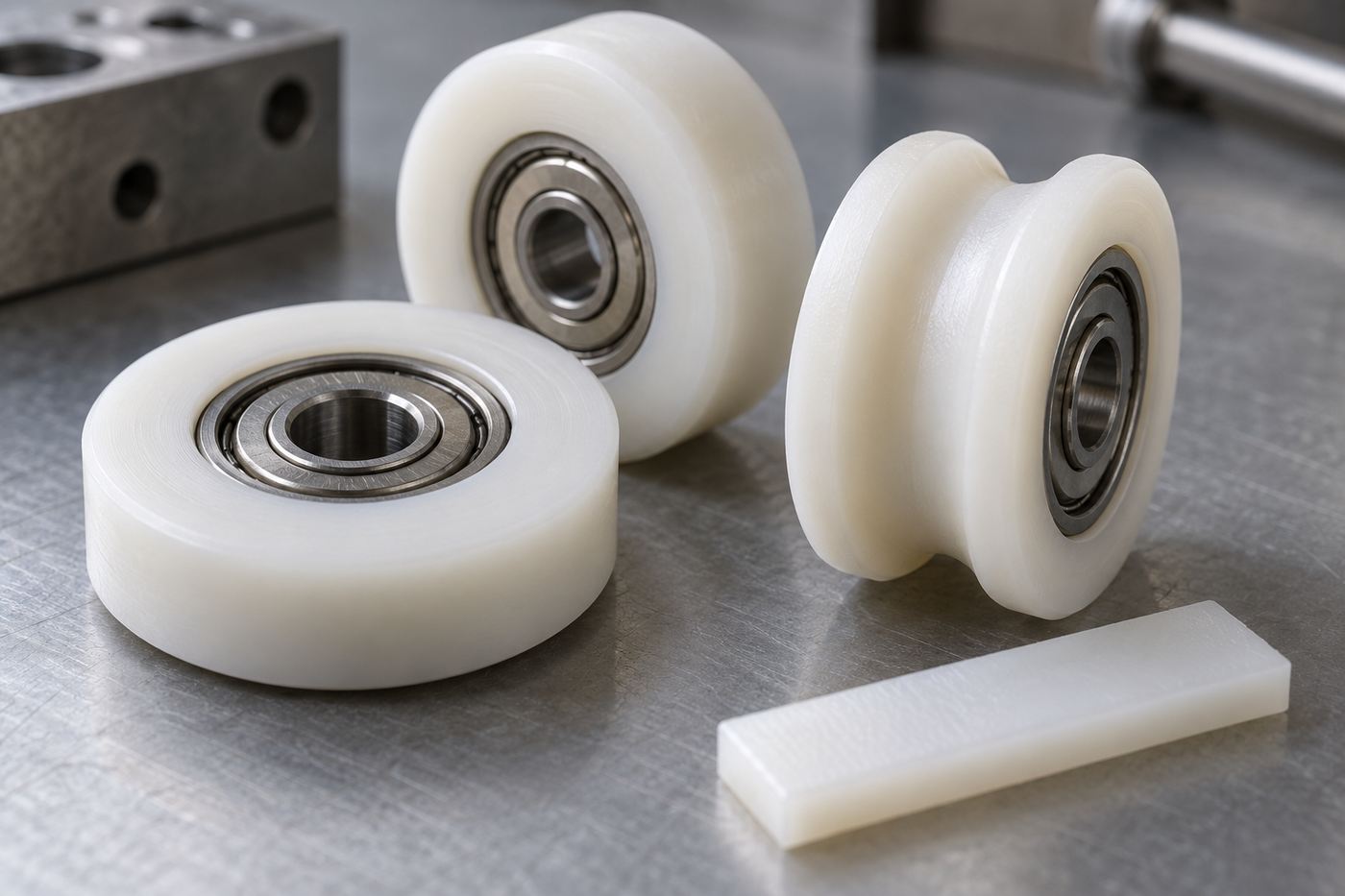 The polymer wheel forms the running surface; the metal bearing inside supports rotation.
POM-C vs POM-H: how should buyers choose?
Start with the dominant operating condition, then confirm it against the exact grade datasheet.
POM-C means acetal copolymer; POM-H means acetal homopolymer. Both are semi-crystalline POM materials, but their molecular structures produce different property balances. Mitsubishi Chemical’s comparison describes POM-H as generally stronger and stiffer, while POM-C generally provides broader chemical resistance and reduced centerline porosity in stock shapes. These are material-family trends, not guaranteed values for every commercial grade.
| Selection factor | POM-C often has the edge when… | POM-H often has the edge when… |
|---|---|---|
| Moisture or chemical exposure | Resistance to water, hydrolysis or a broader range of common chemicals is important. | The environment is relatively dry and chemical exposure is limited. |
| Stiffness and strength | A balanced combination of properties is preferred. | Higher rigidity or mechanical strength is the main material priority. |
| Thick or machined sections | Lower centerline porosity in some stock shapes matters to the part. | The part benefits from the homopolymer’s higher stiffness or hardness. |
| Roller contact | The grade must maintain a stable running profile in a damp application. | The wheel needs a stiffer tread and the environment suits the selected grade. |
These comparisons should not be used as substitutes for a resin manufacturer’s grade data. Mitsubishi Chemical notes that its published properties apply to named standard unfilled grades and specified test methods in its copolymer and homopolymer acetal comparison. Celanese also offers multiple POM-C grades, including grades modified for wear, friction or other needs, so “copolymer” alone is not a complete material specification (Celanese Hostaform/Celcon POM).
When is POM-C a good starting point?
POM-C is often worth evaluating where moisture, water contact or certain cleaning chemicals are part of the service environment. Its chemical-resistance profile can be useful in wet mechanisms, but it is not universally resistant: strong acids, strong alkalis, halogens and other aggressive substances may be incompatible. Confirm the actual chemical, concentration, temperature and exposure time with the resin supplier.
When might POM-H be preferable?
POM-H may be a candidate when the design prioritizes stiffness, strength or hardness and the application is compatible with that grade’s environment limits. This does not mean a POM-H wheel automatically supports a greater system load. Wheel geometry, bearing arrangement, support spacing, temperature, impact and long-term creep all affect the assembly.
What makes POM suitable for roller contact?
Its sliding and wear properties help at the wheel-to-track interface, but test conditions matter.
Guide wheels repeatedly contact a rail or running surface. POM’s stiffness helps the wheel retain its profile, while its sliding properties and wear resistance can support repeated movement. The plastic running surface can also separate a metal bearing from a metal rail, which may reduce direct metal-to-metal contact and operating noise in a compatible design.
However, there is no single friction or wear value that predicts a roller’s field life. Results depend on the exact resin grade and additives, track material and finish, contact pressure, speed, temperature, lubrication, contamination and alignment. A wear-modified POM may behave differently from an unfilled general-purpose grade. Buyers should avoid treating “POM” as a self-lubricating guarantee or selecting a wheel from resin name alone.
Image placement — after this section:
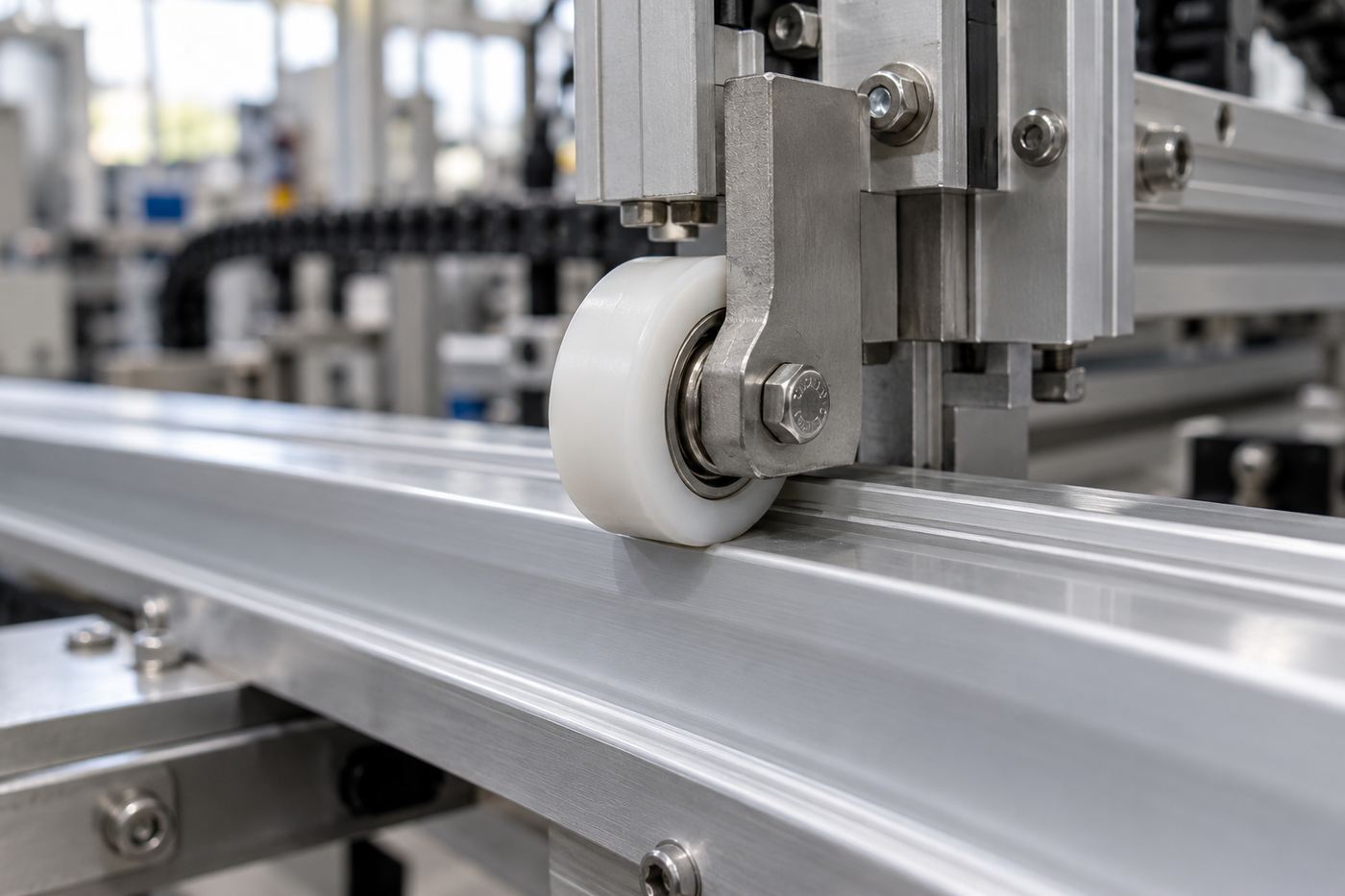 Wheel profile and rail geometry determine where contact occurs and how the guide behaves.
How should POM roller geometry be specified?
Specify the mating surfaces and mounting dimensions, not only the wheel diameter.
For a bearing roller or guide wheel, include the functional dimensions that define track fit:
- Wheel outside diameter and overall width.
- Flat, V-groove, U-groove, convex or flanged running profile.
- Groove angle, radius, depth and flange spacing where applicable.
- Bearing bore or bearing reference, shaft/stud dimensions and retention method.
- Hub or polymer thickness around the bearing, mounting envelope and axial clearance.
- Rail cross-section, material, surface finish and alignment requirements.
A U-groove wheel, for example, should match the diameter and shape of the round rail or cable it follows. A V-groove needs compatible angled faces, while a flat wheel expects a suitable flat running surface. Two wheels with the same outside diameter can behave quite differently if the contact geometry is different.
Image placement — after this section:
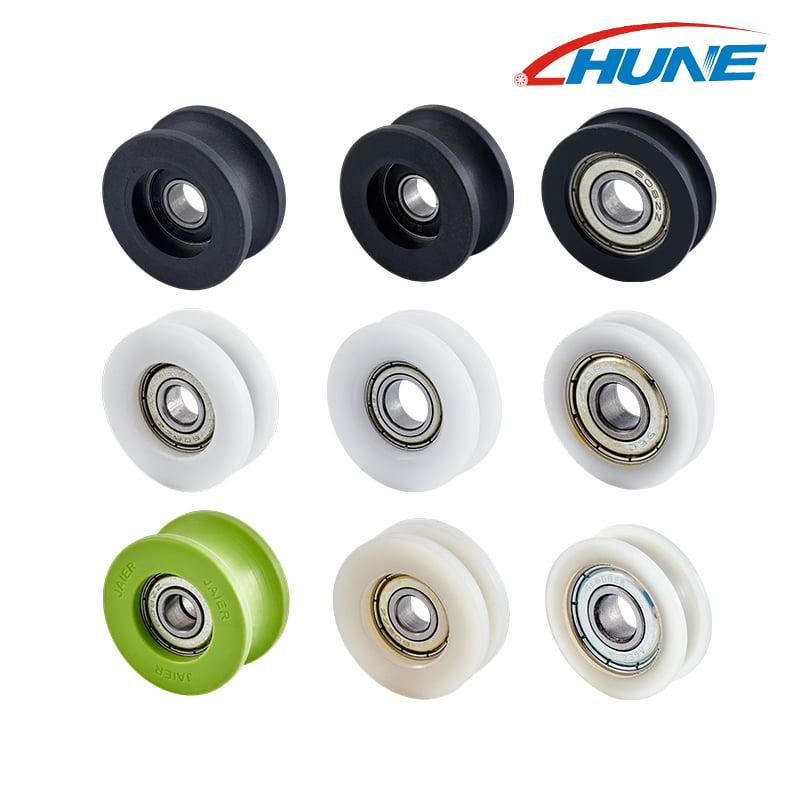 Existing HUNE media-library image; use as a product example, not as a dimensional drawing.
HUNE’s POM bearing roller with a threaded stud combines a POM running wheel, an internal ball bearing and a mounting stud. Its product page notes that the roller’s function depends on the installation and that load direction and wheel count must be confirmed. The wider sliding roller range includes other wheel profiles and mounting structures.
What should OEMs include in a POM roller RFQ?
Send the drawing, track section and operating conditions so the material and wheel can be reviewed together.
A useful request for quotation should state:
- The application and the role of the wheel: supporting weight, guiding laterally, tensioning a belt/cable or another function.
- Total load, load direction, number and spacing of rollers, movement speed, cycle frequency and expected impacts.
- Track cross-section, material, finish and any misalignment or deflection expected in the assembly.
- Wheel profile and critical dimensions, bearing reference, bore, seal/shield and axle or stud details.
- Exposure to moisture, chemicals, dust, UV, temperature changes, lubrication or cleaning agents.
- Resin requirements, if any: POM-C or POM-H, named grade, color, additives, regulatory approvals or traceability.
- Annual volume, sample approval criteria and relevant inspection dimensions.
If the exact resin has not been decided, provide the operating conditions and ask the supplier to compare candidate grades. For new designs, test the roller in the intended track and mounting structure before approving production. HUNE’s OEM process supports review from drawings or samples through bearing, moulded wheel and assembly requirements.
Frequently asked questions
Is POM-C always better than POM-H for a bearing roller?
No. POM-C often suits wet or chemically exposed conditions better, while POM-H may offer higher stiffness or strength in some grades. The correct choice depends on the exact resin grade, load, temperature, track and environment.
Does POM make a roller self-lubricating?
Not necessarily. POM has useful sliding properties, but friction and wear depend on the grade, additives, counterface, pressure, speed, temperature and lubrication. Specify a tribological grade if low friction or wear is a critical requirement.
Is the plastic wheel the bearing?
No. In a bearing roller, the steel bearing supports rotation, while the POM wheel provides the track-contact surface. Both parts and their fit must be specified.
Can a POM guide wheel carry a particular load?
A resin name alone does not define a safe load rating. Load capacity depends on wheel geometry, bearing, mounting, load direction, speed, temperature, support spacing and duty. Ask for application-specific design review and validate the assembly under representative conditions.
What should I send a supplier to select a custom POM guide wheel?
Send a track section or sample, wheel dimensions and profile, bearing and mounting details, load and motion conditions, environment and order quantity. A drawing or existing part helps the supplier review fit and manufacturing route.
Practical recommendation
Choose the POM family from the environment and mechanical duty, then confirm the exact grade and roller design in the real track. POM-C is a sensible candidate to evaluate for moisture or chemical exposure; POM-H is worth comparing when stiffness and strength dominate. Final selection should be based on grade-specific data and a sample test of the complete wheel, bearing, mounting and track.