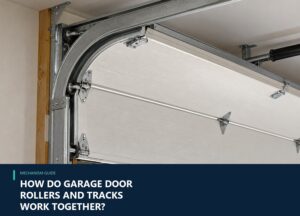

A roller shutter moves because its operator rotates a horizontal barrel, winding or unwinding a connected curtain of slats. As the curtain rises or lowers, the slat ends travel inside two vertical guide rails. The rails keep the curtain aligned and restrain side movement; they do not normally work like tracks carrying a row of small bearing wheels.
The complete motion depends on the curtain, slat-end features, guide channels, barrel, end supports, operator and bottom rail working together. In a typical design, the slats articulate as they enter the curved path around the barrel, while the guide rails control the curtain edges along the straight part of travel. For OEMs, the key questions are how the end geometry fits the rail, how the barrel is supported, and how the whole assembly behaves under its intended operating conditions.
Which parts guide and move the curtain?
The curtain and barrel create the up-and-down motion; the rails control the curtain edges. A conventional rolling shutter includes several interacting parts:
| Part | Function in the system | Interface to check |
|---|---|---|
| Interlocking slats | Form the flexible curtain and transfer motion from one slat to the next | Slat profile, engagement and curtain width |
| Slat ends, end locks or retention features | Keep the curtain edges engaged with the guide channel and help resist pull-out, depending on design | End shape, retention method and clearance to the rail |
| Guide rails | Constrain the curtain edges as it travels vertically | Channel opening, depth, straightness and alignment |
| Barrel or roller tube | Collects the curtain as it rises and pays it out as it lowers | Tube diameter, curtain attachment and support arrangement |
| Operator and drive | Turns the barrel, manually or by motor | Torque, speed, duty cycle and end-limit control |
| End brackets and shaft supports | Carry the barrel ends and its operating reactions | Shaft fit, bearing arrangement and bracket stiffness |
| Bottom rail | Adds a defined lower edge and meets the sill or closing surface | Width, sealing contact and stops or locks |
The precise construction varies. Some systems use end locks or wind-retention features; others use different curtain-edge details. Roll-A-Shield’s component guide describes the box and axle, slatted curtain, two guide rails, operator and accessories as the main groups, and notes pile seals inside guide channels. A ROLLAC parts catalog also identifies rails, a roller tube, brackets and bearing-related components as separate parts of the assembly. These are examples of system layouts, not universal specifications.
Image placement 1 — after this section: Use one HUNE media-library image to illustrate a bearing-integrated roller as a related component type. It is not a standard roller-shutter curtain guide wheel.
How do the guide rails keep the shutter aligned?
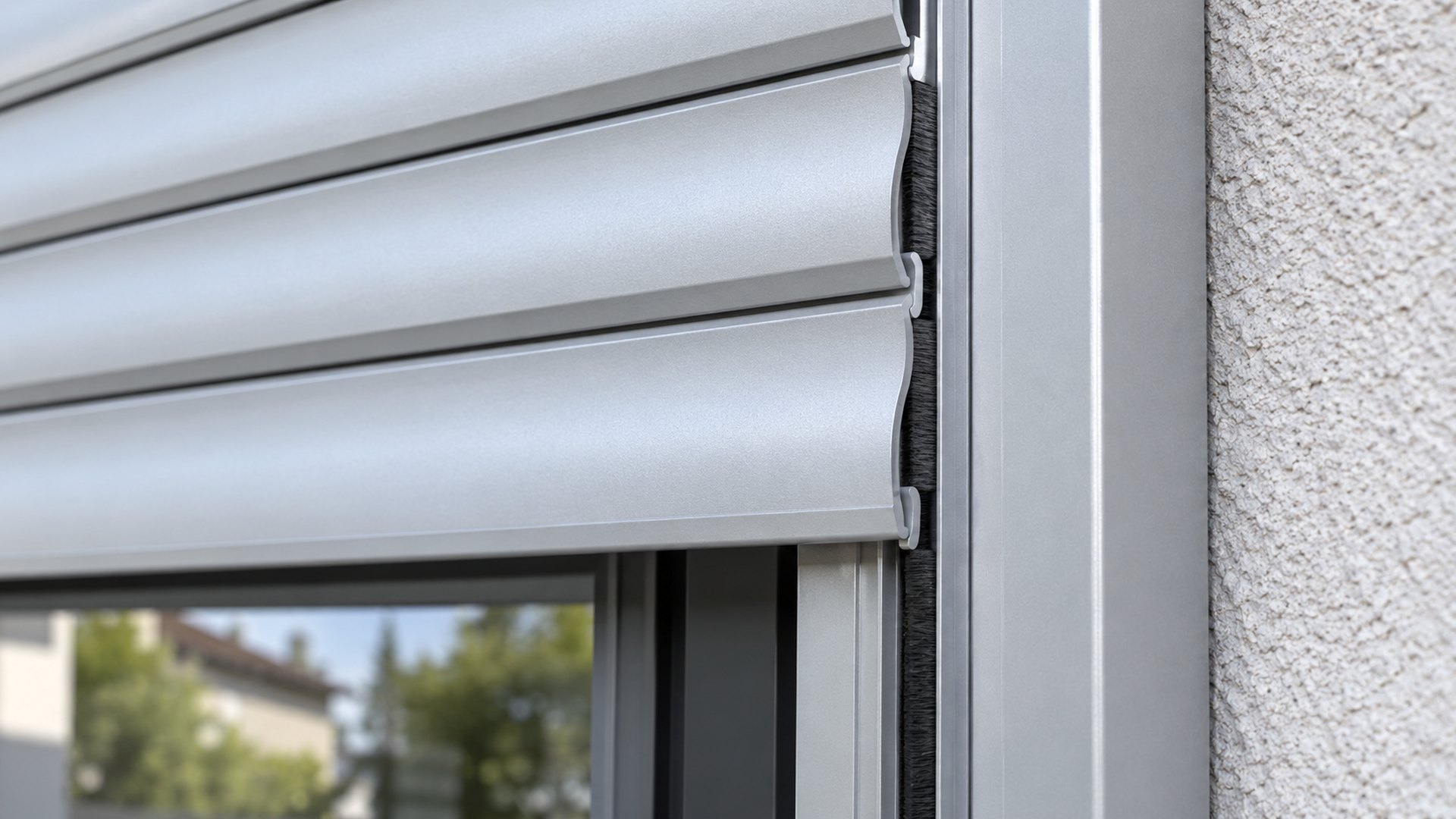
Each rail provides a channel for one curtain edge, limiting lateral movement while allowing the curtain to slide vertically. Depending on the system, the slat ends may run directly within the rail or use end locks and retention features that engage the channel. A brush or pile seal may reduce light, air, dust or rattling at the interface, but it also adds contact and should be included in the operating-force assessment.
The rail’s job is to guide and retain, not to make a misaligned system run smoothly by itself. If the two rails are not parallel, if the opening is out of square, or if the rail entry does not match the curtain-end geometry, the curtain can skew or experience uneven drag. A tight channel can raise friction; excessive clearance can allow more movement and noise. The right balance depends on the slat profile, end feature, materials, seal and environmental requirements.
I normally start with the mating cross-sections rather than a nominal “rail width.” The useful dimensions include the rail’s clear opening and depth, slat-end or end-lock envelope, curtain width, and the clearance available at the rail entrance. Those dimensions should be checked as an assembled pair, including coatings, seals and manufacturing variation.
Image placement 2 — after this section: Insert the generated close-up of the curtain edge and guide channel. It shows the rail-to-curtain interface more clearly than a product-only image.

What happens as the curtain wraps around the barrel?
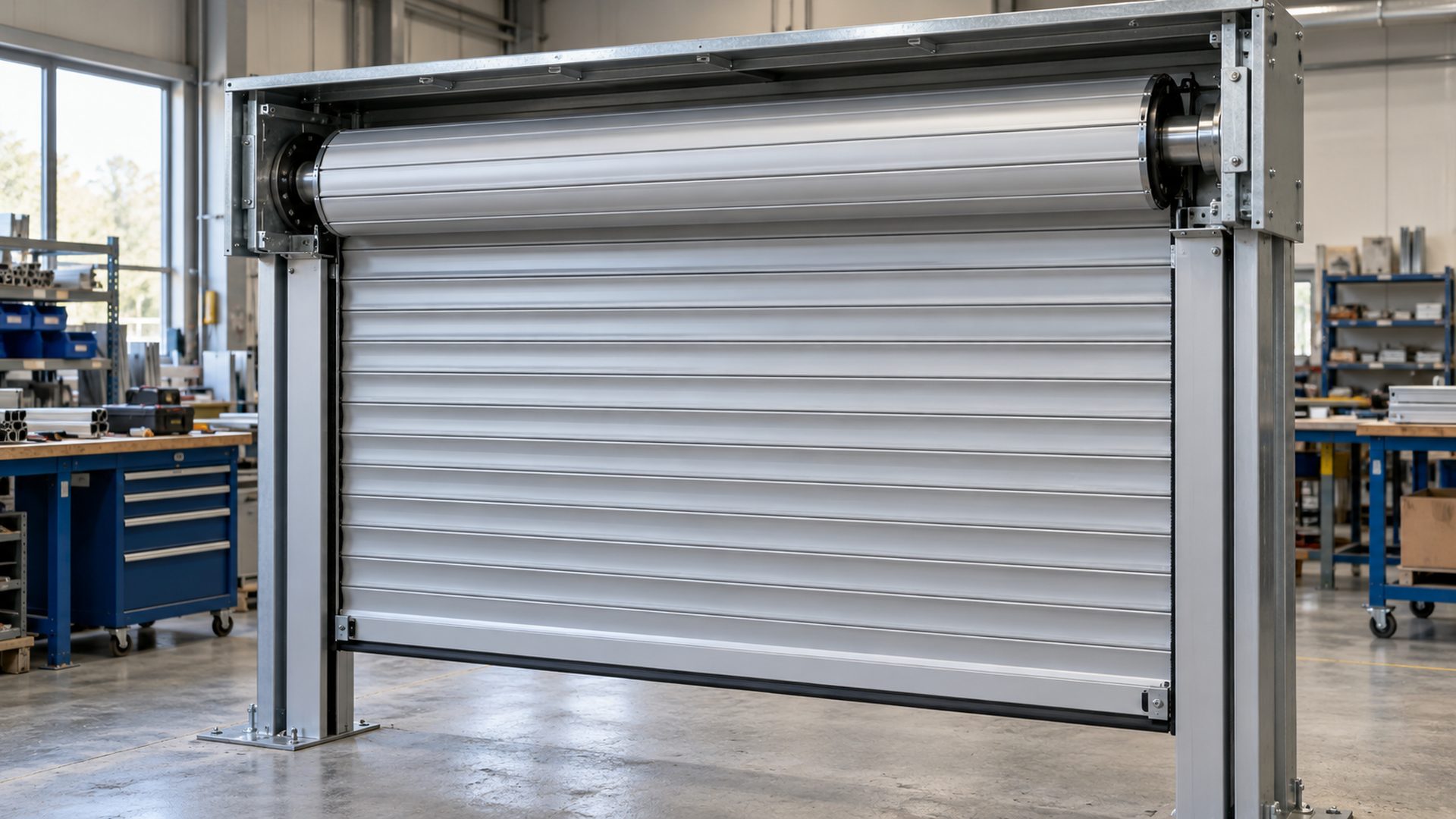
The barrel changes the curtain’s direction, while the slat joints allow it to bend into a roll. When the operator turns the barrel, the attached upper part of the curtain winds onto it. The linked slats pivot relative to one another as the roll builds. When the direction reverses, the curtain unwinds and descends, with its outer edges remaining in the two guide rails.
This means the system has two different motion interfaces: a winding interface at the barrel and a sliding or guided interface at the rails. The barrel supports and operator determine how the curtain is collected; the rails control the edges. On some designs, the top slat attaches through hangers or another connector. The bottom bar helps define the lower edge and may carry seals, stops or locks.
A manufacturer’s parts diagram is useful because it shows why it is misleading to discuss “the roller” as one component: the axle or tube, end supports, curtain, rails and operator are distinct parts. If the barrel support bearing is undersized, poorly fitted or misaligned, the tube may not rotate as intended. If the guide interface is wrong, the curtain may drag even when the barrel support is sound.
Image placement 3 — after this section: Insert the generated assembly photograph to show the barrel, curtain, guide rails and bottom bar as one mechanism.
Where do bearings and bearing rollers fit?
Bearings may support the rotating barrel, but a typical curtain edge is guided by its slat-end geometry inside a channel. This distinction matters when connecting roller-shutter education to bearing-roller sourcing. A standard side guide rail should not automatically be specified as a bearing roller application: many systems use sliding contact at the curtain edge, sometimes with seals or dedicated end-retention parts.
A bearing is more directly relevant at the rotating shaft or barrel support. A bearing-integrated wheel may also be relevant if a particular shutter design includes a separate rolling guide, a moving carrier or an auxiliary mechanism. That decision requires confirmation from the actual assembly drawing. HUNE’s deep groove ball bearing options, plastic-coated bearing rollers and flat roller wheels show different component constructions an OEM might assess for a suitable mechanism. They are examples of HUNE products, not an assertion that a standard shutter curtain uses these wheels; fit and capacity must be checked against the actual application.
When I review a proposed rolling component, I check the wheel or roller profile, bearing bore, outside diameter, axle or stud, mounting bracket and mating track together. I also want the load direction, rotation speed, duty cycle, contamination or moisture exposure, and the expected operating force. For a shutter barrel bearing, shaft dimensions and bracket arrangement matter. For a guide wheel, the wheel-to-track contact geometry and available side clearance matter. These are different component jobs and should not share a specification by assumption.
What should OEMs verify before sourcing parts?
Specify the interfaces and operating conditions as one assembly. A useful drawing package or RFQ should include:
- Curtain width and height, slat cross-section, material and joint geometry.
- Guide-rail cross-section, clear opening and depth, plus any brush or pile seal.
- Slat-end, end-lock or retention-feature geometry and the required engagement with the rail.
- Rail spacing, parallelism and relationship to the barrel axis and opening.
- Barrel or tube dimensions, curtain attachment and end-support arrangement.
- Bearing type and mounting details at the shaft supports, if applicable.
- Operator type, travel speed, operating frequency and end-limit approach.
- Expected curtain mass, wind or other external loading where relevant, and the intended environment.
- Critical dimensions, inspection datums, acceptable running behavior and validation conditions.
- Annual demand, prototype quantity, target production timing and packaging requirements.
Do not send only an outside diameter or a photo if the part must fit a specific rail or shaft. A section drawing of the rail and curtain edge is particularly useful because it reveals whether the interface is sliding, retained or genuinely rolling. For a custom component, HUNE’s OEM/ODM process can be discussed with the drawing, mating geometry and application details in hand.
Frequently Asked Questions
Do roller shutters use wheels inside their guide rails?
Many conventional shutters guide the slat ends or end locks directly inside a channel, so the curtain does not necessarily use small wheels in the side rails. Designs vary, and some assemblies may use rolling components in a separate guide or support function. Check the actual cross-section or bill of materials before specifying a wheel.
What keeps a roller shutter curtain from moving sideways?
The two side guide rails constrain the curtain edges. Slat-end details, end locks or wind-retention features may keep those edges engaged with the rails. The rail spacing, alignment and clearance all affect how securely and freely the curtain travels.
Do guide-rail brush seals affect movement?
They can. A brush or pile seal can close gaps and reduce rattling or ingress, but it also contacts the curtain and contributes drag. Its material, compression, location and compatibility with the curtain should be included when evaluating operating force and wear.
Where are bearings usually found in a roller shutter?
Bearings commonly appear in the support arrangement for the rotating barrel or shaft, depending on the design. They are distinct from the curtain-to-guide interface. The bearing’s bore, shaft fit, support style, load direction and operating conditions should be confirmed from the assembly design.
What should a supplier receive to assess a custom shutter roller?
Send the component drawing, mating rail or shaft dimensions, load direction, expected speed and duty cycle, environment, critical tolerances, target quantity and any validation criteria. Include a section view of the assembled interface so the supplier can see how the part works in the mechanism.
A practical OEM recommendation
Treat the shutter as a coordinated curtain, rail and barrel system before selecting an individual bearing or roller. Confirm the curtain-edge geometry against the rail cross-section, then check rail alignment, seals, barrel supports and operator conditions. If the design includes a separate bearing roller, specify its mating profile, shaft or stud and load path explicitly.
HUNE manufactures bearing-integrated roller components for OEM applications; suitability depends on the specified interface and operating conditions. To review a potential component, send the part drawing, mating geometry, expected loading, duty cycle, environment and annual volume through the HUNE contact page.