
A track-guided awning keeps its moving front bar even by controlling both ends of the bar along matched side guides while the fabric and drive apply balanced forces. The guides may use rollers, sliding shoes, fabric splines or another model-specific arrangement; not every system contains bearing wheels. Rail alignment, front-bar stiffness, guide clearance and fabric tension all affect whether the bar stays square as it travels.
The exact mechanism depends on the awning type. A horizontal pergola or conservatory awning usually moves a front rail along side guide rails above the shaded area. A vertical track-guided blind moves a bottom bar up and down inside side tracks. The same goal—controlled travel with little skew—applies to both, but their load paths and guide elements are different.
What Moves in a Track-Guided Awning?
The front bar is the transverse member that leads the moving fabric; its two ends are constrained by the side guides. In a horizontal conservatory or pergola awning, the fabric is stored or driven from one end and the front rail moves along the roof-side tracks. WAREMA’s conservatory awning overview identifies the fabric, front rail and guide rails as parts of the same system.
In a vertical outdoor blind, the corresponding moving member is often called the bottom bar. Ziptrak describes its track-guided system as using side tracks to guide and retain the fabric, with manual spring-balanced or motorized operation. That is a useful example of the broader principle, but it is a different configuration from a horizontal pergola awning.
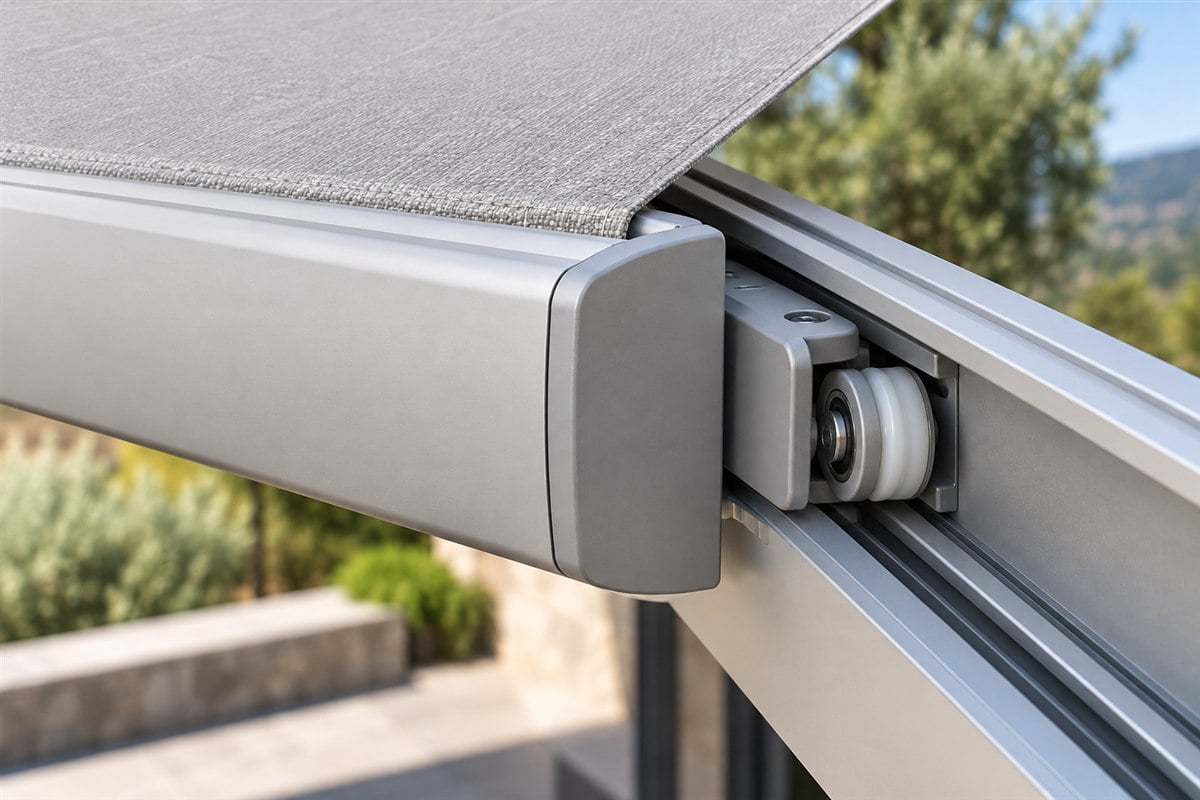
Image placement: after this section. Illustrative concept image; exact rail, fabric and drive layouts vary by awning model.
A complete moving assembly may include:
- a fabric roll or fixed fabric attachment;
- a front bar or front rail that spans the opening;
- left and right guide rails or channels;
- end guides, carriages, glides or fabric-retention features;
- a manual spring, motor, cable, belt or other drive arrangement;
- support profiles that carry the fabric or intermediate reinforcement.
The parts work as a system. The front bar does not stay square because of the roller alone; both ends, the fabric and the drive need compatible geometry and movement.
What Keeps the Front Bar Square?
The two ends must travel at compatible rates with similar resistance, while the front bar resists twisting across its span. A simple design target is equal travel at the left and right ends. How the system achieves that depends on its drive and guide architecture.
In some motorized systems, a common drive arrangement moves the fabric or bar through a coordinated mechanism. In manually operated systems, spring balance or the guide design can help control the effort and position. Some systems use side splines that retain the fabric in channels; others use end carriages with rollers or sliding guides. These are alternative architectures, not interchangeable parts.
The engineering factors that support even motion include:
- Matched guide geometry. The left and right rails need compatible cross-sections and running clearances. If the rails diverge, twist or differ in height, the two ends can encounter different resistance.
- A sufficiently stiff front bar. A wide, flexible bar may twist when fabric tension or wind load is uneven. The profile and end connection must suit the opening width and expected load.
- Balanced drive and fabric tension. Unequal cable tension, spring force, fabric attachment or motor transmission can pull one side ahead of the other.
- Consistent guide friction. A damaged, contaminated or overly tight guide can create drag at one end. The tolerance must allow movement while retaining the bar and fabric as intended.
- Controlled fabric tracking. Lateral fabric guidance can help maintain edge position and tension. WAREMA’s secudrive description explains a design in which a spring-steel strip attached to the fabric guides it continuously in the rail; the details depend on the product configuration.
These are engineering principles, not a claim that every awning uses the same drive or guide technology. For a specific model, the manufacturer’s system drawing determines which end elements actually carry load and which dimensions control travel.
Do Track-Guided Awnings Use Rollers?
Some do, but track guidance does not automatically mean bearing rollers. Depending on the system, the moving end may use a rolling carriage, a polymer glide, a fabric spline captured in a channel, or another guided interface. A vertical blind with a side spline, for example, guides its fabric within the track without the same roller-carriage arrangement found in some horizontal systems.
Where a design does use rollers, the wheel profile must match the rail. A grooved wheel, flanged roller and flat wheel contact a track differently. The bearing supports rotation, while the outer wheel surface and carriage determine how the assembly follows the guide. HUNE’s bearing-integrated sliding rollers and U-groove bearing guide wheels show general roller constructions; they should be treated as component examples, not as awning-specific approved parts.
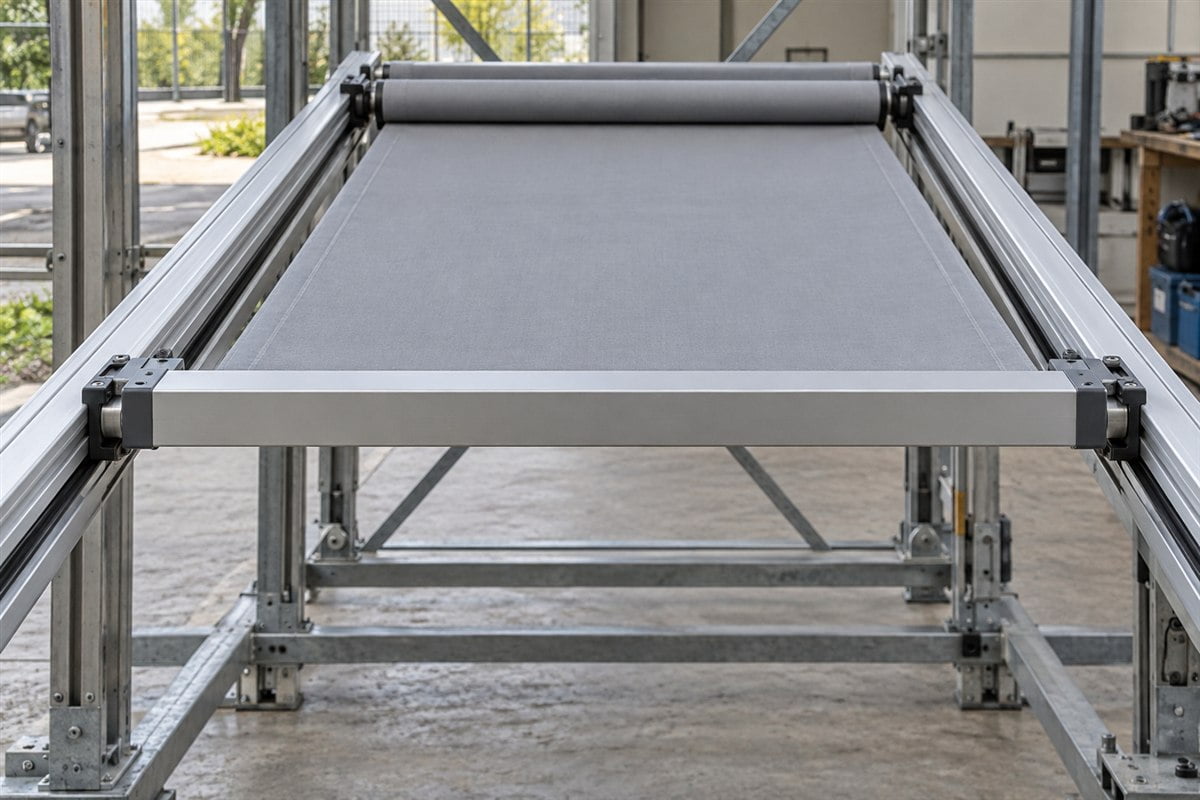
Image placement: in this section after the paragraph introducing roller-guided systems. This is an illustrative example of one possible carriage arrangement, not a universal awning design.
For an OEM roller carrier, review the complete interface: wheel diameter and width, groove or flange geometry, bearing bore, axle or stud, bracket envelope, side clearance and the actual rail section. A wheel that rotates freely on a bench may still bind if its profile or mounting position does not match the installed guide.
Why Can the Bar Travel Unevenly?
Uneven travel is usually a system interaction: different drag at the two ends, poor geometric compatibility or unequal force can make the bar skew. Common design contributors include non-parallel guide paths, inconsistent rail sections, a flexible front profile, unequal fabric tension, variation in carriage fit and debris or water exposure that changes friction.
For a track using small wheels, bearing torque and wheel runout can add to the motion difference, but they are only part of the tolerance stack. The bracket, bearing seat and rail mounting position also affect alignment. In a glide-based or spline-based system, the profile shape, material pair, surface condition and running clearance play the equivalent role.
Wind loading deserves separate consideration. A fabric panel can act as a loaded surface, and its force may not be distributed equally across the bar. Ziptrak’s system FAQ notes that wind pressure can affect operation and that conditions and system configuration matter. A roller or guide component should therefore be selected for the load direction and retention function defined by the awning OEM—not merely by its nominal outside diameter.
How Should OEMs Specify the Guide and Front-Bar Assembly?
Specify the system interfaces before selecting a guide wheel or glide. For an awning project, a supplier should receive enough information to understand the motion, loading, environment and space available at each end of the front bar.
| Information to provide | Why it matters |
|---|---|
| Awning type and orientation | Separates a horizontal roof awning from a vertical track-guided blind |
| Opening width, projection and travel | Defines the front-bar span, guide length and movement envelope |
| Rail cross-section and mounting datums | Controls wheel or glide profile, clearance and alignment |
| Front-bar profile and end connection | Shows stiffness, mounting space and how force reaches each guide |
| Drive arrangement | Identifies whether motion is manual, spring-balanced, motorized, cable-driven or otherwise coordinated |
| Fabric attachment and tensioning method | Affects lateral tracking and force applied to the front bar |
| Expected wind, water, dust, UV and temperature exposure | Influences material, sealing, corrosion and retention requirements |
| Load direction, operating cycles and speed | Helps define bearing, wheel, bracket and wear requirements |
| Initial and annual quantity, sample and inspection needs | Informs manufacturing route, validation and sourcing plan |
If the design includes a bearing roller, send a section view of the guide plus the wheel and bracket drawing. Identify the functional dimensions—running diameter, groove profile, bearing seat, axle or stud location, end clearance and any runout requirement. HUNE’s roller material and process guide explains how the wheel material and construction should be considered alongside the track and service conditions.
!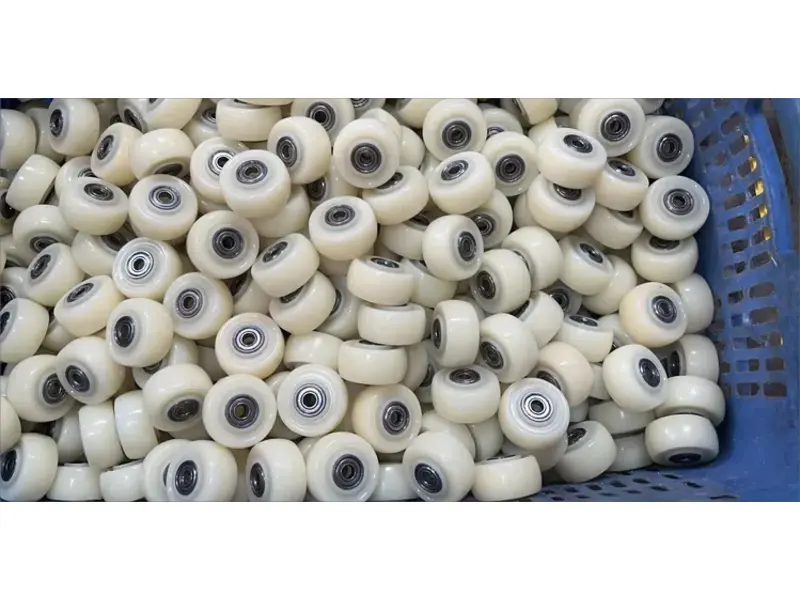
Image placement: after the RFQ table, as a supplier-side example of roller component review. Existing HUNE media-library image; it illustrates rollers, not an awning assembly.
Before production release, validate the complete moving assembly through its intended travel. Check that both ends remain synchronized, the fabric tracks consistently, the front bar does not bind or twist, and the guide elements retain the bar under the agreed operating conditions. Sample approval should represent the production material, geometry and assembly method.
Frequently Asked Questions
What is the front bar on an awning?
The front bar, also called a front rail or leading bar, is the transverse member at the moving edge of the fabric. On a horizontal pergola awning it travels outward along the side guides; on many vertical blinds the similar moving member is called the bottom bar and moves downward in side tracks. The name and load path vary by system.
Do all track-guided awnings have guide rollers?
No. Some use bearing rollers or roller carriages, while others guide the fabric with a spline, use polymer glides, or combine several features. The chosen interface depends on whether the system moves the front bar, fabric edge or both. Review the system drawing before assuming a bearing roller is present or specifying a replacement component.
What keeps the two ends of the front bar aligned?
The paired guides constrain each end, and the front bar connects the two sides across the opening. Even travel also depends on rail geometry, guide clearance, bar stiffness, fabric tension and the drive arrangement. A shared drive may coordinate movement in some systems, while other designs use different mechanisms. The architecture is model-specific.
Can a bearing roller be used in a custom awning guide?
Potentially, if the awning design calls for a rolling carriage and the wheel profile, bearing, axle, bracket and guide rail are compatible. A generic roller is not automatically suitable for outdoor exposure or wind-related loading. The OEM should define the track section, load, speed, environment and retention requirements, then validate the assembled guide in the complete awning.