
OEMs should choose folding-wagon wheels and bearings as one assembly, starting with the wagon’s maximum operating load and the surfaces it must cross. Wheel diameter, tread material and width affect obstacle handling, rolling effort, noise and ground pressure. The bearing, axle, hub, fork and folding frame determine whether that wheel can carry the load while steering and folding as intended. A wheel’s catalogue load rating alone does not establish the capacity of the complete wagon. Load distribution can change when the frame flexes, the ground is uneven or the wagon turns. I would define the real duty, choose the wheel architecture and bearing interface together, then validate a production-representative wagon on the intended surfaces.
What Should OEMs Evaluate First?
Start with the wagon’s real load cases, route and folding layout before selecting a wheel diameter or bearing number.
A folding wagon has a different duty from a warehouse cart that moves on smooth floors. It may cross pavement joints, compact soil, grass, gravel or a short curb transition. It also has to steer, remain stable when loaded, and fold without a wheel or fork colliding with the fabric bed, frame links or one another.
The OEM should define:
- Wagon dead weight and maximum payload.
- How the payload is distributed and whether it can shift.
- Typical route, including surface type and small obstacles.
- Expected walking speed, turning frequency and stop-start pattern.
- Whether the wagon must be pulled, pushed or both.
- Storage, temperature, water, dust and UV exposure.
- Wheel layout and the space available when the wagon is open and folded.
The total load divided by the number of wheels is only an initial average. Wheel loading can vary with frame stiffness, uneven ground, steering geometry and load position. Blickle’s wheel and castor load-capacity guidance considers equipment dead weight, additional load, the number of supporting wheels and a safety factor; its guidance also cautions that loads can vary across four or more wheels. The wagon’s designer still needs to define the appropriate design cases and verify the complete structure.
How Do Wheel Diameter and Tread Affect Wagon Movement?
The tread and diameter determine how the wagon meets the ground, so choose them for the surfaces and handling feel the product must deliver.
A larger wheel generally rolls over small obstacles more easily than a smaller wheel, all else being equal. It can also increase the wagon’s folded envelope, wheelbase or deck height. A wider tread may help the wheel stay on top of softer ground, while adding mass and potentially increasing scrub during tight turns. Those trade-offs should be evaluated with the actual frame and steering layout.
The tread compound and construction change how the wheel feels and performs:
| Wheel construction | Potential benefit | Design points to review |
|---|---|---|
| Pneumatic tire | Cushions impacts and adapts to uneven outdoor ground | Inflation, puncture risk, maintenance expectation and loaded diameter |
| Foam-filled or puncture-resistant tire | Avoids routine inflation while providing some compliance | Rolling effort, mass, tread wear and long-term deformation |
| Solid rubber or elastomer tread | Simple, puncture-free construction with some compliance | Hardness, rolling resistance, heat, wear and surface marking |
| Rigid plastic wheel | Simple and potentially light construction | Noise, impact response, grip and performance on rough surfaces |
| Coated or overmoulded wheel | Can combine a structural core with a chosen contact surface | Bonding or retention, tread thickness, impact and environmental durability |
These are design tendencies rather than guaranteed performance rankings. Compound formulation, wheel structure, hub design, tread pattern, temperature and surface roughness all matter. A softer tread may improve cushioning but raise rolling resistance or deformation. A rigid tread may carry load efficiently on a smooth surface yet feel harsh on rough ground.
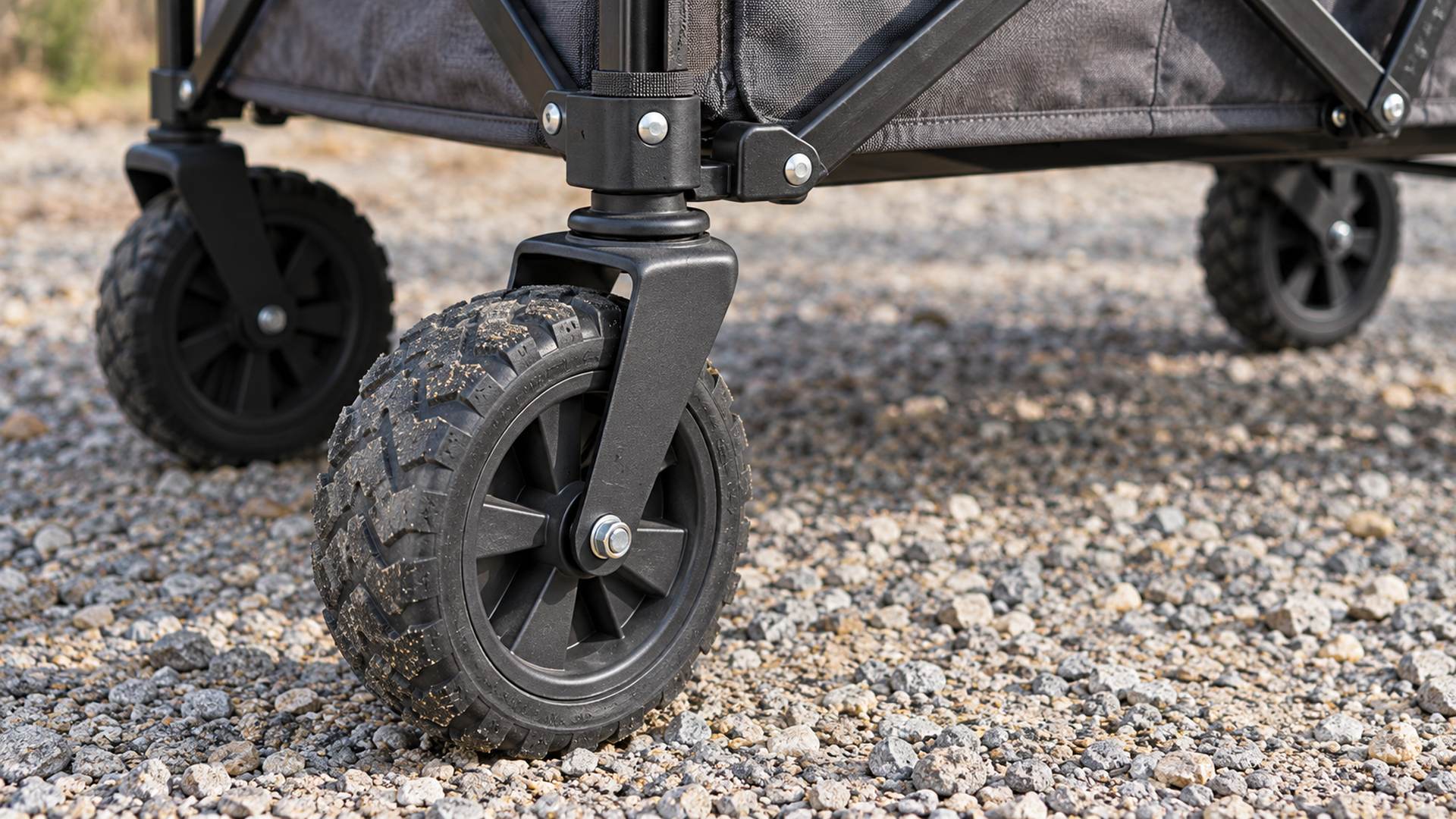 Wheel and axle selection has to fit the fork and folding-frame connection, not just the tire envelope.
How Do the Wheel, Bearing, Axle and Frame Work Together?
The wheel is only one part of the load path; the hub, bearing, axle and supporting frame have to maintain alignment under load.
In a bearing-supported wheel, the bearing sits in the hub while the axle and fasteners retain the wheel assembly. The wheel transfers ground reaction into the hub and bearing; the axle and fork carry that force into the wagon frame. If the hub is too flexible, the axle stack is wrong or the fork spreads under load, a suitable bearing may still rotate poorly or become overloaded.
The assembly drawing should define functional dimensions, not only the outside diameter:
- Tire or tread outside diameter and width.
- Hub width and bearing-seat dimensions.
- Bearing bore, outside diameter and width.
- Axle diameter, shoulder locations, spacers and retention method.
- Wheel centerline relative to the fork and frame.
- Axial clearance after tightening.
- Swivel offset, steering axis and turning clearance, if applicable.
- Minimum clearance between wheels, frame members and fabric in the folded position.
A plain bushing, a single bearing or a pair of bearings may each be suitable in different wheel architectures. The choice depends on radial load, side force, speed, dirt exclusion, available width and assembly method. Do not assume two bearings are automatically better: the hub must hold their seats in alignment, the axle stack must not clamp the rotating parts, and the assembly must tolerate the loads it sees.
Which Bearing Should a Folding Wagon Use?
Choose the bearing from the hub geometry, load direction, speed and environment—not from the bearing designation alone.
A ball bearing can reduce rotational resistance in a compact hub, while a plain bearing may be appropriate for slower, simpler or cost-sensitive constructions. The bearing needs the correct bore-to-axle interface and support in the hub. The wheel’s external load rating does not automatically equal the bearing’s rating, and neither rating alone establishes the wagon’s safe payload.
Outdoor service makes contamination and corrosion part of the decision. Dust, grit and water can reach the hub during storage or use. Seal design may improve contaminant exclusion but can add friction; shielded and sealed versions should be evaluated against the wheel’s speed and environment. SKF’s bearing seal-selection guidance lists contaminants, speed, runout, misalignment, friction and environmental exposure among the factors to consider.
ISO 281 provides methods for calculating rolling-bearing dynamic load ratings and rating life under stated assumptions. It does not cover every field failure mechanism, including wear and corrosion, so the calculated bearing life should not be treated as a prediction of the finished wagon’s service life. See the ISO 281 scope and validate the complete wheel assembly in the intended duty.
HUNE supplies deep-groove ball bearings and plastic-coated bearing wheels for selected roller and guided-motion applications. These are component options to compare only if the required dimensions, mounting, load and environment fit; they should not be assumed to be standard outdoor wagon wheels.
How Should Steering and Folding Geometry Affect the Choice?
A wheel must steer through its full range and clear the folding frame in both its operating and storage positions.
Some wagons use fixed rear wheels with front swivel wheels; others use different steering linkages or multiple swiveling wheels. A swivel wheel’s offset between the vertical steering axis and ground-contact center affects how it aligns during a turn. The wheel must also clear the frame, fabric and neighboring wheel throughout the full steering range.
Folding adds another dimensional condition. Check the wheel’s position as the frame collapses, including the fork’s rotation, axle protrusion, tire compression and any handle or latch movement. A wheel that fits in the open configuration may interfere with a cross-link or fabric panel when folded.
The drawing should identify the open and folded envelope, relevant datums, steering travel, wheelbase and track width. If the frame uses scissor links, the designer should include the link positions and pivot locations so the wheel assembly can be checked against the full motion path.
Why Should OEMs Test the Complete Wagon?
A component sample can confirm fit; only a representative wagon trial can show how the system behaves under load on the intended route.
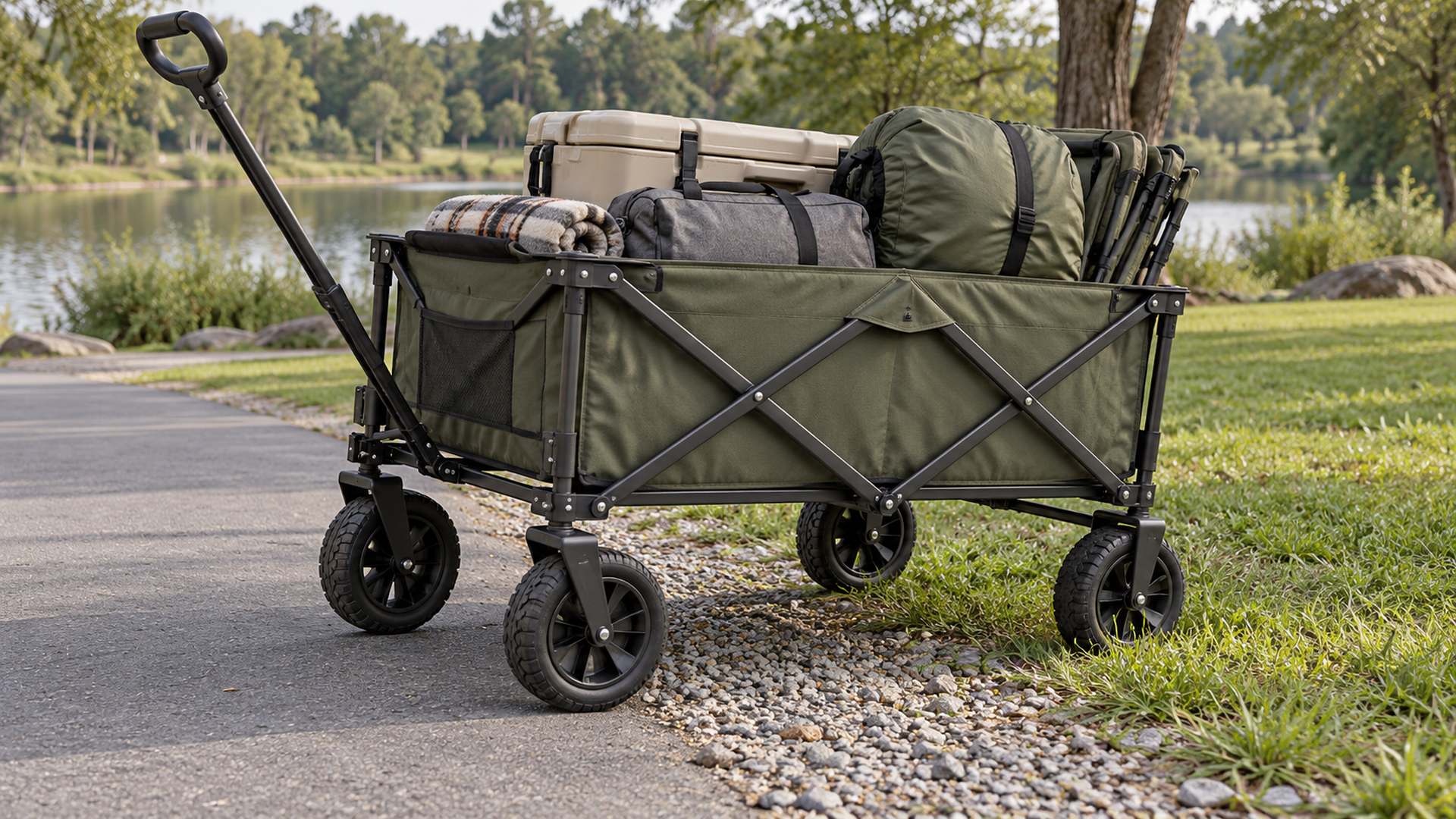 Surface transitions change wheel loading and rolling effort, so validate the assembled wagon rather than only the wheel.
A useful evaluation plan compares the unloaded and loaded wagon on the surfaces that matter to its customers. Check turning effort, straight-line tracking, wheel wobble, noise, tread wear, hub temperature and whether the load shifts or interferes with steering. Include the maximum intended payload and a realistic off-center load if the wagon can be loaded unevenly.
The sample should also be folded and reopened repeatedly while confirming that the wheels, forks, frame links and fabric remain clear. Any change in bearing feel after tightening the axle can point to an incorrect spacer stack, hub distortion or fork alignment issue. Record the sample configuration, wheel material, bearing variant, axle hardware and test conditions so production parts can be compared with the approved design.
Where Could a Bearing-Roller Supplier Fit?
A supplier of compact bearing rollers can support a defined wheel or guide component, but an outdoor wagon’s main wheels need validation as a complete load-bearing design.
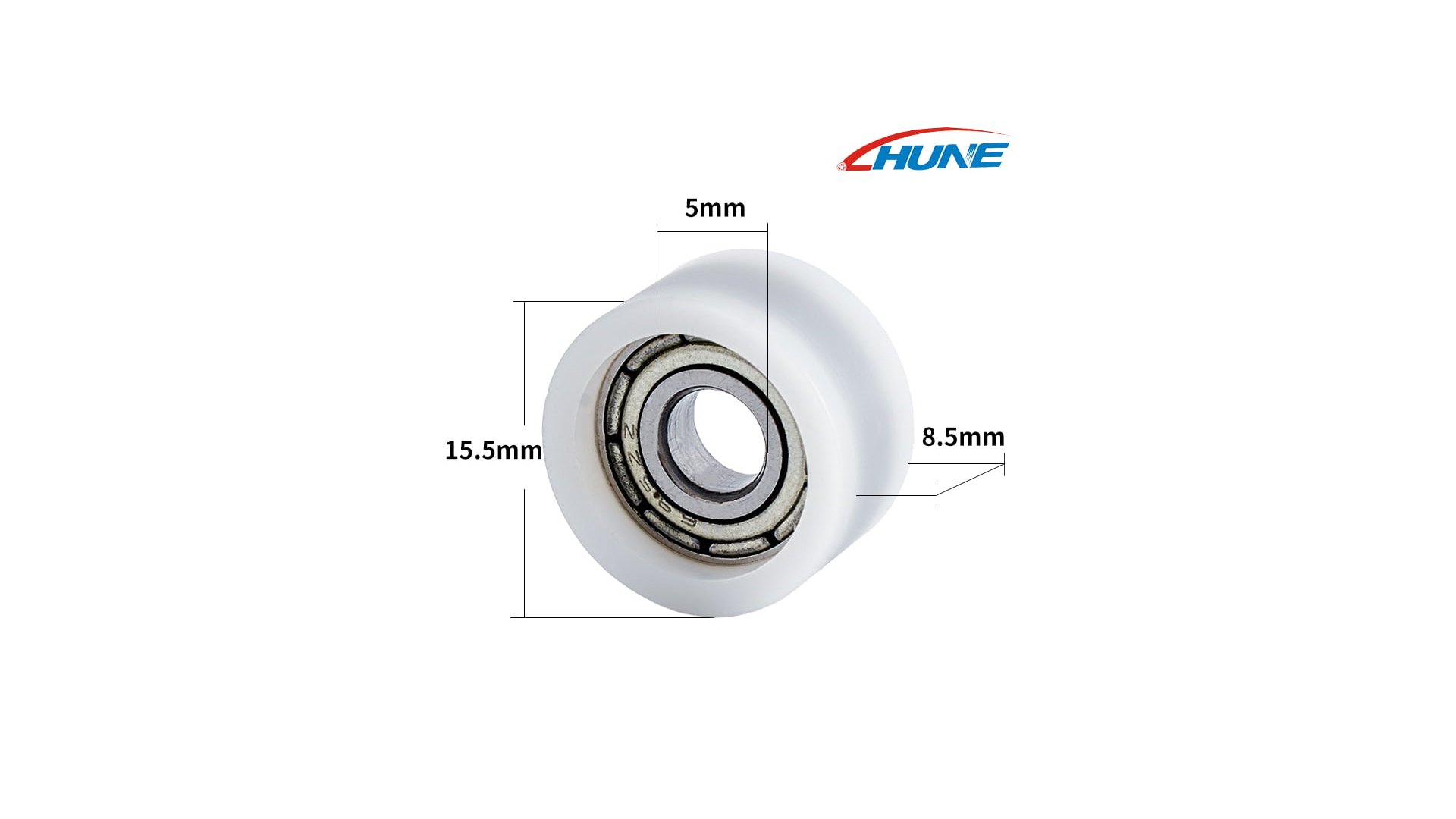 This existing HUNE media image shows a small plastic-coated bearing roller with an integrated bearing. It illustrates the component relationship, not a wagon-scale wheel.
A plastic-coated bearing wheel may be relevant when the application calls for a compact polymer tread over a bearing, or when the wagon design includes a small guide or positioning wheel. It is not automatically interchangeable with a pneumatic or solid-tire wheel used to carry the wagon and payload over rough ground.
For a customized bearing-wheel component, send the supplier the mating parts, hub and axle dimensions, load direction, speed, environment and quantity. The HUNE OEM process begins with a drawing, sample or application information so the structure and manufacturing route can be reviewed. HUNE can evaluate the bearing or coated-wheel portion where the geometry and duty fit; the wagon OEM remains responsible for validating the full product.
What Should a Buyer Include in a Folding-Wagon Wheel RFQ?
Send enough information to let the supplier assess the wheel, bearing and installation as one assembly.
Include:
- Product drawing or 3D model, plus a sample if available.
- Maximum gross load, load distribution and intended number of supporting wheels.
- Wheel diameter, width, hub space and fork dimensions.
- Intended surface types, obstacle conditions and expected use frequency.
- Required tread material, hardness or performance characteristics, if known.
- Bearing type or required bearing dimensions, if fixed.
- Axle diameter, shoulders, spacers, retention and tightening method.
- Swivel or steering requirements and full folded/open clearances.
- Exposure to water, dust, grit, temperature and UV.
- Sample quantity, annual volume, packaging and inspection criteria.
The buyer should also identify which features are critical to fit and performance: wheel concentricity, bearing-seat fit, axial play, tire-to-frame clearance or steering offset. A drawing that specifies only wheel diameter leaves the supplier without the information needed to confirm the assembled mechanism.
Frequently Asked Questions
How many wheels should a folding wagon have?
That depends on the frame, payload, steering layout and stability target. Four wheels are common, but the load is not necessarily shared evenly among them, especially on uneven ground. The OEM should validate wheel loads and frame reactions for the complete design.
Are ball bearings always better than bushings in wagon wheels?
No. Ball bearings can suit applications that need lower rotational resistance or higher wheel speed, while a bushing can fit simpler, slower or cost-sensitive designs. Load, contamination, fit, friction and service expectations should guide the choice.
Should an outdoor wagon use sealed bearings?
Seals can help limit water and dirt entry, but they may add rotational drag. The right closure depends on actual exposure, speed, maintenance expectations and bearing design. A seal label by itself does not make the whole wheel assembly waterproof.
What wheel material is best for gravel and grass?
There is no universal best material. Wheel diameter, width, tread pattern, compliance, inflation and load all influence performance. Compare candidate wheel constructions on the actual surfaces with the intended payload.
Can a small plastic-coated bearing roller be used as a wagon wheel?
Only if the complete wheel is designed and validated for that load, speed, axle and outdoor environment. A small guide roller intended for a rail or mechanism should not be treated as a wagon’s main load-bearing wheel based on appearance alone.
Practical Recommendation for OEM Buyers
Choose the wheel around the wagon’s heaviest realistic use case and the roughest surface it is expected to cross. Then check the bearing, hub, axle, fork, steering and folding clearances as one system. Approve samples only after a representative loaded wagon trial confirms movement and folding behavior.
If you are sourcing a bearing or customized coated-wheel component for a folding-wagon project, send HUNE the drawing or sample, mating dimensions, load direction, operating environment and target quantity through our contact page. We can review the component scope and advise whether an existing bearing or roller structure is suitable for evaluation.