
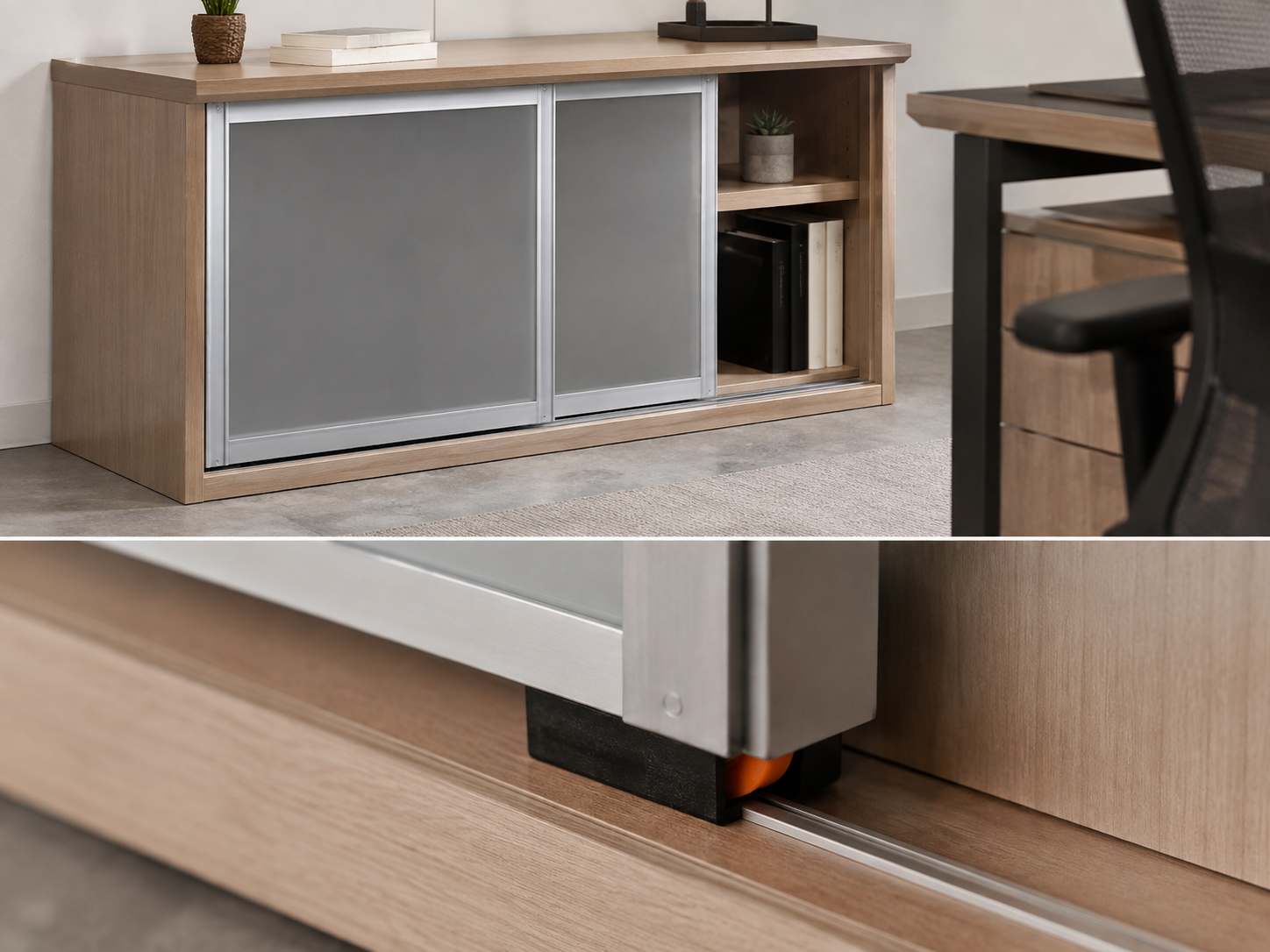
A plastic roller wheel can support, guide or stabilise a sliding storage cabinet. The correct design depends on where the load enters the system. A bottom-running wheel carries weight. An upper guide controls movement. A captive roller prevents the panel or cabinet from leaving its path. These parts may look similar, but they do not perform the same job.
Furniture hardware buyers often receive an outside diameter, a photograph and a target price. This information is not enough for a controlled quotation. The supplier also needs the moving mass, track section, wheel position, mounting method, travel distance, operating frequency and permitted noise.
At HUNE, Zhejiang Huaneng Micro Bearing Co., Ltd., we manufacture injection-moulded wheels, bearing rollers, stamped brackets and customised roller assemblies. We review the wheel, axle, bracket and track as one mechanism. This article explains how furniture manufacturers, storage-system brands, importers and OEM procurement teams can choose the correct architecture before they compare materials or prices.
The discussion covers cabinets, sliding storage units and small mobile shelving mechanisms. It does not assign a load or safety rating to a standard furniture wheel. The finished furniture manufacturer must validate the complete system.
Which Roller Position Carries the Load?
The first purchasing decision is not the resin. It is the roller’s function inside the cabinet.
| Roller position | Primary function | Main design input | Common purchasing error |
|---|---|---|---|
| Bottom-running support | Carries the moving cabinet or panel | Load per wheel and track contact | Selecting from total cabinet mass without load distribution |
| Upper guide | Controls lean and lateral movement | Guide clearance and side force | Treating the guide as a main load wheel |
| Captive anti-lift roller | Keeps the moving part within the path | Retention clearance and installation sequence | Running the roller under constant compression |
| Side guide | Limits sideways drift | Contact frequency and edge finish | Using hard continuous contact to correct poor alignment |
| Small mobile base wheel | Supports a storage unit that moves on the floor or rail | Floor condition, turning arrangement and impact | Substituting a cabinet guide wheel for a castor |
| Drawer or internal carriage roller | Supports a short guided stroke | Rail section, extension and stop impact | Ignoring the load increase near full extension |
A cabinet may use several positions at the same time. The lower rollers can support weight while the upper rollers only control the panel. If the upper guides carry unintended weight, they can bind, wear on one edge or pull a light bracket out of alignment.
The buyer should calculate or test the load at each wheel position. Dividing the total mass by the number of wheels can be misleading. An uneven floor, flexible cabinet base, offset centre of gravity or assembly tolerance can place more load on one wheel.
How Does the Cabinet Architecture Change the Wheel Design?
Two storage products can use the same wheel diameter and still require different components.
Is the panel suspended or bottom-running?
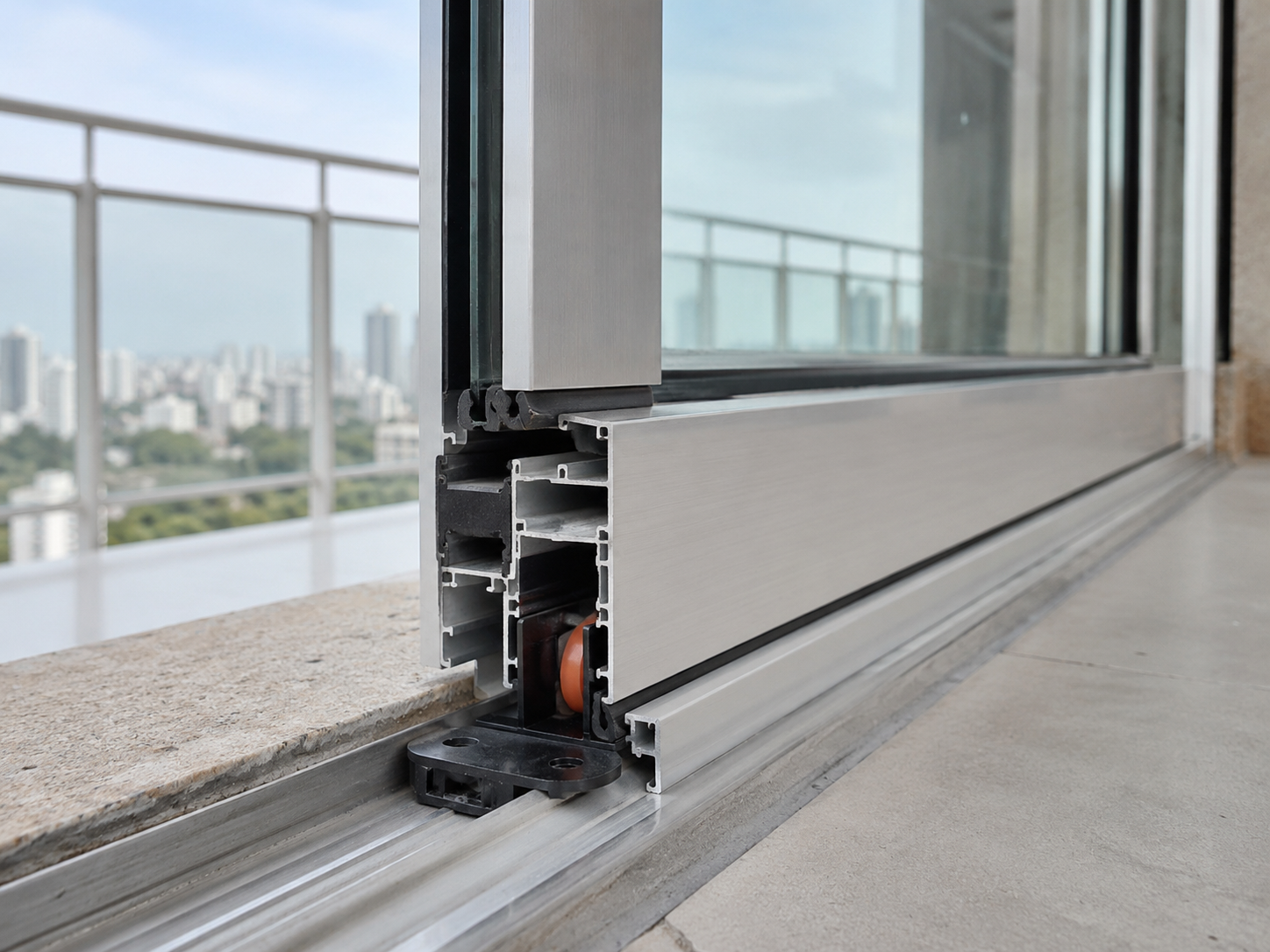
A suspended panel transfers its mass through upper hangers. Its lower wheel may only guide. A bottom-running cabinet transfers mass into the lower track or floor. Its upper component usually stabilises the movement.
The drawing must show the complete load path. The supplier cannot infer it from the wheel alone.
Does the unit move inside a track or across a floor?
A track-guided wheel has a defined mating profile. A floor-running wheel meets joints, debris and local surface changes. A small moulded cabinet roller should not be presented as a floor castor unless the completed assembly has been designed and tested for that duty.
Does the moving part extend beyond its support?
A drawer or pull-out storage module can create a larger moment near full extension. The rear and front rollers may experience different forces during travel. The buyer should provide the closed, mid-travel and fully extended arrangement.
How do users start and stop the movement?
An end stop can transfer impact through the cabinet frame, roller bracket or wheel. A soft-close mechanism changes the final travel but does not remove every impact. The buyer should identify the stop location and expected operating behaviour.
Which Track Information Must Buyers Provide?
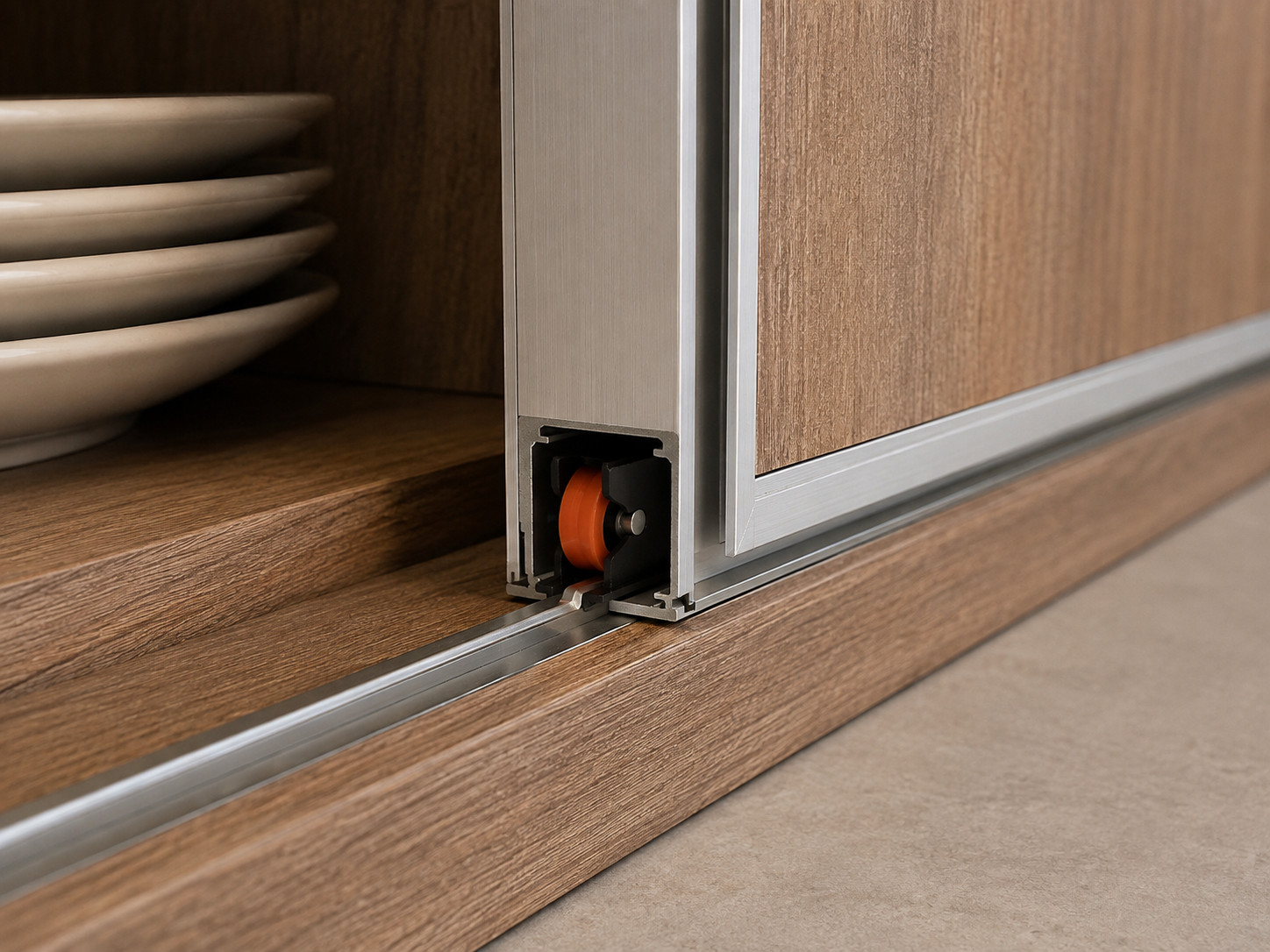
The track controls the real running surface. A wheel drawing without a track section leaves the most important interface undefined.
Provide:
- Track cross-section with tolerances
- Track material and surface finish
- Joint or fixing positions
- Minimum and maximum track width
- Straightness and level assumptions
- Debris or dust exposure
- Permitted lubrication
- Installation access
- Wheel insertion and removal sequence
- Stops, ramps and transitions
An extruded aluminium track, stamped steel channel and laminated furniture board have different contact behaviour. A profile that centres well on a metal rail may mark a decorative board or trap debris inside a channel.
The track drawing should identify the contact points. It should also show whether the wheel rolls on its centre, shoulder, groove or flange. The maximum wheel diameter may not be the effective running diameter.
How should track variation be considered?
The sample test should include track sections near the permitted minimum and maximum dimensions. A wheel that fits the nominal track may bind at the narrow limit or become loose at the wide limit.
The furniture manufacturer should also check assembled track alignment. Individual track pieces can meet their own dimensions while two installed sections create a step or offset.
Which Wheel Profile Fits the Contact Surface?
The profile should create stable rolling contact without unnecessary rubbing.
| Contact arrangement | Possible wheel profile | Buyer must confirm | Main limitation |
|---|---|---|---|
| Broad flat rail | Flat or slightly crowned wheel | Contact width and axis alignment | Edge rubbing if the wheel is skewed |
| Rounded rail or rod | U or rounded groove | Rail radius and groove clearance | Bottoming or pinching when dimensions vary |
| Angled matching rail | V profile | Included angle and contact position | High local stress on soft material |
| Channel with lateral retention | Flanged wheel | Flange clearance and edge radius | Constant flange rubbing if the track is misaligned |
| Decorative board surface | Smooth radiused running face | Marking, debris and wear test | Surface damage from embedded particles |
A deep groove does not automatically improve retention. It can create thin side walls, collect dust and make installation difficult. A high flange can resist disengagement but may rub continuously if the cabinet frame twists.
The buyer should define normal clearance. Positive retention and free rolling require different dimensions. If the roller must prevent lift, the complete upper and lower spacing should control that function. The supplier should not remove all clearance by increasing wheel diameter.
Which Plastic Material Should Buyers Consider?
The words “plastic wheel” and “nylon wheel” do not identify a controlled material.
When can POM be considered?
POM can provide a stable moulded surface, low friction and useful dimensional consistency. It is often considered for furniture guide and support wheels. The exact grade, filler and contact surface still require approval.
When can PA or nylon be considered?
PA materials can provide toughness and wear resistance. Moisture can affect dimensions and mechanical behaviour. This matters when a wheel runs with small track clearance or is stored in different humidity conditions.
When can rubber or an elastomer layer help?
A compliant surface can reduce hard contact noise and improve grip. It can also deform, collect dirt or develop a flat area under static load. A soft outer layer should not be selected only because the buyer wants a “quiet wheel”.
When should filled engineering plastics be reviewed carefully?
Glass fibre or mineral filler can change stiffness, shrinkage, density and wear. The filler may also affect the mating surface. A harder filled material can mark an aluminium or decorative track if contact pressure and finish are unsuitable.
| Furniture requirement | Material property to evaluate | Approval method |
|---|---|---|
| Quiet movement | Surface hardness, damping and bearing condition | Installed sound comparison under equal load |
| Stable track clearance | Moisture response, creep and shrinkage | Conditioned dimensional inspection |
| High cycle frequency | Wear and heat behaviour | Representative cycle test |
| Decorative surface protection | Hardness, finish and contamination | Cosmetic inspection on actual track material |
| Static loaded storage | Creep and permanent deformation | Loaded dwell followed by movement test |
| Cleaning exposure | Chemical compatibility | Test with the intended cleaner and method |
| Visible colour requirement | Pigment and batch control | Approved colour sample under agreed lighting |
At HUNE, we connect the approved material to the drawing and sample record. We do not treat colour or density alone as proof of a resin grade.
When Does a Furniture Roller Need a Bearing?
A bearing can reduce rotational resistance and improve repeatability. It also increases part cost, hub size and assembly requirements.
A simple plain-bore wheel may suit a light guide position with short travel and low cycle frequency. A bearing roller may be more appropriate when the wheel rotates frequently, carries a defined load or must maintain smoother movement.
The decision should consider:
- Load at the wheel position
- Wheel speed
- Travel frequency
- Start-stop cycles
- Required starting force
- Dust exposure
- Axle arrangement
- Available hub wall thickness
- Permitted play
- Required service method
The catalogue rating of the bearing is not the rating of the completed furniture roller. The plastic hub, axle, bracket, rivet and track can become the limiting parts.
Should the bearing be overmoulded or pressed in?
Direct overmoulding can integrate the bearing into the wheel. The process must control material flow, shrinkage and bearing rotation. A later press fit allows the wheel and bearing to be inspected separately, but excessive interference can distort the hub or reduce bearing clearance.
For radial-bearing interface terminology and tolerances, buyers can consult ISO 492:2023. The standard does not define the finished plastic wheel or cabinet assembly. Those functional tolerances require a separate agreement.
How Should the Axle and Bracket Be Designed?
The wheel cannot compensate for an unsuitable mounting structure.
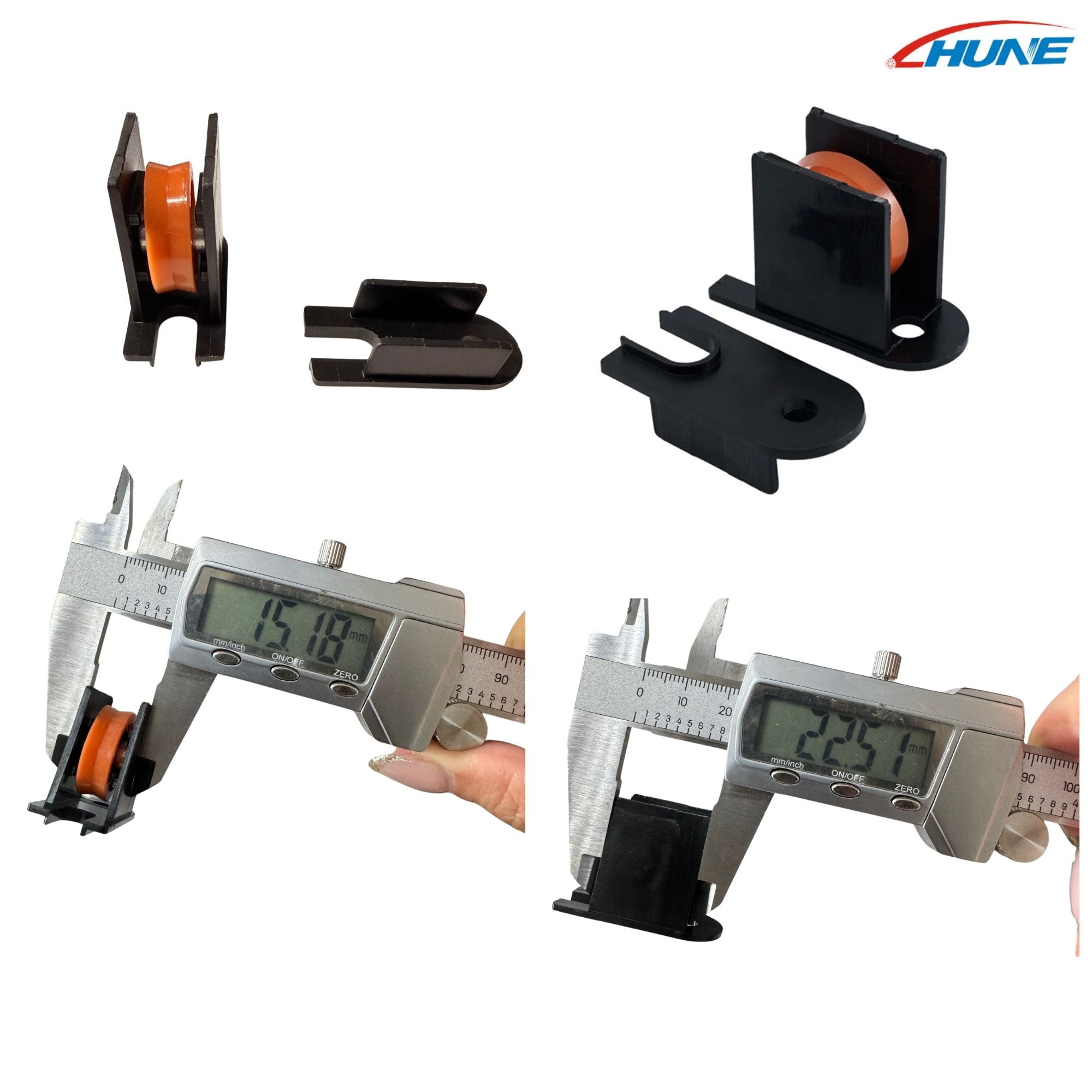
A stamped bracket can provide a compact and economical assembly. Its material thickness, forming angle, hole position and spring behaviour affect wheel alignment. A riveted axle can reduce part count, while a screw and spacer can support service or adjustment. Each route creates different controls.
The supplier should review:
- Axle diameter and tolerance
- Axle material and finish
- Rivet or screw retention
- Spacer width
- Bracket material and thickness
- Forming angle
- Hole position
- Parallelism around the wheel
- Adjustment range
- Fastener access
- Risk of loosening in repeated movement
An over-tightened screw can clamp the bearing or wheel. A short spacer can allow bracket plates to bend inward. A loose rivet can create noise that buyers incorrectly attribute to the plastic.
At HUNE, our injection-moulding, stamping, bearing assembly and secondary machining capabilities allow us to review these interfaces together. Tooling should begin only after the buyer approves the installed stack, not only the loose wheel.
Which Tolerances Control Cabinet Movement?
Tight tolerances on every dimension increase cost without guaranteeing better movement. The drawing should control the dimensions that affect the load path and track contact.
Typical functional characteristics include:
- Effective running diameter
- Wheel width
- Groove or flange geometry
- Bore or bearing position
- Radial runout of the completed wheel
- Axial wobble
- Overall bracket width
- Wheel-to-bracket clearance
- Mounting-hole position
- Adjustment travel
- Installed upper-to-lower roller spacing
The cabinet system also has a tolerance stack. Track position, panel squareness, bracket location and wheel diameter can combine. A nominally correct roller may bind when every surrounding component reaches an unfavourable tolerance limit.
Which tolerance stack should buyers review?
| System variable | Minimum-condition risk | Maximum-condition risk |
|---|---|---|
| Wheel diameter | Excessive looseness or poor engagement | Binding or constant compression |
| Track width | Reduced guidance | Wheel or flange interference |
| Bracket position | Cabinet lean or uneven load | Contact with surrounding structure |
| Upper guide spacing | Excessive lateral play | High rolling resistance |
| Axle clearance | Difficult assembly | Noise and unstable tracking |
| Panel or frame squareness | One wheel loses contact | One wheel receives excessive load |
The prototype should test adverse combinations, not only nominal parts.
What Can a Real Material Investigation Teach Furniture Buyers?
The following is a real HUNE material-control case. The customer’s application was not documented as a storage cabinet, so we do not present it as a furniture project. The case explains why a buyer should control the compound instead of approving a plastic roller by appearance.
The customer sent us an original sample and identified the outer material as POM with 30% glass fibre. We manufactured the requested sample, but its weight differed from the original by more than 100 grams. We did not hide the discrepancy or change the drawing. We sent both samples for material analysis.
The investigation showed that the original material was POM with approximately 18% glass fibre and mineral content. The original description and the analysed composition were different. We then used the material evidence to discuss the correct production direction with the customer.
What is the procurement lesson?
Plastic composition can affect:
- Density and component weight
- Shrinkage
- Stiffness
- Surface behaviour
- Moulding conditions
- Dimensional consistency
- Wear against the track
A furniture buyer should provide the exact material specification when it is known. If it is not known, the buyer should label it as unconfirmed and decide whether sample analysis is justified. A visual match does not prove material equivalence.
This case also shows why weight should be treated as evidence, not as the only acceptance criterion. Two compounds can have similar dimensions and different densities. The approved record should contain the material direction, drawing revision and functional sample result.
How Can Buyers Control Noise Without Guessing?
Noise is a system result. The wheel material is only one contributor.
| Noise pattern | Possible source | Useful first check |
|---|---|---|
| Repeating sound once per wheel revolution | Runout, local defect or contamination | Mark wheel position and compare repetition |
| Rattle during direction changes | Axle play, bracket clearance or loose fastener | Inspect installed free play |
| Scraping throughout travel | Flange contact, skewed bracket or narrow track | Check contact marks and alignment |
| Noise only under load | Hub deformation, bearing fit or track deflection | Compare unloaded and loaded rotation |
| Impact at one location | Track joint, fixing head or local step | Inspect the matching travel position |
| Squeak after cleaning | Cleaner residue or material interaction | Repeat with controlled cleaning method |
The buyer should test noise with the real cabinet mass, track length and installation. A wheel that sounds quiet when spun by hand may become noisy when the bracket is tightened or the cabinet frame twists.
Sound readings are only comparable when the test distance, room, load, speed and track remain controlled. If the project requires a numerical noise limit, the furniture manufacturer should define the method before sample approval.
How Should a Prototype Be Approved?
A useful furniture-hardware trial follows the mechanism through its full travel.
How should buyers inspect incoming samples?
Measure the critical drawing dimensions and record the sample revision. Confirm the material, bearing, axle and bracket construction. Check the completed wheel’s rotation and visible moulding condition.
How should buyers install the sample?
Use the intended fastener, spacer, bracket and track. Tighten the assembly with the production method. Confirm that tightening does not increase resistance or pull the bracket out of parallel.
How should buyers test the load range?
Test the minimum and maximum intended cabinet configurations. Include uneven load placement when it represents real use. Observe whether all supporting wheels remain engaged.
How should buyers test the complete travel?
Check starting force, smoothness, noise, alignment, stop impact and retention from closed to fully open. Repeat the test in both directions.
How should buyers test adverse tolerances?
Use track and cabinet assemblies near relevant tolerance limits. Include joints, transitions and installation positions that created concern during design review.
How should buyers review durability?
Run a representative cycle plan defined by the furniture manufacturer. Inspect wheel wear, bearing rotation, bracket movement, axle retention, track marking and cabinet alignment at agreed intervals.
What should buyers retain after approval?
Both parties should retain an approved sample and record:
- Drawing revision
- Plastic grade and colour
- Bearing model or plain-bore construction
- Axle and bracket specification
- Critical dimensions
- Track revision
- Cabinet configuration
- Test load and cycle method
- Approved noise and cosmetic limits
- Accepted deviations
When Is a Custom Mould or Bracket Justified?
An existing wheel is the preferred starting point when its contact profile, material, bearing and installation fit the cabinet. A custom part becomes reasonable when a functional requirement cannot be controlled with an existing structure.
| Development route | Suitable situation | Main limitation |
|---|---|---|
| Existing wheel | Track and installation already match | Limited material and dimensional choice |
| Existing wheel with secondary machining | One accessible dimension needs a small correction | Added cost and reduced wall thickness |
| New wheel mould | Profile, diameter or material must change | Tooling and sample approval are required |
| Existing wheel with new bracket | Wheel works but mounting geometry differs | New stamping control may still be needed |
| New wheel and stamped bracket | Load path and adjustment require a new assembly | More interfaces must be validated |
| Prototype mechanism | Track contact remains uncertain | Prototype behaviour may differ from production tooling |
Freeze these items before tooling:
- Roller function
- Load path
- Track section
- Effective running diameter
- Profile and clearances
- Material grade
- Bearing or plain-bore choice
- Axle and retention method
- Bracket geometry
- Adjustment range
- Critical tolerances
- Annual and order quantity
- Approval plan
Changing the bearing after the wheel mould is complete can change the hub wall and outside geometry. Changing the bracket position can alter load distribution even when the wheel stays unchanged.
Buyers can review our OEM and ODM roller development process when deciding between an existing product, machining and new tooling. Relevant structures can also be compared in our sliding rollers with bearing category.
What Should a Production Release Record Contain?
| Release item | Confirmation question | Status |
|---|---|---|
| Furniture system | Is the cabinet, drawer or storage mechanism identified? | ☐ |
| Roller position | Does the wheel support, guide, retain or stabilise? | ☐ |
| Load path | Is the force at each wheel position understood? | ☐ |
| Track | Are section, material, finish and tolerances approved? | ☐ |
| Profile | Are contact points and clearances defined? | ☐ |
| Plastic | Is the exact material direction recorded? | ☐ |
| Bearing | Is the bearing or plain-bore structure confirmed? | ☐ |
| Axle | Are diameter, fit and retention approved? | ☐ |
| Bracket | Are material, thickness and forming dimensions controlled? | ☐ |
| Tolerance stack | Have adverse combinations been reviewed? | ☐ |
| Noise | Is the acceptance method defined? | ☐ |
| Surface | Are marking and cosmetic limits agreed? | ☐ |
| Installation | Does the sample use production fasteners and tightening? | ☐ |
| Travel | Was the complete opening and closing path tested? | ☐ |
| Load range | Were minimum, maximum and uneven loads considered? | ☐ |
| Stops | Were impact and retention checked? | ☐ |
| Duration | Was a representative cycle plan completed? | ☐ |
| Sample | Do buyer and supplier retain the approved component? | ☐ |
| Revision | Does the order reference the approved drawing? | ☐ |
| Release | Has the furniture manufacturer approved the complete system? | ☐ |
Which Plastic Roller Wheel Design Should Buyers Choose?
The best plastic roller wheel for a sliding storage cabinet is the design that matches the roller’s position and load path.
A bottom support wheel must carry the real distributed load. An upper guide should control movement without becoming an unintended support. A captive roller needs controlled clearance. The profile must match the track, and the material must suit the contact surface, environment and operating frequency.
Buyers should decide between a plain-bore wheel and a bearing roller from the actual duty. They should then review the axle, bracket and tolerance stack. Noise, wear and smoothness must be tested in the complete cabinet rather than judged from a loose sample.
Our real material investigation showed why an assumed resin description can create a production mismatch. Material evidence, approved drawings and installed testing should form one release record.
If you are sourcing a standard or customised furniture sliding roller, send us the cabinet assembly drawing, track section, wheel position, moving mass, travel, operating frequency, material preference and expected order quantity. We can review whether an existing wheel is suitable or whether the project needs machining, a new mould, a stamped bracket or a complete custom assembly.