Is the outer diameter enough to select a u groove roller? Can one roller work for both a sliding door and a machine? Should you use an existing wheel, modify it or open a new mould?
I receive enquiries like this every week:
> We need a 5 × 30 × 10 mm U-groove wheel. Please quote your best price and load capacity.
These dimensions give me a starting point. They do not tell me whether the wheel will fit the track, protect the contact surface or remain stable in the buyer’s assembly.
A suitable U-groove roller must match the track or rope, load pattern, movement frequency, mounting structure and working environment. A purchasing team should also consider annual demand, replacement supply, inspection standards and tooling costs.
A wheel with the right outer diameter can still fail if the groove, bearing, material or installation clearance is wrong.
What Does a U-Groove Roller Size Mean?
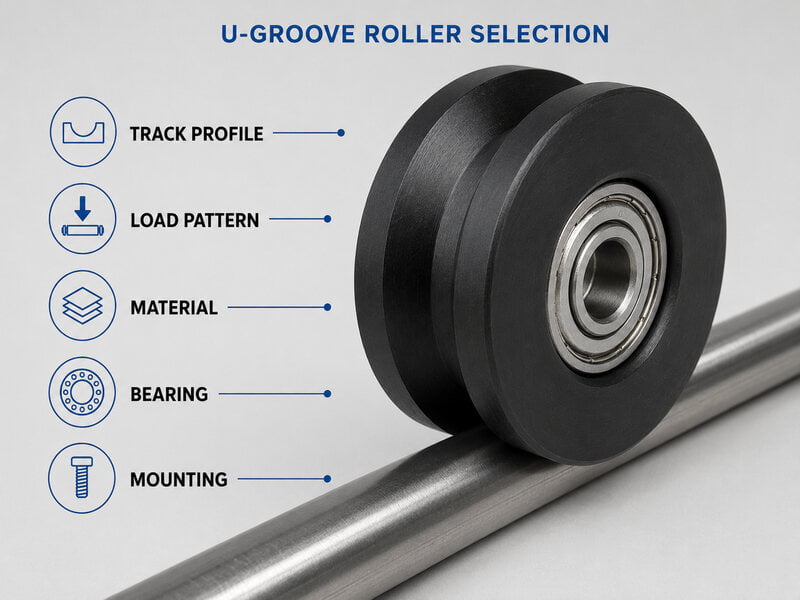
A size such as 5 × 30 × 10 mm normally means a 5 mm inner bore, a 30 mm outer diameter and a 10 mm total thickness. It does not describe the groove or the full roller structure.
For the U-groove wheels that we produce, we normally read the dimensions in this order:
| Dimension | Meaning | Example |
|---|---|---|
| Inner bore | Diameter of the centre hole | 5 mm |
| Outer diameter | Full outside diameter of the wheel | 30 mm |
| Thickness | Total width of the wheel | 10 mm |
Purchasing teams often send these three dimensions and expect an exact match. I can use them to search our mould library, but I still cannot confirm the application.
I also need to check the following details:
| Missing detail | Why I need it |
|---|---|
| Groove width | It affects track or rope clearance |
| Groove depth | It affects guidance and contact position |
| Groove profile | It must match the track or rope shape |
| Bearing model | It affects the bore, movement and mounting structure |
| Shaft or bolt size | It affects installation |
| Bracket space | It limits the total wheel width |
| Dimensional tolerance | It defines whether a close existing wheel can work |
| Track material | It affects material and surface decisions |
Two rollers can both measure 5 × 30 × 10 mm and still use different grooves, bearings and plastic grades.
This is why a basic size should start the discussion, not finish it.
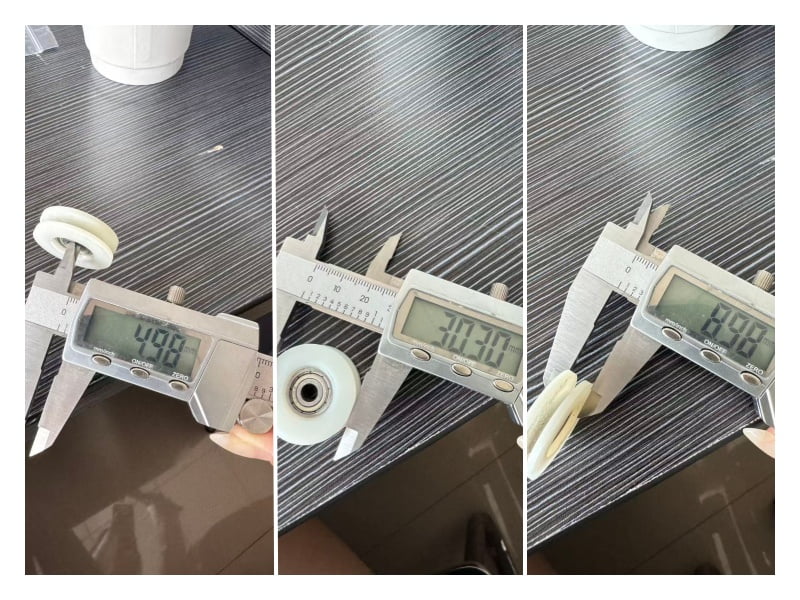
Image Prompt: Realistic close-up of a black POM U-groove wheel with a metal bearing. Mark 5 mm as the inner bore, 30 mm as the outer diameter and 10 mm as the total thickness. Use clean technical labels and a horizontal composition.
Why Should You Select the Track Before the U-Groove Roller?
The track or rope determines the required groove width, depth and profile. The outer diameter alone cannot confirm the correct U-groove roller.
The groove is the contact point between the wheel and the guide surface. I therefore ask what will run inside the groove before I confirm a product.
The contact part may be:
- A round steel track
- A metal rod
- A round tube
- A wire rope
- A cable
- A non-standard guide profile
The buyer should provide a track cross-section, rope diameter, physical sample or clear installation drawing.
How can the wrong groove cause problems?
| Matching problem | Possible result |
|---|---|
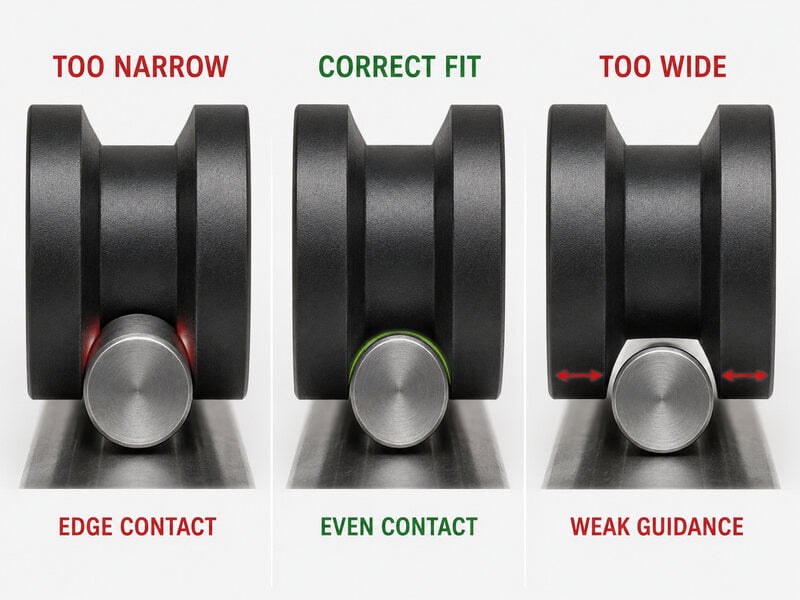
| Groove is too narrow | Edge contact, friction, jamming or local wear |
| Groove is too wide | Weak lateral guidance or wheel movement |
| Groove is too shallow | The wheel may leave the intended running position |
| Groove is too deep | The track may contact the wrong area of the wheel |
| Groove profile is wrong | Concentrated contact and uneven wear |
| Installation is misaligned | Noise, wobble or bearing stress |
| Track surface is rough | Faster wear on the plastic outer wheel |
I do not use one fixed groove clearance for every project. The required clearance depends on the track profile, installation tolerance, load and movement.
A distributor may need a general product range for several customers. An OEM needs a stable part for one assembly. These buyers may require different levels of dimensional control.
If you are developing a new door or equipment system, read our custom plastic-coated bearing rollers guide before you approve the wheel structure.
Do Doors and Machinery Need Different U-Groove Rollers?
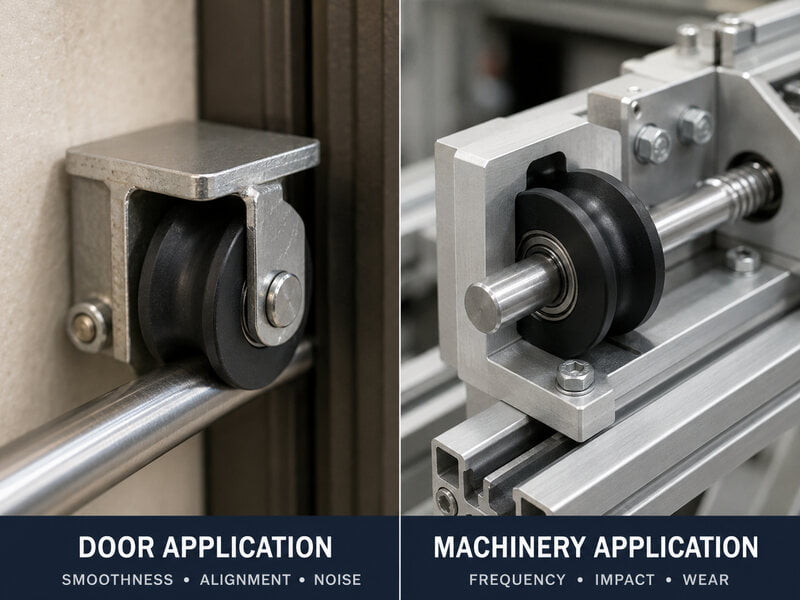
Yes. Door applications often focus on smooth movement, noise, alignment and appearance. Machinery applications may add speed, frequent movement, impact, vibration and non-standard mounting.
A door roller and a machinery roller may look similar in a catalogue. Their working conditions can be very different.
| Selection point | Door and window systems | Machinery and equipment |
|---|---|---|
| Movement frequency | Often intermittent | May be frequent or continuous |
| Main concern | Smooth movement and alignment | Wear, speed and production stability |
| Noise | Often noticed by the user | Depends on the machine |
| Impact | Door slamming may matter | Starting, stopping and impact may matter |
| Appearance | May be important | Often secondary to function |
| Mounting | Door frame, bracket or housing | Shaft, bracket or custom assembly |
| Environment | Indoor, outdoor or humid | Dust, oil, heat, chemicals or vibration |
| Supply need | Stable replacement for a door system | Stable component for equipment production |
For a sliding door project, I normally ask about:
- Door weight
- Number of load-bearing wheels
- Track profile
- Required movement and noise level
- Installation space
- Indoor, outdoor or wet use
For a machinery project, I also ask about:
- Movement frequency
- Travel speed and distance
- Impact and vibration
- Static or moving load
- Temperature
- Dust, water, oil or chemical contact
A sliding roller for a door that opens ten times per day does not face the same conditions as a wheel inside equipment that moves hundreds or thousands of times.
The application must guide the selection.
Why Is the Total Load Not Enough to Select a Bearing Pulley?
The total assembly weight does not show the actual load on each bearing pulley. The buyer must also explain the wheel quantity, load direction, movement and possible impact.
A buyer may divide a 200 kg door by four rollers and assume that every wheel carries 50 kg. The real load may not remain equal.
Several conditions can move more load onto one wheel:
- An uneven track
- Frame deformation
- Installation tolerance
- Poor bracket alignment
- Impact during starting or stopping
- A door or machine that leans to one side
- A wheel that loses contact with the track
For this reason, I ask the buyer to provide the load pattern instead of one total weight.
| Required information | Question to answer |
|---|---|
| Total load | What is the full moving weight? |
| Roller quantity | How many rollers carry the load? |
| Load distribution | Does each roller carry an equal load? |
| Load direction | Is the main force radial, axial or combined? |
| Movement | Is the load static, intermittent or continuous? |
| Speed | How fast does the assembly move? |
| Travel | How far does it move in each cycle? |
| Impact | Does the wheel face sudden starts or stops? |
| Alignment | Can installation tolerance create an uneven load? |
| Test standard | What must the sample pass? |
I do not publish one universal load rating for every 30 mm U-groove wheel. The plastic grade, bearing, wheel body, shaft, bracket, test speed and track all affect the result.
A load claim only has value when the supplier states the product structure and test conditions.
Which Material Should You Use for a U-Groove Roller?
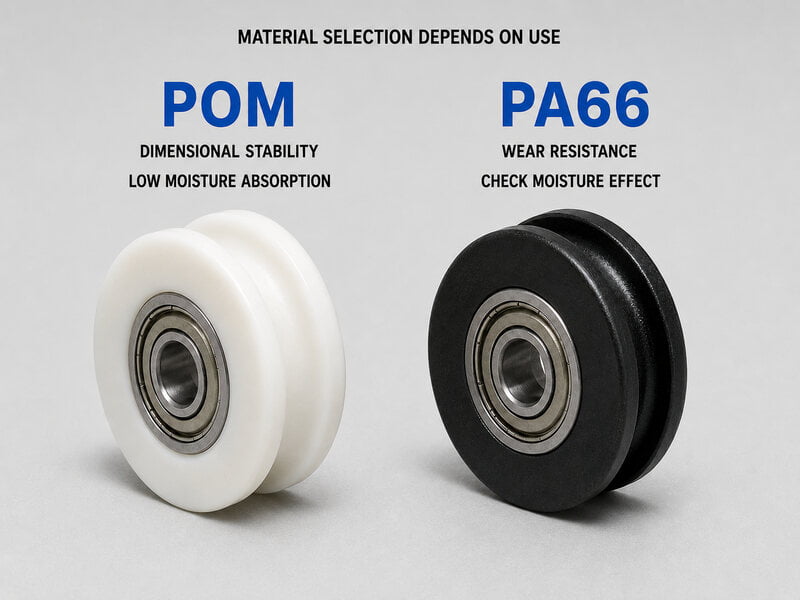
POM is our normal starting material for many plastic-coated bearing rollers. We may consider PA66 when wear is a main concern, but the final choice must follow the environment and product requirements.
We use POM as the default outer material for many U-groove rollers. It offers useful dimensional stability, a clean surface and good machining performance for many door and machinery applications.
However, I do not treat POM as the answer for every project.
If a customer has a high wear requirement, we may consider PA66 nylon after reviewing the track, load, movement and environment.
| Material point | POM | PA66 |
|---|---|---|
| Common use in our rollers | Default choice for many projects | Selected for specific working conditions |
| Dimensional stability | Useful for precision wheel dimensions | Moisture can affect dimensions |
| Wear requirement | Suitable for many standard applications | May suit higher wear demands after evaluation |
| Moisture response | Lower moisture absorption | Higher moisture absorption must be considered |
| Machining | Suitable for secondary machining | Depends on grade and structure |
| Final selection | Based on the complete application | Based on the complete application |
PA66 can offer good abrasion resistance and low-friction properties, but it can absorb moisture and change dimensionally. Ensinger’s PA66 material guide supports both points.
This is why I do not say that PA66 is always better than POM.
The material grade also matters. Additives, moisture, temperature, load and track finish can change the result.
Which working conditions affect the material choice?
- Indoor or outdoor use
- Sunlight and UV exposure
- Low or high temperature
- Water and humidity
- Dust or other contamination
- Oil or chemical contact
- Movement frequency
- Track roughness
- Required noise level
- Required dimensional stability
- Food-contact or other compliance needs
For outdoor use, buyers should confirm UV and temperature requirements. Standard plastic can age under long-term sunlight. Some materials can also become brittle at low temperatures.
For humid use, I check more than the plastic. I also review the bearing seal, shaft, bracket and exposed metal parts.
Read our roller material selection guide for more information about POM, PA and other engineering plastics.
How Does the Bearing Affect the Sliding Roller?
The bearing, shaft and mounting structure affect how the sliding roller moves. A correct plastic outer wheel cannot correct a wrong bearing or poor installation.
Some buyers use the term bearing pulley for a plastic or metal wheel moulded around a ball bearing.
The complete assembly can also include:
- A shaft
- A bolt
- A spacer
- A washer
- A stamped bracket
- A metal housing
- A retaining part
The buyer should provide the bearing model if it is known. However, the bearing number alone does not define the full roller.
I still need to confirm:
- Inner bore
- Bearing outer diameter
- Bearing width
- Seal or shield type
- Shaft fit
- Axial clearance
- Bracket width
- Retaining method
- Working environment
Dust, moisture and contamination can affect the bearing. Seals can help keep contamination away from the rolling contact, but the seal structure must match the application.
I may consider a 2RS sealed bearing for some wet or contaminated applications. I do not treat 2RS as a universal answer. Speed, rolling resistance, environment and product structure still need review.
A buyer should send the complete assembly information instead of selecting the bearing and outer wheel separately.
Can an Existing U-Groove Roller Be Modified?
Yes. We can sometimes use secondary machining to reduce the outer diameter or adjust the groove. We must first check the remaining material, tolerance, structure and track requirements.
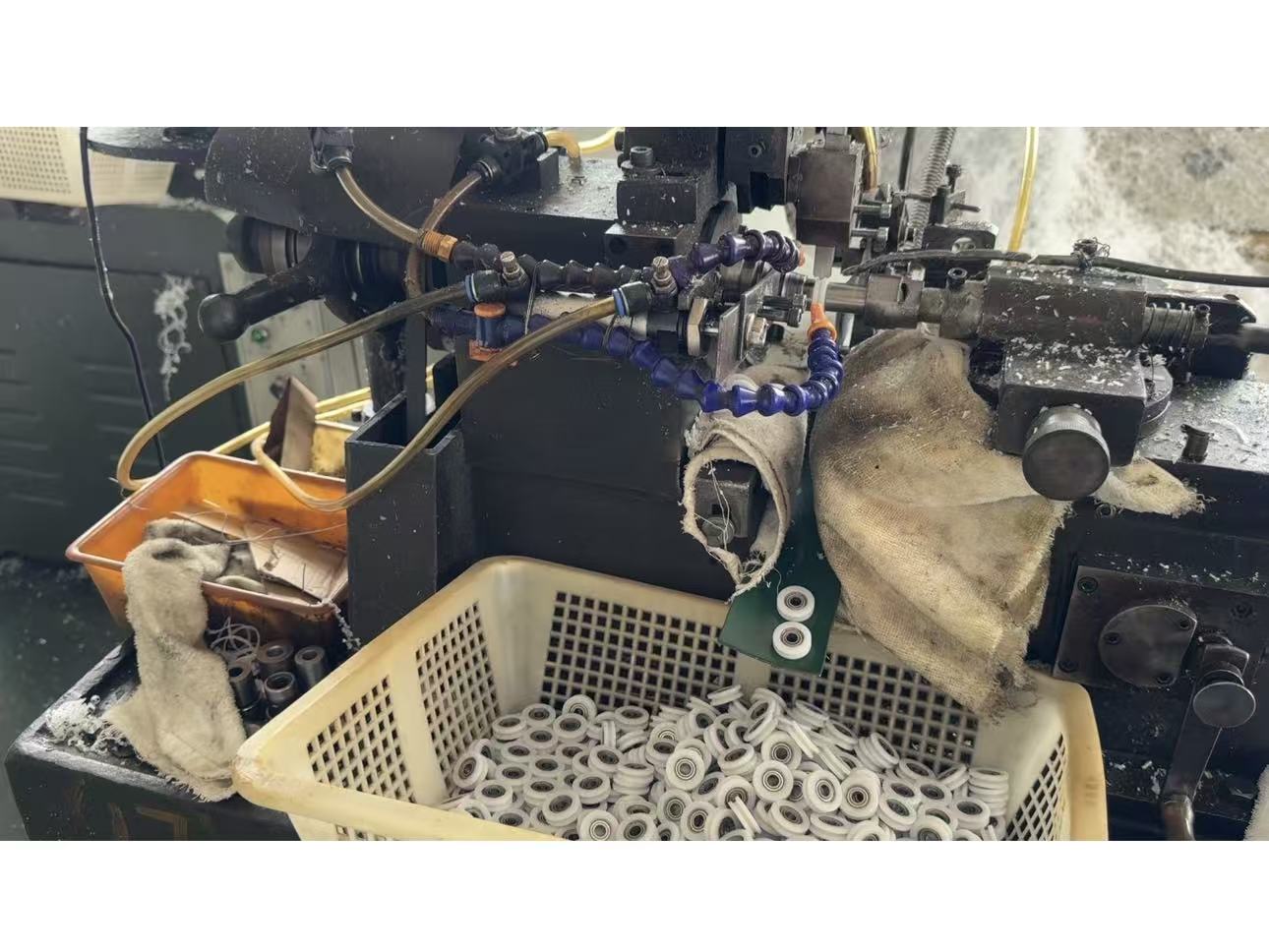
Our existing mould library can help a buyer avoid unnecessary tooling costs.
If an existing wheel has an outer diameter that is about 0.5–1 mm larger than the required diameter, we may be able to turn the outer surface to the required size.
We may also adjust the groove width or groove depth in some cases.
I check the following points before I confirm the work:
| Check | Why it matters |
|---|---|
| Original outer diameter | It defines how much material we need to remove |
| Plastic thickness | Enough material must remain after machining |
| Groove width and depth | The final groove must fit the track or rope |
| Wheel structure | The work must not expose or weaken the inner part |
| Tolerance | The process must meet the drawing |
| Surface requirement | Turning may affect the finished surface |
| Quantity | Processing cost must make sense for the order |
| Long-term demand | A dedicated mould may support repeat orders better |
Secondary machining can support both small and large orders. We mainly propose it when the customer’s order is too small to justify a new mould.
For stable large-volume demand, I normally recommend a dedicated mould. The mould can reduce secondary work and support repeat production.
How Did We Match a 5 × 30 × 10 mm Customer Requirement?
We found a close 5 × 30 × 9 mm existing wheel, confirmed that the 1 mm thickness difference was acceptable and reviewed the groove separately against the customer’s track requirement.
A customer asked us for a 5 × 30 × 10 mm U-groove roller.
The dimensions meant:
- 5 mm inner bore
- 30 mm outer diameter
- 10 mm total thickness
Our closest existing option measured 5 × 30 × 9 mm.
I did not ask the customer to open a new mould straight away. I first explained the 1 mm difference in total thickness. The customer checked the installation space and confirmed that 9 mm was acceptable.
We then reviewed the groove according to the customer’s track requirements. A close basic size did not remove the need to check the groove.
This case shows how I handle a close existing product:
- I compare the basic dimensions.
- I identify each difference.
- The customer confirms which dimensions can change.
- We check the groove against the track.
- We produce and inspect the sample.
- We test the sample in the bracket and on the track if required.
- We confirm the production method before the order.
This process can save mould costs for a lower-volume project. It also prevents us from calling two visually similar wheels interchangeable without checking the application.
When Should You Open a New U-Groove Roller Mould?
A new mould makes sense when the existing wheels cannot meet the drawing or when the buyer expects stable, long-term volume. It gives the buyer a dedicated production structure for repeat orders.
An existing wheel with secondary machining can help during an early project or a low-volume order. A dedicated mould may offer a better route for ongoing production.
| Buying point | Existing mould with machining | Dedicated new mould |
|---|---|---|
| Initial tooling cost | Lower or no new mould cost | New mould investment |
| Low-volume order | Often practical | May not be economical |
| Trial production | Useful when the structure is close | Useful when an exact design is required |
| Dimensional freedom | Limited by the existing wheel | Based on the approved design |
| Secondary work | May be required | Usually reduced |
| Production efficiency | Depends on the machining steps | Better suited to repeat volume |
| Part ownership | Uses an existing product base | Customer has a project-specific mould |
| Long-term supply | Possible, but depends on the process | Better for a stable product programme |
We can also use secondary machining for larger orders. The decision depends on unit processing cost, required tolerance, production speed and future volume.
For many long-term projects, we recommend a customer-specific mould.
We can refund the mould fee after the cumulative order quantity reaches 100,000 pieces, subject to the terms confirmed in the quotation or agreement.
A purchasing team should ask these questions before approving tooling:
- Is this a trial order or a long-term programme?
- What is the expected annual quantity?
- Will the dimensions remain stable?
- Does the buyer need exclusive dimensions?
- Can secondary machining meet the tolerance?
- What is the cost difference over the expected order volume?
- How will the supplier control future batches?
- What are the mould refund conditions?
How Do We Inspect and Test Each Sliding Roller?
We manually inspect 100% of our finished products before shipment. If the customer provides a track and bracket, we can install the roller and move the assembly by hand to check basic fit and movement.
Our inspection does not apply only to samples. Every finished product receives manual inspection before shipment.
The inspection plan depends on the drawing, approved sample and product requirements.
| Inspection item | What we check |
|---|---|
| Outer diameter | Match with the confirmed dimension |
| Inner bore | Fit with the shaft, bolt or bearing structure |
| Total thickness | Fit inside the bracket or assembly |
| Groove | Width, depth and visible profile |
| Surface | Moulding defects, damage and machining condition |
| Bearing rotation | Obvious resistance, jamming or abnormal movement |
| Assembly | Position and condition of the combined parts |
| Appearance | Colour and visible consistency |
| Packaging | Quantity, labels and customer requirements |
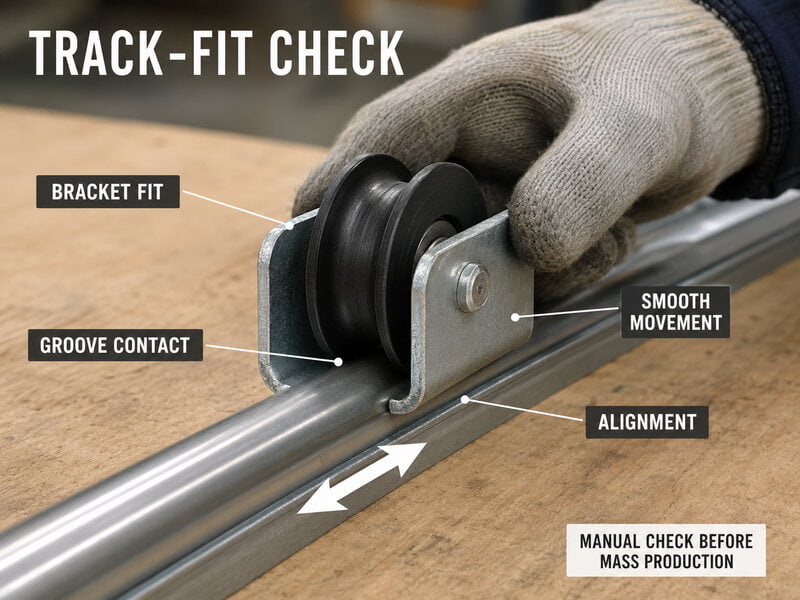
If a customer requests a track-fit test, we install the wheel into the actual bracket. We then push the assembly back and forth by hand along the track.
This check can show:
- Whether the wheel fits the bracket
- Whether the groove sits on the track
- Whether the assembly moves smoothly
- Whether there is visible wobble
- Whether any part jams or interferes
- Whether the wheel stays aligned
- Whether there is obvious abnormal noise
This manual test checks basic fit and movement. It does not prove service life, load capacity or high-speed performance.
A customer who needs a specific performance test should provide the test load, movement, cycle count, environment and acceptance standard.
What Risks Can an Incomplete U-Groove Roller Enquiry Create?
An incomplete enquiry can lead to a wrong groove, material, bearing or production method. The resulting costs can be much higher than the unit-price difference between suppliers.
A supplier may still quote from one photo and three dimensions. The supplier must then make assumptions.
Those assumptions can create:
- Poor running
- Noise
- Wobble
- Premature wheel wear
- Bearing wear
- Track damage
- Incorrect bracket fit
- Rework
- Unusable stock
- Batch mismatch
- New tooling costs
- Delayed product launch
- Unstable replacement supply
For an importer, a mismatch can affect a complete shipment. For an OEM, one small roller can delay the assembly line. For a distributor, an unclear specification can create repeated claims from different customers.
This is why I prefer a complete enquiry before I give a final production quotation.
The lowest unit price does not reduce purchasing cost if the wheel needs sorting, reworking or replacing.
What Should You Send for an Accurate U-Groove Roller Quotation?
Send the track or rope information, wheel dimensions, load conditions, sample or drawing, environment, quantity and delivery requirements. This information lets the manufacturer quote the correct structure and production route.
Use the following checklist for a new enquiry.
| Information group | What to provide |
|---|---|
| Application | Door, window, shower door, machine, equipment or other assembly |
| Basic size | Inner bore × outer diameter × thickness |
| Groove | Width, depth, radius or profile |
| Track or rope | Drawing, cross-section, diameter, material or physical sample |
| Existing wheel | Sample, photos, measurements and current problem |
| Installation | Bracket, shaft, bolt, housing and available space |
| Load | Total weight, wheel quantity and load distribution |
| Movement | Speed, travel distance, frequency and impact |
| Environment | Indoor, outdoor, water, dust, oil, chemical and temperature |
| Material | POM, PA66 or required material grade |
| Bearing | Model, seal type and required structure |
| Quality | Tolerance, inspection documents and test requirements |
| Quantity | Sample, first order and annual demand |
| Supply | Delivery date and repeat-order plan |
| Branding | Packaging, label, logo and private-label requirements |
| Commercial target | Budget range, target price or tooling limit |
A drawing gives the best starting point.
If a drawing is not available, send:
- Photos from several angles
- A physical wheel sample
- A track or rope sample
- Installation photos
- Manual measurements
- A short video of the current assembly
- A description of the current problem
Do not measure only the outer diameter. Record the inner bore, thickness, groove width and groove depth as well.
For OEM projects, you can also review our OEM and ODM roller development process.
What Should You Confirm Before Approving a U-Groove Roller Sample?
The buyer should confirm the sample inside the real bracket and on the real track. A loose wheel sample cannot show the full installation result.
Before mass production, the buyer should check:
- Does the inner bore fit the shaft or bolt?
- Does the wheel fit inside the bracket?
- Does the groove sit correctly on the track?
- Does the wheel move through the full travel?
- Is the lateral clearance acceptable?
- Does the wheel remain aligned?
- Is there any jamming or interference?
- Is the movement acceptable under the real load?
- Does the material suit the environment?
- Does the sample match the drawing?
- Are the packaging and labels correct?
- Can the supplier maintain the same specification for repeat orders?
A manual track test can confirm basic fit. A buyer should run an application test if the project has a defined load, speed, cycle or environment.
I prefer to solve these questions during sample approval. A change costs less at this stage than after mass production.
How Can B2B Buyers Reduce Long-Term Supply Risk?
B2B buyers should control the approved drawing, material grade, bearing structure, inspection standard, mould terms and replacement plan. These details support stable repeat orders.
A company does not purchase one wheel in isolation. It purchases a supply result.
The purchasing team should keep a clear record of:
| Supply document | Purpose |
|---|---|
| Approved drawing | Controls dimensions and structure |
| Approved sample | Provides a physical reference |
| Material specification | Prevents an unapproved material change |
| Bearing model | Controls the internal rolling part |
| Inspection standard | Defines acceptance |
| Packaging specification | Supports warehouse and distribution needs |
| Mould agreement | Records ownership and refund terms |
| Change-control rule | Prevents silent product changes |
| Batch identification | Supports future tracking |
| Forecast or annual demand | Helps production planning |
Importers and distributors should also decide whether they need:
- Neutral packaging
- Branded packaging
- Product labels
- Barcode labels
- Mixed-size cartons
- Batch identification
- Spare stock
- Exclusive dimensions
A stable specification protects both the buyer and the manufacturer.
What Is the Best Way to Source a U-Groove Roller?
Start with the track, installation and working conditions. Then compare the wheel size, groove, material, bearing and production method. Do not select the roller by price or outer diameter alone.
A good sourcing process follows this order:
- Define the application.
- Provide the track, rope or guide profile.
- Confirm the inner bore, outer diameter and thickness.
- Define the groove.
- Explain the load and movement.
- Confirm the environment.
- Select the material and bearing structure.
- Compare an existing wheel, secondary machining and a new mould.
- Test the sample in the real bracket and track.
- Approve the drawing, inspection plan and supply terms.
From my experience, most U-groove roller problems start before production. The buyer or supplier misses one part of the application, and the wheel is approved from a photo or three basic dimensions.
A better enquiry helps us find a better answer. Sometimes we can use an existing product. Sometimes we can machine a close wheel. Sometimes a new mould gives the buyer a better long-term result.
The application should decide the route.
Do You Need a U-Groove Roller for an OEM or Distribution Project?
Send us the following information:
- Wheel drawing or sample
- Track or rope drawing
- Inner bore × outer diameter × thickness
- Groove width and depth
- Bracket or installation structure
- Load and movement conditions
- Working environment
- Trial and annual quantities
- Required delivery date
We will first check our existing moulds. If a close product is available, we will assess whether secondary machining can meet your requirements.
If your project has stable large-volume demand, we can also assess a dedicated mould.
Send Your U-Groove Roller Requirements