Choosing a sliding gate roller with bearing is not simply a matter of finding a wheel with the same outside diameter.
When I evaluate a roller for a heavy-duty sliding gate, I first check the gate weight, track profile, operating environment, installation structure and bearing protection.
Two rollers may look almost identical but perform very differently. One may run smoothly, while another may crack, rust or become difficult to rotate because the material, bearing seal or groove does not match the actual gate system.
What Is the Direct Answer?
The right sliding gate roller with bearing must match five parts of the application:
- The load and structure of the gate
- The shape and dimensions of the track
- The required noise level and rolling smoothness
- The temperature, moisture and outdoor exposure
- The bearing size, material and sealing method
For indoor applications, materials such as POK or PPSU may be considered according to the required load, noise and rolling performance.
For outdoor gates, the material must also resist sunlight, temperature changes and impact. Some plastics can age or crack after long-term outdoor exposure, while certain materials become brittle at low temperatures.
For humid or wet environments, I normally consider 2RS sealed bearings and corrosion-resistant components such as stainless steel bearings, shafts or brackets.
The best roller is therefore not always the largest, hardest or most expensive one. It is the roller whose bearing, plastic outer ring and groove profile work correctly with the gate and track.
What Is a Sliding Gate Roller with Bearing?
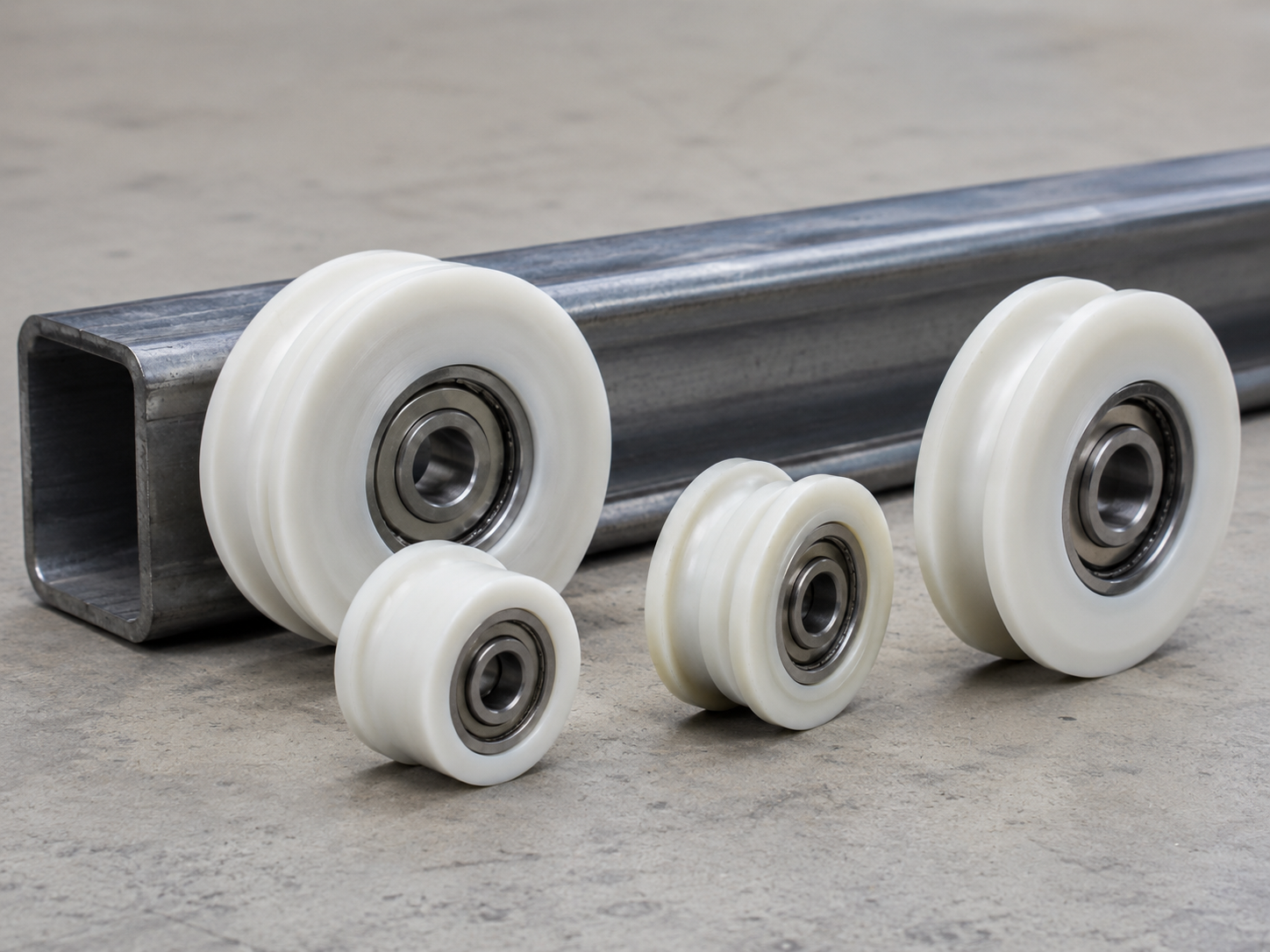
A sliding gate roller with bearing normally combines an internal ball bearing with an external rolling surface.
For many of the products we manufacture, plastic is injection-molded directly around the bearing. This type of product is also commonly described as a:
- Plastic-coated bearing roller
- Plastic bearing wheel
- Overmolded bearing roller
- Injection-molded bearing roller
- Sliding gate roller wheel
- Custom gate roller with bearing
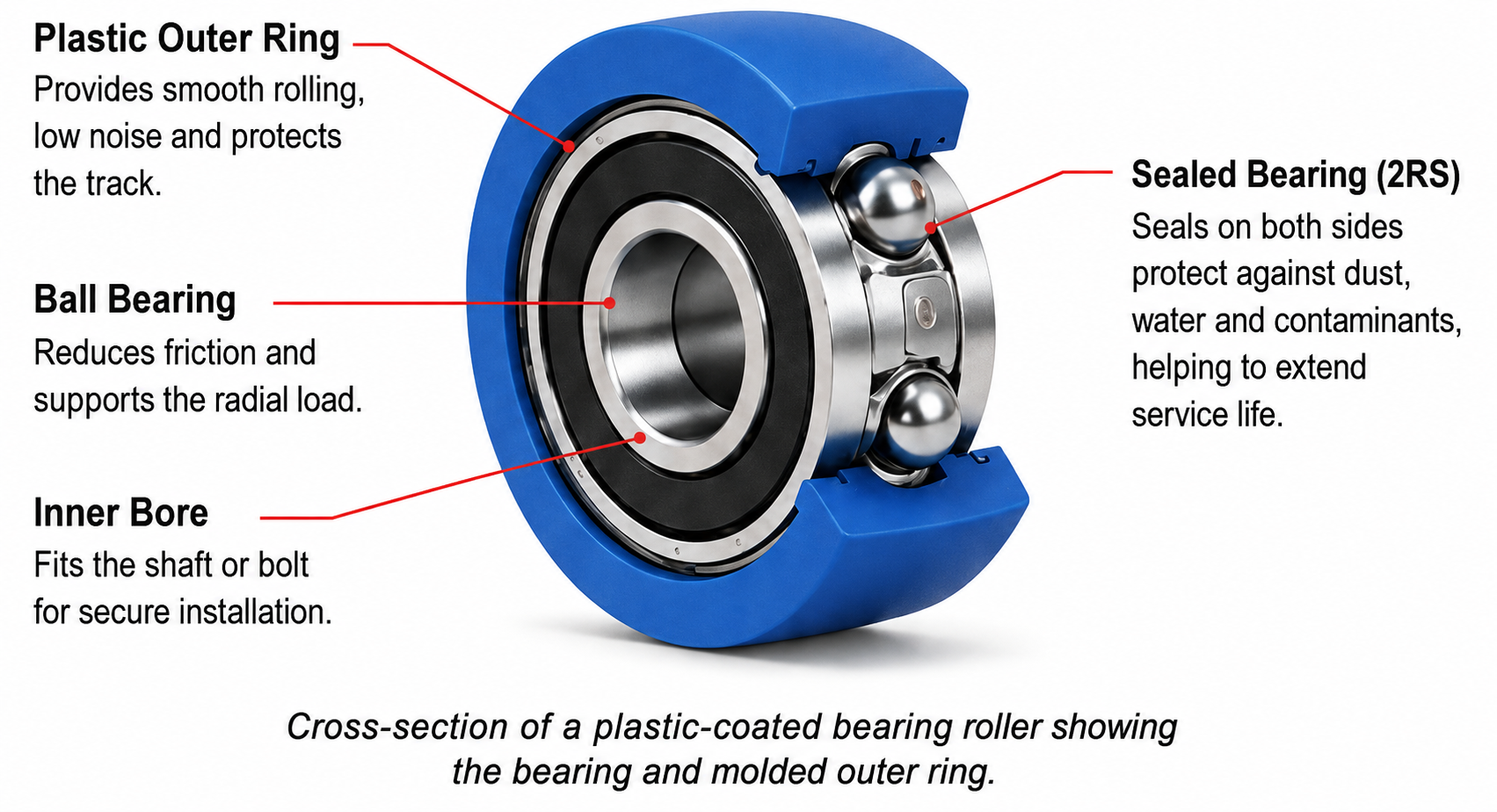
The internal bearing and the plastic outer ring perform different functions.
The bearing influences:
- Rotation
- Rolling resistance
- Load performance
- Noise
- Corrosion resistance
- Service life
The plastic outer ring influences:
- Contact with the track
- Impact absorption
- Rolling noise
- Wear resistance
- Track protection
- Outdoor aging
- Low-temperature performance
A reliable heavy-duty gate roller must combine the correct bearing, plastic material and groove structure.
What Information Should You Provide Before Selecting a Roller?
When a buyer sends me only the outside diameter of a wheel, I cannot confirm whether that wheel is suitable for the gate.
I normally ask for four essential pieces of information first:
- Gate weight
- Application and working environment
- Installation drawing or physical sample
- Track dimensions
For a more accurate evaluation, the following information is useful.
| Information | Why does it matter? |
|---|---|
| Gate weight | Helps determine the bearing size and roller structure |
| Roller function | Confirms whether the roller carries weight, supports movement or guides the gate |
| Track dimensions | Determines the groove profile and contact area |
| Installation drawing | Shows the shaft, bracket and available installation space |
| Physical sample | Helps confirm dimensions that may be missing from a drawing |
| Indoor or outdoor use | Influences plastic, bearing and metal material selection |
| Temperature | Helps prevent low-temperature brittleness |
| Rain and moisture | Determines whether sealed or stainless components are needed |
| Operating frequency | Separates occasional use from frequent automatic operation |
| Noise requirement | Influences the outer-ring material |
| Quantity | Helps determine whether an existing size or custom mold is more suitable |
A supplier should understand the actual application before recommending a product.
Otherwise, the buyer may receive a roller that looks correct but does not work reliably in the gate system.
How Does Gate Weight Affect Roller Selection?
Gate weight is one of the first factors I check, but it should not be considered alone.
A common mistake is to divide the total gate weight by the number of rollers and select each roller according to that result.
Real gate systems rarely distribute the load perfectly.
One roller may temporarily receive more force because of:
- An uneven track
- Incorrect installation
- Gate-frame deformation
- Dirt or debris
- Track joints
- Starting and stopping impact
- Side pressure
- Misalignment
For this reason, I also evaluate:
- The number of rollers
- The bearing model
- The wheel diameter
- The plastic thickness
- The groove-bottom thickness
- The shaft structure
- The operating frequency
- The possibility of impact
- The condition of the track
Increasing the outside diameter alone does not automatically create a heavy-duty roller.
If the internal bearing is too small, the shaft is unsuitable or the plastic around the groove is too thin, the roller may still fail.
How should load-related factors be reviewed?
| Selection factor | What do I check? |
|---|---|
| Total gate weight | The complete moving weight of the gate |
| Number of rollers | How many rollers actually share the load |
| Load distribution | Whether the gate and track are level |
| Starting impact | Whether the gate is manual or automatic |
| Track condition | Whether joints or dirt create additional shock |
| Bearing size | Whether the internal bearing supports the required load |
| Groove structure | Whether the groove bottom has enough material |
| Shaft design | Whether the bearing is supported correctly |
How Should the Roller Groove Match the Track?
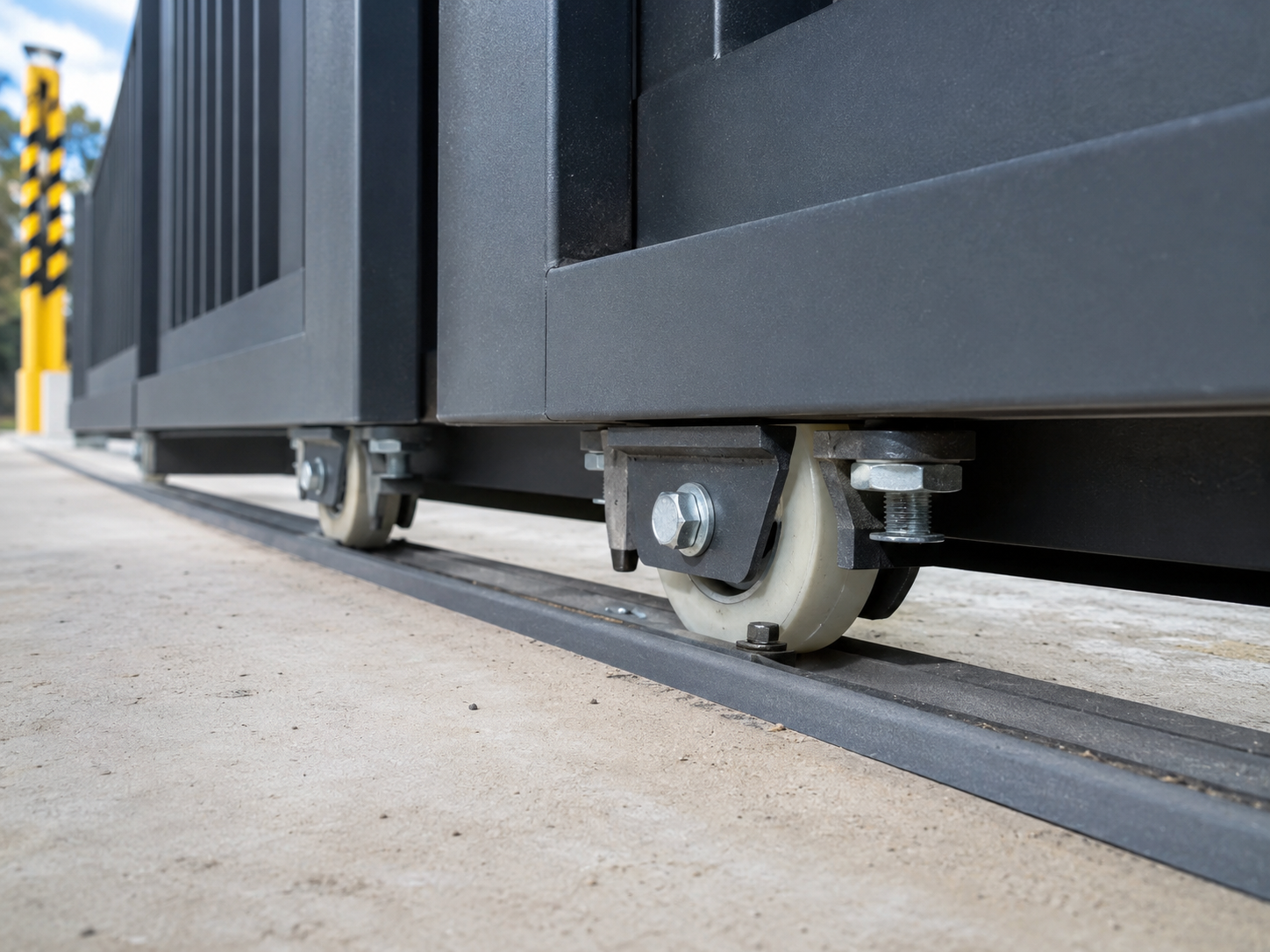
The groove profile must match the real track.
A mismatch can reduce the contact area and concentrate the load on one edge of the wheel.
This may cause:
- Uneven wear
- Abnormal noise
- Gate vibration
- Increased rolling resistance
- Groove damage
- Plastic cracking
- Gate misalignment
Which groove fits which track?
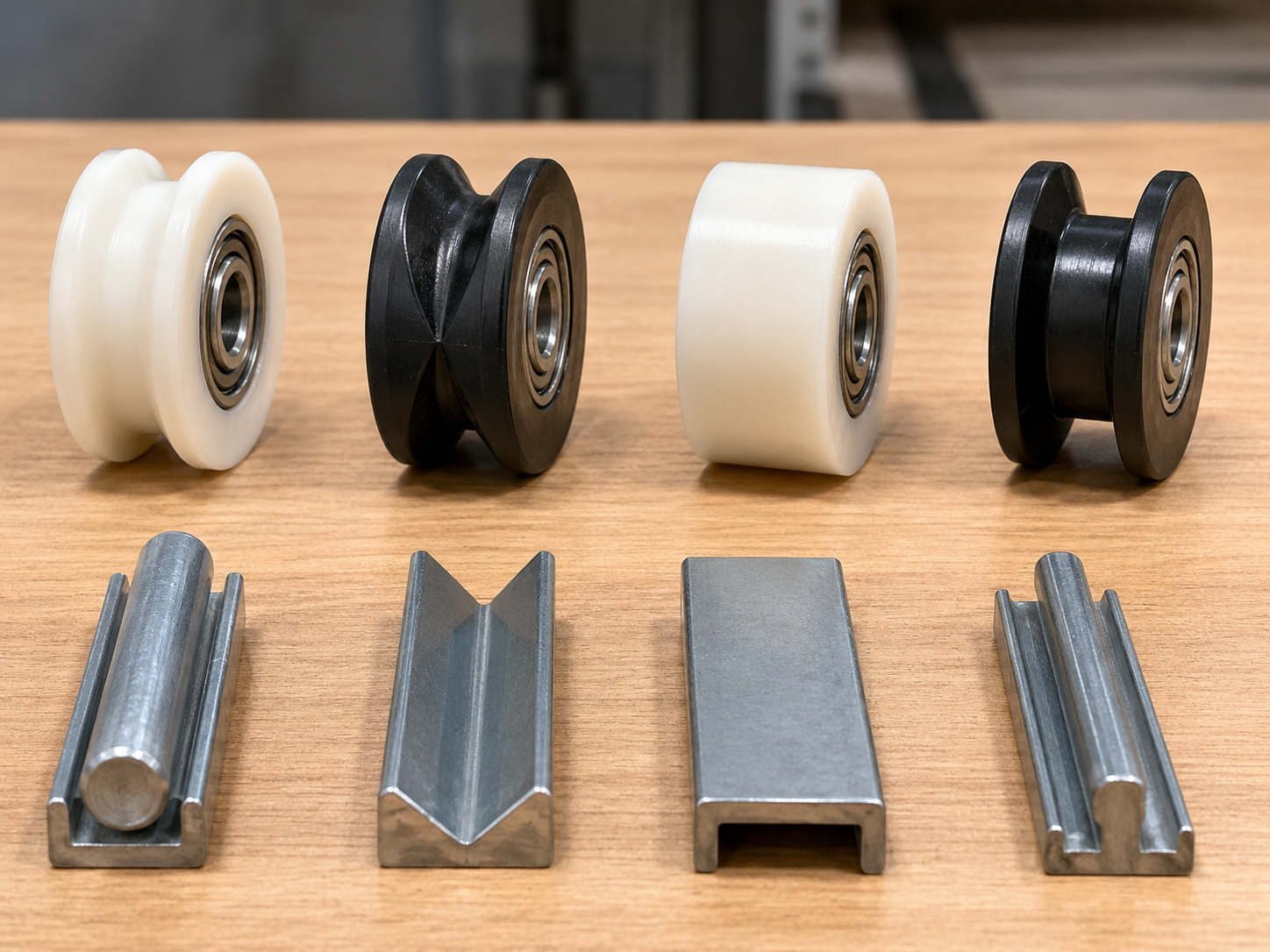
| Roller profile | Typical matching track | What should be confirmed? |
|---|---|---|
| U-groove roller | Round rail or pipe track | Rail diameter, groove radius and groove depth |
| V-groove roller | V-track or angle track | Groove angle, opening width and track width |
| Flat roller | Flat track or steel plate | Wheel width and side-guiding structure |
| Round-groove roller | Curved or round-profile rail | Track radius and contact position |
| Double-flange roller | Narrow rail requiring lateral guidance | Rail width and flange clearance |
| Custom-profile roller | Special extruded or formed track | Complete track section or physical sample |
A U-groove wheel should not be selected only because the gate runs on a round rail.
I also need to know the rail diameter and the required contact position.
The same rule applies to a V-groove roller. Two products may both be called “V-groove rollers,” but they may have different groove angles, opening widths and depths.
A drawing of the track section is useful. For a special rail, a physical track sample is even better.
You can learn more from our:
- U-Groove Bearing Roller Guide
- V-Groove Roller Wheel With Bearing
- Custom Roller Groove Development Process
Which Plastic Outer-Ring Material Should You Choose?
There is no single material that is best for every plastic-coated bearing roller.
When I select the outer-ring material, I consider:
- Required load
- Noise requirement
- Rolling smoothness
- Impact
- Temperature
- Indoor or outdoor use
- Humidity
- Corrosion
- Track material
- Expected service life
How can common roller materials be compared?
| Material | When may I consider it? | What still needs to be checked? |
|---|---|---|
| POM | General rollers requiring dimensional stability and smooth movement | Impact, outdoor grade and temperature |
| PA or nylon | General-purpose rollers requiring toughness and wear resistance | Moisture absorption and dimensional change |
| POK | Indoor applications requiring toughness and rolling performance | Load, wear and track contact |
| PPSU | Indoor or demanding applications requiring toughness and heat resistance | Friction and long-term rolling wear |
| PU or rubber | Applications requiring lower noise and vibration | Deformation and rolling resistance |
| Steel | High-load applications where noise is less important | Corrosion and track wear |
| Stainless steel | Wet, humid or corrosive applications | Noise, cost and track compatibility |
For selected indoor applications, I may consider POK or PPSU according to the required load, noise level and rolling smoothness.
However, a stronger or more expensive plastic is not automatically the best roller material.
For example, Solvay describes PPSU as a material with high toughness and impact strength. That information is useful, but the roller still needs application-specific friction and wear evaluation before the material is confirmed. You can review the manufacturer's description of Radel PPSU properties here.
How should outdoor exposure affect material selection?
Outdoor rollers may face:
- Direct sunlight
- Rain
- Condensation
- Dust
- Low temperatures
- Large temperature changes
- Impact from an uneven track
Long-term outdoor weathering can negatively affect the properties of some plastics.
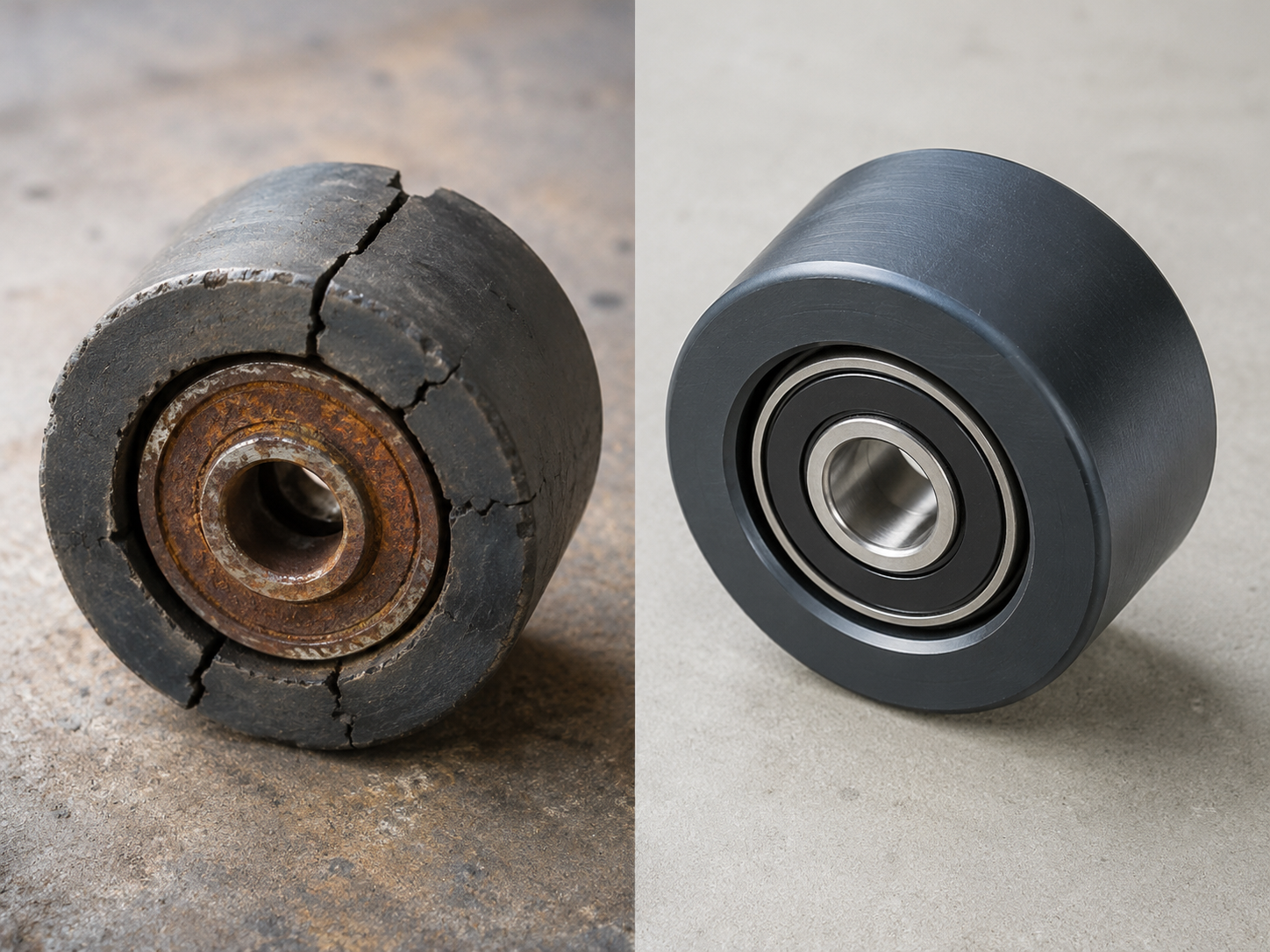
From our own project experience, I have also seen some plastic wheels become brittle at low temperatures. When the gate passes over an uneven track or receives an impact, the outer ring may chip or break around the groove.
For an outdoor gate roller, I pay particular attention to:
- UV resistance
- Minimum working temperature
- Impact resistance
- Plastic grade
- Additives
- Groove-bottom thickness
- Bearing sealing
- Metal corrosion resistance
I do not recommend choosing an outdoor material based only on the general name “nylon,” “POM” or “engineering plastic.” The exact grade and working environment matter.
How Should You Select the Bearing for Indoor or Outdoor Use?
The plastic outer ring is the most visible part of the wheel, but the internal bearing often determines whether the gate continues to move smoothly.
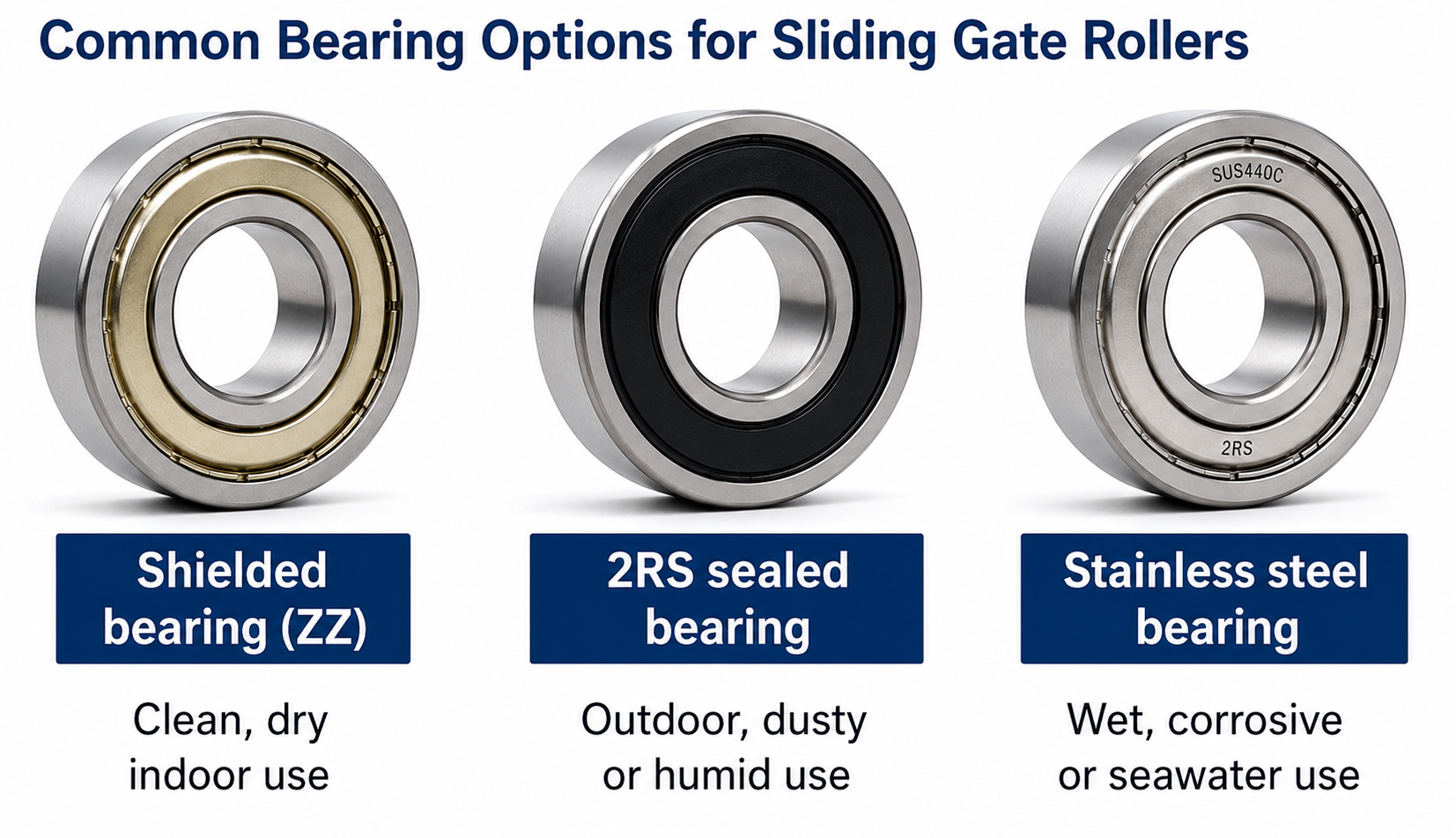
For a clean and dry indoor environment, a shielded bearing may be suitable for some applications.
For an outdoor gate exposed to rain, dust or dirt, I normally consider a 2RS sealed bearing.
A 2RS bearing has rubber seals on both sides. The seals help retain grease and reduce the entry of water and contaminants.
However, I do not describe a 2RS bearing as completely waterproof.
The installation should still avoid continuous direct water exposure.
What may happen after water enters a bearing?
- Internal corrosion
- Rough rotation
- Abnormal noise
- Increased rolling resistance
- Lubricant deterioration
- Increased bearing clearance
- Bearing seizure
Which bearing configuration may suit each environment?
| Working environment | Bearing or metal configuration to consider |
|---|---|
| Clean indoor area | Shielded or sealed carbon-steel bearing |
| Dusty area | 2RS sealed bearing |
| Outdoor gate | 2RS sealed bearing with protected installation |
| Humid environment | Sealed bearing and corrosion-resistant metal parts |
| Frequently wet area | Stainless steel bearing, shaft or bracket |
| Corrosive or salty air | Stainless steel components and suitable plastic grade |
| Low-temperature area | Suitable grease, seal and plastic material |
In wet or humid applications, I may recommend:
- Stainless steel bearing
- Stainless steel shaft
- Stainless steel fasteners
- Stainless steel bracket
- 2RS sealing
- Improved drainage
- A protected installation direction
The bearing material, seal and installation structure should be reviewed together.
Why Do Some Plastic-Coated Bearing Rollers Crack?
Plastic-coated rollers can crack for several different reasons.
The failure is not always caused by the plastic material alone.
Could the plastic be unsuitable for outdoor use?
A material that works well indoors may not perform the same way under sunlight, rain and temperature changes.
The outer ring may gradually:
- Harden
- Lose toughness
- Develop surface cracks
- Become brittle
- Break under impact
Could low temperature make the wheel brittle?
Some materials lose impact resistance at low temperatures.
When the gate crosses a track joint or uneven area, the wheel may receive a sudden impact. A material that has become brittle may chip or break around the groove.
Could the groove bottom be too thin?
The groove bottom is often a highly stressed part of the wheel.
If the groove is too deep or the remaining plastic is too thin, the wheel may crack in this area.
Could the bearing be too small?
A very small bearing inside a large wheel creates a thick plastic layer.
This may increase:
- Injection shrinkage
- Cooling differences
- Dimensional variation
- Internal stress
- Difficulty controlling concentricity
A smaller bearing is therefore not always the most economical solution.
Could the track profile be wrong?
If the track contacts only one side of the groove, the force becomes concentrated in a small area.
The roller may then show local wear or cracking even if the material itself is suitable.
Could the gate create repeated impact?
Track joints, debris, misalignment and automatic starting or stopping can create repeated shock.
A roller selected only for static load may not perform well under continuous impact.
What Happened in a Real Outdoor Gate Roller Project?
One real project I use when explaining this issue involved a plastic-coated roller used on an outdoor sliding gate.
Because the project details belong to the customer, I will not disclose the country, customer name or exact gate specifications. However, the failure pattern is useful for buyers facing similar problems.
The customer reported two obvious issues:
- The plastic outer wheel had aged and started to crack.
- The internal bearing had been affected by water ingress.
The cracking became more serious during cold weather. The outer material had become brittle and was more likely to break when the gate received an impact.
At the same time, moisture had entered the bearing.
The customer experienced:
- Abnormal noise
- Rough rotation
- Increased gate resistance
- Bearing corrosion
- Cracks around the plastic wheel
The first request was to reproduce a roller with the same dimensions.
Before discussing production, I asked for:
- Gate weight
- Working environment
- Track dimensions
- Installation information
- Existing roller details
After reviewing the application, I found that copying the original roller without changes could reproduce the same failure.
The problem was not only the wheel size.
What did I identify as the main failure causes?
The outer material was not suitable for long-term outdoor and low-temperature use.
The bearing also did not have enough protection against moisture.
What did we review before recommending a new roller?
- Plastic material grade
- Outdoor exposure
- Minimum operating temperature
- Impact condition
- Bearing sealing
- Possible use of a 2RS bearing
- Possible use of stainless steel components
- Groove profile
- Groove-bottom thickness
- Track contact
- Installation direction
The lesson from this project was clear:
> A heavy-duty gate does not simply need a larger or harder roller. It needs a bearing, outer material and groove profile that work together in the real environment.
This is why I always ask about the application before recommending a replacement.
What Purchasing Mistakes Should You Avoid?
Are you selecting the roller by outside diameter only?
Two rollers with the same outside diameter may use different:
- Bearings
- Wheel widths
- Groove depths
- Groove radii
- Plastic thicknesses
- Materials
- Load structures
Outside diameter alone is not enough.
Are you ignoring the track dimensions?
A roller can have the correct overall size but still be unsuitable if its groove does not match the track.
Provide:
- Rail diameter
- Track width
- Track height
- Groove angle
- Track section
- Installation clearance
Are you using an indoor material outdoors?
A plastic that works indoors may age, crack or become brittle outdoors.
Provide information about:
- Sunlight
- Rain
- Humidity
- Minimum temperature
- Maximum temperature
- Dust
- Corrosive conditions
Are you using an unprotected bearing in a wet environment?
If moisture enters the bearing, corrosion and rough rotation may follow.
Consider:
- 2RS seals
- Stainless steel bearings
- Stainless steel shafts
- Stainless steel brackets
- Improved installation protection
Are you choosing the smallest possible bearing?
A small bearing may reduce the metal size, but it can create an excessively thick plastic outer layer.
The bearing and plastic wheel should be designed as one structure.
Are you copying a failed sample without checking why it failed?
A physical sample is useful for dimensional measurement.
However, if the original product has already failed, copying the same material and bearing configuration may reproduce the same problem.
Are you treating a guide roller as a load-bearing roller?
Some rollers guide the gate, while others carry the gate weight.
The supplier must understand the real function before confirming the structure and material.
How Should a Factory Inspect a Custom Sliding Gate Roller?
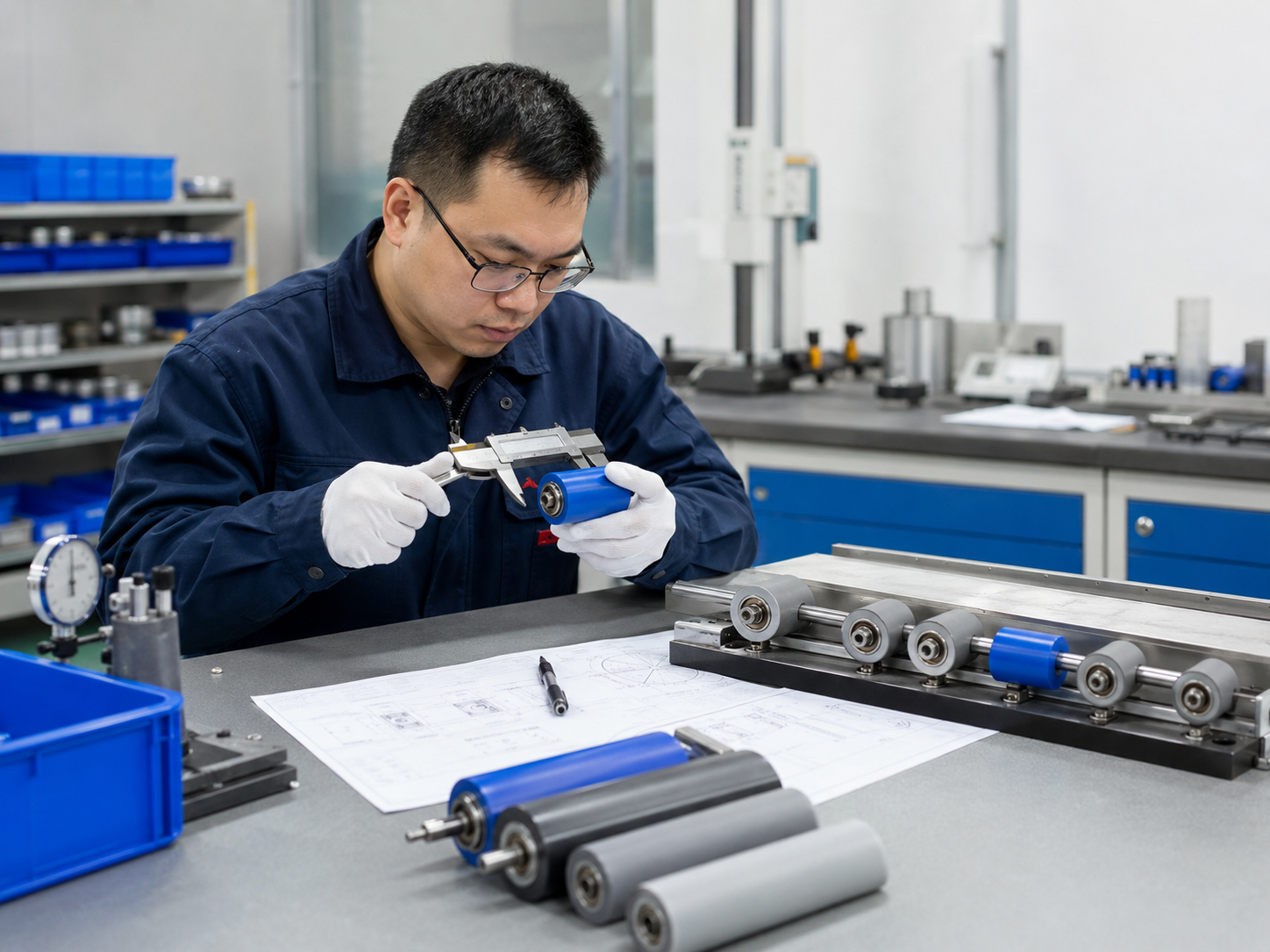
A professional sliding gate roller manufacturer should inspect more than the outside diameter.
Because our factory handles bearing assembly, injection molding, metal processing and final inspection, I evaluate the complete component rather than treating it as only a plastic wheel.
What should be checked during routine inspection?
| Inspection item | What does it help confirm? |
|---|---|
| Outside diameter | Overall wheel size |
| Bearing bore | Fit with the shaft or bolt |
| Total width | Installation compatibility |
| Groove width | Track clearance |
| Groove depth | Track contact and remaining plastic thickness |
| Groove angle or radius | Match with the rail |
| Injection appearance | Flash, short shot, cracks or other defects |
| Bearing rotation | Smoothness and abnormal noise |
| Concentricity | Whether the wheel rotates evenly |
| Radial runout | Rolling stability |
| Plastic coverage | Whether the bearing is completely and correctly overmolded |
| Assembly dimensions | Fit with shafts, bolts or brackets |
What additional tests can be arranged?
According to the project requirements, the inspection plan can also include:
- Static load testing
- Dynamic rolling testing
- Side-load testing
- Wear testing
- High-temperature testing
- Low-temperature testing
- Salt-spray testing
- Material verification
- Actual-track rolling tests
If the customer provides a section of the real track, we can test the roller on that track.
This is especially useful for:
- U-groove rollers
- V-groove rollers
- Round-groove rollers
- Double-flange rollers
- Special-profile rollers
The test method should be confirmed before production because different applications require different inspection plans.
You can read more about our:
What Should You Send to a Roller Manufacturer?
To receive a useful technical recommendation instead of only a general quotation, prepare as much information as possible.
| What should you provide? | Preferred information |
|---|---|
| Gate weight | Estimated or confirmed total weight |
| Roller function | Carrying, supporting or guiding |
| Track profile | Drawing, dimensions or physical sample |
| Existing roller | Photos, drawing or sample |
| Installation structure | Assembly drawing or installation photos |
| Environment | Indoor, outdoor, humid, dusty or corrosive |
| Temperature | Normal and minimum operating temperature |
| Operating frequency | Approximate daily use |
| Noise requirement | Standard, low-noise or very quiet |
| Quantity | Trial quantity and expected future demand |
For a custom project, the following items can normally be adjusted:
- Outside diameter
- Wheel width
- Bearing model
- Bore diameter
- U-groove
- V-groove
- Flat running surface
- Double-flange structure
- Special groove profile
- Plastic material
- Color
- Bearing seal
- Carbon-steel or stainless steel bearing
- Shaft
- Bolt
- Bracket
- Metal surface treatment
A drawing is useful, but a physical sample can reveal details that are missing from the drawing.
For a special track, I recommend sending both the existing roller and a short section of the track whenever possible.
How Can You Make the Final Selection?
Before confirming a heavy-duty sliding gate roller with bearing, ask the following questions:
- Does the bearing match the real gate load?
- Is the roller carrying weight or guiding the gate?
- Does the groove match the actual track?
- Is the outer-ring material suitable for the environment?
- Will sunlight affect the plastic?
- Could low temperature make the material brittle?
- Is the roller exposed to rain or condensation?
- Is a 2RS sealed bearing needed?
- Are stainless steel components required?
- Is the groove bottom thick enough?
- Is the bearing-to-plastic proportion reasonable?
- Has the supplier reviewed the installation drawing?
- Can a sample be tested on the real track?
The best roller is not selected by one dimension.
It is selected by combining:
- Load
- Track
- Bearing
- Material
- Environment
- Installation
- Inspection
When these conditions are clear, a manufacturer can recommend an existing roller or develop a custom solution with much lower selection risk.
What Do Buyers Commonly Ask About Sliding Gate Rollers?
Can a plastic-coated bearing roller carry a heavy gate?
Yes, provided that the bearing size, plastic material, groove structure, shaft and number of rollers are selected for the actual load.
A plastic outer ring does not automatically mean that the roller is only suitable for light-duty use.
Is a 2RS bearing completely waterproof?
No.
A 2RS sealed bearing provides better protection against moisture and contaminants than an open bearing, but the installation should still avoid continuous direct water exposure.
Should I choose POK, PPSU or stainless steel?
The answer depends on the application.
POK or PPSU may be considered for selected indoor projects according to load, noise and rolling requirements.
Stainless steel components are more suitable when moisture or corrosion is the main concern.
Can a roller be copied from a physical sample?
Yes.
A physical sample can help confirm:
- Outside diameter
- Width
- Bearing model
- Bore
- Groove
- Shaft structure
However, I still need to understand why the original roller failed. Copying a failed material may reproduce the same problem.
Can the groove be customized for an existing track?
Yes.
U-groove, V-groove, flat, round-groove, double-flange and special-profile rollers can be developed according to the track drawing or physical sample.
What should I provide if I do not have a complete drawing?
Provide:
- Clear photographs
- Basic roller dimensions
- Gate weight
- Track dimensions
- Installation photographs
- Existing roller sample
The manufacturer can then identify which additional information is required.
Who Wrote This Sliding Gate Roller Guide?
I am Shirley Ying, and I work directly with international buyers, engineers and our production team at Zhejiang Huaneng Micro Bearing Co., Ltd.
My daily work includes:
- Reviewing customer drawings
- Measuring roller samples
- Checking track compatibility
- Selecting plastic materials
- Confirming bearing configurations
- Evaluating groove profiles
- Coordinating mold development
- Confirming inspection requirements
Our factory manufactures plastic-coated bearing rollers, rubber-coated rollers, custom roller wheels, metal brackets and sliding door or gate hardware components.
Because bearing assembly, injection molding, metal processing and inspection are handled within our manufacturing system, I evaluate every roller as a complete operating component.
My purpose in writing this guide is not to tell buyers that one material or one roller is suitable for every project.
It is to help buyers identify the questions that should be answered before ordering a custom sliding gate roller with bearing.
How Can You Request a Technical Roller Evaluation?
Before requesting a quotation, prepare:
- Gate weight
- Track drawing
- Roller drawing or physical sample
- Working environment
- Temperature range
- Noise requirement
- Required quantity
Send the information through our custom roller inquiry page.
We will first check whether an existing roller can meet the application. If it cannot, we will evaluate whether the bearing, plastic material, groove profile, shaft or bracket needs to be customized.