POM plastic is polyoxymethylene, an engineering thermoplastic also called acetal or polyacetal. It is chosen for many precision moving parts because it combines stiffness, wear resistance, low moisture uptake and useful sliding behavior. But “POM” is a material family, not a complete grade specification: homopolymer and copolymer types, lubricants, reinforcement, colorants and processing route all affect the result. For an OEM roller, the right choice depends on the track contact, bearing fit, load, environment and production volume—not the polymer name alone.
What Is POM Plastic?
POM is a semi-crystalline engineering thermoplastic used for dimensionally controlled parts that move, rotate or engage with another component. The name describes its polymer chemistry: polyoxymethylene. In manufacturing and trade, you may also see “acetal” or “polyacetal.”
POM is supplied as a range of resin grades. Those resins can be injection molded, extruded into stock shapes, or machined into prototypes and low-volume components. Celanese describes POM as a crystalline engineering polymer with stiffness, wear resistance, low moisture absorption and solvent resistance, while also offering grades with different performance features. Those are family-level characteristics; the grade data sheet is what matters for design approval.
The terms POM, acetal, Delrin, Celcon and Hostaform are not all interchangeable specifications. POM and acetal describe the material family; Delrin, Celcon and Hostaform are trade names associated with particular suppliers and resin portfolios. When a drawing names only a brand or “acetal,” I would confirm the exact grade and approved equivalent before production.
Which POM Properties Matter in Product Design?
POM is useful when a part needs stiffness, wear resistance and stable geometry, but its performance still depends on load, temperature, mating material and grade.
| Property or behavior | Why engineers consider it | What still needs checking |
|---|---|---|
| Stiffness and strength | Helps a molded feature retain shape under working load | Grade, wall section, stress concentration and long-term creep |
| Wear and sliding behavior | Can suit gears, guides, rollers and other moving interfaces | Counterface material, surface finish, contact pressure, speed and debris |
| Low moisture uptake | Can help dimensional control compared with more moisture-sensitive polymers | Actual grade, temperature and tolerance stack |
| Chemical resistance | Some grades resist many fuels, solvents and alkalis | Chemical identity, concentration, temperature and exposure duration |
| Fatigue and resilience | Useful in repeated-motion features such as clips and mechanisms | Geometry, cycle count, strain and operating environment |
A low coefficient of friction is not a universal number for all POM. Friction and wear change with the mating material, surface finish, pressure, speed, temperature, lubrication and contamination. For this reason, I treat a supplier’s material data as a starting point, then validate the actual contact pair in the intended assembly.
POM also has limits. A standard grade may not be the right answer for sustained high temperature, aggressive chemical exposure, severe impact or unprotected outdoor UV exposure. Additives can improve a particular behavior, but they can also alter stiffness, wear, processability, color or cost. Check the grade data sheet and application conditions before substituting POM for metal or another engineering plastic.
What Is the Difference Between POM-H and POM-C?
POM-H is homopolymer acetal and POM-C is copolymer acetal; each can be appropriate, but there is no universally better type.
Celanese’s design literature describes homopolymer grades as having somewhat higher short-term mechanical properties, while copolymer grades generally offer a wider processing window and improved resistance to thermal degradation. Mitsubishi Chemical Group likewise publishes different property data for POM-H and POM-C grades, illustrating why grade-level comparisons matter. Do not turn a general tendency into a blanket selection rule. Compare the supplier data in the Mitsubishi POM materials guide using the same test method and conditioning.
| Grade family | Typical selection consideration | Buyer should verify |
|---|---|---|
| POM-H (homopolymer) | May be considered where higher short-term strength or stiffness is sought in a particular grade | Exact grade data, chemical exposure, heat, wear and molding or machining requirements |
| POM-C (copolymer) | Often considered where processing stability or resistance to certain chemicals and hot-water exposure matters | Exact chemical compatibility, long-term temperature and mechanical requirements |
| Modified POM | May include internal lubricant, impact modification, reinforcement, UV stabilization, conductivity or other tailored features | Additive package, counterface wear, color, approval status and grade availability |
The comparison is directional, not a substitute for a grade-to-grade review. Compare supplier technical data under the same test method and conditioning. For a roller, also test the complete wheel and bearing assembly because the polymer hub, bearing retention and track can affect function independently of resin properties.
What POM Grades Are Available?
Select a grade by the property the part must deliver, then confirm that the resin is approved for the manufacturing process and end-use conditions.
Commercial POM portfolios may include unfilled general-purpose grades, higher-flow molding grades, low-friction or internally lubricated grades, impact-modified grades, reinforced grades, UV-stabilized grades, conductive grades, and application-specific food-contact or medical grades. Availability and certification depend on the resin supplier and exact designation.
“POM” by itself does not identify these differences. A buyer should request the manufacturer’s full grade name, technical data sheet, color designation and any relevant compliance documentation. If the design depends on sliding wear, ask whether the grade is intended for tribological use and whether its recommended counterface or operating conditions match the application.
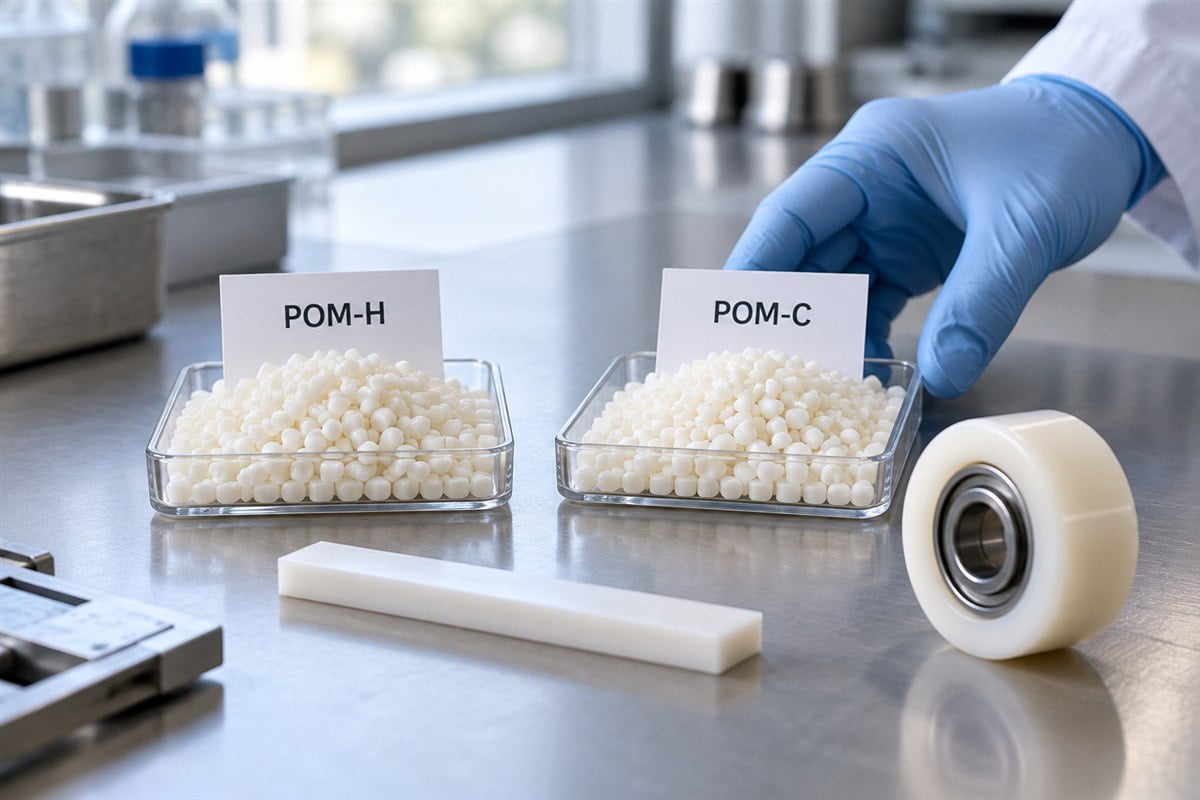
Image placement: in “What Is the Difference Between POM-H and POM-C?” The image is illustrative; it does not represent a comparative laboratory test.
Where Is POM Plastic Used?
POM is commonly used in components that need controlled movement or repeated mechanical engagement. Supplier portfolios list applications across automotive, appliances, consumer goods, electrical equipment and industrial machinery. Part-level examples include gears, bushings, clips, guides, pump components and rollers.
For sliding and rolling hardware, POM can form the outer wheel or contact surface. It is not the bearing itself. A bearing-integrated roller may contain a steel bearing, a POM wheel, an axle or threaded stud, and a bracket or track. Each interface has its own function: the bearing supports rotation, the wheel profile contacts the rail, and the mounting feature carries loads into the structure.
HUNE’s POM bearing roller with a threaded stud is one example of this construction. Its material name alone does not establish suitability; the running profile, bearing, stud, fit and mating track must all match the application. A POM sliding window roller shows another hardware context where wheel geometry and the surrounding assembly are part of the selection.
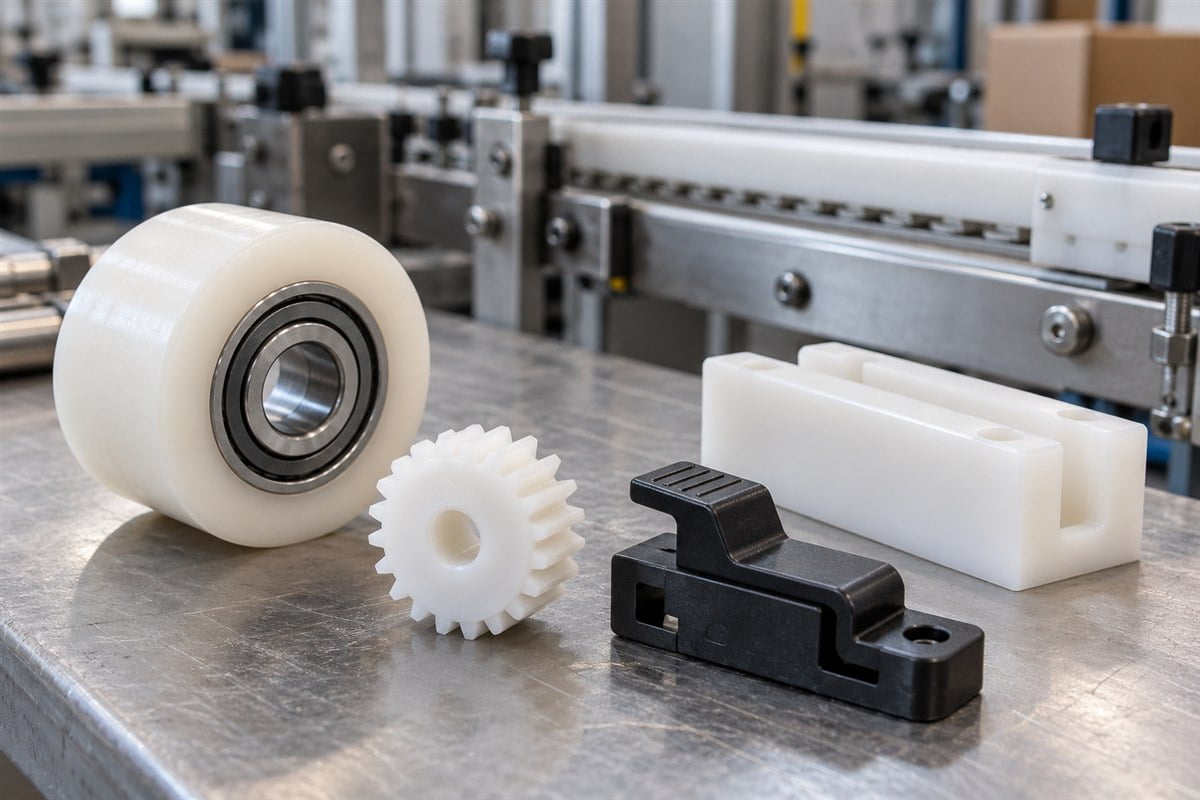
Image placement: after the paragraph explaining POM applications in sliding and rolling hardware.
How Should OEMs Select POM for a Roller or Moving Part?
Start with the function and mating interface, then choose the resin grade and manufacturing route. For a roller, review the system rather than approving a wheel material in isolation.
- Define the contact. Identify the rail or track material, cross-section, surface finish and actual contact position. Confirm whether the wheel runs on a flat, groove, flange or curved profile.
- Describe the loading. Share radial and axial load directions, load distribution, speed, cycle frequency, shock, dwell time and expected service conditions. Sustained load can make creep and deformation important even when initial stiffness looks adequate.
- Specify the environment. List temperature range, moisture, cleaning agents, oils, chemicals, UV exposure, dust and any regulatory requirements.
- Match the resin to the process. CNC machining can be useful for prototypes or lower quantities; injection molding may make sense for repeat production, but tooling, shrinkage, warpage and gate location become design considerations. HUNE’s material and process overview explains the factors to review for roller outer rings.
- Control functional dimensions. On the drawing, identify running diameter, wheel width, groove radius or angle, bearing-seat diameter, bearing retention, concentricity or runout, axial faces and mounting dimensions. Mark nonfunctional dimensions separately so tolerances remain tied to actual performance.
- Validate the assembled part. Check fit, free rotation, runout, noise, track contact and wear in the real mechanism. Approve the production sample and the material grade together; a prototype made from stock material does not automatically validate a molded production part.
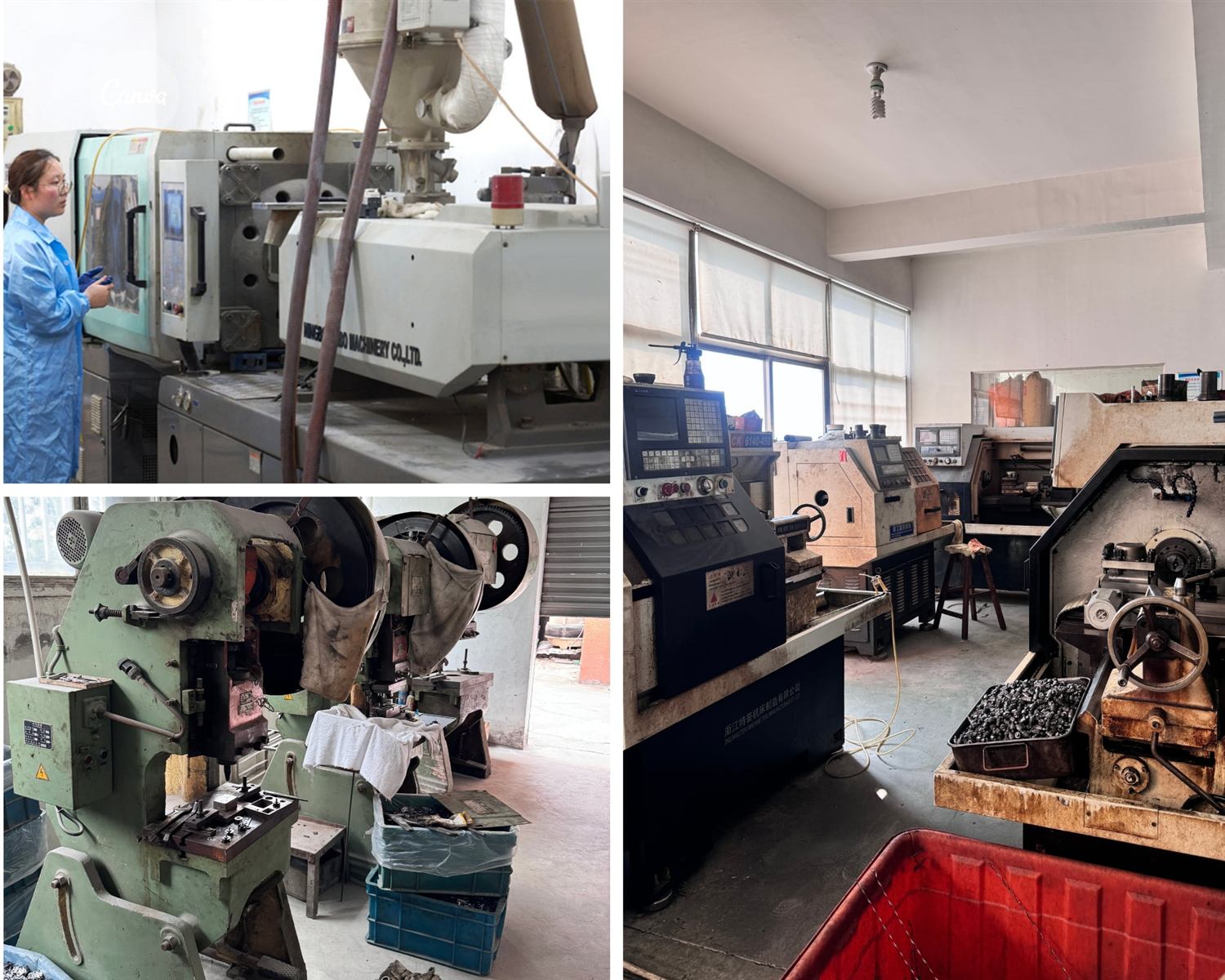
Image placement: in “How Should OEMs Select POM for a Roller or Moving Part?” near the manufacturing-route discussion. Existing HUNE media-library image.
For a custom roller RFQ, send a dimensioned drawing or sample, the mating track profile, expected load and movement, operating environment, required material grade or performance target, annual and initial quantities, color, inspection requirements and revision status. If you do not yet have a final drawing, a track sample and a description of the mechanism can still help establish the functional interfaces.
Frequently Asked Questions About POM Plastic
Is POM the same as acetal?
POM is the chemical abbreviation for polyoxymethylene; acetal and polyacetal are common names for the same polymer family. Trade names identify supplier portfolios, not one universal recipe. Individual grades can differ in additives, properties and approvals, so buyers should confirm the resin manufacturer and full grade designation on the drawing or purchase specification.
Is POM plastic stronger than nylon?
There is no universal answer. Strength, stiffness, impact behavior, moisture response and wear depend on the exact POM and nylon grades, test conditions and part geometry. A comparison between generic POM and nylon names is not enough to predict the finished part. Compare technical data for candidate grades under comparable conditions, then validate the component under its intended load and environment.
Is POM suitable for bearing rollers?
POM can be used as the outer wheel material in some bearing rollers; it is not a replacement for the bearing itself. The internal bearing, wheel profile, track, axle or stud, fit and load path must be considered together. Material suitability should be confirmed against the application’s contact pressure, speed, temperature, chemicals and duty cycle, preferably with an assembled sample in the intended mechanism.
Can POM be injection molded and machined?
Yes. POM resin is commonly injection molded, and POM stock shapes can be machined. Molding is often considered for repeat production where tooling can be justified; machining can support prototypes or lower-volume parts. The processes can produce different shrinkage, surface condition and dimensional behavior, so do not assume a machined sample fully represents a molded production part. Confirm the chosen grade and finished geometry for the selected process.
Practical Recommendation for POM Selection
POM is a strong candidate when a moving component needs stiffness, wear resistance and controlled dimensions, but the right resin is a specific grade selected for a specific interface. Compare POM-H, POM-C and modified grades using supplier data, then check the manufacturing route and validate the assembled component under representative conditions.
For an OEM roller, send the drawing, track profile, load direction, bearing and mounting arrangement, operating environment, critical dimensions and expected volume. HUNE supplies bearing-integrated sliding rollers in different materials and profiles; contact the engineering team with those details to review whether an existing construction or a custom design is the better starting point.