
Sliding patio door rollers usually fail because the wheel, bearing, carriage and track stop sharing the door load as the designer intended. A contaminated or corroded bearing can increase drag, but the bearing is only one possible cause. A worn wheel tread, dented rail, unsuitable groove, tilted carriage, loose axle, frame deflection or uneven height adjustment can create the same hard-sliding symptom.
The practical answer is to treat the roller as one part of a load path: panel → lower profile → carriage → axle and bearing → wheel → track → frame. Material selection matters, but it cannot compensate for poor mating geometry or unequal load distribution. For an OEM investigation, I first separate the observed symptom from the physical cause, then check the functional dimensions at every interface. This article explains that process and the information a buyer should give a roller supplier before approving a design.
What Does “Roller Failure” Mean in a Patio Door System?
A roller has failed when the door can no longer move, guide, carry or remain aligned within the system’s defined requirements—even if the wheel still turns by hand.
OEM teams should define failure in measurable system terms. Common indicators include:
- increasing breakaway force when movement starts;
- high or inconsistent force while the panel is moving;
- rumbling, scraping, clicking or cyclic vibration;
- side-to-side movement or a panel that no longer remains vertical;
- local wheel slip instead of rolling;
- loss of adjustment or changing door height;
- visible tread wear, cracking, corrosion or track damage; and
- derailment risk or contact between the door profile and frame.
This distinction matters because free rotation on a bench does not prove that an installed roller is healthy. A wheel may spin freely without load yet deform, tilt or rub the carriage when the panel weight is applied. Conversely, a good bearing may run poorly on a dirty or damaged track.
ASTM E2068 describes a method for measuring both breakaway and in-motion operating forces of sliding windows and doors in both directions. It does not diagnose the failed part, but its separation of starting force from moving force is useful. A high starting force and a force that rises at one track position can point to different mechanisms.
How Does the Complete Patio Door Roller System Carry Load?
The roller assembly works only when the full load path remains aligned and each interface has enough stiffness, clearance and contact area.
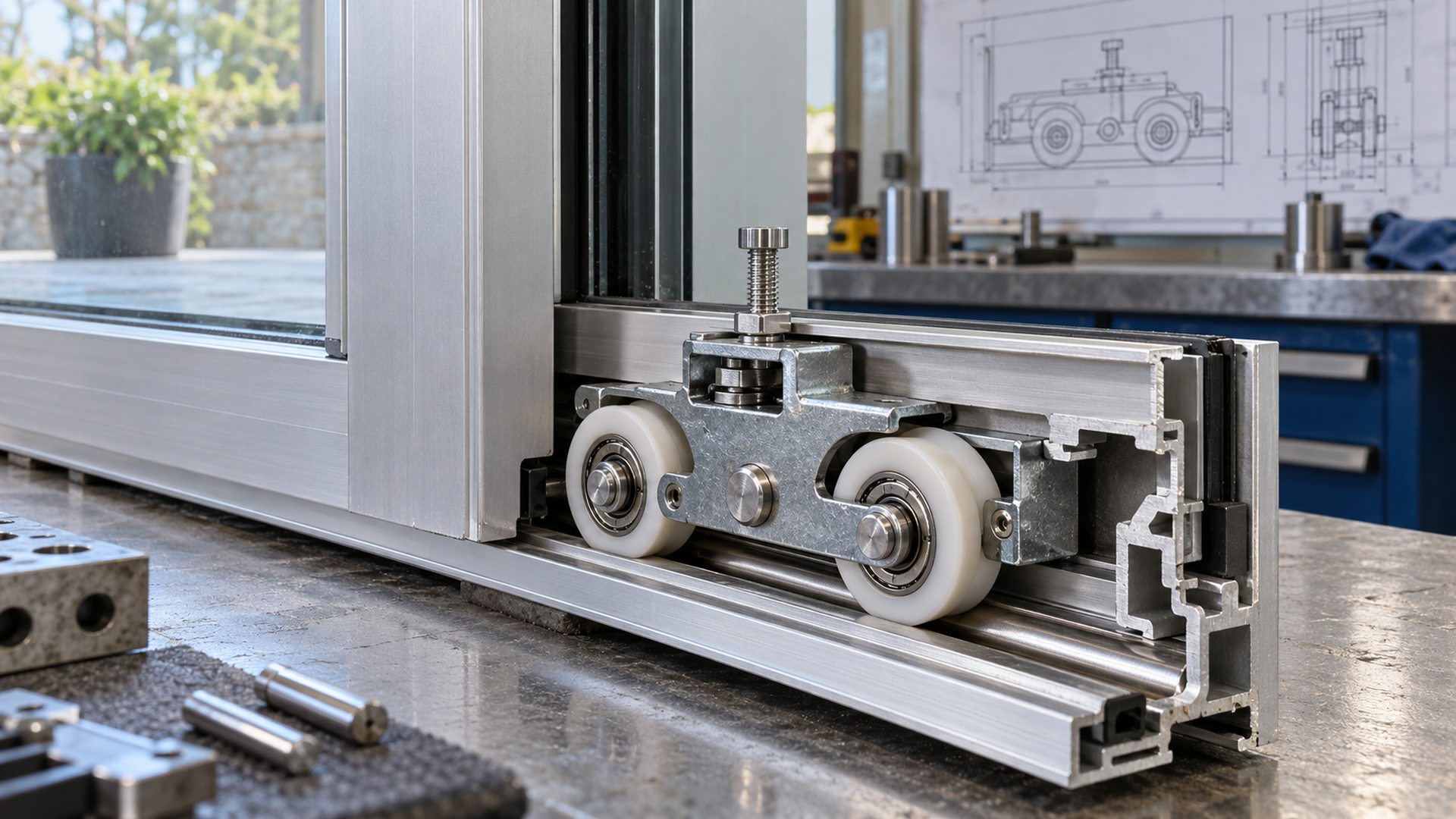 The wheel, bearing, axle, carriage, adjustment mechanism, door profile and rail form one working system.
The glass and panel mass is transferred through the bottom door profile into one or more roller carriages. Inside each carriage, the load passes through an adjustment feature or supporting body to the axle, through the rolling bearing or bushing, into the wheel, and finally through a small contact region on the rail.
That apparently simple path creates several design questions:
- Does each carriage receive a similar share of the panel load?
- Does the wheel contact the rail at the intended location?
- Can the carriage remain square inside the door profile?
- Is the bearing mainly radially loaded, or is misalignment adding axial load?
- Does the adjustment screw retain its position under repeated movement?
- Can water, dust and cleaning residue reach the bearing or tread?
- Does the frame remain straight after installation and under environmental change?
I would not approve a wheel from outside diameter and bearing number alone. Two rollers with the same nominal diameter can behave differently if their running profiles, axle support, housing stiffness or installed height are different. The door and window roller hardware range illustrates why the bracket and adjustment structure must be considered with the wheel.
Why Do Wheel Materials Wear, Flatten or Crack?
Wheel material fails when its stiffness, wear behavior and environmental resistance do not match the actual contact stress and duty cycle.
A patio door wheel needs enough stiffness to retain its running geometry, but the hardest material is not automatically the best. A more compliant polymer can reduce transmitted noise and tolerate minor track imperfections. Too much deformation, however, increases rolling resistance and may produce a temporary or permanent flat spot during long periods of static loading.
Material labels such as “nylon,” “POM” or “stainless steel” are incomplete specifications. Polymer grade, reinforcement, moisture condition, moulding quality, bearing retention and wheel geometry all influence performance. Metal grade, hardness, finish and compatibility with the rail also matter.
| Wheel approach | Potential advantage | Failure risk to evaluate | System question |
|---|---|---|---|
| POM or other rigid engineering polymer | Low mass, controlled mouldability and relatively quiet contact | Tread wear, creep, moulding variation or cracking at a thin hub | Is the grade and section suitable for sustained load and environment? |
| Nylon-based wheel | Toughness and useful wear behavior in suitable grades | Moisture-related dimensional change and grade-dependent behavior | Will humidity change the running or bearing-seat geometry? |
| Elastomer-coated wheel | Lower noise and more compliance | Heat build-up, compression set, coating separation or debris pickup | Is the coating supported by a rigid hub and compatible with cleaners? |
| Stainless-steel wheel | High stiffness and corrosion resistance when the grade is appropriate | Noise, rail wear and concentrated contact stress | Are wheel and rail profiles/materials compatible? |
| Hybrid wheel with bearing insert | Separates tread and race functions | Retention loss, hub cracking or eccentric assembly | How are the bearing and wheel located, retained and inspected? |
For custom parts, I prefer to review the exact grade and the complete cross-section rather than select from a generic material name. HUNE’s roller material and manufacturing options provide a useful starting point for discussing plastic, metal and combined constructions, but the final choice still needs installed validation.
How Do Bearings Create Drag or Noise?
Bearings usually become noisy or resistant because lubrication, sealing, fits, alignment or contamination has changed—not simply because the bearing is “too small.”
Fine debris can enter a poorly protected bearing or collect between the wheel and carriage. Moisture can attack rings, shields or adjacent hardware. A tight bearing seat can reduce internal clearance; a loose seat can permit creep or fretting. A skewed axle can add edge loading and an axial component that the assembly did not intend.
The SKF bearing damage and failure analysis guide discusses contamination, moisture, corrosion, misalignment, unsuitable fits and excessive preload among the conditions that can damage rolling bearings. Those mechanisms are relevant to a patio door roller, but the correct diagnosis still requires evidence from the installed assembly.
Seals and shields also involve a trade-off. A contact seal can offer stronger exclusion of dirt and moisture but adds seal friction. A metal shield normally creates less rubbing but provides less protection against liquid entry. The supplier needs the exposure condition, acceptable operating force and expected duty before choosing an open, shielded or sealed bearing arrangement.
For compact assemblies, sliding rollers with integrated bearings show how the bearing, tread and mounting feature can be combined. The buyer should still confirm seat geometry, retention method, axle fit and side clearance.
Why Does Track Geometry Matter So Much?
A sound roller can fail quickly when its tread and the rail create the wrong contact pattern.
The rail is the mating part of the wheel. A rounded wheel on a narrow crest, a V-profile running at the wrong included angle, or a concave wheel bottoming in a rail can concentrate stress and increase steering force. Dirt and impact dents then repeat at every pass, producing periodic noise or a force peak at the same door position.
The functional interface is the actual contact between the loaded wheel and track. Nominal rail width may be less important than the radius, crest, groove angle, local straightness and height that establish that contact. For this reason, a roller drawing without the mating track section is incomplete for OEM review.
Track-related causes include:
- a rail crest that is dented, worn or contaminated;
- mismatch between wheel groove and rail radius or angle;
- local height variation at joints or fasteners;
- insufficient lateral guidance or excessive flange contact;
- rail deflection under panel load;
- frame twist that makes parallel rails converge or diverge; and
- drainage geometry that leaves water and abrasive residue in the running path.
I first inspect whether the force or noise repeats at a fixed track location. If it does, I inspect the rail before disassembling every carriage. A symptom that follows the roller around the system suggests a different root cause from one that remains tied to one point on the track.
How Do Load Sharing and Alignment Cause Premature Failure?
The nominal panel mass does not tell an engineer how much load each wheel actually carries.
A door with two carriages does not automatically divide its load equally. Adjustment height, frame straightness, glass and profile stiffness, carriage compliance and floor movement can place more load on one wheel or one side of a tandem unit. A small difference in installed height may unload one contact while the adjacent contact carries much more of the door.
Unequal loading can produce:
- local tread deformation or accelerated wear;
- bearing overload at one carriage;
- skewing and flange rub;
- adjustment screw or housing deformation;
- track indentation; and
- a door that alternates between rolling and sliding.
Tandem or multi-wheel carriages can spread load across more contact points, but only if the structure allows the wheels to share it. A rigid multi-wheel bracket on an imperfect rail may still concentrate force. Equalization geometry, pivot behavior, axle location and carriage stiffness therefore matter as much as wheel count.
The product architecture should be selected from the actual door profile and load path. HUNE’s heavy-duty sliding door and window roller assemblies include different carriage arrangements for this reason.
Which Failure Symptom Points to Which Cause?
Use symptoms to plan inspection, but do not treat one symptom as proof of one failed component.
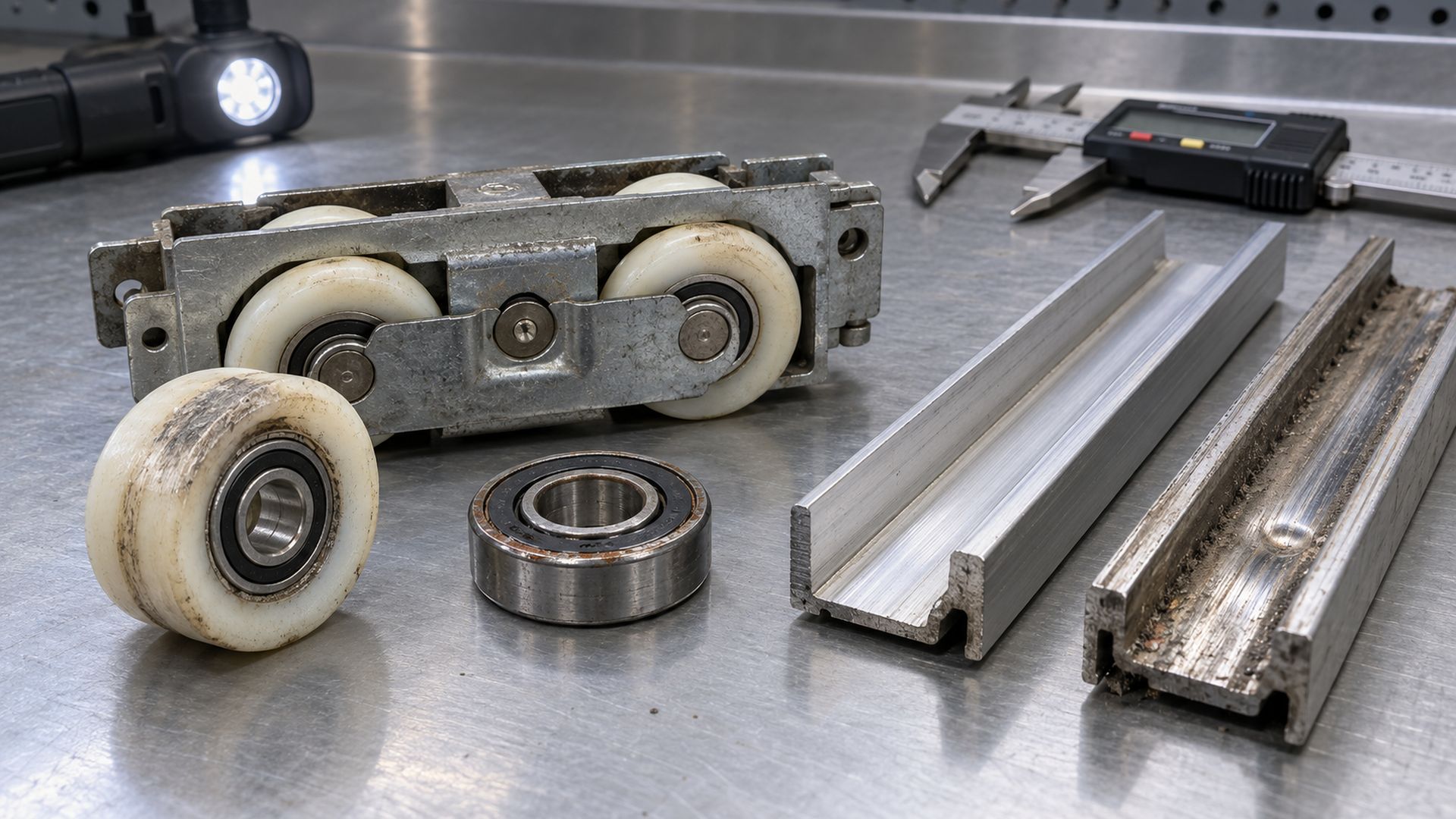 Wheel wear, bearing condition, carriage alignment and the mating rail should be inspected together.
| Observed symptom | Plausible causes | First checks | Evidence that helps separate causes |
|---|---|---|---|
| High force at movement start | Tread deformation, seal drag, excess preload, profile contact | Leave time, loaded wheel shape, seal choice, door-to-frame clearance | Compare immediate restart with restart after a long static period |
| High force through the full stroke | Contamination, bearing damage, rubbing carriage, rail misalignment | Cleanliness, bearing feel under load, side clearance, rail parallelism | Measure in-motion force in both directions |
| Force peak at one position | Track dent, joint step, local debris, frame distortion | Track profile and straightness at that location | Mark door position and confirm repeatability |
| Cyclic rumble or clicking | Wheel flat spot, tread defect, damaged raceway, eccentric wheel | Wheel circumference, run-out, bearing condition | Relate noise frequency to wheel rotation |
| Door drops or changes height | Adjustment migration, bracket deformation, loose fastener | Adjustment screw retention, carriage seating, profile support | Record installed height before and after cycling |
| Side wobble or flange rub | Excess axial clearance, guide issue, skewed carriage, profile mismatch | Side clearance, top guide, axle squareness, track contact | Inspect wear marks on wheel sides and carriage |
| Corrosion stains or roughness | Moisture ingress, unsuitable alloy or protection, trapped water | Seal path, drainage, bearing and fastener materials | Identify where water enters and remains |
This table is a fault-isolation guide rather than a replacement rule. For example, a new roller may temporarily reduce operating force while the damaged rail continues to accelerate wear.
Which Roller Architecture Fits the Door?
Choose the carriage structure from available envelope, adjustment method, load sharing and environment before choosing a catalogue wheel.
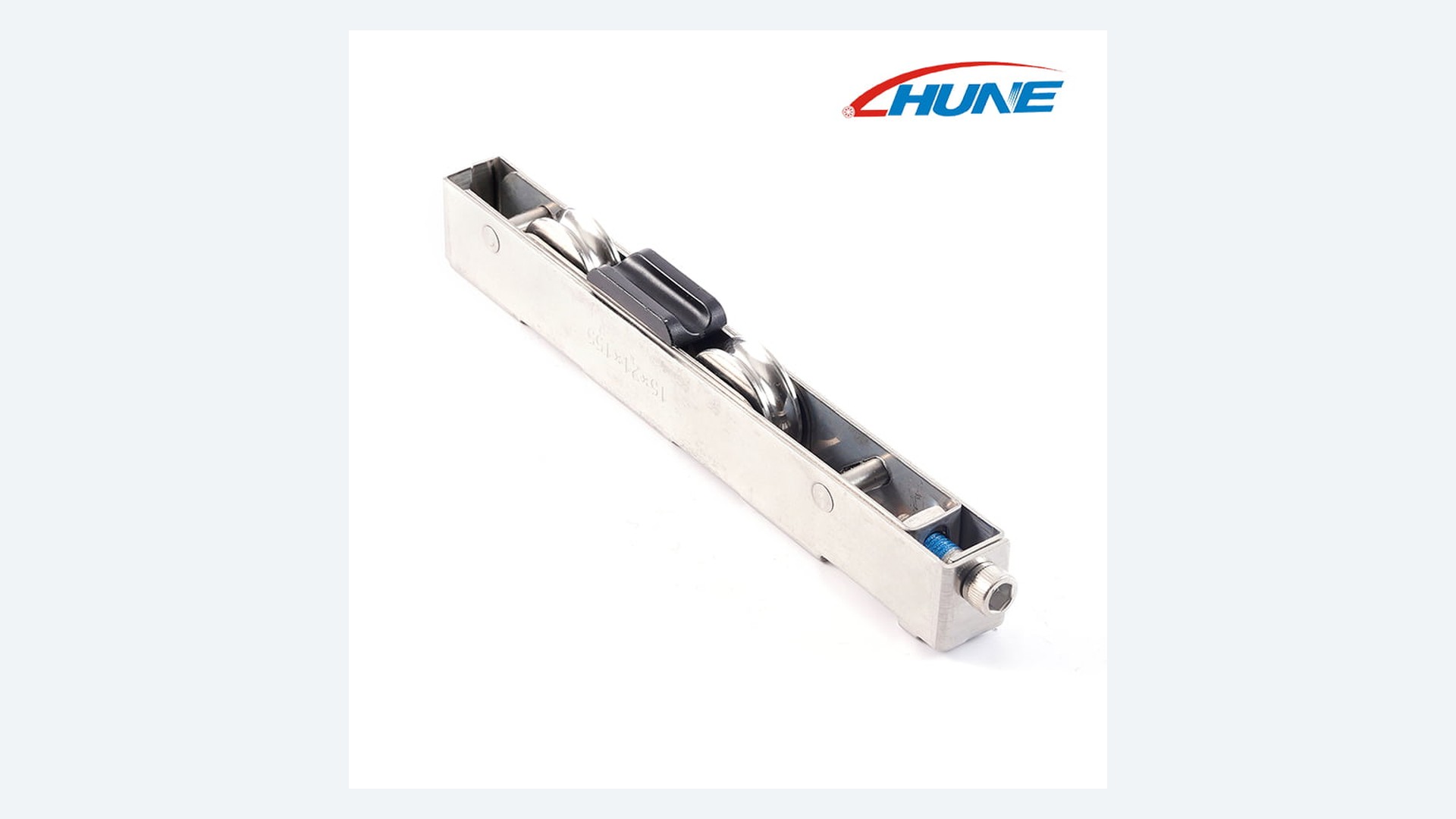 A real HUNE carriage roller from the existing media library; the matching profile, rail and installed load still require confirmation.
A single-wheel carriage can be compact and simple. A tandem carriage adds a second contact and may improve load distribution over small rail irregularities when its structure can equalize. Multi-wheel units serve larger or more demanding panels, but they require more space and more careful control of wheel height and alignment.
An adjustable carriage allows the panel height and squareness to be set after assembly. The adjustment range must be useful inside the door profile, and the mechanism needs retention against vibration and repeated motion. A nominal adjustment feature that becomes inaccessible after glazing or conflicts with a frame wall is not functionally useful.
As a concrete construction example, HUNE’s adjustable stainless-steel carriage rollers combine bearing-supported wheels, a metal carriage and height adjustment, with single- and multi-wheel options. That product page is a starting architecture, not proof of compatibility with every patio door. Compatibility depends on the buyer’s door profile, rail, adjustment access and performance targets.
The FGIA/AAMA 906.3-75 specification covers roller assemblies, with or without height adjustment, used in sliding glass doors. Its scope reinforces a useful procurement point: the roller assembly is the controlled article, not just the loose wheel.
Which Functional Dimensions Must Match?
The critical dimensions are those that control load contact, installed position, retention and free movement.
I normally separate dimensions into functional, installation, process and cosmetic groups. This avoids tightening every dimension when only a few interfaces determine performance.
| Dimension or control | Why it matters | Recommended mating information |
|---|---|---|
| Loaded running diameter | Sets panel height and travel per wheel revolution | Rail contact location and allowable installed-height range |
| Tread radius, groove or angle | Controls contact stress and lateral guidance | Full rail cross-section with radius/angle and datum |
| Wheel width and side-face position | Prevents rubbing and controls available guidance | Carriage window and side-clearance stack |
| Bearing seat diameter and width | Controls bearing fit, support and internal clearance risk | Bearing designation, fit intent and retention method |
| Axle or stud diameter | Controls bearing fit and load transfer | Axle material, support span, shoulder and fastening method |
| Wheel-to-wheel spacing | Affects tandem load sharing and travel over rail defects | Track continuity and carriage pivot/equalization geometry |
| Carriage width and height | Determines fit inside the lower door profile | Profile cavity section and assembly access |
| Adjustment range and datum | Controls panel height and squareness | Door reference plane, minimum/maximum setting and access |
| Radial and axial run-out | Affects cyclic force, noise and side movement | Inspection datum and loaded acceptance method |
| Track straightness and local profile | Controls smoothness through the full stroke | Rail drawing, joints, fasteners and installed support |
The outside diameter printed in a catalogue may not equal the functional running diameter of a grooved or crowned wheel. The drawing should identify where the diameter is measured and where the wheel is intended to contact the rail. Likewise, a bearing fit should specify function and inspection method rather than an unexplained tight tolerance.
How Should an OEM Validate a Patio Door Roller Design?
Validate the roller in stages, ending with the real door, rail and environment rather than a free-spinning bench sample.
A practical approval sequence is:
- Requirement review. Define panel mass distribution, travel, duty, operating-force target, environment, noise expectations and service access.
- Geometry review. Overlay the carriage and wheel section with the door profile and rail. Check contact, clearances, adjustment access and tolerance stack.
- Material and bearing confirmation. Record the exact wheel grade or metal specification, bearing protection, axle material and corrosion strategy.
- Prototype fit check. Confirm assembly, installed height, track contact and adjustment before committing to production tooling.
- Loaded door test. Measure starting and moving force in both directions and inspect for rubbing, steering and local force peaks.
- Duty and exposure validation. Cycle the representative door and apply relevant contamination, moisture or temperature conditions defined by the product specification.
- Pilot-production approval. Inspect parts made by the intended production process and confirm that assembly and door results remain stable across samples.
A prototype proves only what was tested. It does not automatically validate moulding variation, bearing insertion, axle staking, adjustment retention or repeat production. The control plan should connect each functional dimension to a practical inspection method.
What Should OEM Buyers Send in an RFQ?
A useful RFQ describes the door system and performance target, not only a photo of the old roller.
Send the supplier:
- the lower door-profile cross-section and mating rail drawing;
- a 2D roller or carriage drawing with functional datums;
- 3D files if the surrounding envelope is complex;
- panel mass and expected load distribution, without assuming equal sharing;
- number and location of roller assemblies;
- required adjustment range and adjustment access direction;
- travel distance, use frequency and intended product life target;
- indoor, outdoor, coastal, wet, dusty and cleaning-chemical exposure;
- operating-force and noise requirements;
- wheel material or performance requirements rather than colour alone;
- bearing protection, axle and corrosion requirements;
- prototype, pilot and annual quantities;
- inspection report expectations; and
- current failure samples, photos and force-versus-position observations when investigating an existing problem.
If the existing roller is unavailable, measure more than wheel diameter. Include carriage length, width and installed height; fastener and adjustment locations; wheel profile; axle position; and the rail cross-section. A worn part can no longer be treated as the design master, so identify which surfaces are damaged.
HUNE’s OEM development process shows the progression from requirement review through tooling, samples and production. For a patio door project, each stage should have a defined approval question rather than a general “sample accepted” note.
Discuss a Custom Patio Door Roller with HUNE
HUNE develops custom rollers, bearing-supported wheels and metal hardware for OEM door and equipment manufacturers.
For a meaningful review, send the door-profile and rail sections, carriage envelope, wheel or sample dimensions, panel load information, environment, expected quantity and the symptom you need to prevent. The engineering team can then compare an existing architecture with a modified wheel, bearing, axle or custom carriage approach.
Send your patio door roller requirements to HUNE with the drawing revision and the mating geometry. Clear interface data makes it much easier to judge feasibility and prepare a useful quotation.
Frequently Asked Questions
Do patio door rollers fail only because the bearing wears out?
No. Bearing contamination, corrosion or raceway damage can create drag and noise, but similar symptoms come from a deformed wheel, damaged rail, skewed carriage, loose axle, poor adjustment or frame distortion. Diagnose the installed system before assigning the cause. A bearing that spins freely without load may still be incorrectly fitted or misaligned in the door.
Is a stainless-steel patio door roller always better than a polymer roller?
No. Stainless steel offers high stiffness and useful corrosion resistance when the grade and finish suit the environment. It can also transmit more noise or wear an incompatible rail. A polymer wheel may run more quietly and tolerate small irregularities, but grade, creep, moisture and tread geometry must be checked. The better choice is the one validated with the actual rail, load and exposure.
Why does a sliding door become harder to move at one position?
A repeatable force peak at the same door position often points to a local track or frame condition: a dent, joint step, fastener distortion, accumulated debris or loss of straightness. Mark the panel position, inspect the corresponding rail area and compare movement in both directions. If the noise or resistance follows a particular carriage instead, inspect that assembly and its wheel circumference.
Do tandem rollers automatically double load capacity?
No. Adding a second wheel increases the number of possible contact points, but the real load split depends on carriage equalization, stiffness, adjustment and track geometry. One wheel can remain overloaded while the other is lightly loaded. Load capacity should come from the complete carriage and installed-door validation, not from multiplying a single-wheel figure.
Should OEMs specify sealed or shielded bearings for patio doors?
Choose from the exposure and operating-force requirements. Contact seals generally exclude moisture and debris more effectively but add seal drag. Shields usually have lower rubbing friction but less liquid protection. The decision also depends on wheel-side protection, drainage, cleaning practices, bearing fit and corrosion strategy. State the environment in the RFQ instead of specifying a suffix without context.
Can a new roller solve a damaged patio door track?
It may reduce force temporarily, but it does not remove a dent, incorrect profile or frame distortion. A damaged rail can quickly mark the new tread or overload the bearing at each pass. Check the complete running path and confirm that wheel and track profiles mate correctly before approving a replacement or production change.
Final Engineering Recommendation
Treat sliding patio door roller failure as a system problem before changing the wheel material or bearing.
Start with the symptom and its position, then trace the load through the profile, carriage, axle, bearing, wheel and rail. Confirm the real contact geometry, installed height, load sharing, side clearance, adjustment retention and environmental protection. Measure both breakaway and in-motion force where possible, and inspect whether the problem follows the roller or remains at one track location.
For a new OEM project, send the supplier the roller and carriage drawing together with the mating door-profile and rail sections, panel load information, environment, functional dimensions, inspection datums and volume forecast. That package gives the supplier enough information to recommend a credible material and roller architecture—and gives the buyer a much stronger basis for sample approval and repeat production.