Polyurethane-coated bearing rollers are used when an OEM needs the low-friction rotation of a ball bearing together with a resilient running surface. Compared with a bare steel bearing or a hard plastic wheel, the PU coating can improve grip, cushion impact, reduce contact noise and protect rails, profiles, cable jackets or coated workpieces. Polyurethane can also provide useful abrasion and tear resistance when the compound and operating conditions are matched correctly.
The coating is not an automatic upgrade. Hardness, thickness, profile, temperature rise, compression set, chemical exposure and bond quality all affect performance. The bearing still has to match the shaft, load, speed and environment. I select a PU-coated roller only after reviewing the complete contact system: bearing, coating, axle, bracket, mating surface and duty cycle. The correct reason to use PU is controlled contact behavior, not appearance or softness alone.
What Is a Polyurethane-Coated Bearing Roller?
It is a rolling bearing combined with a moulded or cast polyurethane running surface.
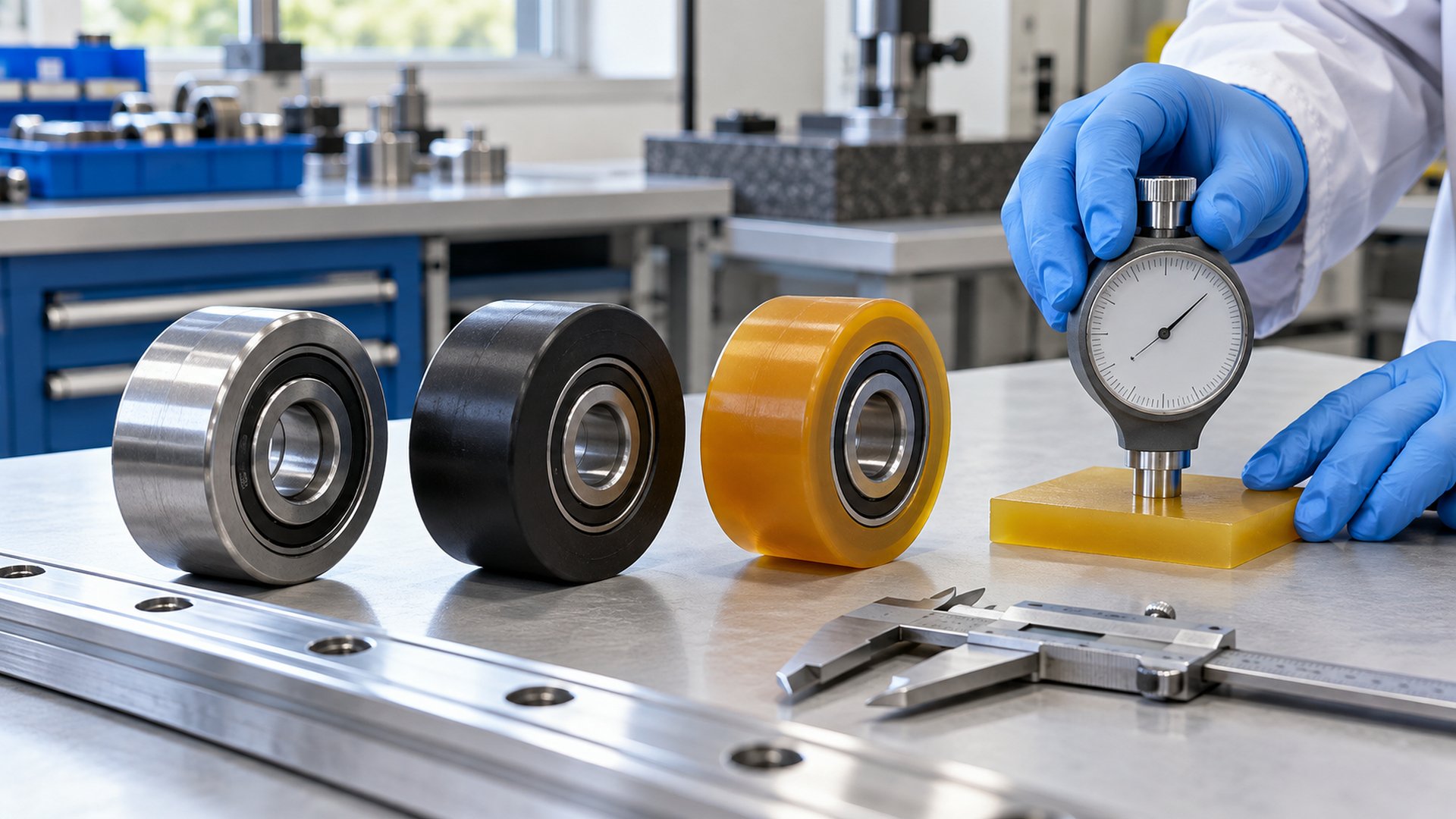 The polyurethane profile, coating thickness and internal bearing can be configured around the intended mating surface and duty.
The inner bearing supports rotation around a shaft, pin or stud. The polyurethane coating forms the surface that contacts a track, rail, belt, cable, tube, panel or workpiece. Depending on the design, the PU may be moulded directly around the bearing outer ring, bonded to a prepared metal hub, or applied to another rigid core that contains the bearing.
This construction separates two functions:
- the bearing controls rolling motion, internal friction and shaft support; and
- the polyurethane controls contact compliance, grip, damping, surface protection and much of the external wear behavior.
HUNE's polyurethane-coated bearing roller range includes configurable bearing types, coating dimensions, hardness, profiles and mounting components. The product should still be treated as an engineered assembly rather than a standard bearing with decorative plastic around it.
Why Does Polyurethane Improve Grip and Traction?
PU can conform slightly to the mating surface, creating more stable contact than a hard, smooth metal ring in many drive or guide applications.
A resilient tread develops a finite contact patch instead of an almost line-like contact. This can help a roller transmit tangential force, guide coated stock or maintain contact with small surface variations. The benefit is relevant to feed rollers, light drive rollers, pinch rollers and guide wheels where slip must be controlled.
More grip is not always better. Excessive traction can mark delicate surfaces, increase motor load or prevent the intended slip that protects a mechanism during a jam. Oil, water, powder and release agents can also change the friction condition. Friction data from a dry laboratory sample should not be treated as a universal coefficient for the installed machine.
I normally ask whether the roller is driving, idling, guiding or applying pressure. A driven roller needs torque-transfer data. An idler may need low rolling resistance and gentle contact. The same PU compound is unlikely to optimize both without a trade-off.
How Can PU Reduce Noise and Vibration?
The coating can absorb small impacts and isolate high-frequency contact vibration before it reaches the metal structure.
A bare steel bearing running on a metal rail creates a stiff contact. Surface joints, particles and runout can pass force directly into the bracket and machine frame. A polyurethane layer deforms locally and can reduce the sharpness of these impacts. This often makes PU attractive for indoor equipment, office machines, packaging lines, automation modules and sliding mechanisms where sound quality matters.
Noise still depends on the whole system. Bearing quality, internal clearance, grease, wheel runout, bracket stiffness, track joints and alignment can dominate the result. A soft coating cannot correct a bent shaft or a rail that forces the bearing to run out of line. Our explanation of how bearings reduce friction shows why the bearing and external tread solve different parts of the motion problem.
How Does PU Protect Tracks and Products?
A polyurethane tread separates hard bearing steel from a softer or finished mating surface.
This can be useful when a roller contacts:
- anodized aluminium profiles;
- painted or powder-coated rails;
- polished tubes;
- cable jackets and hoses;
- printed or laminated stock;
- glass-handling fixtures with an approved compound; or
- finished components moving through an assembly cell.
The coating spreads contact over a wider area and reduces direct metal-to-metal marking. Protection depends on cleanliness. Embedded metal chips, abrasive dust or hardened adhesive can turn a soft wheel into an abrasive tool. A maintenance and cleaning plan still matters even when PU is selected to protect the product.
The tread profile is equally important. A flat wheel, crown, U-groove, V-groove or custom radius must match the actual mating geometry. A narrow or mismatched contact line can raise local stress and heat even when the material itself is suitable.
Is Polyurethane Wear-Resistant?
Many PU formulations offer strong abrasion and tear resistance, but the result depends on compound chemistry, hardness, heat and the real wear mechanism.
BASF describes Elastollan TPU as combining elasticity with wear resistance and mechanical strength, and its material-properties guide discusses abrasion, compression set and other relevant properties. Covestro's cast polyurethane overview lists caster wheels among typical uses and highlights the broad hardness range plus abrasion, tear and chemical resistance available from cast PU systems.
These are material-family capabilities, not guaranteed roller life. Wear can occur through abrasion, cutting, chunking, fatigue, heat softening, hydrolysis, chemical attack or bond failure. A compound that performs well against dry abrasion may not be the best choice for hot water, sharp debris or repeated high-speed flexing.
ISO 4649:2024 defines a rotating-drum method for comparing the abrasion resistance of vulcanized or thermoplastic rubber. The standard also cautions that a close relationship between that laboratory result and service performance cannot be inferred. Use abrasion data to compare controlled samples, then validate the roller in its actual contact and environment.
How Does PU Hardness Change Roller Behavior?
Softer PU generally increases compliance and damping; harder PU generally improves dimensional support and reduces deflection.
 Hardness should be measured under a defined method and selected with coating thickness, load and contact geometry.
Shore hardness is often used to describe polyurethane. ISO 48-4:2018 specifies the durometer method for Shore hardness, including A and D scales for different hardness ranges. A value is meaningful only when the scale, test method, specimen condition and reporting details are clear.
| Design direction | Potential benefit | Trade-off to review |
|---|---|---|
| Softer PU | More conformity, damping and gentle contact | Greater deflection, heat generation and possible flat spotting |
| Harder PU | Better shape retention and lower rolling deformation | Less cushioning and potentially higher track stress or noise |
| Thicker coating | More material for compliance and wear allowance | More heat path, greater dimensional change and larger wheel envelope |
| Thinner coating | Compact package and firmer support from the core | Less cushioning and less wear volume before the core is affected |
Hardness alone does not define stiffness. A thin soft coating over a large steel core can behave firmer than a thick coating of the same compound. Roller width, diameter, load, speed and core geometry also change deflection. I do not approve a PU roller from a Shore value alone.
How Does a PU-Coated Roller Work as a Complete System?
The coating carries contact force into the bearing, axle, bracket and machine frame, so each interface must stay aligned.
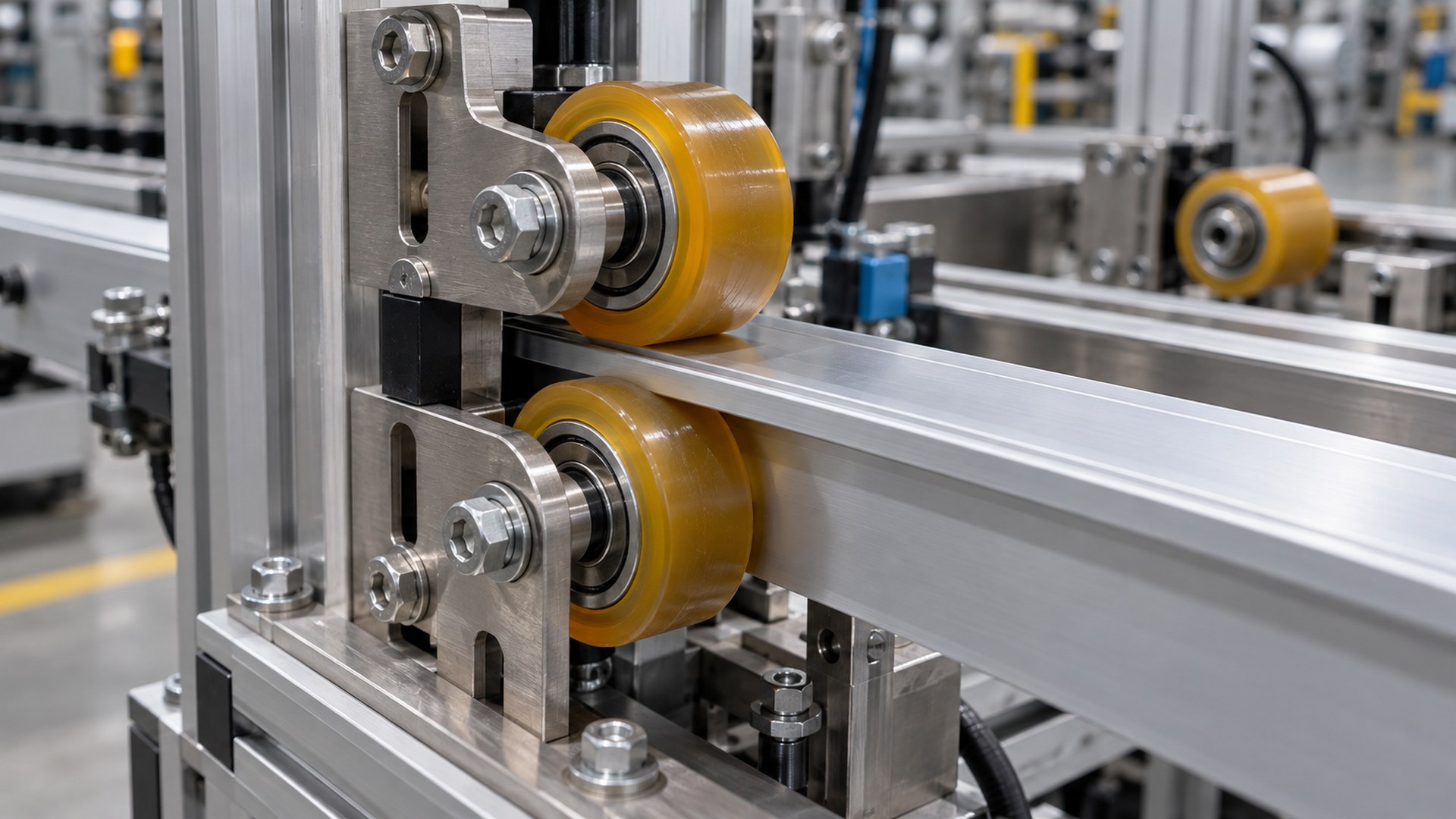
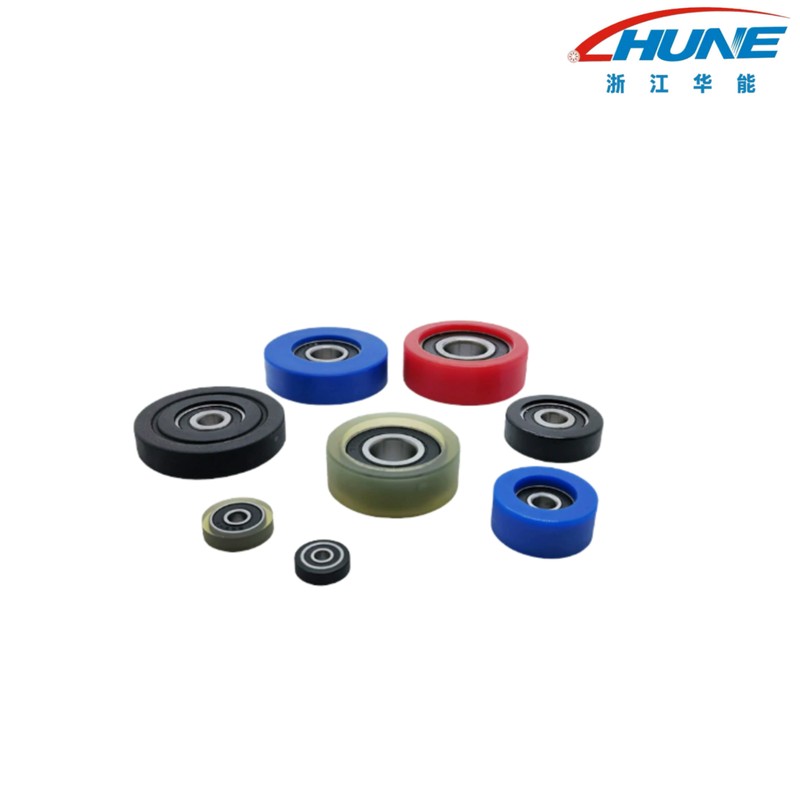 Roller spacing, preload, profile alignment and bracket stiffness determine how the polyurethane contact works in the machine.
A typical load path is:
moving product or rail → PU running surface → rigid core or bearing outer ring → rolling elements → inner ring → axle → bracket → machine frame
If opposed rollers pinch a profile, their centre distance controls compression and preload. Too little engagement may allow slip or loss of guidance. Too much engagement can increase rolling resistance, heat, coating strain and bearing load. Adjustable slots can help during development, but mass production still needs a defined setting and inspection method.
The HUNE sliding rollers with bearing category illustrates how wheel profile, bearing and mounting form one component. HUNE's roller material and process guide places PU alongside POM, nylon, TPE, rubber and metal options so the contact material can be chosen around the actual machine.
What Causes Heat in a Polyurethane Roller?
Repeated deformation creates hysteresis heat, while bearing friction, slip and misalignment can add more.
As PU enters and leaves the contact zone, it compresses and recovers. The material does not return all deformation energy immediately; part becomes heat. Higher speed, load, deflection and cycle frequency can raise temperature. A thick or soft coating may experience more deformation than a thin hard coating under the same nominal load.
Heat can alter hardness, dimensions, bond stress and bearing grease behavior. It can also accelerate some ageing mechanisms. This is why a static load check is not enough for a continuously rotating roller.
For a new design, measure steady-state roller temperature during a representative duty cycle. Include the real preload, speed, ambient temperature, stops and starts, contamination and cooling conditions. Do not use the bearing's catalogue speed limit as proof that the PU tread can run at that speed.
What Are Compression Set and Flat Spotting?
A roller left under load can retain part of its deformation, creating a temporary or permanent flat area.
Compression set describes the material's inability to recover fully after prolonged compression under specified test conditions. In a stationary machine, a loaded PU wheel may remain pressed against a rail for hours or days. On restart, the operator may feel periodic vibration until the tread recovers—or the deformation may persist.
The risk depends on compound, hardness, load, coating thickness, temperature and dwell time. A design with continuous rotation can have a different failure mode from one that parks under preload. Buyers should tell the supplier how long the mechanism remains stationary under load and whether restart smoothness is critical.
How Important Is the Bond Between PU and the Core?
The coating is useful only while it remains securely attached to the bearing or hub.
Bond performance depends on core material, surface preparation, cleanliness, primer or adhesive system, moulding process, cure conditions, coating thickness and geometry. Oil on the bearing OD, inadequate surface preparation or trapped contamination can weaken the interface. Sharp geometry can concentrate stress at the coating edge.
Directly coating a bearing also requires protection of the raceway, seals and internal lubricant during processing. Moulding temperature and pressure must not damage the bearing or alter its running condition. Another route uses a prepared hub or separately moulded ring, followed by bearing assembly. Each architecture changes tooling, tolerances and inspection.
HUNE's OEM roller development process coordinates bearing preparation, moulding, metal hardware, assembly and inspection. For critical projects, the drawing should identify the bond interface and the validation plan rather than treating adhesion as an unmeasured supplier detail.
Which Bearing Should Be Used Inside the PU Roller?
Select the bearing from load, speed, duty, environment and fit; do not let the coating hide an unsuitable bearing.
The bearing review should include:
- bore, outside diameter and width;
- radial and axial load direction;
- rotating ring and load direction;
- seal, shield or open construction;
- internal clearance after coating and mounting;
- bearing material and corrosion exposure;
- grease and operating temperature;
- shaft fit and outer-ring retention; and
- alignment across multiple rollers.
The PU coating may reduce impact entering the bearing, but it does not remove bearing fatigue, contamination or lubrication limits. Our guide to what determines bearing life explains why catalogue life calculations and real roller service conditions must be kept separate.
PU vs POM, Rubber and Steel Rollers
PU occupies a useful middle ground between hard engineering plastics and softer rubber, but the exact compound matters more than the category name.
| Running-surface option | Typical reason to consider it | Main issue to verify |
|---|---|---|
| Polyurethane | Grip, damping, abrasion resistance and surface protection | Hardness, hysteresis heat, compression set, chemistry and bond |
| POM | Dimensional stability, machinability and low-friction hard contact | Impact noise, track wear, wall section and temperature |
| Nylon | Toughness and broad moulding options | Moisture response, dimensions, noise and track compatibility |
| Rubber | Soft contact, high damping or traction | Wear, ageing, compression set, chemistry and rolling resistance |
| Steel | High stiffness, temperature capability and precise machined geometry | Noise, corrosion, track wear and mass |
This table is a screening tool. “PU” can refer to different thermoplastic or cast systems with different base chemistry and additives. “Rubber” and “nylon” are also broad families. Compare named grades and test conditions, then test the complete roller.
Where Are PU-Coated Bearing Rollers Commonly Useful?
They suit equipment that needs controlled, quiet contact between a rotating bearing assembly and a surface that should not be damaged.
Potential applications include:
- automation guide and positioning rollers;
- packaging, labelling and converting machinery;
- wire, cable, hose and tube handling;
- light conveyors and transfer equipment;
- profile-feeding and straightening fixtures;
- printer, scanner and office-equipment mechanisms;
- inspection and assembly fixtures; and
- sliding systems where low noise and track protection matter.
Application labels do not establish suitability. A cable guide may require a specific groove radius and low marking. A drive roller may require repeatable traction. A packaging roller may need chemical compatibility with ink, cleaner or adhesive. The same catalogue wheel should not be assumed suitable for all three.
When Should You Avoid a PU-Coated Roller?
Choose another construction when the application needs a very hard, dimensionally rigid contact or exposes PU to conditions outside the approved compound range.
Review alternatives when the roller faces:
- high temperature beyond the material and bond rating;
- sharp chips or cutting edges that can gouge the tread;
- chemicals, steam or water exposure not covered by the compound data;
- very low permissible deflection;
- prolonged static preload with strict restart smoothness;
- extreme speed and heat generation;
- a requirement for direct electrical conductivity without a qualified formulation; or
- a surface where high grip would overload the drive during a jam.
These are selection questions rather than universal exclusions. Polyether- and polyester-based polyurethane systems, thermoplastic TPU and cast PU can behave differently. Use the supplier's compound data and validate the final roller.
How Should an OEM Validate a PU Bearing Roller?
Test material, coating integrity and complete-system motion under production-representative conditions.
I recommend a staged validation:
- Define the contact: mating material, surface finish, profile, load, preload and permitted marking.
- Approve the compound: chemistry, hardness scale and value, colour and relevant material data.
- Inspect geometry: bearing position, running diameter, width, profile, concentricity and runout.
- Check the bond: use a project-appropriate adhesion or destructive sample method agreed with the supplier.
- Run a dynamic test: representative speed, duty, stops, starts and ambient conditions.
- Measure operating effects: temperature, traction or slip, noise, wear, debris, flat spotting and bearing rotation.
- Inspect mating surfaces: scratches, transfer, polishing or contamination.
- Approve production controls: compound traceability, cure or moulding controls, critical dimensions and sampling.
A short free-spin check cannot evaluate tread heat or bond fatigue. A material certificate cannot prove that the finished roller is concentric or correctly mounted.
What Should Buyers Include in a PU Roller RFQ?
Send the contact requirement and duty, not only a desired colour and wheel size.
Include:
- application and whether the roller drives, guides, supports or pinches;
- 2D drawing, 3D model or physical sample;
- bearing designation, bore, OD, width and closure preference;
- finished roller OD, width and profile;
- proposed PU chemistry or existing approved grade, if fixed;
- Shore scale and target hardness;
- coating thickness and core construction;
- mating material, surface finish and geometry;
- radial load, axial load, preload and number of rollers sharing load;
- speed, duty cycle, acceleration and stationary dwell time;
- temperature, moisture, UV, ozone, oil, cleaner and chemical exposure;
- traction, noise and surface-marking limits;
- colour and cosmetic requirements;
- critical dimensions and inspection method;
- prototype test plan; and
- annual quantity and packaging requirements.
If the existing design has a failure, send photographs and describe whether the problem is wear, delamination, cracking, flat spotting, slip, heat, noise or bearing seizure. These symptoms lead to different corrective actions.
Discuss a Custom PU-Coated Bearing Roller with HUNE
HUNE can review the PU tread, bearing, shaft, bracket and mating geometry as one OEM project.
We manufacture plastic- and polyurethane-coated bearing rollers and can coordinate related shafts, studs, spacers, stamped brackets and assemblies. The review can begin with a drawing, physical sample or equipment requirement. We can compare an existing mould with a modified profile or new tooling route after the functional dimensions are confirmed.
Send your roller drawing, bearing details, target hardness, mating surface, load, speed, environment and expected quantity through the HUNE contact page. This information allows an engineering and sourcing review before sample production.
Frequently Asked Questions
Are polyurethane-coated bearing rollers quieter than steel rollers?
They can reduce contact noise and impact because the PU tread is more compliant than bare steel. Actual noise also depends on bearing condition, wheel runout, track joints, alignment, bracket stiffness and speed. Validate the complete assembly rather than relying on material alone.
Does softer polyurethane always provide more grip?
Softer PU can increase conformity, but grip also depends on compound chemistry, surface finish, contamination, temperature, pressure and slip speed. Excessive softness may increase deformation and heat. Select grip with the required dimensional stability and duty cycle.
What Shore hardness should a PU bearing roller use?
There is no universal value. The correct hardness depends on load, coating thickness, diameter, speed, desired traction, damping, track material and permitted deflection. Specify the Shore scale and test method, then validate samples in the intended system.
Can polyurethane rollers run in wet environments?
Some PU formulations have useful water and hydrolysis resistance, while others are less suitable for prolonged hot or wet service. Confirm the exact chemistry, temperature, chemicals and exposure duration. The bearing material and closures must also suit the wet environment.
Why does a PU roller develop a flat spot?
Static load, soft or thick coating, elevated temperature, long dwell time and compound compression set can all contribute. Review preload, parking duration, hardness, coating geometry and material data, then test restart behavior under representative conditions.
Can a worn PU coating be replaced without changing the bearing?
Recoating may be possible for some hub constructions, but it is not automatically economical or safe. The old coating must be removed, the core and bearing evaluated, and the new bond and dimensions controlled. For small OEM rollers, replacing the complete unit may provide more consistent quality.
Final Engineering Recommendation
Use a polyurethane-coated bearing roller when the machine needs resilient contact, traction, damping or surface protection and when the coating can be validated for the real duty. Start with the mating surface and motion requirement, then select hardness, thickness, profile and PU chemistry. Complete the design with the correct bearing, shaft fit, bracket stiffness and alignment.
Before approving production, test temperature rise, wear, bond integrity, noise, traction, flat spotting and surface marking in a representative assembly. For sourcing, send the supplier a complete drawing and operating conditions rather than a generic request for a “PU wheel with bearing.”