POM and nylon can both work as roller materials, but neither is better in every application. POM is often the stronger starting point when dimensional stability, low moisture uptake and a hard, low-friction running surface matter. Nylon is often worth evaluating when toughness, impact resistance or a more compliant response is important. That is only a first screen: PA6, PA66, reinforced nylon and modified POM grades behave differently. For a roller, the track, load, bearing fit and environment can matter as much as the resin family.
POM vs Nylon for Rollers: What Is the Difference?
POM and nylon are both engineering plastics, but they respond differently to moisture, impact, stiffness and sliding contact. POM is polyoxymethylene, also called acetal. Nylon is polyamide, commonly supplied as PA6, PA66, reinforced grades and specialty compounds. Supplier references describe POM as a stiff, wear-resistant material with low moisture absorption; BASF describes PA6 as a tough material with good damping and shock resistance, while noting that polyamide parts absorb moisture depending on ambient conditions.
For roller selection, I would not compare only generic resin names. First identify what the wheel must do: carry a load, guide laterally, roll over a track joint, resist impact, run quietly, or hold a precise position. Then compare grades under the real operating conditions.
| Selection factor | POM may be a useful starting point when… | Nylon may be a useful starting point when… |
|---|---|---|
| Dimensional stability | The wheel has tight running geometry and moisture variation should be limited | The specified nylon grade is conditioned and dimensioned for the service environment |
| Impact and toughness | The load is controlled and the selected grade meets the impact requirement | Toughness, shock response or resilience is a priority for the design |
| Track contact | A hard, smooth, wear-resistant contact surface is needed | A specific nylon grade provides the needed toughness or wear response against the rail |
| Humidity or water exposure | Lower moisture uptake is beneficial, subject to grade and chemical conditions | The dimensional change and property shift from moisture are included in design and validation |
| Reinforcement | An unfilled or modified POM grade meets stiffness needs | Reinforced nylon is considered for added stiffness, with fiber exposure and track wear reviewed |
These are screening directions, not a final material specification. Celanese and BASF publish grade-specific data because the performance range inside each family is broad. Review the exact resin data sheet and test conditions before using values in a drawing or acceptance plan.
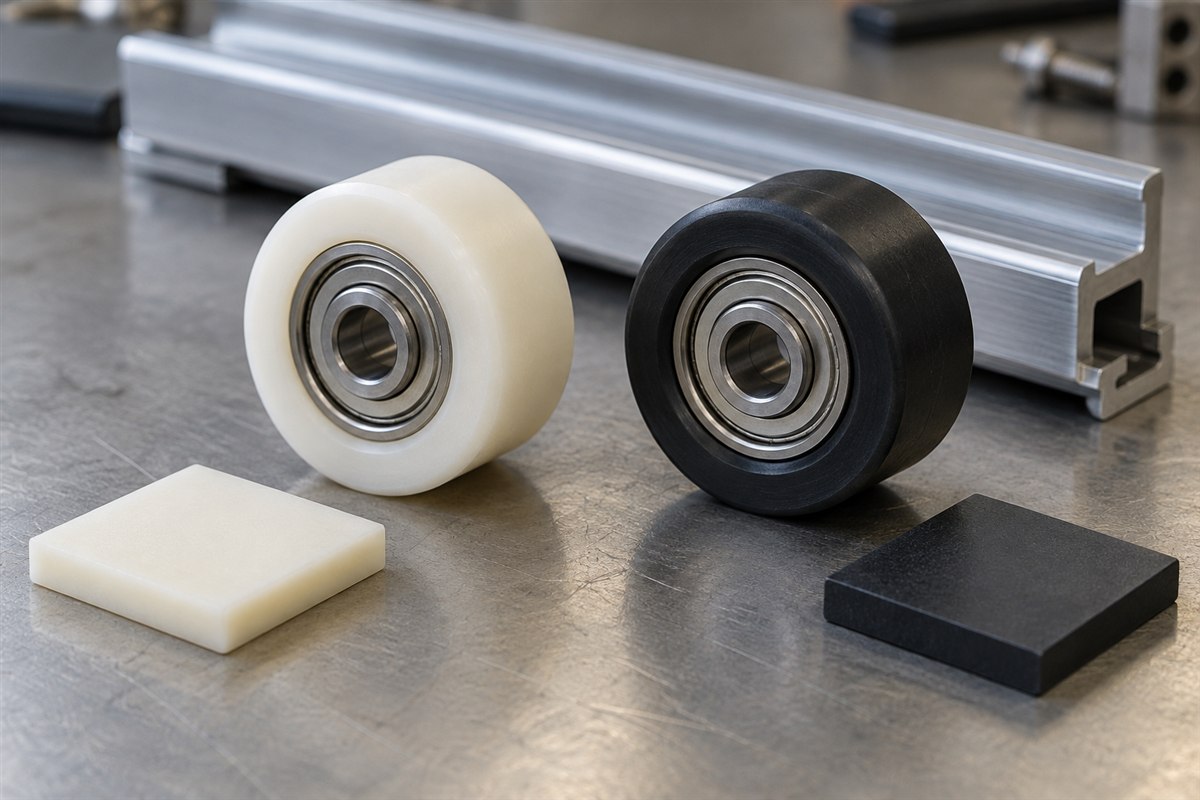
Image placement: after the comparison table. The colors are illustrative and do not identify a particular resin grade.
Does POM or Nylon Handle Moisture Better?
POM generally absorbs less moisture than common unfilled PA6 or PA66, which can make it easier to maintain dimensions in changing humidity. The exact difference depends on grade, conditioning, temperature and exposure; use the supplier data for the specific material rather than a generic family value.
Moisture matters when a roller has a close fit on a bearing, a small groove, a controlled running diameter or a narrow clearance in a bracket. If a nylon wheel changes dimension after conditioning, the effects may show up as altered track clearance, assembly force or running resistance. That does not automatically disqualify nylon. It means the part should be designed and inspected at a defined moisture condition, especially when the equipment operates in variable humidity or sees water exposure.
The BASF Ultramid PA material information and its PA6/PA66 product brochure discuss polyamide properties and moisture uptake. For an OEM drawing, specify the material conditioning and inspection state when dimensional performance depends on moisture content.
Which Material Is Better for Wear and Sliding?
There is no reliable winner based on the material name alone; wear depends on the exact grade and the two surfaces in contact. A roller runs against a track, not against an abstract test value. Contact pressure, wheel profile, speed, surface finish, dust, lubrication and alignment all affect wear and friction.
POM is often selected for precise, hard-running guide wheels where low moisture response and dimensional control are valuable. Nylon may be preferable when its toughness or impact behavior suits the load profile. Reinforced nylon can increase stiffness, but exposed glass fibers can be abrasive to a softer or finished track; the wheel design must keep the reinforcement and contact surface compatible with the rail.
For either material, look at the wear pair: wheel grade against track material and finish. A smooth polymer wheel on a rough rail can wear differently from the same wheel on a polished rail. A misaligned guide can concentrate contact at one edge and create a failure that looks like a material problem. I would inspect track geometry, wheel runout and load distribution before changing resin.
What About Load, Stiffness and Impact?
Choose the grade around the load profile, not a single tensile-strength number. A roller sees contact stress, bending in its hub or bracket, repeated cycles and sometimes shock when it crosses a joint or receives an impact. A static material datasheet cannot represent all of those conditions by itself.
POM can be a good fit when a wheel must retain a precise profile under controlled loading. Nylon grades can offer useful toughness and shock response, while glass-reinforced nylon may be considered where greater stiffness is required. Reinforcement changes more than stiffness: it can affect impact behavior, shrinkage, anisotropy, surface finish and track wear. Likewise, an unfilled grade and a lubricated or impact-modified grade should not be treated as equivalent.
When a plastic roller carries a bearing, the hub wall around the bearing is part of the load path. Check bearing-seat dimensions, concentricity, retention method and the axle or stud. A hard material choice cannot compensate for a thin hub, poor support or a track profile that puts load on the wrong part of the wheel.
How Do POM and Nylon Compare in an Actual Roller System?
The wheel material is only one part of the mechanism. Review the roller, bearing, axle or stud, bracket, track, load direction and installation clearance together. The wheel profile determines where the track contacts the roller; the bearing supports rotation; the mounting hardware transfers force into the frame.
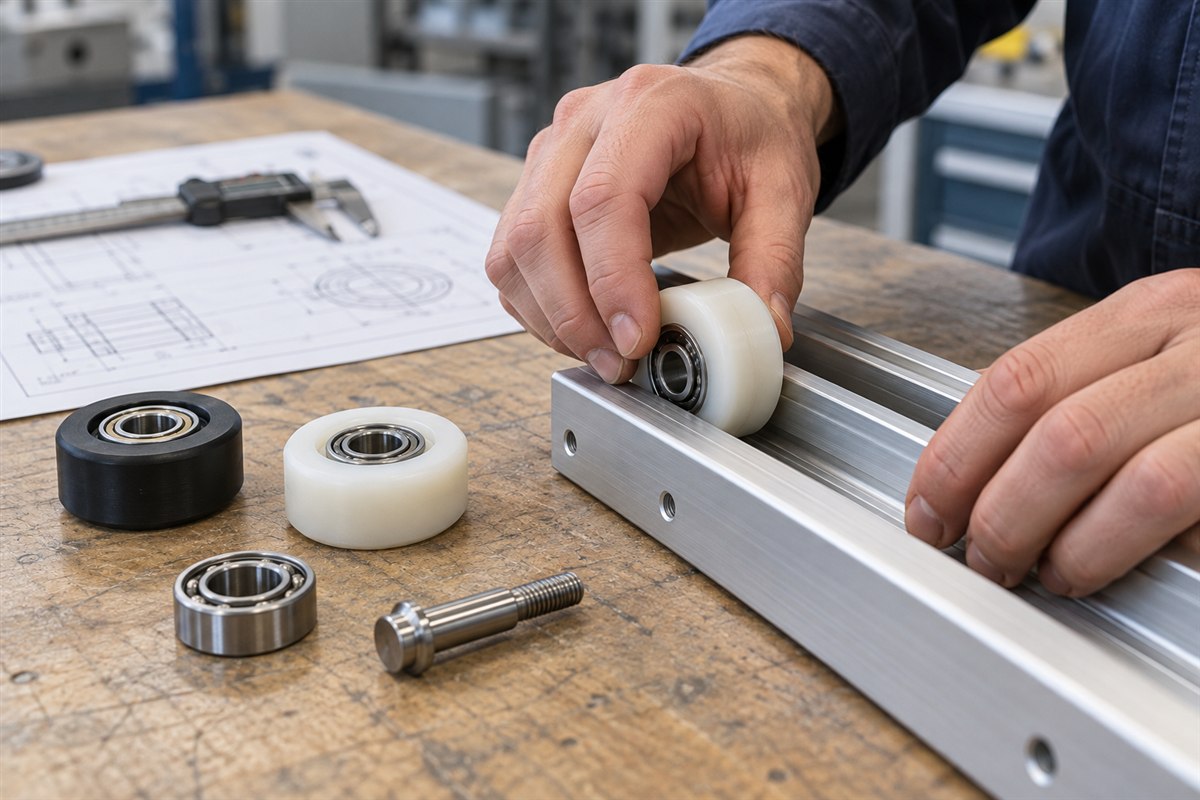
Image placement: in this section, beside the explanation of the full roller assembly.
HUNE’s POM bearing roller with threaded stud shows a construction that combines a POM running wheel, bearing and mounting stud. The nylon sliding window roller shows a nylon wheel option within a bracket-and-track application. These are examples of product constructions, not proof that one material is universally better; check the actual wheel profile and installation interface.
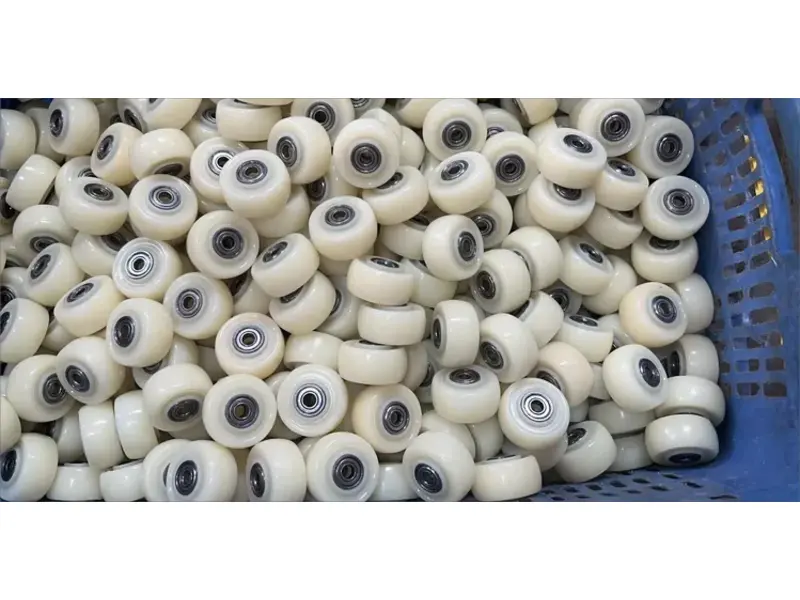
Image placement: after the product examples. This is an existing HUNE media-library image.
How Should OEM Buyers Choose Between POM and Nylon?
Start with the operating conditions and functional dimensions, then request samples of the exact grades being considered. I would ask the supplier to evaluate the following before approving the material:
- Track and contact geometry: rail cross-section, material, finish, groove radius or angle, contact width and alignment.
- Load and movement: static and dynamic load, direction, wheel count, speed, cycle frequency, shock and dwell time.
- Environment: humidity, water, temperature, chemicals, cleaning agents, dust and UV exposure.
- Critical dimensions: running diameter, overall width, groove geometry, bearing-seat diameter, runout, concentricity, axle or stud size and mounting clearance.
- Material specification: supplier and grade, PA6 or PA66 type, reinforcement or lubricant, color, recycled content policy and any compliance requirements.
- Production and volume: prototype quantity, expected annual demand, molded or machined route, tooling responsibility, inspection plan and change-control requirements.
- Validation: fit, free rotation, noise, wear, load distribution and dimensional checks after conditioning in the relevant environment.
For nylon, state the moisture conditioning that applies to dimension inspection. For reinforced grades, state which surface contacts the track and whether fibers may be exposed there. For POM, verify the grade’s temperature and chemical limits and bearing retention. HUNE’s roller material and manufacturing-process guide provides a starting point for comparing POM, nylon and other roller materials.
Frequently Asked Questions
Is POM better than nylon for sliding door rollers?
Not in every sliding door. POM can be a suitable choice where dimensional stability, low moisture uptake and a rigid wheel are priorities. Nylon may be appropriate where toughness or impact response is more important. The correct choice also depends on the door load, wheel profile, bearing assembly, track material, humidity and temperature. Compare the proposed grades in the real track system before approving production.
Is nylon stronger than POM?
That depends on what “stronger” means and which grades are being compared. Tensile strength, stiffness, impact resistance, fatigue and creep are different properties, and reinforcement changes the comparison. Compare technical datasheets using the same methods and conditioning, then confirm the wheel design under its actual load and cycle. Do not select a roller from one headline strength value alone.
Does nylon absorb moisture and change roller dimensions?
Many PA6 and PA66 grades absorb moisture from their surroundings, and this can change dimensions and mechanical behavior. The amount depends on grade, conditioning, humidity and exposure. That change can matter in a close-fitting wheel or bearing seat. Suppliers publish grade-specific absorption and conditioning data; define the condition for measurement and validate the assembled roller in its service environment.
Can glass-filled nylon be used for rollers?
It can be considered when the design needs greater stiffness, but reinforcement affects surface behavior and processing. If fibers reach the running surface, they may wear the mating track, depending on the grade and contact pair. Review the molded surface, wheel profile, shrinkage and track material with the supplier, then test the actual assembly. A glass-filled grade is not automatically a better replacement for an unfilled roller.
What should I send a roller supplier for a POM-versus-nylon comparison?
Send a dimensioned drawing or sample, the track profile and material, load direction, movement speed and cycle, operating environment, critical tolerances, quantity and the desired production route. Identify whether the wheel contains a bearing and how it is retained. If you have specific POM or nylon grades in mind, include their full designations. This lets the supplier compare the complete roller assembly instead of quoting a material name alone.
Practical Recommendation
Use POM as an initial candidate when low moisture uptake and controlled running geometry matter. Evaluate nylon when the required grade’s toughness, impact response or stiffness better matches the load and environment. Then compare the specific grades against the actual track, bearing fit and production process; neither material family has a universal performance advantage.