Sealed and shielded bearings use different closures to retain lubricant and limit contamination. A metal shield normally forms a narrow non-contact gap near the inner ring. It creates little additional friction and can suit clean, relatively dry or higher-speed positions. A seal uses an elastomeric lip or closely controlled non-contact design. A contacting seal usually excludes fine dust and moisture more effectively, but its rubbing contact can increase starting torque, heat and speed limitations.
Neither option is universally better. The correct choice depends on what can reach the bearing, the required rotational resistance, speed, temperature, grease life and the protection provided by the surrounding wheel or housing. For an OEM roller, I also check which bearing ring rotates, whether both faces are exposed, and whether pressing the bearing into the wheel can damage the closure.
What Is a Shielded Bearing?
A shielded bearing uses a rigid metal disc to block larger contaminants while maintaining a small running gap.
The shield is normally fixed to the outer ring and extends toward the inner ring. It does not usually rub against the inner ring. The narrow gap restricts the path into the bearing but remains open at a microscopic or small geometric level.
That construction offers several practical advantages:
- low closure-related friction;
- low starting resistance;
- no elastomer lip wear;
- grease retention suitable for many protected positions;
- compatibility with relatively high rotational speeds, subject to the manufacturer's data;
- a thin, dimensionally stable metal closure.
Its limitation is the same feature that keeps friction low: the gap does not create a strong barrier against fine dust, fibres, water or cleaning fluid. A shielded bearing performs best when the equipment housing, wheel body or surrounding cover already limits contamination.
Common designations include Z for one shield and ZZ or 2Z for shields on both sides. These suffixes are widely used but are not perfectly universal. The complete manufacturer designation and drawing should control purchasing.
What Is a Sealed Bearing?
A sealed bearing uses an elastomeric or polymer closure designed to provide stronger grease retention and contaminant exclusion.
A common contact seal contains an elastomer lip reinforced by a metal insert. The lip runs against a counterface on the inner ring. This contact creates a more difficult path for fine particles and moisture, while also helping keep grease inside the bearing.
Typical reasons to assess a sealed bearing include:
- fine dust or textile fibres;
- wood particles or production debris;
- humidity, splash or outdoor exposure;
- limited access after assembly;
- a long grease-service requirement;
- a roller face that remains exposed in use.
Contact also creates a trade-off. Seal-lip friction can increase breakaway torque and running torque. Heat generated at the lip can matter at higher speed or in very small, low-torque mechanisms.
Not every seal contacts with the same force. Bearing manufacturers also offer low-friction contact seals and non-contact seals that sit between a traditional shield and a heavy contact seal in the protection-versus-friction balance.
How Does a Shield Differ from a Contact Seal?
A shield relies on a narrow gap; a contact seal relies on a rubbing lip and a more controlled exclusion path.
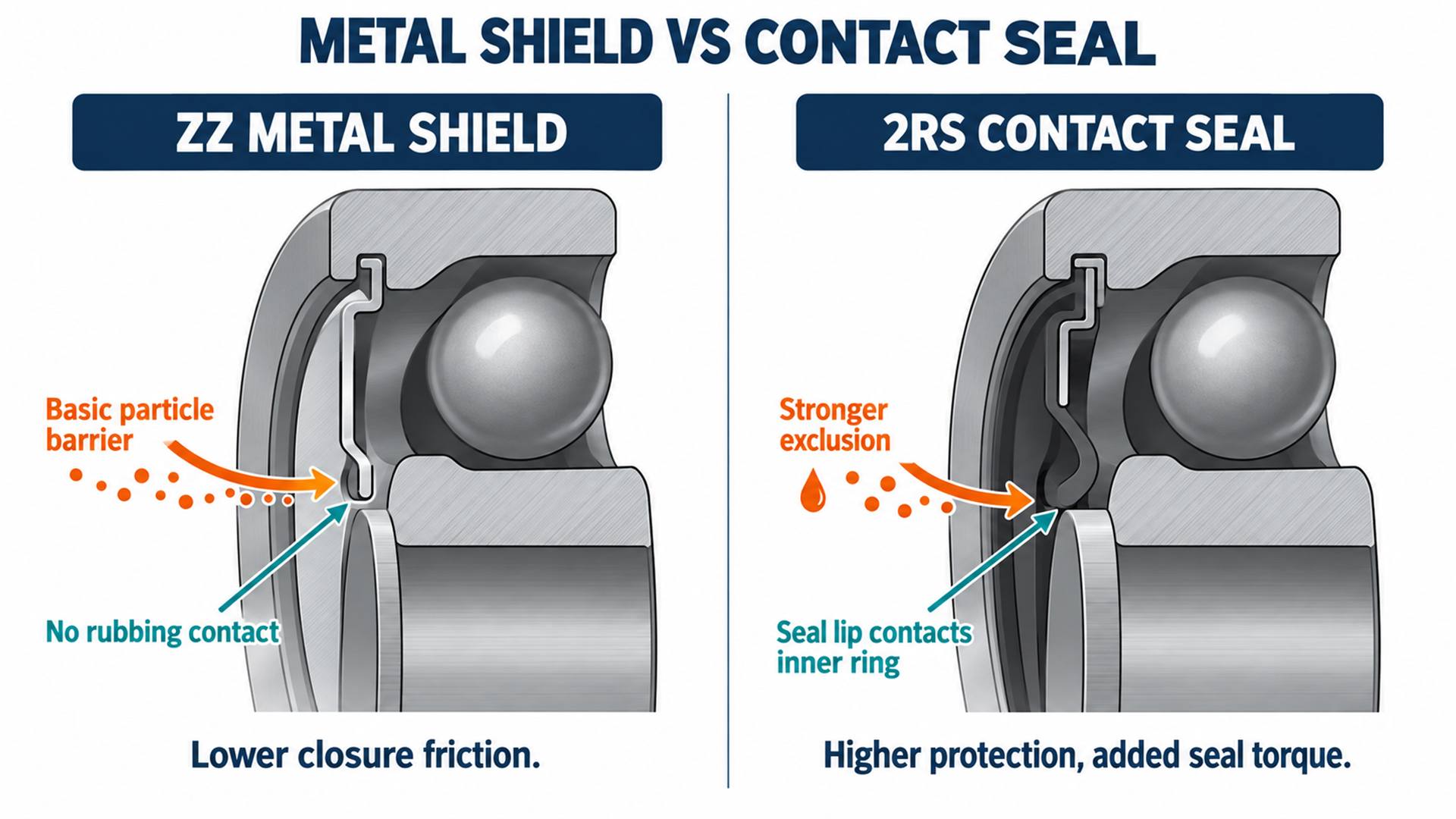 The shield avoids rubbing contact, while the seal lip contacts the inner-ring counterface.
The closure sits between the outer and inner rings, but it should not carry the bearing's main load. Its function is environmental control and lubricant retention.
| Design feature | Metal shield | Contact seal |
|---|---|---|
| Typical material | Formed sheet metal | Elastomer bonded to or reinforced by metal |
| Inner-ring interface | Small non-contact gap | Lip contacts a counterface |
| Closure friction | Usually low | Usually higher because of lip contact |
| Fine-particle exclusion | Limited compared with a contact seal | Generally stronger |
| Moisture resistance | Limited; external protection remains important | Generally stronger for splash and humidity |
| Grease retention | Suitable for many clean applications | Generally stronger |
| Seal wear | No rubbing lip | Lip and counterface can wear |
| Speed implication | Often favourable | Contact friction may reduce the catalogue speed limit |
NSK's deep-groove ball bearing guide states that seals and shields help protect internal components and maintain lubrication, with sealed versions providing greater sealing performance than shielded versions. The same page also shows that NSK uses Z or ZZ for shields while using other manufacturer-specific designations for seals.
Are All Sealed Bearings Contact-Sealed?
No. A bearing described as sealed may use a contact, low-friction or non-contact design.
This distinction matters because two black closures can look nearly identical from the outside while producing different torque and exclusion behavior.
SKF's description of deep-groove bearing sealing solutions separates metal shields, low-friction seals and contact seals. That structure is more useful than treating every polymer closure as one category.
The main closure families are:
Contact seals
The lip touches the rotating counterface. These seals generally provide the strongest exclusion among standard integral closures, with a friction and speed trade-off.
Low-friction contact seals
The lip geometry and contact pressure are designed to reduce friction while retaining useful protection. Performance and suffixes depend on the manufacturer and bearing series.
Non-contact seals
The polymer closure forms a narrow labyrinth-like gap without rubbing contact. It may offer better exclusion than a basic metal shield while keeping closure friction low. It should not be assumed to provide the same protection as a heavy contact seal.
I do not approve a bearing from the words “rubber seal” alone. I confirm whether the design contacts, the seal material, the number of sealed sides and the current catalogue suffix.
What Do Z, ZZ, RS and 2RS Mean?
Suffixes indicate closure configuration, but their exact meaning can vary by brand.
The following convention is common in commercial bearings:
| Common suffix | Usually indicates | Buyer check |
|---|---|---|
| Z | Metal shield on one side | Which side is shielded and whether the other side is open |
| ZZ or 2Z | Metal shields on both sides | Manufacturer's gap design and grease specification |
| RS | Elastomer seal on one side | Contact or non-contact design and seal material |
| 2RS | Elastomer seals on both sides | Exact seal construction, torque and speed data |
Manufacturers may use suffixes such as DDU, VV, 2RZ, 2RSL, 2RST, 2RS1, 2RSH, LLU or LLB for specific designs. Cross-brand substitution from a generic suffix can therefore create a specification change.
The safe purchasing record includes:
- manufacturer;
- full bearing designation;
- closure drawing or catalogue description;
- grease specification where controlled;
- internal-clearance group;
- tolerance class;
- approved equivalent or change-control rule.
HUNE's model-specific guide on whether a 6208ZZ can replace a 6208-2RS bearing shows why matching boundary dimensions do not prove functional interchangeability.
Which Bearing Has Lower Friction?
A shielded bearing usually has less closure friction, but total bearing torque also includes lubricant, load and internal sliding losses.
A shield does not contact the rotating inner ring, so it normally adds little direct rubbing torque. A contact seal does touch the inner ring, creating breakaway and running friction.
That does not mean every ZZ bearing rotates more easily than every 2RS bearing. Total torque is affected by:
- bearing size and internal geometry;
- radial and axial load;
- grease type and fill quantity;
- operating temperature;
- internal clearance after fitting;
- cage and rolling-element behavior;
- seal material, lip geometry and contact pressure;
- speed and lubricant churning.
A low-friction seal can outperform an older or heavier contact design. A shielded bearing with unsuitable grease can feel more resistant than a well-designed sealed version. Compare current data from the actual suppliers.
Our engineering guide to how bearings reduce friction explains why rolling losses, sliding losses, seal friction and lubricant drag all contribute to the finished result.
Which Bearing Offers Better Dust and Moisture Protection?
A contact-sealed bearing is normally the stronger starting point when fine contamination or moisture can reach the bearing face.
A metal shield blocks larger particles and direct access, but fine material can pass through its inner gap. Fibres can also migrate through the gap over repeated movement.
A contact seal creates a more restrictive path. It can help exclude fine dust, retain grease and resist occasional splash. However, an integral bearing seal does not make the bearing waterproof.
Conditions that require additional engineering include:
- pressure washing;
- continuous water spray;
- immersion;
- salt water or chloride exposure;
- aggressive cleaning chemicals;
- abrasive slurry;
- large pressure differences across the bearing.
These conditions may require external seals, flingers, drainage, corrosion-resistant bearing materials, compatible grease and protected shafts or brackets. A 2RS suffix alone does not protect the complete assembly.
How Do Closures Affect Grease and Bearing Life?
The closure helps retain factory grease and control contamination, but grease life still depends on speed, temperature and environment.
Many small sealed or shielded deep-groove bearings are supplied greased for their intended service arrangement. The closure reduces leakage and limits contaminant entry. The bearing may not be designed for field relubrication.
Contact seals often provide stronger grease retention. Shields can be sufficient where the bearing remains clean and the surrounding product provides another barrier. At higher speed, lower shield friction may help control temperature, which also affects grease life.
SKF's bearing maintenance handbook separates contact and non-contact external seals and explains the balance between friction, wear, lubricant retention and contaminant exclusion. The same system principle applies when evaluating integral bearing closures.
The bearing supplier should confirm whether the selected closure, grease and temperature range belong to one approved product variant. Replacing only the visible seal style can change more than the cover material.
Does a Seal or Shield Change Bearing Load Capacity?
The closure does not carry the primary rolling load, but it can change practical operating limits and service life.
For some bearing series, sealed and shielded variants share the same basic ring and rolling-element geometry and may list the same basic load ratings. This cannot be assumed for every brand or special design.
The closure can still affect:
- permissible speed;
- friction and operating temperature;
- grease retention;
- contamination-related life;
- maximum seal temperature;
- starting torque;
- maintenance strategy.
In a contaminated environment, the bearing with the stronger closure may outlast a nominally identical shielded bearing because the raceways remain cleaner. In a clean high-speed position, unnecessary contact friction may be the greater risk.
Which Closure Suits Different Operating Conditions?
Choose the lightest closure that provides enough protection for the real exposure and service requirement.
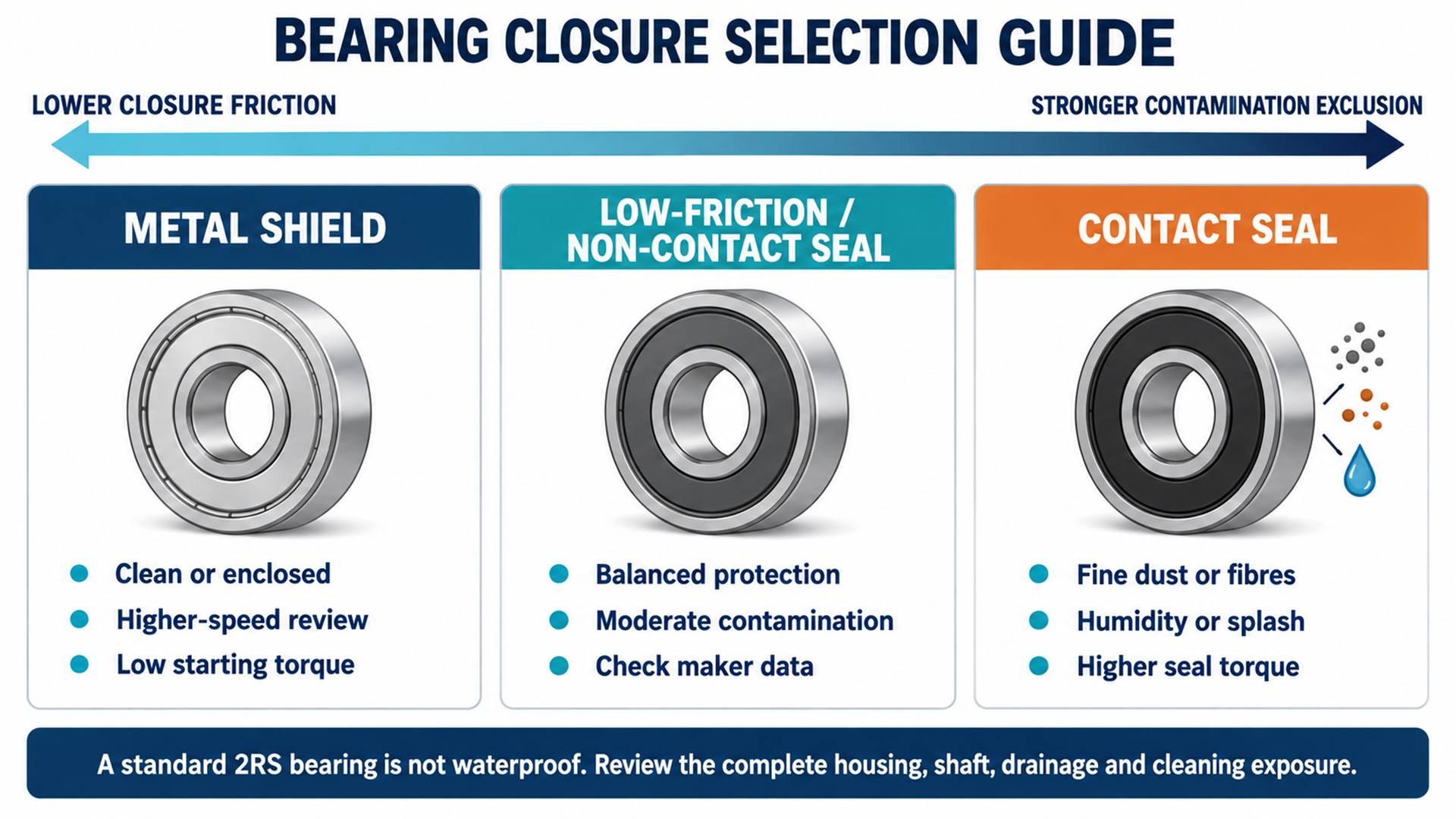 Closure selection balances environmental protection against friction, speed and starting-torque requirements.
| Operating condition | First closure to assess | Main confirmation needed |
|---|---|---|
| Clean enclosed mechanism | ZZ or non-contact seal | Grease life, speed and housing protection |
| High-speed protected position | Shield or non-contact seal | Manufacturer speed and temperature data |
| Very low starting torque | Shield or low-friction seal | Contamination remains adequately controlled |
| Fine dust or textile fibres | Contact seal | Seal wear and temperature |
| Woodworking or packaging debris | Contact seal plus assembly protection | Particle path around the shaft and wheel |
| Humid indoor equipment | Contact or low-friction seal | Condensation, grease and corrosion risk |
| Sheltered outdoor roller | Contact seal | Rain path, drainage, shaft and bracket materials |
| Washdown equipment | Application-specific sealing system | Fluid pressure, chemistry and external sealing |
| Quiet customer-facing product | Test both approved variants | Seal torque, grease, wheel contact and housing resonance |
This table is a screening tool. The selected bearing must still pass the equipment manufacturer's installed tests.
How Do Seals and Shields Behave Inside a Bearing Roller?
The wheel can protect the bearing face, expose it or damage the closure during assembly.
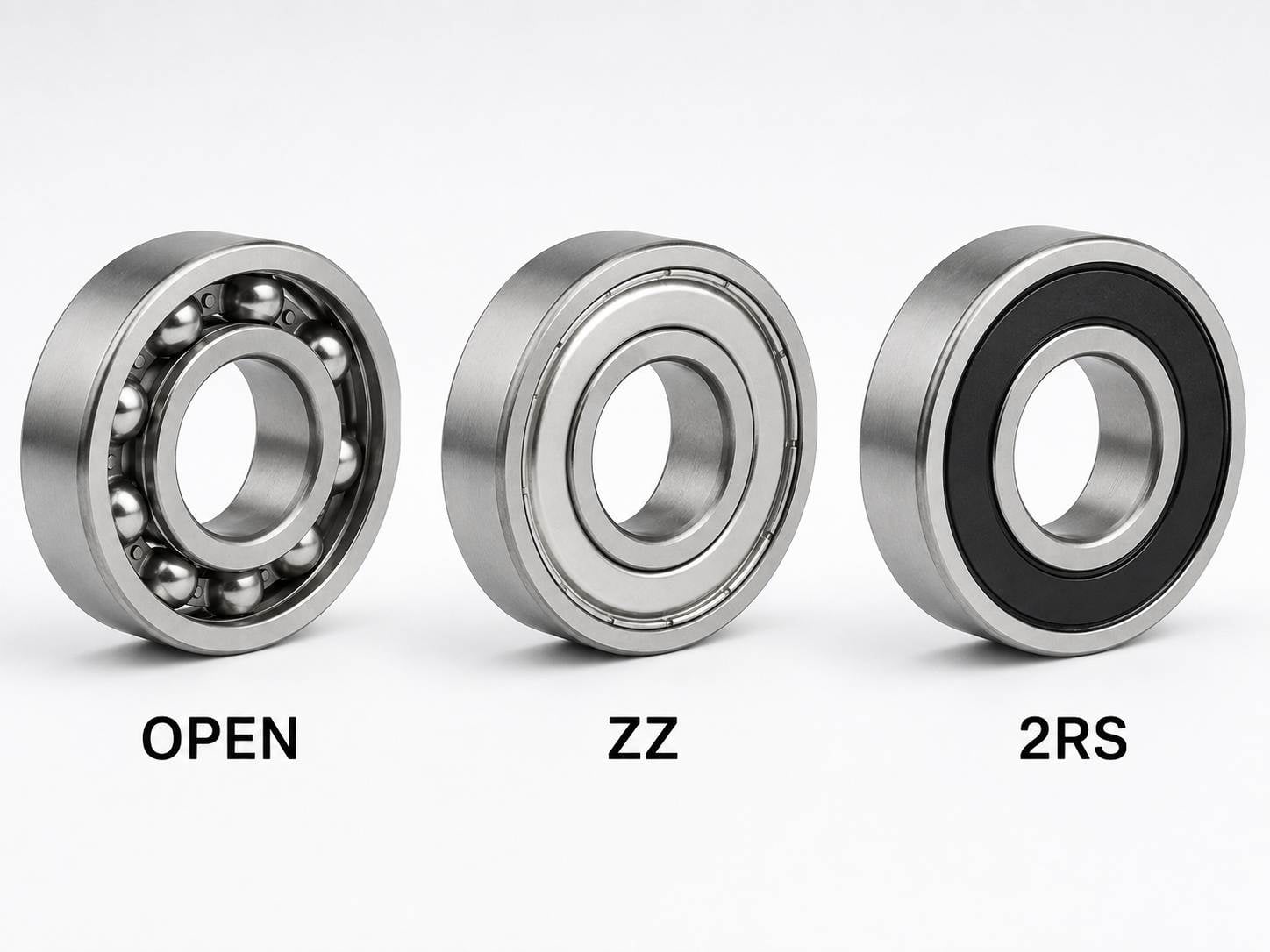 Existing HUNE media-library comparison of open, ZZ shielded and 2RS sealed bearing formats.
In a plastic-coated bearing roller, the load path is:
Track → plastic wheel → bearing outer ring → rolling elements → bearing inner ring → axle → bracket.
The closure is located at the side faces of the bearing. Its protection depends on how those faces interact with the wheel, spacers and bracket.
I normally check:
- whether one or both bearing faces remain exposed;
- whether the plastic wheel overlaps the closure without rubbing it;
- whether a press tool contacts the shield or seal;
- whether molding heat or pressure can affect the closure;
- whether spacers touch the rotating ring or seal lip;
- whether water can travel along the axle into the bearing face;
- whether the wheel body traps contaminants or allows drainage;
- whether the inner or outer ring rotates in the application.
HUNE's sliding rollers with bearings combine a bearing with a molded external wheel for doors, furniture and equipment. A U-groove bearing roller can be supplied with different bearing configurations, but the groove-to-track contact and closure selection solve separate functions.
Can a 2RS Bearing Replace a ZZ Bearing?
It may share the same nominal dimensions, but replacement requires a functional review.
Changing from ZZ to 2RS may improve contamination protection while increasing torque or reducing the listed speed limit. Changing from 2RS to ZZ may reduce seal friction while exposing the bearing to more contamination.
Before approving the change, compare:
- Full designations and manufacturers.
- Bore, outside diameter and width.
- Contact, low-friction or non-contact closure design.
- Internal-clearance group.
- Grease type and quantity.
- Load ratings and permissible speed.
- Seal material and temperature limits.
- Installed starting torque and running temperature.
- Dust, moisture and cleaning exposure.
- Customer approval and drawing revision.
Stock availability is not a technical approval. A sample can support evaluation, but the production specification should change only after the installed mechanism passes its acceptance plan.
What Should an OEM Validate Before Production?
Validate the bearing after it is pressed, clamped and exposed as it will be in the finished product.
A practical validation plan can include:
- incoming designation and closure inspection;
- bearing rotation before assembly;
- closure damage after insertion into the wheel or housing;
- installed breakaway and running torque;
- operating temperature under representative speed and load;
- noise and vibration in the complete mechanism;
- contaminant or moisture exposure matched to the application;
- grease leakage inspection;
- endurance testing through the intended duty pattern;
- teardown inspection where the risk justifies it;
- repeat-production verification of the approved part number.
An unloaded hand-spin test does not measure exclusion performance or grease life. It can reveal a severe bind, but it should not be the only reason to prefer a shield over a seal.
What Should a Buyer Send to the Supplier?
A useful inquiry defines the exposure, torque requirement and complete mounting arrangement.
Send the supplier:
- Full bearing designation or required boundary dimensions.
- Preferred manufacturer or approved-equivalent rules.
- Required closure on one or both sides.
- Dust, fibres, moisture, splash, chemicals and cleaning method.
- Speed, load, duty cycle and direction changes.
- Starting-torque, running-torque, noise or temperature targets.
- Shaft, housing, wheel, spacer and bracket drawing.
- Which bearing ring rotates and which ring is clamped.
- Operating and storage temperature range.
- Grease, clearance or material requirements already approved.
- Sample quantity, validation method and annual volume.
If the suffix is not fixed, describe the application instead of requesting “rubber seals.” The supplier can then identify a specific contact, low-friction or non-contact design for evaluation.
FAQs
Are sealed bearings waterproof?
No. A standard integral seal can improve resistance to dust, humidity and occasional splash, but it does not make the bearing suitable for immersion or pressure washing. External sealing, drainage, grease and corrosion-resistant materials may also be required.
Do shielded bearings spin faster than sealed bearings?
Shielded bearings often have lower closure friction and may have a higher catalogue speed than comparable contact-sealed versions. The actual limit depends on bearing size, load, grease, clearance, temperature and manufacturer design.
Is ZZ the same as 2Z?
Both commonly indicate shields on both sides, but suffix conventions vary. Confirm the current manufacturer's catalogue and full designation before treating them as equivalent.
Does 2RS always mean a contacting rubber seal?
It commonly indicates seals on both sides, but the contact condition and seal design can vary by manufacturer. Some brands use different suffixes for contact, low-friction and non-contact seals.
Discuss Your Bearing Roller Application with HUNE
The correct closure must protect the bearing without creating unacceptable torque, heat or speed limits.
HUNE manufactures plastic-coated bearing rollers, sliding wheels, shafts, brackets and customized hardware assemblies for doors, furniture, printers, conveyors and mechanical equipment. We can review the bearing closure, grease, wheel fit, axle stack and operating environment together.
Send your bearing designation, roller drawing, contamination exposure, speed, load, target torque, sample quantity and annual demand through the HUNE contact page. Our practical recommendation is to specify the exact manufacturer closure and validate it inside the finished roller rather than approving a generic ZZ or 2RS label alone.