Bearings reduce friction by separating moving and stationary parts with controlled rolling elements or a low-friction sliding surface. In a ball bearing, balls roll between hardened inner and outer raceways. This replaces much of the direct sliding that would occur if a shaft rubbed against a plain hole. The bearing also locates the shaft, carries load and maintains a repeatable path of rotation.
The friction does not disappear. Rolling elements deform elastically under load, lubricant is sheared, cages guide the balls, and seals may contact the rings. Incorrect fits, excessive preload, contamination or misalignment can add further resistance. In a plastic-coated bearing roller, the bearing reduces rotational resistance at the axle, while the outer wheel material and track geometry determine how the complete roller contacts and moves along its rail.
How Does Rolling Contact Reduce Friction?
Rolling contact limits the amount of relative sliding between the load-carrying surfaces.
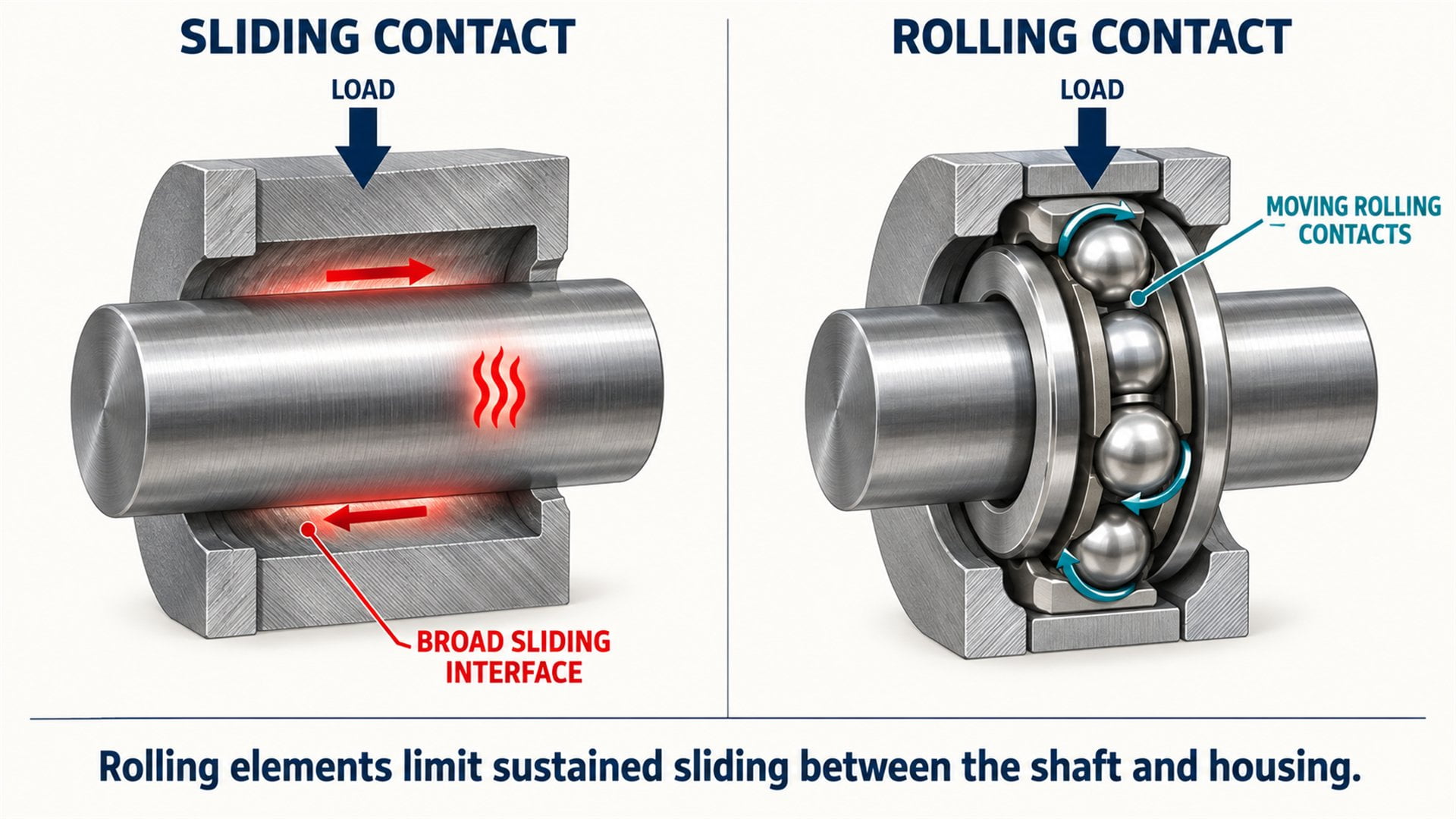 Simplified comparison. Both arrangements still require suitable materials, geometry and lubrication for their operating conditions.
Imagine moving a loaded block directly across a surface. The two surfaces slide relative to one another over the full contact region. Their microscopic high points interact, and the interface resists motion.
A rolling bearing inserts balls or rollers between the rotating and stationary rings. Each rolling element enters the loaded zone, carries part of the load and leaves it as the bearing turns. The contact points move through the bearing instead of one shaft surface continuously sliding around a bore.
NSK's bearing fundamentals distinguish plain bearings, which operate through sliding contact, from rolling bearings that use balls or rollers for efficient rolling motion. Rolling bearings generally provide lower friction while retaining useful rigidity.
The phrase “rolling contact” should not be interpreted as perfectly slip-free contact. Ball and raceway geometry, elastic deformation and differences in local surface speed create some microslip. The bearing succeeds because it controls these contacts and keeps the dominant movement closer to rolling than direct sliding.
Which Parts of a Ball Bearing Carry the Load?
The load passes through the rings and rolling elements into the shaft and surrounding structure.
A typical deep-groove ball bearing contains:
- an outer ring with an outer raceway;
- an inner ring with an inner raceway;
- balls positioned between the raceways;
- a cage that spaces and guides the balls;
- optional shields or seals that protect the internal contact;
- lubricant that separates surfaces and limits wear.
If the outer ring is fixed in a wheel and the inner ring is clamped to a stationary axle, the wheel and outer ring rotate around the inner ring. In a driven shaft arrangement, the inner ring may rotate with the shaft while the outer ring is located in a stationary housing.
NSK's introduction to bearings identifies the inner ring, outer ring, rolling elements and cage as the principal parts of a rolling bearing. Each component has a different interface, so an OEM drawing must show which ring rotates and how each ring is supported.
The load path matters as much as the bearing number. For a guide wheel it may be:
Track → plastic wheel → bearing outer ring → balls → bearing inner ring → axle → bracket.
If one interface lacks support or is clamped incorrectly, the bearing designation alone cannot ensure smooth rotation.
Why Is Rolling Friction Lower Than Sliding Friction?
Rolling elements reduce sustained sliding and confine deformation to small moving contact zones.
In direct sliding contact, friction acts across surfaces that continuously move against each other. Lubrication can separate those surfaces, but their relative movement remains sliding.
In a rolling bearing, balls or rollers rotate as the rings move. The small contact zones travel around the raceways, and the cage keeps rolling elements spaced. This reduces the energy lost through broad sliding contact.
Rolling bearings also control shaft position. A shaft rotating directly in an oversized hole may shift, tilt or contact unevenly. A correctly selected bearing establishes a defined rotational axis and distributes the load through designed raceway contacts.
The benefit depends on operating conditions. A plain bearing can be effective where motion is slow, oscillating, heavily loaded or exposed to contamination. A rolling bearing is not automatically best for every mechanism. The engineering decision must consider load direction, speed, available space, stiffness, environment and required service behavior.
Where Does Friction Remain Inside a Bearing?
Bearing friction comes from rolling, sliding, seals and lubricant movement.
SKF's engineering discussion of its rolling-bearing friction model separates bearing losses into rolling friction, sliding friction, seal friction and lubricant drag. This is more accurate than treating a bearing as frictionless.
| Friction source | What creates it | Why it matters in a small roller |
|---|---|---|
| Rolling losses | Elastic deformation and lubricant behavior in the loaded contact | Increase with load, contact geometry and lubricant condition |
| Sliding losses | Microslip, ball spin, cage contact and imperfect rolling geometry | Can increase heat, torque and surface stress |
| Seal friction | Contact between a seal lip and a rotating ring | Improves contamination protection but may raise starting and running torque |
| Lubricant drag | Grease or oil being displaced and sheared | Too much or unsuitable lubricant can increase resistance |
| Cage interaction | Guidance and spacing of rolling elements | Cage design and material influence smoothness and noise |
At startup, seal contact and internal sliding can form a noticeable part of the required torque. At higher speeds, lubricant behavior becomes more important. In compact furniture or equipment rollers, users may feel this as the difference between a wheel that begins moving easily and one that resists initial movement.
The correct objective is controlled, sufficiently low friction for the application. The lowest possible internal resistance may conflict with sealing, stiffness or load requirements.
How Does Lubrication Reduce Bearing Friction?
Lubricant forms a separating film and limits direct metal contact in the raceways.
The balls and raceways carry concentrated loads. A suitable oil film helps separate their microscopic surface features, reducing wear and controlling friction. Grease combines oil with a thickener so the lubricant can remain in the bearing and provide a reservoir over time.
Schaeffler's rolling-bearing lubrication guide explains that lubricant selection depends on bearing type, size, load, speed and operating conditions. It also treats frictional moment, operating temperature and contamination as connected design issues.
More lubricant is not automatically better. Excess grease must be displaced as the bearing rotates and can increase churning resistance. Lubricant that is too viscous for the operating speed and temperature can add drag, while insufficient film thickness can allow greater asperity contact and wear.
For a sealed miniature bearing inside a molded roller, the lubricant is normally part of the selected bearing specification. Buyers should state temperature, speed, contamination and noise requirements rather than requesting an arbitrary grease fill without application data.
How Do Seals and Shields Affect Friction?
Protection and rotational resistance must be balanced for the actual environment.
A metal shield creates a narrow non-contact barrier that helps exclude larger particles while adding little contact friction. A contacting elastomer seal provides stronger exclusion of dust or moisture but normally creates some seal drag. Designs and manufacturer suffixes vary, so the actual bearing data must be checked.
An open bearing can have low seal-related resistance but leaves the internal surfaces more exposed. That may be unsuitable inside a door roller, conveyor guide or equipment wheel where dust and cleaning residue can reach the bearing.
The choice should consider:
- expected dust, fibers, moisture and chemical exposure;
- required starting torque and running resistance;
- operating speed and temperature;
- whether the surrounding wheel or housing provides additional protection;
- expected storage and duty conditions.
A buyer should not change from a shielded bearing to a sealed bearing based only on appearance. The change affects protection, torque and sometimes available internal space.
How Do Fits and Internal Clearance Affect Friction?
The bearing must retain suitable internal clearance after it is fitted and clamped.
The inner and outer rings require fits that locate them without allowing unwanted creep. Excessive interference can expand or compress a ring and reduce the bearing's internal clearance. If the operating clearance becomes too small, friction, heat and noise can increase.
A fit that is too loose creates a different problem. The ring can move relative to the shaft or housing, causing wear, loss of concentricity or unstable wheel position. The designer must choose the fit according to which ring rotates relative to the load, the materials involved and the assembly method.
Plastic housings and overmolded wheels need special attention because molding shrinkage, temperature and material creep can change the pressure on the bearing outer ring. A nominal bearing outside diameter does not define the finished fit by itself.
Axial clamping also matters. Tightening a fastener across both bearing rings can prevent normal rotation. A stud-mounted wheel should clamp the intended stationary ring while leaving the rotating ring free from adjacent washers, brackets or shoulders.
How Does Misalignment Increase Bearing Resistance?
Misalignment shifts the contact and can force the bearing and wheel to run under unintended loads.
Deep-groove ball bearings tolerate limited operating variation, but they are not intended to correct a poorly aligned roller system. If the axle is angled relative to the track, the wheel may scrub sideways while the bearing carries additional moment or axial load.
Misalignment can come from:
- nonparallel bracket faces;
- a bent axle or stud;
- inconsistent spacers;
- a wheel bore or outer profile that is not concentric with the bearing;
- a track that is not aligned with the roller axis;
- an assembly tightened against the rotating ring.
The resulting resistance may be blamed on the bearing even when the main loss occurs between the wheel and track. I would inspect the complete load path before specifying a lower-torque bearing.
How Does a Bearing Work Inside a Plastic Roller?
The bearing supports rotation at the axle; the plastic outer wheel manages contact with the track or moving part.
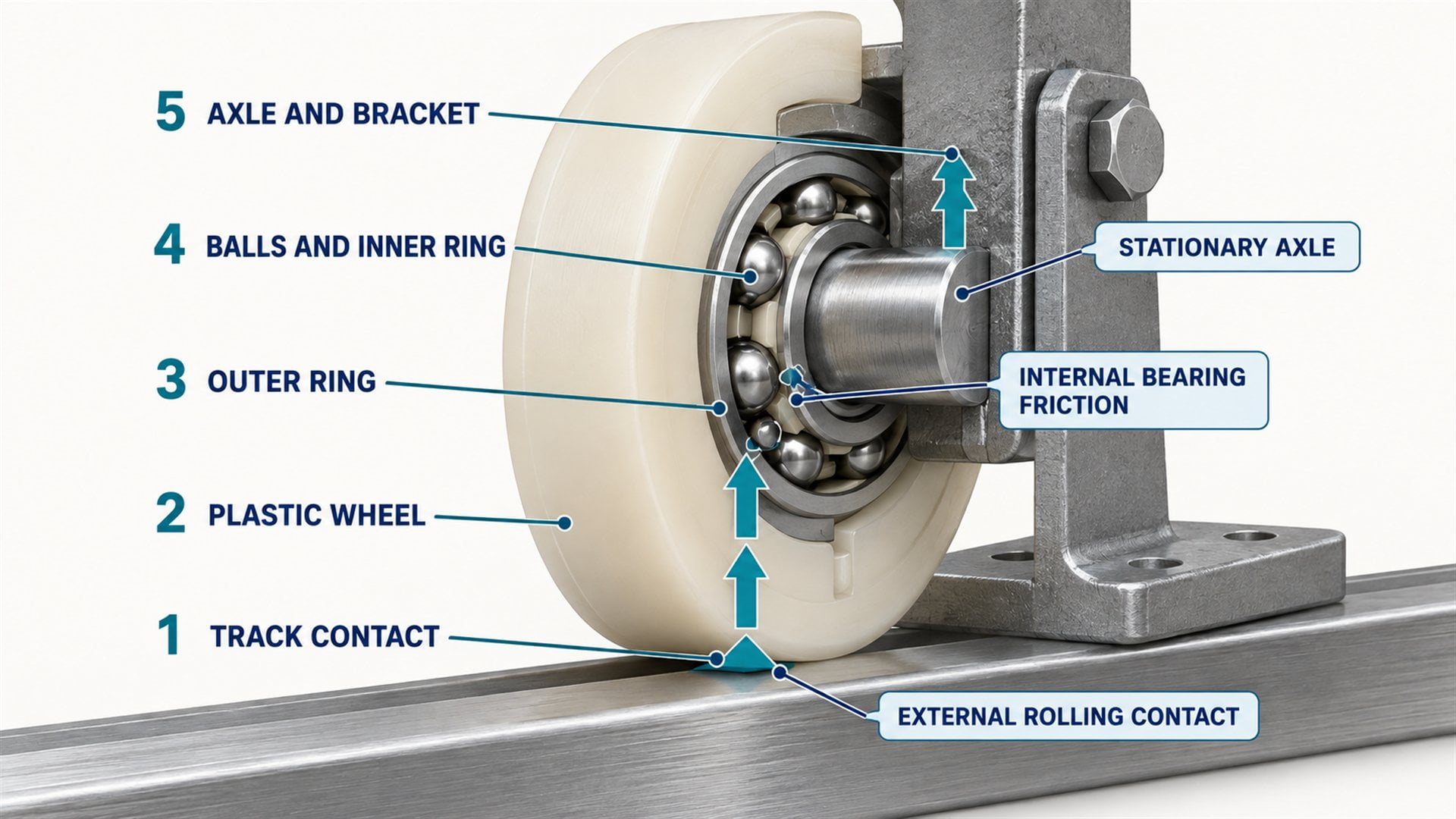 The bearing and outer wheel perform different jobs within the same roller assembly.
In a plastic-coated bearing roller, engineering plastic is molded around or assembled onto the bearing outer ring. The plastic can form a flat, crowned, U-groove, V-groove or other application-specific running surface.
The bearing influences:
- starting and running resistance;
- radial and axial support capability;
- rotational accuracy and internal noise;
- protection against contamination;
- fit on the shaft or stud.
The outer wheel influences:
- contact with the rail, belt, cable or product;
- traction or free-guiding behavior;
- rolling noise at the external interface;
- track protection and surface marking;
- load distribution through the tread profile;
- dimensional stability and wear.
This distinction explains why a premium bearing does not guarantee a good roller. An eccentric molded tread, incorrect groove radius or rubbing wheel flange can dominate the assembly resistance.
HUNE's sliding rollers with bearings show how the bearing and molded wheel are combined for guiding and sliding mechanisms. Our guide to what a bearing roller is explains the complete wheel, bearing, axle and bracket load path.
Does a Larger Bearing Always Reduce Friction?
Bearing size must match the load and geometry; larger does not automatically mean lower resistance.
A larger bearing may offer greater load capacity or stiffness, but it also contains larger contacts, more lubricant and potentially larger seals. Its friction depends on design, load, speed, lubrication and sealing rather than diameter alone.
An undersized bearing may deform excessively or have inadequate life. An unnecessarily large bearing may add cost, mass and packaging difficulty without improving the user experience.
For a roller assembly, bearing size also affects plastic wall thickness and wheel geometry. Increasing the bearing outside diameter while keeping the same finished wheel diameter leaves less plastic around the bearing. That can affect molding, stress distribution and the ability to form the required groove.
The bearing bore must fit the available axle, but selecting only by bore diameter is incomplete. Outer diameter, width, internal design, seals, clearance and surrounding plastic structure must be reviewed together.
How Are Ball Bearings Different from Roller Bearings?
Balls and rollers create different contact geometry and load behavior.
Ball bearings use spherical rolling elements and typically create point-like contacts that become small elliptical areas under load. Roller bearings use cylindrical, tapered, spherical or needle-shaped elements, producing more line-like contact regions.
Deep-groove ball bearings are common in compact wheels because they support radial load, some axial load and relatively low-friction rotation in a standardized package. Roller bearings may suit higher radial loads or specialized operating conditions but usually require different space, alignment and mounting arrangements.
The word order causes frequent sourcing mistakes:
- roller bearing means a bearing containing rollers as its internal rolling elements;
- bearing roller often means an external wheel or roller that contains a bearing.
HUNE's article on deep-groove ball bearing applications explains why this bearing type commonly appears inside door, window, furniture and equipment rollers.
What Determines the Friction of the Complete Roller System?
System resistance combines bearing friction, external rolling resistance and any unwanted sliding.
| System interface | Main variables | Typical design consequence |
|---|---|---|
| Bearing interior | Load, speed, lubricant, seals and clearance | Starting torque, heat, noise and rotational resistance |
| Bearing-to-wheel fit | Interference, molding shrinkage and concentricity | Internal clearance and tread runout |
| Bearing-to-axle fit | Shaft size, clamping and retention | Ring location and freedom to rotate |
| Wheel-to-track contact | Material, profile, diameter and surface finish | Rolling resistance, noise and wear |
| Roller alignment | Axle angle, bracket stiffness and track datum | Side scrub, uneven loading and instability |
| Whole mechanism | Number of rollers, load sharing and preload | Total operating force and sensitivity to tolerances |
A door, drawer, printer or conveyor can still feel difficult to move with low-friction bearings if its wheels are misaligned or heavily preloaded. Conversely, some external friction may be intentional where a drive roller needs traction.
HUNE's flat roller wheels with bearings illustrate one low-drag support format. A conveyor application may require a different tread and mounting arrangement, as described in our plastic-coated bearing guide-system specification.
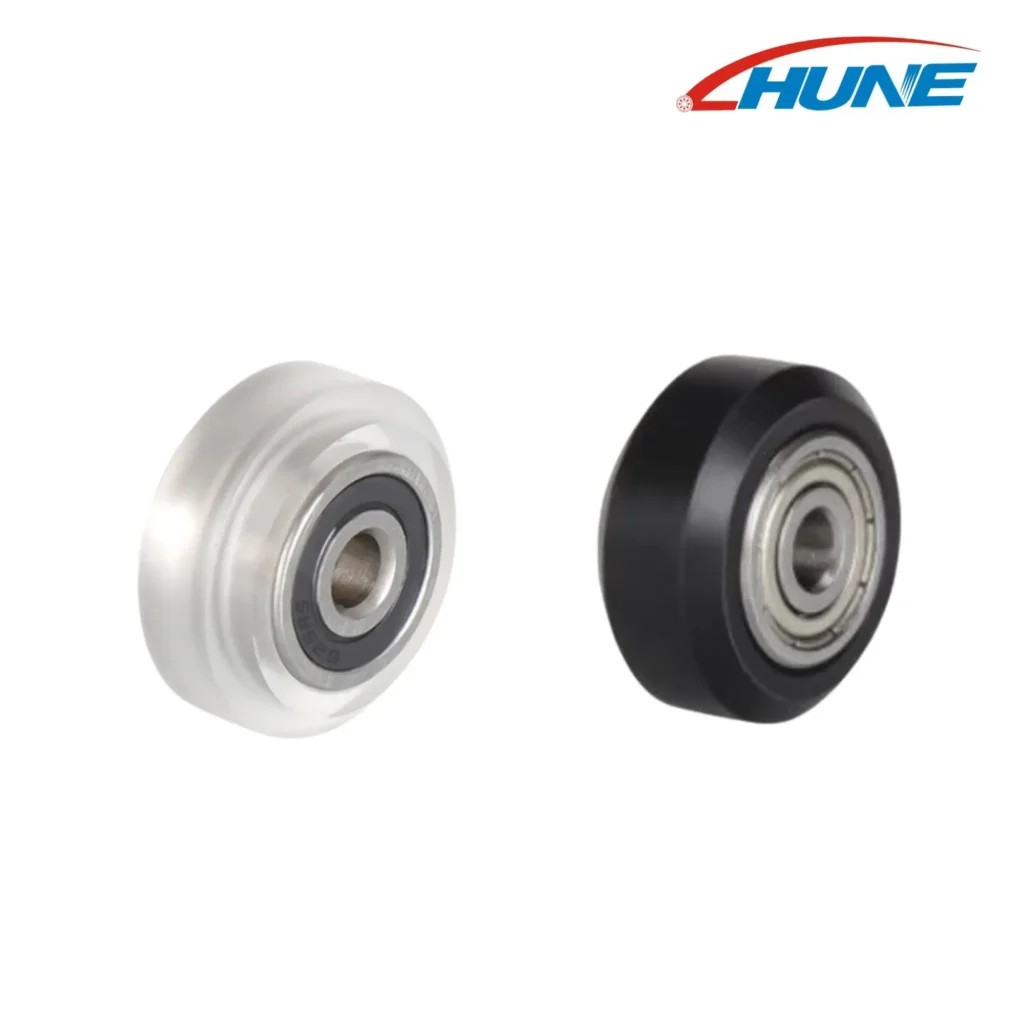 Existing HUNE plastic-coated bearing rollers. The correct bearing, outer profile and mounting depend on the application.
Which Dimensions and Mating Surfaces Matter Most?
The drawing should control the surfaces that establish rotation, load transfer and track contact.
For the bearing, specify or confirm:
- bearing type and designation;
- bore, outside diameter and width;
- shield or seal configuration;
- internal clearance or other required variant where relevant;
- shaft fit and housing or overmold fit;
- which ring rotates and which ring is clamped;
- radial, axial and moment loads from the system design.
For the complete roller, define:
- finished running diameter and width;
- radial runout relative to the bearing bore;
- flat, crowned or grooved tread profile;
- groove radius, width and depth for the mating rail or cable;
- shoulders, spacers and axial clearance;
- axle or stud geometry and fastener stack;
- track material, surface and alignment datum;
- operating speed, environment and duty pattern.
There is no universal fit or runout value for every bearing roller. The correct limits depend on part size, materials, load, speed, assembly process and the equipment's motion requirement.
What Should an OEM Buyer Send to a Bearing Roller Supplier?
A useful inquiry defines both the internal bearing and the external rolling interface.
Send the supplier:
- An assembly drawing showing the roller, axle, spacers, bracket and track.
- The roller's function: supporting, guiding, driving, tensioning or retaining.
- Bearing designation or the required bore, outside diameter and width.
- Which ring rotates and how the stationary ring is clamped.
- Wheel diameter, width, profile, material and required color.
- Track, rail, belt, cable or product-contact geometry.
- Radial and axial load directions and any known system load values.
- Speed, duty cycle, direction changes and time under static load.
- Temperature, moisture, dust, cleaning agents and corrosion conditions.
- Prototype quantity, validation plan and annual purchasing volume.
If the exact bearing is not fixed, describe the required behavior instead of selecting one by appearance. The supplier can then review the balance among friction, protection, load support, wheel geometry and cost.
FAQs
Do ball bearings eliminate friction completely?
No. They replace much of the direct sliding with rolling contact, but friction remains through elastic deformation, microslip, lubricant shear, cage interaction and seals. Incorrect fits or alignment can add further resistance.
Why can a sealed bearing feel harder to turn than a shielded bearing?
A contacting seal rubs against a bearing ring to provide stronger contamination protection. That contact can increase starting and running torque. The correct choice depends on the required protection and operating resistance.
Does a bearing reduce friction between the roller and the track?
It reduces friction at the axle and supports controlled rotation. The wheel material, diameter, profile, load and track condition determine the external rolling contact. Both interfaces contribute to total resistance.
Can a plain plastic wheel rotate as smoothly as a bearing roller?
It can work well in suitable low-speed, light-load or low-cost applications. A bearing roller generally offers more controlled rotation for repeated movement, but its benefit depends on correct fits, alignment and complete-system design.
Discuss Your Bearing Roller Application with HUNE
Reducing friction requires the bearing, wheel, axle and track to work as one assembly.
HUNE develops plastic-coated bearing rollers, sliding wheels and customized precision hardware for doors, windows, furniture, conveyors and industrial equipment. We can review the bearing, molded outer wheel, running profile, shaft fit and mounting geometry together.
Send your drawing, sample, mating track profile, load direction, operating environment, quantity and target behavior through the HUNE contact page. Our practical recommendation is to define the complete load path before choosing a lower-friction bearing or changing the wheel material.


[…] A bearing does not make friction or wear disappear. Rolling elements still deform at their contact points, lubricant shears, seals may create drag, and misalignment or contamination can increase resistance. The goal is controlled movement and load transfer within the bearing’s design limits. For the friction mechanisms in a rolling bearing, see our explanation of how bearings reduce friction. […]