A standard 608 bearing has a bore of 8 mm, outside diameter of 22 mm and width of 7 mm. It is a single-row deep-groove ball bearing. These are the nominal boundary dimensions, not a complete fit or performance specification: the exact suffix, internal clearance, tolerance class, seals, lubricant and manufacturer can change other details. For a replacement or OEM assembly, verify the full bearing designation and the mating shaft, housing or roller before ordering.
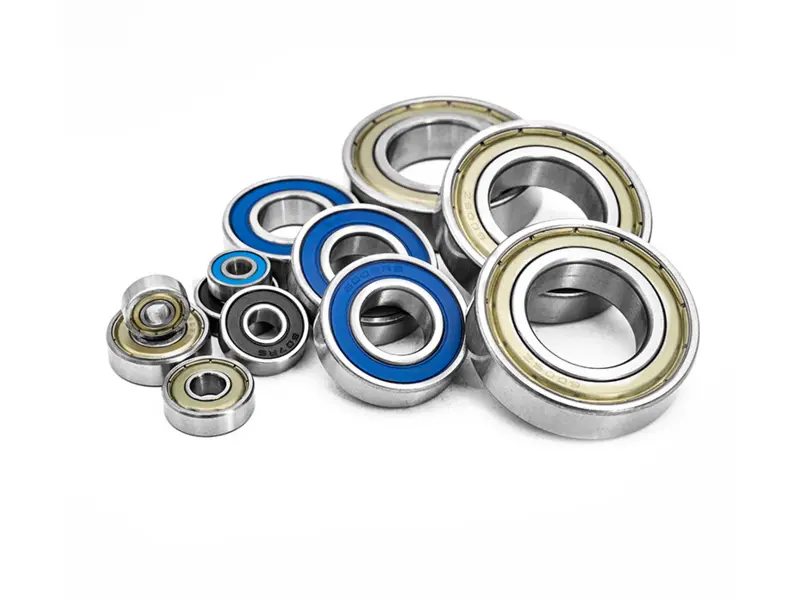
[Image placement 1: Insert 03-hune-bearing-library.webp after this direct answer.] [Image source: HUNE website media library — https://sliding-roller.com/wp-content/uploads/2026/08/assorted-deep-groove-ball-bearings.webp] [Alt text: Deep groove ball bearings shown in several sizes]
What are the standard 608 bearing dimensions?
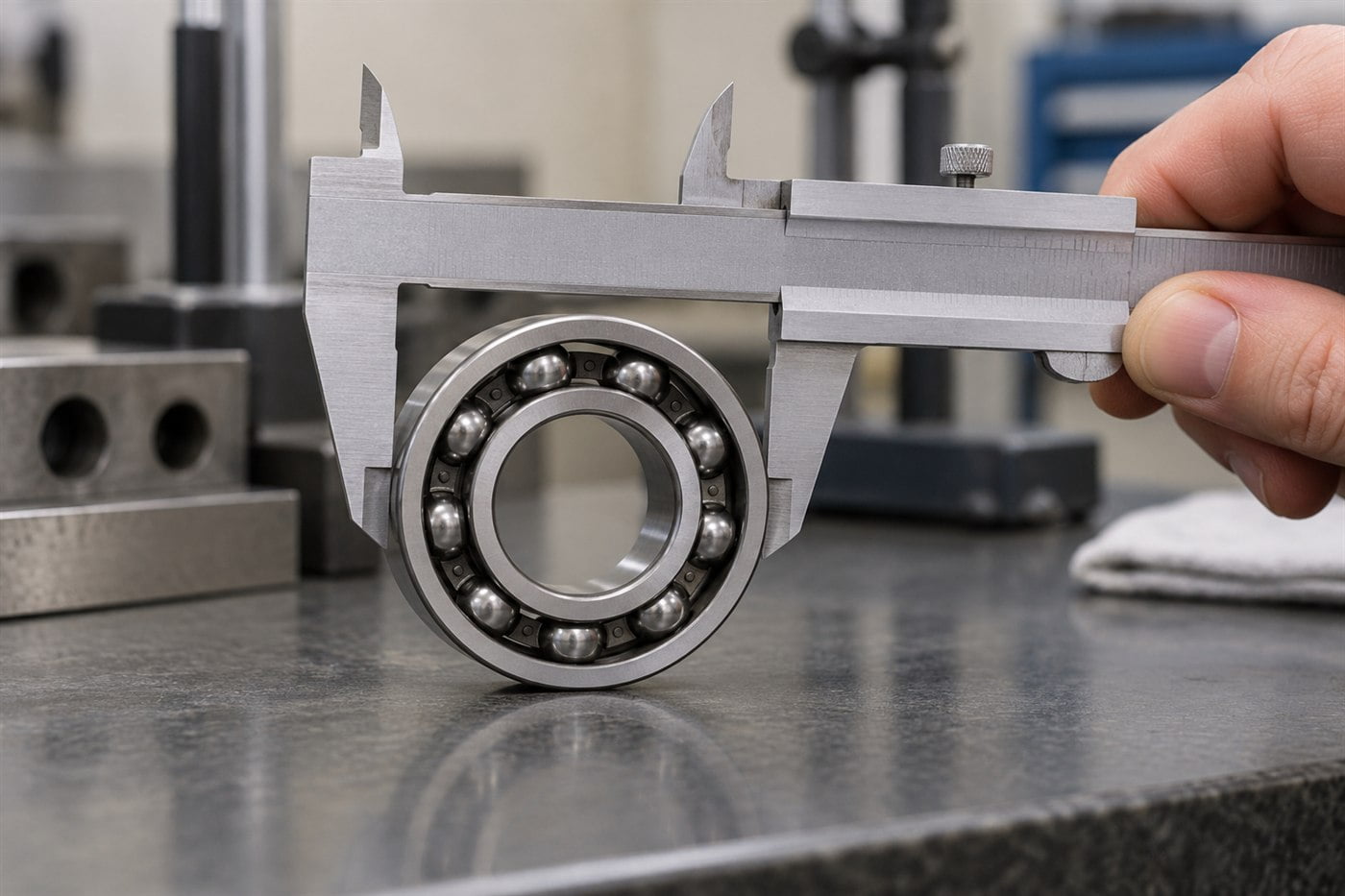
The common 608 boundary dimensions are 8 × 22 × 7 mm: bore × outside diameter × width. NTN lists these dimensions for its open 608 deep-groove ball bearing, and NSK gives the same dimensions for its 608DD variant. Use the sequence shown in a supplier’s drawing because catalogs may label or order dimensions differently.
| Dimension | Symbol | Nominal size | What it controls |
|---|---|---|---|
| Bore / inner diameter | d | 8 mm (0.3150 in) | Fit on the shaft or axle |
| Outside diameter | D | 22 mm (0.8661 in) | Fit in the housing, wheel or bearing seat |
| Width | B | 7 mm (0.2756 in) | Axial space and shoulder arrangement |
| Minimum chamfer radius | r | 0.3 mm in cited catalog examples | Clearance at shaft and housing shoulders; confirm the exact drawing |
The first three values are the dimensions most buyers mean when they ask for a 608 bearing size. Chamfer, shoulder and tolerance details still matter when the bearing sits against a shaft shoulder, press-fit housing or molded roller. The NTN 608 product data and NSK 608DD data are useful examples of how a full manufacturer specification adds details beyond the nominal 8 × 22 × 7 mm envelope.
What does the 608 bearing number mean?
“608” identifies a bearing design and size family, but it does not specify every feature a buyer needs. Treat the number as a starting point, then read the manufacturer’s complete designation and drawing.
A 608 is commonly listed as a single-row deep-groove ball bearing. Its basic dimensions identify the shaft bore, outside diameter and width. They do not, on their own, tell you whether the bearing is open, shielded or sealed; what internal clearance it has; which tolerance class applies; what lubricant is supplied; or what load and speed ratings the manufacturer assigns.
Suffixes such as ZZ, 2Z, 2RS, 2RS1 or DD are manufacturer-specific codes. They often describe shield or seal arrangements, but the exact construction can differ between brands. I do not treat two suffixes as interchangeable without comparing the suppliers’ datasheets.
What is the difference between 608 open, 608ZZ and 608-2RS?
The main difference is how the bearing is protected from contamination and how the closure interacts with rotation. The best option depends on the real environment and allowable running torque.
| Configuration | General construction | Selection point |
|---|---|---|
| Open 608 | No integral shields or seals | Internal parts are exposed; assess contamination and lubrication access |
| 608-ZZ / 608-2Z | Metal shields, commonly on both sides | Often suited to cleaner environments where a non-contact or low-contact closure is specified |
| 608-2RS / 608-2RS1 / 608-DD | Elastomer seals, often on both sides | Can provide stronger exclusion of dust or moisture, depending on the exact seal design; seal drag may be higher |
These labels are common examples, not a universal codebook. Check the bearing maker’s drawing for whether the seal contacts the inner ring, whether it is fitted on one or both sides, what lubricant is used and what speed limits apply. A sealed bearing should not automatically be assumed waterproof or suitable for washdown; exposure, temperature, chemicals and required service life all matter.
For an OEM roller, also consider whether the wheel or housing creates a second barrier around the bearing. The complete arrangement may protect the bearing differently from a standalone bearing in an exposed housing.
How does a 608 compare with 607 and 609 bearings?
The neighboring sizes change both the shaft bore and the outside envelope. A 607, 608 and 609 may look similar, but they are not direct substitutes if the shaft or housing is already designed.
| Designation | Bore (d) | Outside diameter (D) | Width (B) |
|---|---|---|---|
| 607 | 7 mm | 19 mm | 6 mm |
| 608 | 8 mm | 22 mm | 7 mm |
| 609 | 9 mm | 24 mm | 7 mm |
These are common standard boundary dimensions shown in SKF catalog data. Before changing from one number to another, check the shaft, housing bore, axial shoulders, available wall thickness and any wheel or pulley dimensions around the bearing. A larger outside diameter can require a larger hub; a different bore requires a different axle or a properly designed sleeve, not a forced fit.
Are all 608 bearings rated for the same load and speed?
No. The same nominal dimensions do not guarantee identical performance ratings. Load rating, limiting speed, clearance, precision class, material, cage, lubrication and seal design depend on the exact product and manufacturer.
For example, the cited NTN open 608 and NSK 608DD are both 8 × 22 × 7 mm, but their published specifications are tied to different constructions and manufacturer conditions. Do not copy a rating from one catalog and apply it to every bearing carrying the 608 designation.
When checking a datasheet, distinguish:
- Basic dynamic load rating: used in a manufacturer’s bearing-life calculation under defined assumptions.
- Basic static load rating: relates to permanent deformation risk under a stationary or slowly moving load.
- Limiting or reference speed: depends on bearing design, lubrication, closure and operating conditions.
- Internal clearance and tolerance class: affect how the bearing behaves after mounting and during operation.
These catalog values are not automatically a safe working load for an assembled wheel. The wheel material, bearing fit, axle support, impact, duty cycle and load direction also affect system performance.
How do you check whether a 608 bearing fits a roller assembly?
Check the bearing and the surrounding mechanism as one load path. A correct 8 × 22 × 7 mm bearing can still be wrong for a roller if the wheel, axle, fit or track does not match.
In a common bearing-integrated guide wheel, the load path is:
Track → roller wheel → bearing outer ring → balls → bearing inner ring → axle or stud → bracket and frame.
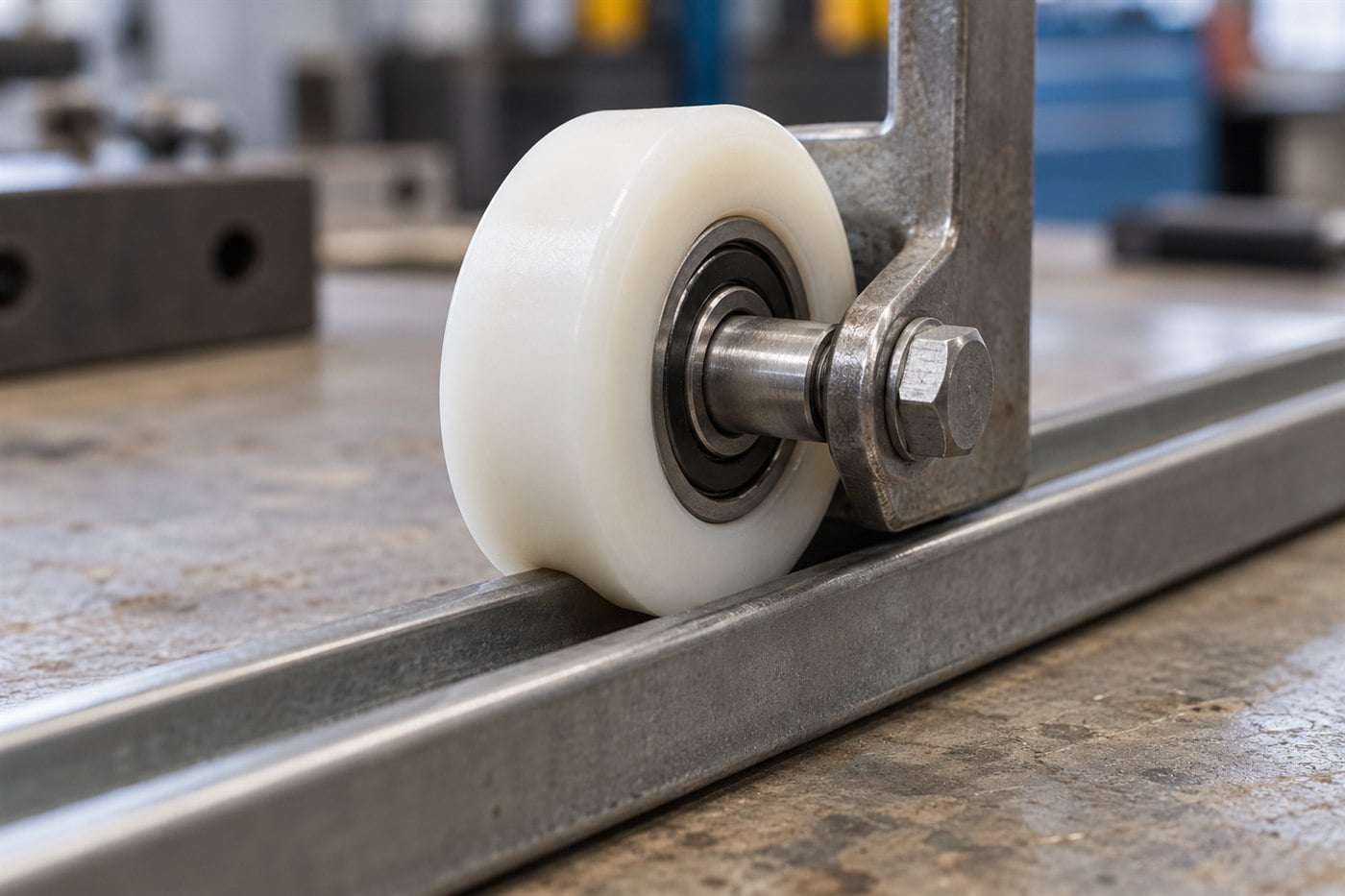
The 608 bearing supports rotation; the outside wheel contacts the track. That means wheel running diameter, width, groove or tread profile, and track cross-section remain functional dimensions. The 22 mm bearing outside diameter also determines how much material remains around the bearing in the wheel. A thin or poorly supported hub can change how the complete component handles load, even when the bearing itself is correctly specified.
HUNE’s deep groove ball bearing category shows bearing series supplied for individual use and integration into mechanical assemblies. For a wheel-and-track application, the sliding rollers with bearings range illustrates why the bearing, wheel profile and mounting feature need to be matched together. A 608 designation alone does not confirm that a particular product configuration is available; confirm the required model and suffix with the supplier.
What should OEM buyers include in a 608 bearing RFQ?
Send enough information to identify both the bearing and how it will be mounted. “608 bearing, quote please” may identify a nominal size, but it leaves important configuration questions open.
Include:
- Full designation and brand, if a current bearing is being matched.
- Dimension sequence with units: bore, outside diameter and width.
- Closure and internal requirements: open, shields or seals; clearance, precision class and lubricant where specified.
- Operating conditions: radial and axial load direction, speed, duty cycle, temperature, dust, moisture or chemical exposure.
- Mounting details: shaft/axle diameter and tolerance, housing or wheel seat, which ring rotates, and how the bearing is retained.
- For a bearing roller: wheel diameter, width, groove or tread profile, mating track section, axle or stud details, and drawing or sample.
- Commercial details: sample quantity, expected annual volume, packaging and required approval documentation.
For a roller project, it helps to send the bearing drawing together with the wheel and track drawings. HUNE’s industrial door roller selection guide gives further context on the information that helps suppliers assess the complete roller mechanism.
Frequently Asked Questions
What are the dimensions of a 608 bearing in inches?
The nominal dimensions are approximately 0.3150 in bore × 0.8661 in outside diameter × 0.2756 in width. The metric values—8 × 22 × 7 mm—are the clearest reference for ordering. Use the full model drawing for tolerance and fit details.
Is 608 the same as 608ZZ or 608-2RS?
They share the 608 basic size family, but the suffix indicates a closure or other construction detail. ZZ or 2Z commonly identifies metal shields, while 2RS, 2RS1 or DD commonly identifies rubber seals. Suffix definitions vary by manufacturer, so compare the exact datasheets before substitution.
Can I replace a 608 bearing with a 607 or 609?
Not as a direct drop-in replacement unless the shaft, housing and surrounding assembly are designed for the changed dimensions. A 607 uses a 7 mm bore and 19 mm outside diameter; a 609 uses a 9 mm bore and 24 mm outside diameter. Both differ from a 608 at the interfaces that control mounting.
Does an 8 mm bore mean the bearing fits every 8 mm shaft?
It identifies the nominal bore, not the mounted fit. Shaft tolerance, bearing tolerance, load, which ring rotates, material and temperature affect the fit decision. Confirm the shaft specification and bearing manufacturer’s fit guidance rather than assuming any nominal 8 mm pin will work.
Does the 608 size tell me its load capacity?
No. The designation and nominal envelope do not provide a universal capacity. Use the selected manufacturer’s data for the exact variant, and assess the bearing together with the housing, shaft, wheel and real operating loads.
For sourcing, treat 8 × 22 × 7 mm as the starting envelope, then confirm suffix, fit, load and environment from the exact manufacturer’s specification. If the 608 is going inside a roller, send the bearing details with the wheel drawing, axle and mating track so the complete assembly can be checked before approval.