

What is a bearing? A bearing is a machine element that supports and guides relative motion while transferring load between connected parts. It can let a shaft rotate, a wheel roll, or a carriage travel along a guide. Bearings are not all built with balls: rolling bearings use balls or rollers, while plain bearings support motion through sliding contact. The right type depends on the load direction, speed, available space, environment and how the bearing fits into the surrounding assembly.
What does a bearing do?
A bearing supports a moving part, controls its path and carries load into the surrounding structure. Reducing friction is one result, but a bearing also locates components and limits unwanted movement.
Take a rotating shaft supported by a housing. The bearing keeps the shaft in position while allowing rotation. In a conveyor roller, the bearing supports the roller around an axle. In a guided wheel, it lets the wheel turn while the wheel profile follows a rail or track. Linear bearings perform a related job for straight-line travel.
A bearing does not make friction or wear disappear. Rolling elements still deform at their contact points, lubricant shears, seals may create drag, and misalignment or contamination can increase resistance. The goal is controlled movement and load transfer within the bearing’s design limits. For the friction mechanisms in a rolling bearing, see our explanation of how bearings reduce friction.
What are the main parts of a rolling bearing?
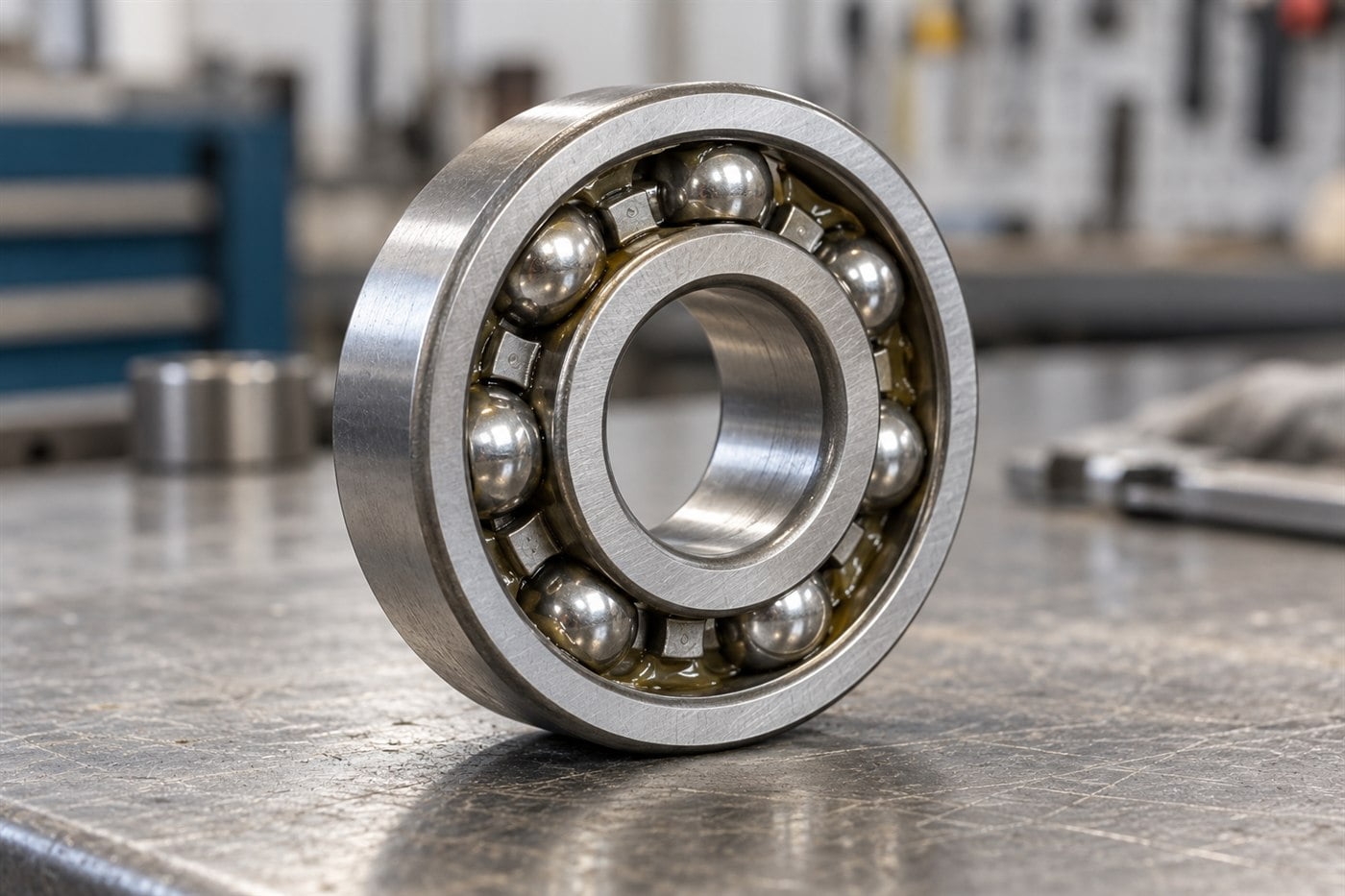
A typical rolling bearing uses rings, rolling elements and a cage; shields or seals and lubricant may also be part of the design. Each part has a distinct job, and not every bearing uses the same construction.
- Inner ring: provides a raceway and usually mounts on a shaft or axle. Whether it rotates depends on the arrangement.
- Outer ring: provides the other raceway and usually fits in a housing, wheel or support. In a bearing-integrated roller, the outer ring may rotate with the wheel around an axle-supported inner ring.
- Rolling elements: balls or rollers transfer load between the two raceways.
- Cage: spaces and guides the rolling elements. It is not a substitute for the raceways and is not normally the main load-carrying path.
- Shields or seals: help retain lubricant and limit the entry of contaminants. A shield and a contacting seal do not create identical drag or protection.
- Lubricant: reduces wear and helps manage heat at internal contacts. Many sealed bearings are supplied with grease, but the lubricant and service assumptions vary by design.
SKF’s bearing reference identifies the inner ring, outer ring, rolling elements and cage as the basic components of a typical rolling bearing. Some bearing designs omit a ring or use different supporting elements, so this list describes a common arrangement rather than every bearing on the market.
How does a bearing work?
A rolling bearing transfers load through rolling elements between raceways, while a plain bearing transfers load through a sliding surface. The bearing’s internal geometry determines which movement it permits and which forces it can support.
In a ball bearing, the balls roll along grooves in the inner and outer rings. In a roller bearing, cylindrical, tapered, spherical or needle-shaped elements roll between raceways. The shaft or axle, bearing rings and housing then pass the load into the machine structure.
Bearings are commonly described by the main direction of load:
- Radial load acts perpendicular to the shaft axis.
- Axial load, also called thrust load, acts parallel to the shaft axis.
- Combined load includes both radial and axial components.
A bearing’s ability to carry these loads depends on its design, size, internal clearance, fits, speed and operating conditions. A deep groove ball bearing can carry radial load and, within its specified limits, axial load in either direction. That does not mean every ball bearing can support a large axial load. I first check the actual load path and the manufacturer’s rating for the exact bearing instead of choosing from the name alone.
What are the main types of bearings?
Bearing types differ in contact geometry, load direction, alignment tolerance and space requirements. No type is universally best; selection begins with the motion and load the machine must support.
| Bearing type | Typical design role | Key selection consideration |
|---|---|---|
| Deep groove ball bearing | General rotary motion; commonly used where compact size and low running resistance matter | Primarily radial loading with limited axial capacity according to the bearing specification |
| Angular contact ball bearing | Combined radial and axial loads | Contact angle and mounting arrangement affect axial load direction and capacity |
| Cylindrical roller bearing | Higher radial loads in many shaft arrangements | Usually needs suitable alignment and axial-location strategy |
| Needle roller bearing | High radial load in a compact radial space | Raceway and shaft requirements matter because the rollers are slender |
| Tapered roller bearing | Combined radial and axial loads | Often installed in matched or opposed arrangements with controlled adjustment |
| Spherical roller bearing | Higher loads where some angular misalignment must be accommodated | Alignment capability is limited by the design and is not permission to ignore poor mounting |
| Thrust bearing | Primarily axial load | Must be supported and arranged for the intended thrust direction |
| Plain bearing or bushing | Sliding or oscillating movement, often with a simple compact interface | Surface material, lubrication, clearance, speed and operating environment determine suitability |
This is a practical overview, not a complete classification. NSK’s reference on rolling bearing types and characteristics compares common designs by load and construction. Actual ratings and limits must come from the bearing manufacturer’s data for the selected model.
What is the difference between a bearing, a roller bearing and a bearing roller?
The terms describe different things. Confusing them can lead to the wrong product or an incomplete drawing.
- A bearing is the broader machine component that supports relative motion and transfers load.
- A roller bearing is a rolling bearing whose internal rolling elements are rollers rather than balls.
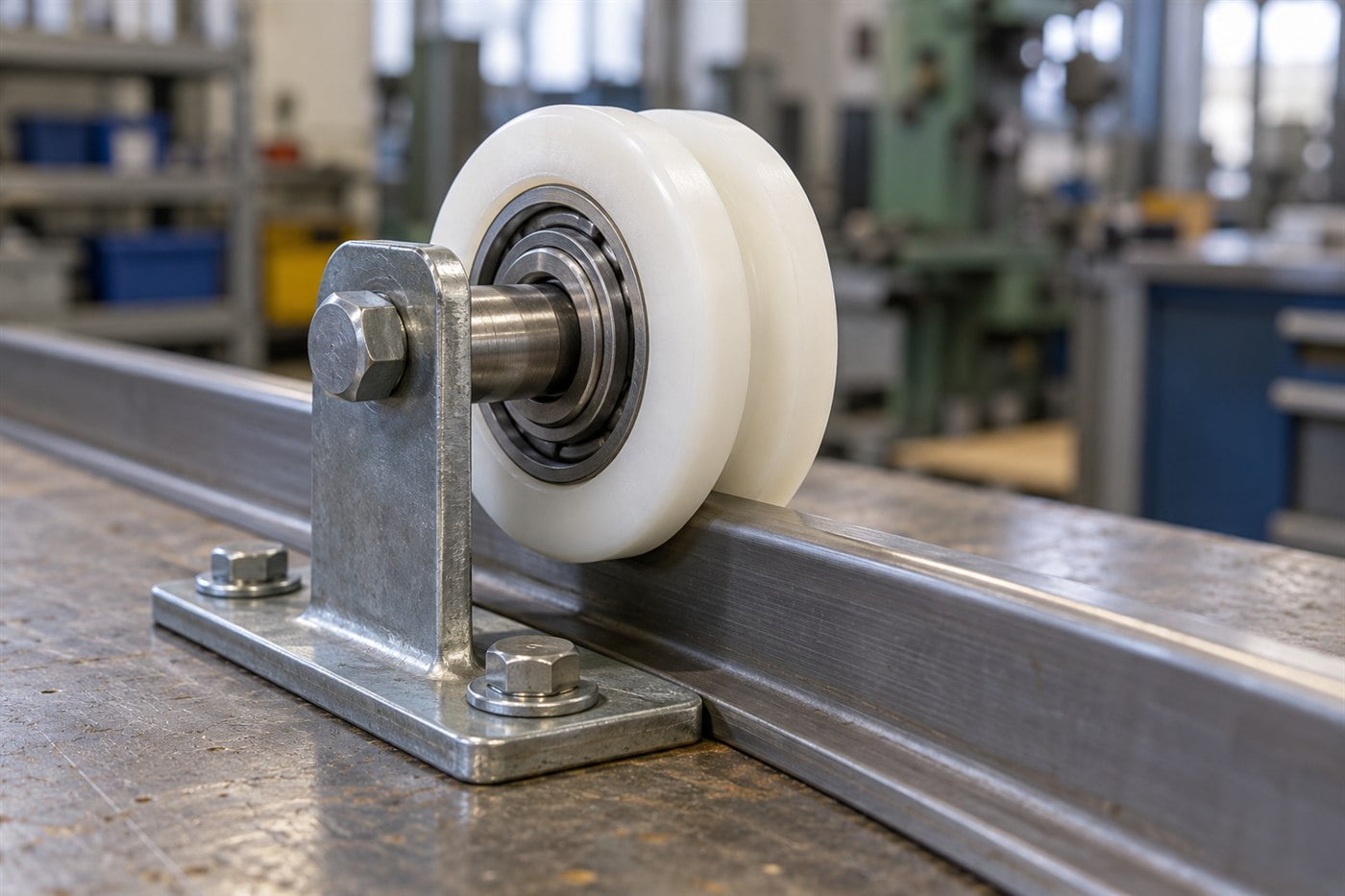
- A bearing roller often means a wheel or roller assembly that contains a bearing.
In a bearing-integrated guide wheel, the bearing supports rotation at the axle while the outer wheel contacts the track. The complete load path may be:
Track → wheel or roller body → bearing outer ring → rolling elements → bearing inner ring → axle or stud → bracket and machine frame.
That distinction matters because the bearing bore, outer diameter and width are only part of the specification. The wheel’s running diameter, groove profile, width, axle or stud, fit, and contact with the mating track determine whether the complete roller works as intended. HUNE’s sliding rollers with bearings show examples of integrated wheel-and-bearing assemblies; for a grooved guide-wheel application, compare the U-groove bearing roller construction.
Where are bearings used?
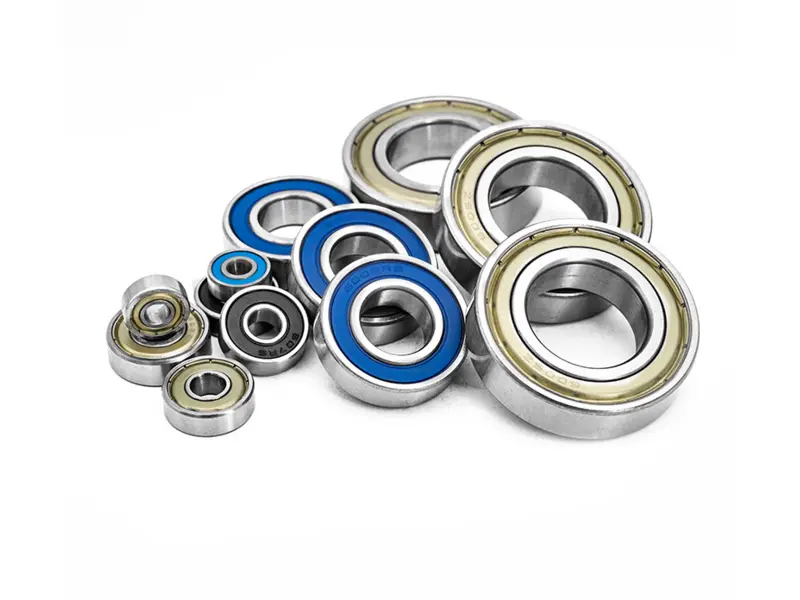
Bearings appear wherever a design needs supported rotation, oscillation or guided linear movement. The bearing type changes with the load, speed, space and environment.
Common examples include:
- Motors, pumps and gearboxes: bearings support rotating shafts and locate them within a housing.
- Printers and office equipment: bearings may support feed rollers, shafts and moving carriages.
- Conveyors and material handling: bearings support rollers, pulleys and moving guide components.
- Doors, windows and furniture: compact bearings may be integrated into wheels that roll along tracks.
- Elevators and machinery: bearings may appear in door rollers, guide systems, pulleys and rotating assemblies, with the design selected for the specific mechanism.
The application name alone does not specify a bearing. A door roller and an electric motor can both contain deep groove ball bearings, but their speed, load pattern, mounting, contamination exposure and acceptable noise may be very different.
How should engineers choose a bearing?
Start with the operating conditions and mounting arrangement, then check the bearing’s dimensions and construction. Matching only the bore or series number can leave a critical fit, load direction or seal requirement unresolved.
For an equipment or roller design, I normally check:
- Motion: continuous rotation, intermittent rotation, oscillation or linear travel.
- Load: radial, axial or combined load, including shock or uneven loading where relevant.
- Speed and duty: operating speed, starts and stops, run time and service expectations.
- Space and interfaces: bore, outside diameter, width, shaft or axle fit, housing fit, retention and available wall thickness around the bearing.
- Environment: dust, water, chemicals, temperature, vibration and corrosion exposure.
- Closure and lubrication: open, shielded or sealed construction; grease compatibility and maintenance access.
- Assembly: which ring is fixed or rotates, how the bearing is pressed or retained, and whether a wheel, bracket or track creates additional side load.
For a custom bearing roller, I would ask the buyer to provide the bearing model or dimensions, a drawing or sample, the mating track profile, load direction, operating speed, environment, required material and expected quantity. If the assembly has a wheel around the bearing, include the wheel’s functional running diameter, profile and width, plus the axle or mounting details. The prototype should be checked in the actual mating assembly; a bearing that spins freely by itself may still bind or run unevenly after installation.
Frequently Asked Questions
Is every bearing a ball bearing?
No. Ball bearings are one type of rolling bearing. Other rolling bearings use cylindrical, needle, tapered or spherical rollers. Plain bearings have no rolling elements and carry load through a sliding surface. The correct type depends on motion, load direction, space and operating conditions.
Does a bearing only reduce friction?
No. It also supports and locates moving parts, carries load into the housing or frame, and controls the permitted motion. Lower friction is one performance objective, but fit, stiffness, noise, sealing, lubrication and load capacity can be just as important.
What is the difference between radial and axial load?
A radial load acts across the shaft, perpendicular to its axis. An axial or thrust load acts along the shaft axis. Some bearing designs accommodate both, but the allowable combination depends on the bearing model, mounting, speed and operating conditions.
Does a bearing’s inner ring always rotate?
No. In a typical shaft-and-housing arrangement, the inner ring often rotates with the shaft and the outer ring stays in the housing. In a bearing-integrated wheel on a fixed axle, the wheel and outer ring may rotate around an inner ring supported by the axle. The assembly determines which ring rotates.
What information should I send when sourcing a bearing or bearing roller?
Provide the bearing designation or bore, outside diameter and width; the load direction and operating speed; the environment and closure requirement; and a drawing or sample if available. For a bearing roller, include the wheel profile, running diameter, width, mating track section, mounting or stud details and expected order quantity. These details let the supplier assess the complete interface instead of matching only one dimension.
A bearing should be selected as part of the mechanism it supports. Confirm its load and motion first, then verify fit, sealing, lubrication and the mating parts. For OEM roller assemblies, send the bearing specification together with the wheel, axle and track details so the finished assembly can be reviewed as one system.