What is a bearing roller, and how is it different from a wheel or a bearing purchased on its own?
In sliding and guiding hardware, a bearing roller is a wheel or roller fitted with a bearing so it can rotate around an axle while carrying or guiding a moving component. The outside profile contacts the track; the bearing supports rotation inside the wheel. Some versions also include a threaded stud, spacer or mounting bracket.
I normally assess it as an assembly. A wheel can match the required diameter yet fail to fit the rail, clear the bracket or handle the actual load direction. The useful selection question is whether the wheel, bearing, mounting and track work together under the intended duty.
How Does a Bearing Roller Work?
The wheel provides the running surface, while the bearing allows it to turn relative to its mounting.
In a typical bearing wheel on a fixed axle, the wheel and bearing outer ring rotate together. The inner ring is supported on the axle. The wheel rolls along a track as a door, panel, carriage or other component moves.
I trace the load through the complete arrangement:
Track contact → wheel body → bearing → axle or stud → bracket → supporting frame
Each interface has a different job. The groove establishes contact with the rail. The wheel supports the bearing. The axle transfers force into the mounting, and the bracket keeps the assembly positioned.
The term also needs context. A roller bearing is a bearing that uses cylindrical, tapered or other rollers as its internal rolling elements. A bearing roller, as discussed here, is the wheel assembly used for external rolling contact. It may contain a ball bearing. Reversing those two words can send a buyer towards a different product category.
Our sliding rollers with bearings show examples of the wheel assemblies covered in this guide.
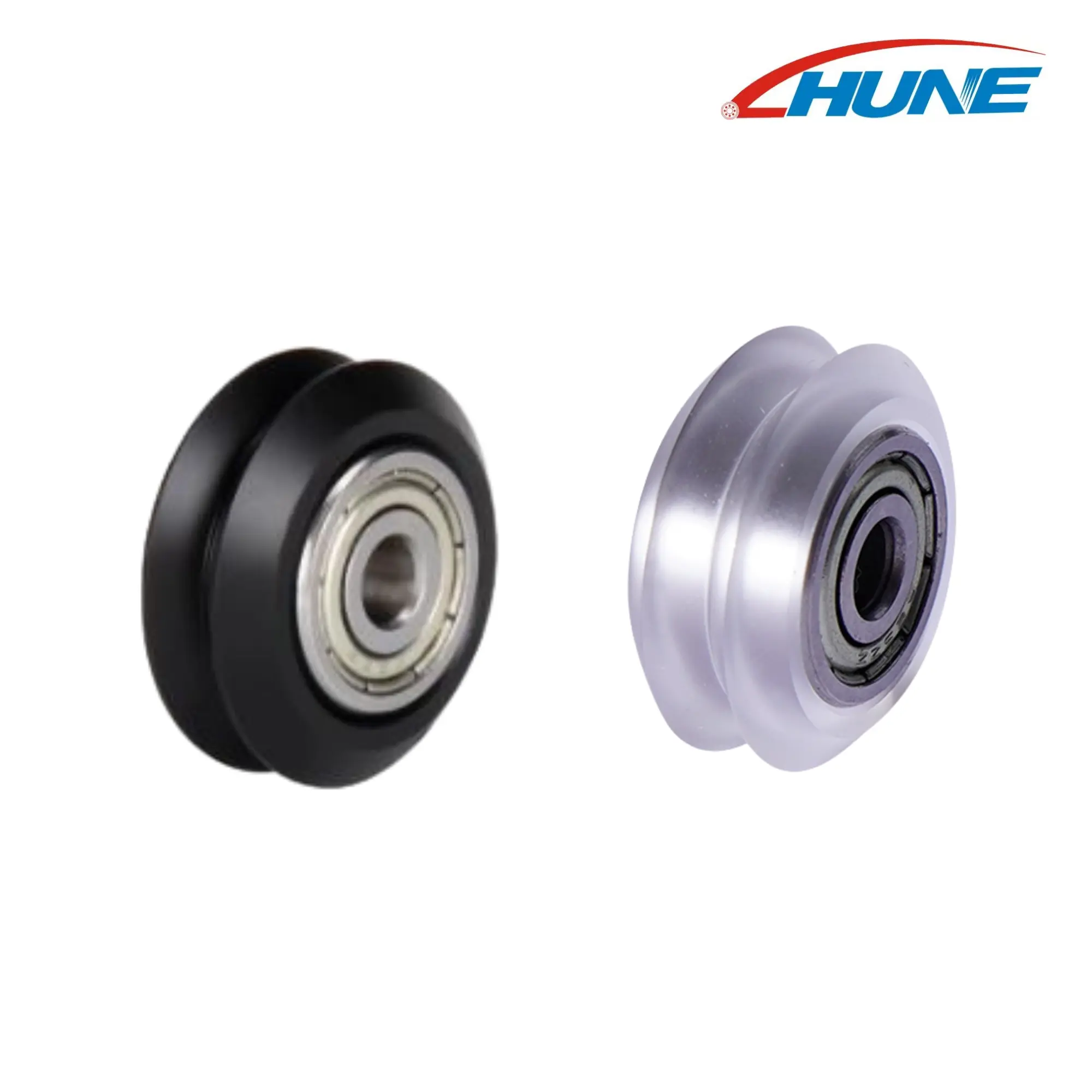
The outer wheel profile and central bearing perform different functions. Both must be specified when selecting a replacement or developing an OEM assembly.
Where Are Bearing Rollers Used?
Their role is to support, guide or stabilise movement along a defined path.
For a sliding door or cabinet, I first establish which rollers support the panel and which provide guidance. For a machine guard or equipment cover, I also ask about opening frequency, stops and contamination. For a conveyor guide, I identify what the roller actually contacts: a product, carrier, belt edge or moving fixture.
Those applications can require different wheel profiles, mountings and acceptance checks. A guide wheel that touches a moving part occasionally should not be specified solely from the requirements of a wheel that continuously supports its weight.
Which Wheel Profile Matches the Track?
Select the contact profile from the mating geometry, then confirm the available wheel size.
| Wheel profile | What I check first | What the buyer should provide |
|---|---|---|
| Flat running surface | Contact width and how lateral movement is controlled elsewhere | Track width, usable running area and side-guidance arrangement |
| V-groove | Groove angle, flank contact and clearance at the groove root | Rail section, angle, corner condition and alignment requirements |
| U-groove or rounded groove | Groove radius, depth and clearance around the mating profile | Dimensioned rail or cable section and intended contact location |
| Flanged profile | Which surface carries the main load and when the flange makes contact | Rail width, flange clearance and expected side forces |
Our flat roller wheels for sliding systems are a starting point when the running surface does not need a locating groove. A V-groove roller wheel with a bearing provides a different contact arrangement that must match the rail section.
For rounded mating profiles, compare the actual section of our U-groove bearing sliding rollers with the required track. A shared label such as “U-groove” does not establish compatibility.
I would request a section drawing rather than approve the match from a front photograph. The drawing needs to show where contact is intended and where clearance is required.
Which Dimensions Matter Beyond Outside Diameter?
Functional dimensions control contact, alignment and installation; overall size alone does not define the fit.
On a grooved roller, the largest outside diameter may be measured across the outer edges. The effective running diameter depends on where the mating profile contacts the wheel. I therefore define the contact geometry before using a diameter to establish installation height or movement.
| Functional feature | What to specify | Why it matters |
|---|---|---|
| Running profile | Diameter at a defined location, groove geometry and edge condition | Establishes the track interface |
| Wheel and hub width | Overall width, hub projection and side clearance | Determines whether the wheel clears the bracket |
| Bearing seat | Seat dimensions, retention method and assembly condition | Controls how the bearing is supported in the wheel |
| Axle or stud | Bearing-seat diameter, shoulder, thread size and usable length | Establishes mounting fit and position |
| Running accuracy | Radial or axial run-out relative to an identified datum | Makes the inspection relevant to assembled rotation |
I would agree tolerances after reviewing the track clearance and production method. Applying the tightest tolerance to every face increases manufacturing and inspection work without necessarily improving movement.
For replacement parts, measure an unworn reference where possible. A worn wheel can help identify the arrangement, but its measured profile should not automatically become the new production target.
Does the Bearing Rating Equal the Roller Load Capacity?
The bearing rating is only one input to the capacity of the assembled roller.
A larger bearing cannot compensate for an inadequately supported wheel, a flexible stud or a bracket that allows the contact to shift. I would review wheel contact, bearing support, axle strength and mounting stiffness together.
Separate the radial force acting across the axle from axial force along it. Include side guidance, impact at stops and any offset between the contact force and the mounting. I would also check how the load is shared between rollers instead of assuming that every wheel carries an equal fraction.
ISO 281 provides methods for dynamic bearing ratings and rating life. Its scope concerns rolling bearings, and its life calculation excludes effects such as wear and corrosion. It does not establish the allowable load or lifetime of the complete plastic wheel and bracket assembly.
For a quotation, ask whether a stated capacity applies to the bearing, one assembled roller or a complete system, and under which conditions it was determined.
How Should Buyers Specify the Wheel Material?
Specify a material grade against the contact and environment, rather than choosing from colour or a generic material name.
POM, nylon, polyurethane and metal wheel constructions deserve different reviews. I would compare the candidate grade's dimensional behaviour, contact properties, environmental resistance and manufacturing requirements before approving it.
For a plastic wheel, the questions include:
- Does the wheel remain loaded while the equipment is stationary?
- Will moisture or cleaning fluids reach it?
- What temperatures occur at the contact and bearing seat?
- Are fillers, pigments or recycled content permitted?
- What track marking, noise and dimensional change are acceptable?
The ISO 62 methods for measuring water absorption in plastics provide a defined basis for comparing moisture-absorption data. They do not, by themselves, prove that an assembled roller will retain its required track clearance. I would pair material information with dimensional checks under the agreed exposure conditions.
For sustained loading, ASTM D2990 addresses creep and creep-rupture testing of plastics. This is relevant when evaluating long-term deformation, including changes that could affect the running profile or bearing seat. A material test supports the review; the finished assembly still needs validation.
Wheel material and bearing protection should also be specified separately. Changing the outer plastic does not define the steel, seal or lubricant inside the bearing.
When Does a Bearing Roller Need a Threaded Stud or Bracket?
Choose the mounting around support, positioning and assembly access.
A wheel with a through-bore can be mounted on a separate axle. A threaded-stud version provides an attachment to a frame or bracket. A bracket assembly may also establish axle support, fixing position or adjustment.
Our POM bearing roller with a threaded stud illustrates a mounting structure to consider when an external threaded connection is useful. Confirm the selected bearing-supported version, wheel profile and shaft specification in the order drawing.
I normally review shoulder length, thread engagement, fixing-face position and tool access together. The assembly drawing should show which parts are clamped when the fastener is tightened and which parts must remain free to rotate. A spacer or washer must not rub against the rotating wheel or bearing seal.
For a stud supported from one side, I would also assess the distance from the support face to the load contact. That distance belongs in the mechanical review, even when the thread itself fits correctly.
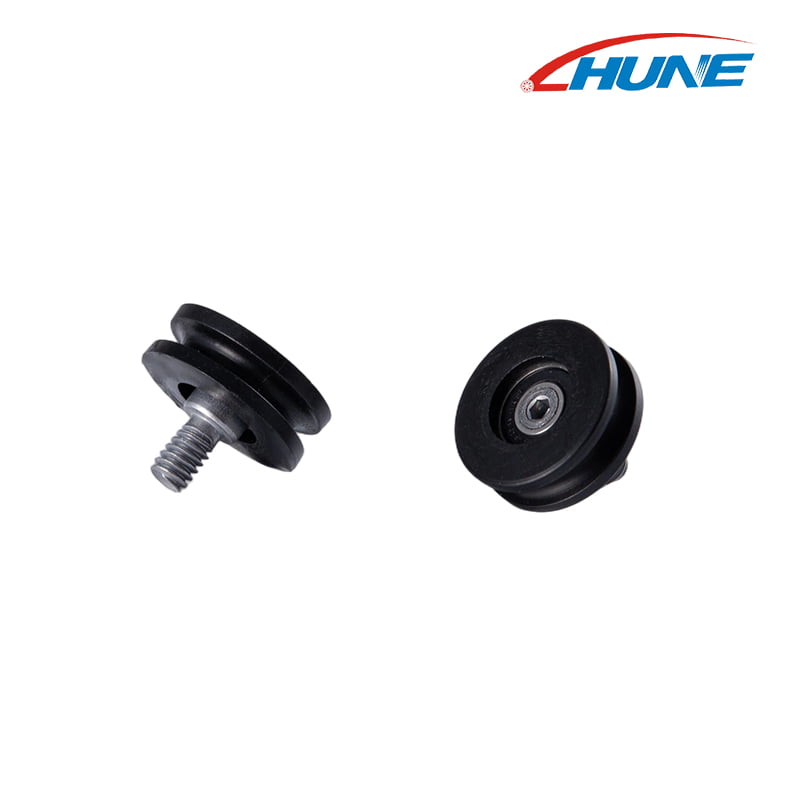
Wheel profile, stud position and mounting clearance should be reviewed together before approving a threaded roller.
When Is a Custom Roller Justified?
Custom development makes sense when the available structure cannot meet the functional interface or production requirements.
I would first compare an existing wheel and mounting with the required drawing. If they match, starting from that structure may avoid unnecessary tooling. If the groove, bearing seat or mounting position needs a substantial change, a superficially similar product may be a poor starting point.
For a plastic wheel, compare the intended production routes:
- Machining for geometry trials or quantities that do not justify tooling.
- Injection moulding for an established design and suitable demand.
- Moulding followed by machining where selected surfaces need a finishing operation.
The article on machining versus injection moulding for POM rollers explains how functional surfaces and design stability affect that decision.
I would compare total project cost at prototype, first-order and annual-demand levels. Include the bearing, axle, bracket, assembly, inspection and likely design changes so quotations cover the same deliverable.
How Should Buyers Approve Samples?
Check production-representative rollers in the intended track and mounting.
I use a staged review because each stage answers a different question:
- Drawing review: Are the contact profile, critical dimensions, material and load directions defined?
- Fit sample: Does the wheel install correctly, clear adjacent parts and travel through the required movement?
- Production sample: Does the intended material and manufacturing process reproduce the approved geometry?
- Installed trial: Does the assembly meet the specified load, cycling, environment and acceptance criteria?
Where relevant, I would record operating force, noise, run-out, wear and track marking. The buyer should define the acceptable result before testing begins.
A wheel that spins freely on a bench has passed a limited check. It has not yet demonstrated installed performance, and a successful machined prototype does not automatically approve a different moulded production construction.
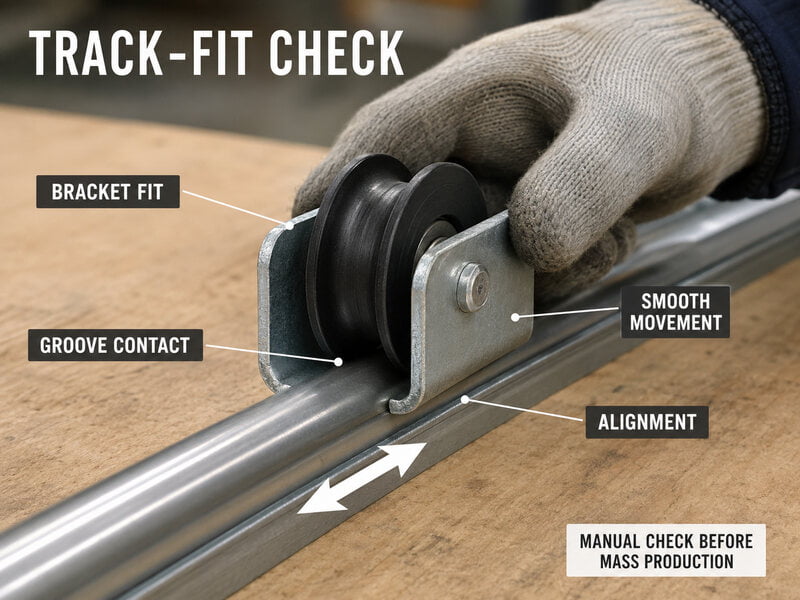
Check the groove contact, bracket clearance and alignment in the mating track. This illustration shows review points, not a reported test result.
What Should an OEM Buyer Send the Supplier?
Send enough information to define the complete assembly and its operating conditions.
A useful inquiry includes:
- Application: What moves, what the roller contacts and whether it supports or guides.
- Wheel drawing: Running profile, width, hub geometry, bearing seat and critical tolerances.
- Mating geometry: Track section, bracket drawing, mounting faces and available clearance.
- Bearing and mounting: Bearing designation if known, seals, lubricant, axle or stud details and retention.
- Operating duty: Loads and directions, movement speed, cycling, stops and exposure conditions.
- Material requirements: Exact grade where specified, permitted substitutions and relevant documentation.
- Commercial scope: Sample quantity, first order, annual forecast and whether the quotation covers loose wheels or complete assemblies.
If no drawing exists, send clear photographs and a reference sample with measured interfaces. Identify which dimensions are requirements and which are estimates. For repeat orders, retain an approved drawing revision and sample reference so that future deliveries can be checked consistently.
Discuss Your Bearing Roller Project with HUNE
Start with the track and mounting requirements so the roller can be reviewed as a working assembly.
HUNE manufactures custom injection-moulded rollers, sliding rollers and metal hardware for door and window systems, furniture, appliances and industrial equipment. We support OEM and ODM projects involving wheel profiles, bearing arrangements, axles and brackets.
A bearing roller should be selected for its contact geometry, internal bearing, mounting and operating duty together. If you are evaluating an existing structure or developing a custom assembly, send your bearing roller inquiry to HUNE. Include the wheel drawing or sample, mating track profile, load directions, operating conditions and expected quantity so we can review the requirements and discuss an appropriate production approach.
Frequently Asked Questions
Are Bearing Rollers Universal Replacements?
No. Matching the outside diameter does not establish interchangeability. I would compare the groove or running profile, wheel width, bearing bore, hub projection and mounting position against the original assembly. Also inspect the track and bracket for wear or distortion. A new roller should be checked in the actual installation before the replacement is approved, particularly where the original part number or drawing is unavailable.
Can I Replace Only the Bearing Inside the Roller?
Only if the wheel is designed to accept a replacement bearing and its seat remains serviceable. Some constructions are not intended for bearing removal. I would first confirm the retention method and removal procedure with the supplier, then inspect the wheel for cracks, distortion or a loose seat. If the bearing cannot be replaced without damaging the wheel or retention features, replacing the complete roller assembly is the appropriate option.
Is a Bearing Roller with Seals Waterproof?
Do not treat the presence of bearing seals as proof that the complete roller is waterproof. For outdoor, shower-door or washdown use, I would request the intended exposure conditions and supporting validation for the selected assembly. Include water pressure, cleaning chemicals, drainage and drying conditions where relevant. The wheel, bearing, axle and mounting hardware all need to be considered before approving the roller for that environment.
Why Is My Bearing Roller Noisy Even Though It Turns Freely?
Free rotation by hand does not reproduce the loaded track contact or mounting conditions. I would check for debris, a damaged running surface, groove mismatch, side rubbing and installation misalignment before attributing the noise to the bearing. Compare the roller before and after installation, and note whether the sound occurs continuously or at one point in its travel. Avoid adding lubricant until the source and permitted maintenance method are confirmed.