Two sliding door roller suppliers can quote the same wheel diameter and still offer very different assemblies. Which one should an OEM approve for repeat production?
Choose a supplier that can review your track and roller drawings together, define the wheel, bearing, axle and bracket, demonstrate a suitable production route, and provide traceable sample and inspection records. Compare quotations only after the material, functional dimensions, validation requirements and supply scope match. Approve the supplier through production-representative samples and a pilot order before committing to routine deliveries.
I start with the interfaces that control movement. Price becomes meaningful once both parties understand what the assembly must do. This guide explains how to compare engineering responses, manufacturing capability and commercial terms for an OEM sourcing decision.
What Should OEM Buyers Ask Sliding Door Roller Suppliers First?
Define the complete assembly and its operating conditions before requesting a firm quotation.
A supplier needs to know whether the roller supports the door, guides it sideways or controls movement near the top. These roles create different load paths and geometry requirements.
Start with the door or panel size and mass, roller positions, track cross-section, travel, operating frequency and environment. State whether the purchase covers a wheel, a wheel with bearing, or a complete carriage with axles, spacers and brackets.
The construction options in HUNE's sliding rollers with bearings help illustrate why “roller” alone is an incomplete purchasing description.
I would send every shortlisted supplier the same drawing revision and ask for a written list of assumptions and exceptions. A useful response identifies missing information, proposes a production route and explains what requires sample validation. A price based on an undefined bearing or an assumed track profile is still a preliminary estimate.
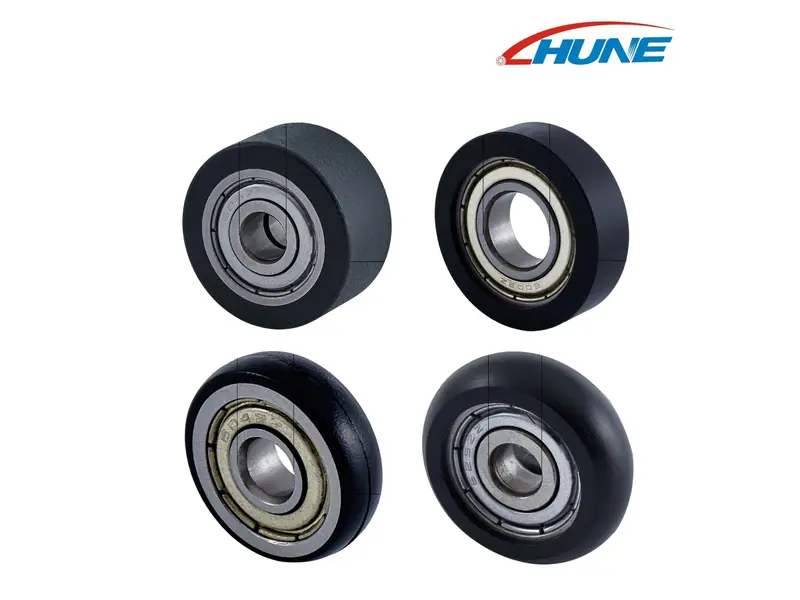
Wheel profile and bearing construction should be identified before suppliers compare prices.
Can the Supplier Review the Wheel, Bearing, Axle and Track Together?
A capable supplier should explain which interfaces control fit, load transfer and free movement.
The running profile must suit the mating rail. For a grooved wheel, the largest outside diameter may differ from the diameter at the actual contact band. A familiar nominal diameter therefore does not establish the correct running height.
Ask how the supplier will check the following interfaces.
| Interface | What the drawing or review should establish | What the supplier should explain |
|---|---|---|
| Wheel to track | Groove angle or radius, contact position, running diameter and side clearance | How the wheel meets the actual rail profile and its dimensional variation |
| Wheel to bearing | Seat dimensions, retention method and locating faces | How assembly holds the bearing without unacceptable distortion or movement |
| Bearing to axle | Bore and shaft fit, shoulders, spacers and axial location | How the mounting arrangement locates the bearing while allowing rotation |
| Axle to bracket | Shaft support, hole positions, fastening method and available space | How load reaches the supporting structure |
| Complete carriage to door | Overall height, width, fixing locations and adjustment range | Which combinations of component variation could cause interference |
For example, a double-wheel sliding door roller with a steel shaft needs assessment as an assembly. Two wheels do not automatically share the load equally; alignment, supporting stiffness and track condition influence the distribution.
I would also question a door-weight claim derived only from a bearing catalogue. ISO 281 addresses rolling-bearing dynamic load ratings and rating life. It does not establish the capacity of a plastic wheel, axle, bracket or complete door system. Its scope also excludes the effects of wear and corrosion on bearing life.
Ask the supplier to identify the basis of any assembly rating: the tested configuration, loading direction, track, duty and acceptance criteria. For a more detailed interface review, the guide to matching sliding door tracks and rollers provides useful context.
Which Manufacturing Capabilities Should Be Verified?
Verify the process proposed for your part and who controls each operation.
A list of machines provides limited evidence on its own. Ask the supplier to describe the route from purchased material to the finished roller assembly, including any subcontracted operations.
A practical review covers material receipt, wheel production, shaft and bracket manufacture, bearing assembly, inspection and packing. Establish who owns the drawing review and who resolves a problem that crosses several components.
Existing Tooling, Machining or a New Mould?
An existing mould can reduce initial development work when its geometry fits the project. Confirm the actual dimensions and available modifications before accepting it. A close catalogue shape may leave insufficient material for a different groove or bearing seat.
Machining can be useful while geometry or demand remains uncertain. Injection moulding may suit a stable design and repeat quantities, while moulding followed by machining can address selected functional surfaces. Each route introduces different costs and process controls.
Ask for the reasoning behind the proposal, including mould release, shrinkage, machining datums, assembly sequence and inspection access. The comparison of POM roller machining and injection moulding explains these production choices further.
In-House and Subcontracted Operations
Subcontracting is not an automatic reason to reject a supplier. The question is whether the supplier controls specifications, incoming acceptance, traceability and changes at the outside source. Ask who supplies bearings, who produces metal fittings and who performs any surface finishing.
For capacity, request a lead-time breakdown covering tooling, trial parts, bought-in components, production and inspection. Assess available capacity for your planned order pattern rather than relying on a total factory output figure.
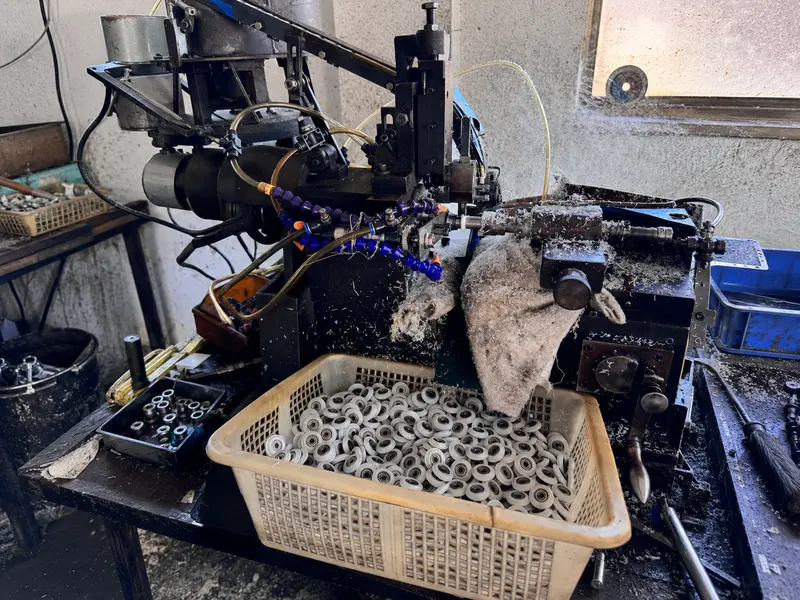
A process review should connect the proposed equipment and fixtures to the dimensions that matter on the drawing.
How Should Materials and Functional Dimensions Be Specified?
Approve a defined material and drawing revision, with inspection methods for the features that affect operation.
“POM,” “nylon” and “stainless steel” are starting descriptions. Ask for the proposed material grade and supporting data, together with any permitted pigment, filler or recycled-content variation. Identify metal grades and surface treatments separately from the wheel material.
For the bearing, record its designation, dimensions, closure arrangement, lubrication specification where applicable, and approved source or controlled equivalent. A change to the bearing can affect fit and running behaviour even if the wheel drawing stays the same.
I normally identify the running profile, bearing seat, locating faces and shaft position before discussing tolerances. The drawing should show the datum used to check wheel run-out and the dimensions that govern bracket clearance. Set these limits from the assembly requirements and supplier capability evidence; do not assign an arbitrary tight tolerance to every surface.
Agree on how parts are supported during measurement and any material-conditioning requirements. Measuring an unsupported plastic feature can produce a different result from measuring it in the intended fixture.
Before sample approval, ask the supplier to return a marked drawing showing accepted requirements, proposed changes and unresolved features. Resolve these items before they disappear into production assumptions.
What Quality Evidence Should a Supplier Provide?
Look for records that connect the approved specification to actual production parts.
If a supplier presents an ISO 9001 certificate, check the company name, covered site, scope, issuer and validity. ISO describes ISO 9001 as a quality management system standard. Treat certification as evidence about the management system; your roller still needs its own technical acceptance.
Useful evidence includes a dimensional report tied to a drawing revision, material and bearing identification, measurement methods, equipment calibration records, and the procedure for handling nonconforming parts.
For a critical measurement, ask whether the method is suitable for the specified tolerance. NIST's guidance on metrological traceability explains that traceability belongs to a measurement result and requires a documented calibration chain with uncertainty considered. A calibration sticker alone does not establish that a particular inspection result is reliable enough for its purpose.
I would then agree on which characteristics need routine sampling, which need more extensive checks and how rejected lots are contained. State the response expected when a result falls outside the approved limit. If statistical capability data are requested, confirm the measurement method and representative production conditions before interpreting the numbers.
How Should Samples and Pilot Production Be Approved?
Give each sample stage a defined purpose and keep the production route visible.
A carefully finished prototype may establish geometry without demonstrating the repeatability of a moulded production part. Ask whether the sample uses the proposed material, tooling, bearing, fixtures and assembly process.
| Approval stage | Question it should answer | Evidence to retain |
|---|---|---|
| Drawing review | Are requirements and exceptions understood? | Agreed revision and resolved technical questions |
| Geometry sample | Does the assembly fit the intended track and envelope? | Dimensional results and mating-part checks |
| Production-tool sample | Can the proposed material and process produce the required features? | Process identity and results across relevant mould cavities |
| System validation | Does the roller meet the defined operating requirements? | Test configuration, conditions, measurements and acceptance decision |
| Pilot order | Can normal production repeatedly deliver acceptable assemblies? | Lot records, inspection results and any corrective actions |
Define the system test before testing starts. Depending on the application, evaluate movement under the specified load, operating force, noise, bearing retention, wheel wear and changes in running clearance. Include the relevant environment and duty. Acceptance limits should come from the product requirements rather than being invented after the results arrive.
Keep an approved reference sample identified by part number and revision, together with the drawing and inspection record. A reference sample helps comparison but does not replace numerical requirements for functional features.
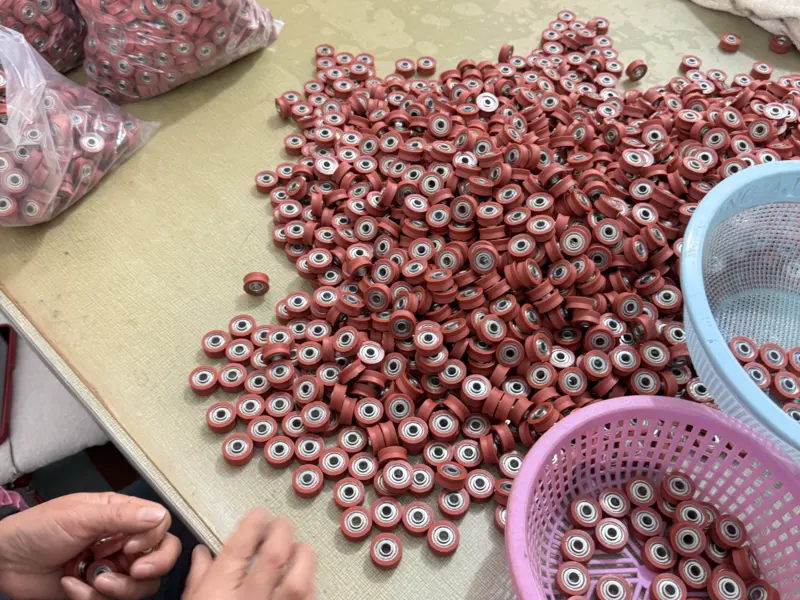
Batch identification and documented acceptance help connect repeat deliveries to approved samples. This image shows parts handling, not measured test results.
How Can OEM Buyers Compare Quotations Fairly?
Compare the same assembly, acceptance requirements and order assumptions before comparing unit prices.
Separate prototype quantities, the first production order and expected annual demand. A price for one large release may not apply to the same annual quantity split across many small deliveries.
Ask each supplier to identify:
- The quoted drawing revision, material, bearing and included hardware.
- Tooling, fixtures, sample work and one-time engineering charges.
- Minimum order quantities for each variant, colour or packaging format.
- Inspection reports, agreed testing and any outside laboratory charges.
- Packaging, shipment basis, quote validity and payment milestones.
- Lead times and the event that starts each lead-time commitment.
Review tooling terms before authorising development. Record ownership, permitted use, storage, upkeep, modification charges and the agreed arrangements if production ends or moves. Confirm whether the quote includes trial corrections needed to meet the agreed drawing.
I prefer a visible cost breakdown to a low headline price with undefined exclusions. It makes the consequences of a material change, a tighter functional tolerance or a different release quantity easier to assess.
What Must Stay Controlled Across Repeat Orders?
The approved part includes its material, process and component sources as well as its shape.
Agree which changes require notification and which require approval before shipment. Relevant changes can include the resin grade, filler or pigment, bearing source, metal treatment, mould cavity, production location, fixture or assembly method.
Define how the supplier will identify affected lots and decide whether new samples or testing are needed. An unchanged part number should not conceal an unreviewed component substitution.
For repeat deliveries, retain the part and drawing revision, batch identification, agreed inspection results and packaging identification. Also establish who investigates a quality complaint and how stock from the affected lot is located and contained.
A supplier's response to an engineering question is part of the assessment. Clear ownership, recorded decisions and a realistic correction plan are more useful than an unsupported promise that problems will never occur.
Frequently Asked Questions
Can a Supplier Quote Without a Complete CAD Drawing?
Yes, a supplier may prepare a preliminary proposal from a physical sample, photographs, measured features and the mating track. State which requirements are known and which need development. An old sample may be worn or incomplete, so it should not automatically define the new specification. Before production approval, convert the agreed geometry, material and acceptance requirements into a controlled drawing and parts list.
Should an OEM Use One Roller Supplier or Qualify Two?
A second qualified source can reduce dependence on one production location, but it adds tooling, validation and specification-management work. Decide according to supply risk and demand. If two sources are needed, give both the same functional requirements and qualify both assemblies in the same system. Similar catalogue dimensions alone do not establish interchangeability between their parts.
Can Several Roller Variants Share One Mould?
Sometimes. A common moulded blank, interchangeable tooling features or planned secondary machining may support related variants. The supplier needs to confirm remaining wall thickness, bearing retention and which surfaces change. Also establish variant identification and separate inspection requirements. Shared tooling is useful only when it preserves the required geometry and makes commercial sense across the expected order quantities.
Is the Lowest Minimum Order Quantity Always the Better Offer?
No. Check whether the minimum applies to each wheel geometry, colour, bearing combination or delivery release. A small initial order can help a project with uncertain demand, but its price and process may differ from repeat production. Compare the sample route, production route and future release terms together. Approve the supply arrangement that fits the project's actual purchasing pattern.
Discuss Your OEM Roller Project with HUNE
HUNE manufactures custom sliding rollers, plastic components and metal hardware for door and window systems and related applications. Its manufacturing capabilities include injection moulding, machining and metal stamping, supporting review of both the wheel and its associated fittings.
For a useful enquiry, send the roller drawing or sample together with the track cross-section, door size and mass, roller positions, bearing arrangement, critical dimensions, operating environment and expected order quantities. Include the drawing revision, required validation and target sample schedule.
Use the HUNE contact form to submit your OEM roller requirements. Ask for a proposed construction, production route, sample plan and quotation with assumptions clearly stated. Select your sliding door roller supplier after those requirements are agreed and the representative assembly has passed the planned review and validation.