
Wide drawers wobble or move unevenly when the left and right sides do not advance by the same amount or remain in the same plane. Their width gives an off-center hand force or uneven payload a long lever arm, creating a yawing moment that tries to rotate the drawer inside the cabinet. Flexible drawer panels, rail clearance, unequal roller friction, axle play, mounting error and cabinet deflection can then let one side lead the other.
The result is usually called racking. It may feel like side-to-side looseness, a diagonal drawer front, alternating resistance or a soft-close mechanism engaging on one side first. For an OEM, the solution is to control the complete system: drawer torsional stiffness, rail spacing and parallelism, roller and axle geometry, left-right load sharing and, where required, mechanical synchronization. Installing a higher-capacity bearing alone rarely corrects wide-drawer racking.
What Is Wide-Drawer Racking?
Racking is relative left-right movement that rotates the drawer in plan view.
Imagine looking down on the drawer from above. In the ideal condition, its front edge remains parallel to the cabinet opening as both runners travel together. During racking, one front corner moves ahead of the other. The drawer becomes slightly diagonal even though both slides still point generally forward.
This motion is different from several related problems:
| Symptom | Main direction of movement | Likely system issue |
|---|---|---|
| Racking | One side leads in the horizontal plane | Off-center force, low torsional stiffness, unequal runner motion |
| Vertical sag | Front edge drops as the drawer extends | Rail, cabinet or drawer bending under load |
| Side-to-side wobble | Drawer shifts laterally between the runners | Excess side clearance, roller or guide play |
| Binding | Travel force rises or the drawer stops | Misalignment, insufficient clearance, rail twist or cross-load |
| Pitching | Front edge moves up and down | Vertical clearance, wheel diameter variation or loose mounting |
More than one condition can occur at the same time. A drawer may begin by racking, then bind when its diagonal position consumes the available side clearance. This is why a buyer should describe the observed direction and the drawer position rather than reporting only that it feels “loose.”
Why Does Width Make the Problem More Noticeable?
A wider front increases the moment created by an off-center pull.
When a user pulls near the center, the force is shared more symmetrically. When the same force is applied near one corner, its offset from the drawer center creates a turning moment. The farther the handle or hand is from the centerline, the larger that moment becomes.
Wide, shallow drawers are especially sensitive because the front is wide while the runner engagement length is relatively short. The drawer can rotate slightly before the runners or structure develop enough restoring force. A deep drawer usually has a longer structural box and runner spacing in the travel direction, which can improve resistance to rotation, although depth alone does not guarantee stability.
Blum’s technical guidance for a TANDEM lateral stabilizer recommends the accessory when a drawer is more than twice as wide as it is long. That is a product-specific recommendation, not a universal ratio for all slides, but it illustrates why width-to-depth proportion belongs in the engineering review.
Why Does Pulling from One Side Make a Wide Drawer Rack?
An eccentric pull asks the drawer box and runner pair to resist rotation as well as translation.
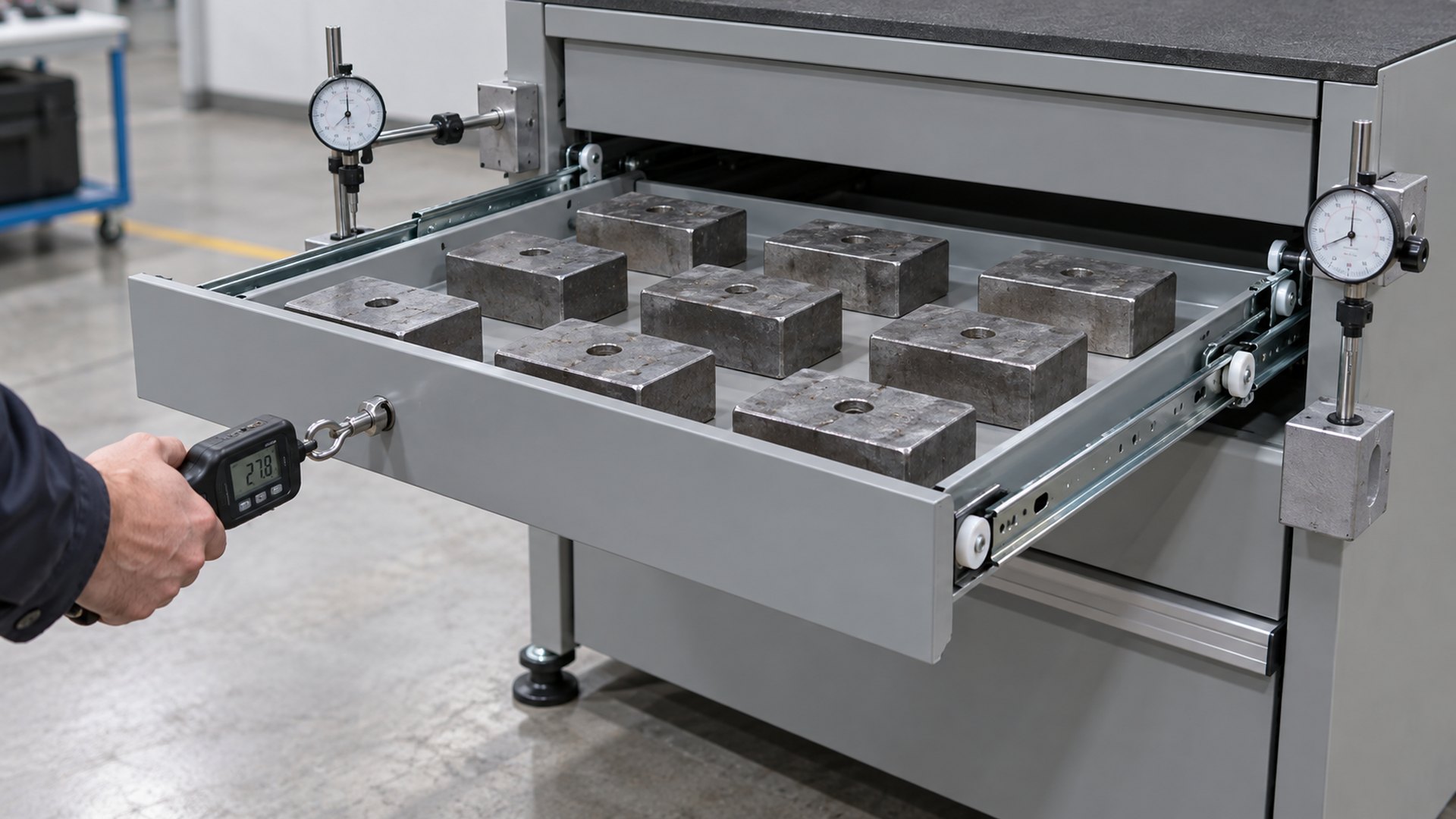 A side-pull test reveals whether the drawer front, runner pair and cabinet can keep both sides moving together.
The force path starts at the handle or front panel. It passes through the front-to-side joints, drawer sidewalls, runner attachments, rolling elements and cabinet structure. If any part twists, the near-side runner starts moving first. Clearance in the opposite runner allows a small angular displacement before it begins carrying the lateral reaction.
Several effects can follow:
- the near-side runner has lower initial resistance and advances first;
- the drawer front twists relative to the drawer box;
- one runner contacts the side of its guide path;
- friction rises on the lagging side;
- the user applies more force, increasing the turning moment; and
- the drawer suddenly releases or alternates between sides.
This feedback is why a wide drawer may feel smooth when pulled from the center but jerky from one edge. The cause is not necessarily damaged hardware. It may be insufficient lateral stiffness or synchronization for the chosen width.
Hettich notes that very wide or shallow-wide drawers can have activation or closing problems when a push-to-open front is pressed at its edge. Its Quadro runner guidance recommends synchronization options to enlarge the effective activation zone for high or wide fronts.
How Does the Drawer Box Control Stability?
The runners cannot keep a flexible drawer square by themselves.
The front, back, bottom and side panels form a torsional box. Joint stiffness and panel construction determine how well that box transfers an off-center force to both runners.
Important design details include:
- front-panel thickness and attachment spacing;
- strength of front-to-side and rear-to-side joints;
- drawer-bottom thickness, groove engagement and fastening;
- height and section of the sidewalls;
- internal dividers or structural crossmembers;
- material modulus and moisture response; and
- the vertical position of the runner relative to the drawer’s center of force.
A large decorative front fixed to a light drawer box can amplify the issue. The front may feel rigid locally while the connection behind it permits twist. Similarly, a thin bottom that contributes little shear stiffness may allow the two sidewalls to move out of square.
I would measure the drawer diagonals and front-corner displacement both unloaded and loaded. If the box changes shape before the runner movement differs, strengthening the drawer structure may be more effective than changing rollers.
How Do Runner Spacing and Alignment Affect Uneven Travel?
The left and right runners need compatible spacing, height and parallelism throughout the stroke.
Side clearance is not simply empty installation space. It establishes how the drawer fits between the two guiding systems. Too little clearance can preload the runners; too much can allow racking before both sides engage.
The following errors are common:
- cabinet sides are not parallel;
- the front opening and rear runner spacing differ;
- one runner is mounted higher or farther forward;
- screw heads or distorted brackets twist a rail;
- the drawer width changes from front to rear;
- cabinet panels bow under the drawer load; or
- mounting holes locate the runners from cosmetic surfaces instead of functional datums.
The empty drawer may still move because the structure can flex around the error. Under load, the drawer, rails or cabinet deflect differently, and the available clearance disappears. Our article on why drawer slides bind under load explains that transition from free movement to cross-loaded contact.
For repeat production, specify installed runner spacing and parallelism, not only individual cabinet and drawer widths. The assembly stack is what the rollers actually experience.
How Do Rollers, Bearings and Axles Affect Stability?
The rolling components determine clearance, height and friction at each side of the drawer.
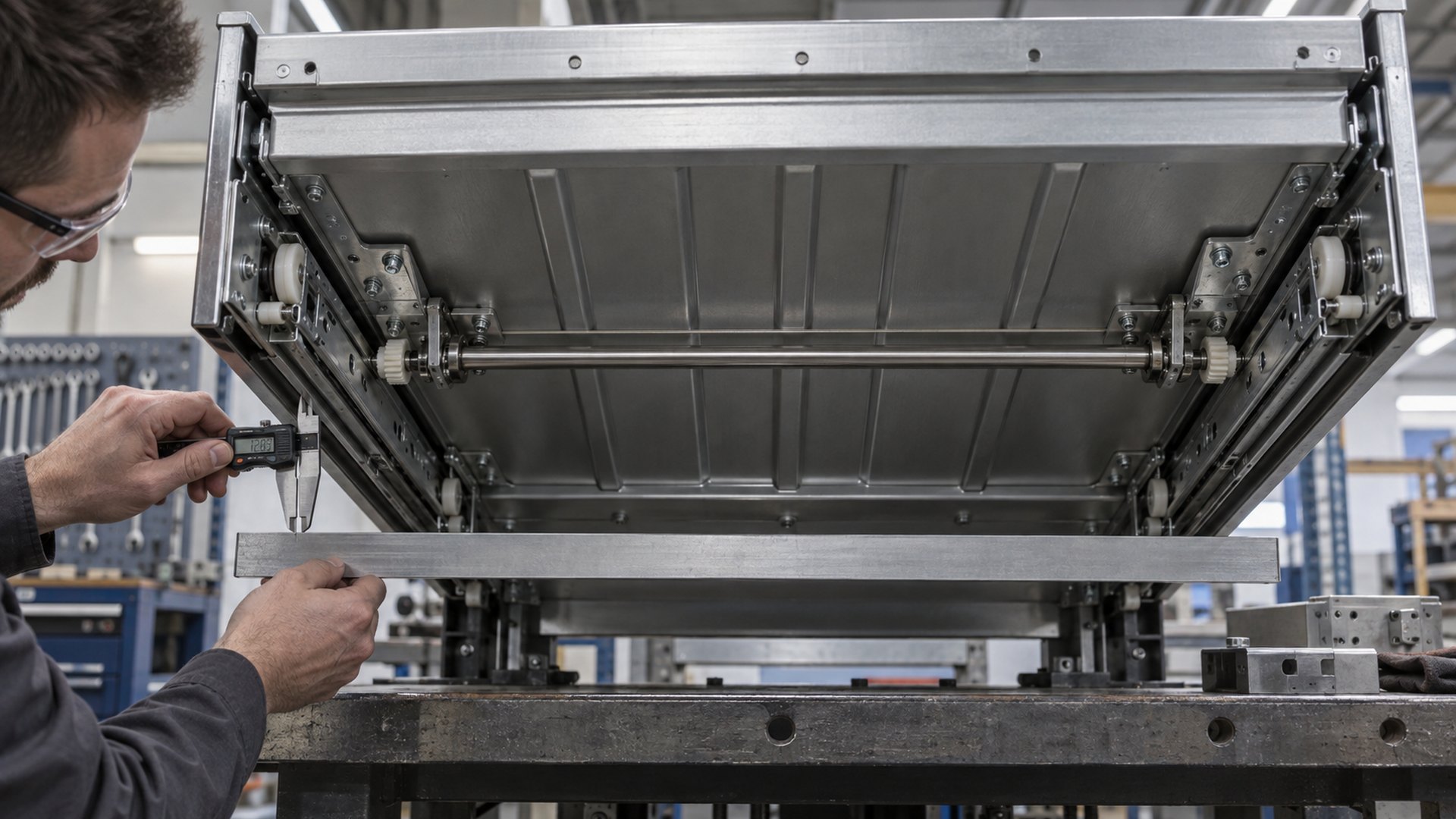 Wheel diameter, tread width, bearing fit and axle position all contribute to the installed runner geometry.
Roller outside diameter controls the running height. If left and right wheel diameters differ, the drawer can tilt and transfer load unevenly. Tread width and profile determine lateral contact with the rail. A narrow contact band or excessive crown can reduce lateral support; an overly tight side guide can increase friction when alignment changes.
The wheel material also matters. A soft polymer can damp impact and noise but may deform more under sustained or concentrated load. POM, nylon, polyurethane and other materials respond differently to temperature, moisture, wear and time. Selection must follow the operating environment and contact geometry.
Inside the wheel, a bearing, bushing or plain bore controls rotation and radial play. A bearing can reduce axle-interface friction, but it does not remove tread deformation, axle bending or rail clearance. Excess bearing fit pressure can increase torque; a loose fit can let the wheel shift relative to its axis.
Axle diameter, unsupported length, shoulder squareness and retention determine wheel tilt. A rivet or pin that loosens can let one side develop more play and more rolling resistance than the other. HUNE’s flat plastic-coated bearing rollers can be specified by wheel diameter, width, material, bearing and mounting interface for furniture and equipment slide systems.
Why Do Unequal Friction and Load Sharing Matter?
Small left-right differences become steering inputs in a wide drawer.
If one runner needs more force to start moving, the other side advances first. Sources of unequal resistance include seal torque, lubricant condition, wheel interference, rail surface finish, contamination, soft-close timing and mounting preload.
Uneven payload creates a similar effect. A heavy object near one corner increases the vertical reaction and rolling resistance on that side. The rail or cabinet panel may deflect more there, further changing alignment. Even when the total mass is within the slide rating, the asymmetric condition can cause unstable motion.
The rated capacity of the slide pair should therefore not be treated as permission to place the entire payload anywhere. Our guide to roller drawer-slide load capacity explains why extension, load center, rail stiffness, roller contact, fasteners and cycle requirements must be considered together.
For applications with predictable asymmetric payloads, the validation fixture should reproduce the worst credible load location. An evenly distributed laboratory load alone may miss the actual racking condition.
Does a Higher-Capacity Slide Prevent Wobble?
Higher capacity can increase stiffness, but it does not automatically synchronize the two sides.
A larger rail section, wider carriage or stronger mounting arrangement may reduce deflection and improve lateral control. However, a high-capacity slide can still rack if it contains normal operating clearance and the wide drawer is pulled from one edge.
Capacity and lateral stability are separate performance targets:
| Target | Main question | Typical control methods |
|---|---|---|
| Load capacity | Can the system support and cycle the specified load? | Rail section, roller contact, axle, fasteners, structure |
| Vertical stiffness | How far does the front sag at extension? | Section geometry, overlap, drawer and cabinet stiffness |
| Lateral stability | How far can the drawer shift or rotate? | Guide geometry, side clearance, runner spacing |
| Synchronization | Do both sides begin and continue moving together? | Cross-shaft, rack-and-pinion or linked mechanism |
| Motion quality | Is operating force smooth and consistent? | Alignment, friction balance, material and surface control |
Buying a heavier-duty slide without defining which target is failing can add cost and space while leaving the wobble unchanged.
When Does a Synchronization Mechanism Help?
Synchronization mechanically couples the left and right runners so one side cannot travel independently.
 A transverse shaft or linkage can reduce racking by coordinating left and right runner travel.
A common arrangement uses a transverse rod with pinions, racks or linkages. When one side moves, the mechanism drives the other side through a matching displacement. This is useful for wide fronts, shallow-wide drawers, push-to-open systems and applications that are frequently operated from an edge.
Blum describes its lateral stabilizer as a device that increases lateral stability and synchronizes the runners to prevent racking. Its documentation also states that the accessory does not increase load capacity. That distinction is important for OEM specifications: the synchronizer controls relative motion, while the runners and structure still carry the vertical load.
The Accuride 3160EC wide-drawer design uses lateral support and an anti-racking system to reduce side-to-side movement. This is another example of wide-drawer stability being treated as a system feature rather than a simple load-rating increase.
A synchronizer introduces its own requirements:
- backlash must be low enough for the target feel;
- left and right engagement must be phased correctly;
- the shaft must resist twist across the drawer width;
- brackets must hold alignment under load;
- added friction and noise must be acceptable; and
- assembly tolerances must allow repeatable installation.
It is not always necessary. A moderately wide, deep, stiff drawer with well-guided runners and a centered handle may meet the target without one. Prototype testing should decide.
Can an Extra Guide Roller Reduce Wobble?
A guide roller can control lateral movement if it contacts a suitable reference surface without overconstraining the drawer.
An additional roller may support the drawer front, reduce rail migration or establish a second lateral contact. The design must account for tolerance. If the main runners and guide roller all demand incompatible positions, the drawer can bind instead of becoming more stable.
Useful questions include:
- Which component is the lateral datum?
- Is the guide loaded continuously or only after clearance is taken up?
- Can its position be adjusted during assembly?
- Does the mating surface remain straight through full travel?
- Will dirt or wear change the guide clearance?
- Does the guide carry vertical load, lateral load or both?
For custom systems, the wheel, axle and bracket need to be designed with the mating rail. HUNE also manufactures custom stamped hardware for roller assemblies, allowing the guide position and mounting datum to be controlled in the same component stack.
Which Functional Dimensions Matter Most?
Control dimensions that establish left-right position, running height and diagonal squareness.
| Functional characteristic | Why it matters | Suggested inspection condition |
|---|---|---|
| Drawer width front and rear | Reveals taper that changes side clearance | Drawer unloaded and at reference temperature |
| Cabinet runner spacing front and rear | Controls parallelism of the two paths | Installed condition from common datum |
| Left-right runner height | Controls tilt and load sharing | From cabinet mounting datum |
| Roller-axis location | Sets functional running height | From rail mounting face |
| Roller outside diameter and runout | Controls vertical movement and force variation | Relative to axle or bearing axis |
| Axial and lateral roller play | Controls wobble before guidance engages | Fully assembled fastener condition |
| Drawer diagonal difference | Indicates box squareness and racking | Unloaded and representative load |
| Front-corner differential travel | Direct measure of racking | Center, left and right actuation |
| Rail straightness and twist | Controls smooth contact through the stroke | Free state and installed state |
| Synchronizer backlash | Controls how far one side leads | Complete linked assembly |
Dimensional tolerances should be supported by a functional test. A drawer can meet every separate component dimension and still rack if the stack permits too much differential movement.
How Should an OEM Test a Wide Drawer?
Test center pulls, edge pulls and asymmetric loads across the full travel.
A useful validation plan includes:
- Geometry check: measure drawer width, diagonals, runner spacing, height and parallelism before loading.
- Centered operation: record starting and running force through the complete stroke.
- Left-edge and right-edge operation: compare pull force, left-right travel difference and front-panel angle.
- Distributed load: repeat at representative total mass.
- Offset load: place the payload at the most demanding credible side and depth.
- Partial and full extension: check positions where rail overlap and guidance change.
- Cycle test: monitor force, play, noise and synchronizer backlash over the required duty.
- Post-test inspection: check wheel wear, axle looseness, rail marking, fastener movement and permanent drawer distortion.
The measurement method should define where the drawer is pulled. A center-pull result cannot be compared directly with an edge-pull result. Pull speed and force direction should also be controlled because upward or downward hand force can change contact inside the runner.
The ANSI/BHMA A156.9 Cabinet Hardware overview confirms that cabinet hardware evaluation includes operational, cyclical and strength criteria. A product-specific OEM method can add differential-travel and edge-actuation limits when wide-drawer stability is critical.
What Should a Buyer Send the Supplier?
A wide-drawer inquiry needs geometry and motion requirements, not only drawer weight.
Send:
- cabinet opening width and depth;
- drawer outside width, depth, height and construction;
- slide type, length, extension and mounting orientation;
- complete moving mass and payload distribution;
- handle location and likely user actuation points;
- required left-right travel difference or allowable racking angle;
- acceptable lateral and vertical play;
- starting and running force targets;
- rail profile, material and mounting datums;
- roller diameter, width, material and bearing or bore preference;
- axle or rivet geometry and retention;
- whether a synchronizer or added guide is permitted;
- duty cycle, environment and noise target;
- applicable standard or in-house test method; and
- prototype quantity and annual demand.
Photos or video of the symptom can help, but drawings and measured conditions are needed for a repeatable correction. HUNE’s materials and manufacturing-process guide and OEM development process show how wheel material, molding, stamped parts, samples and production control can be coordinated.
Frequently Asked Questions
Why does a wide drawer move smoothly from the center but bind from one side?
An edge pull creates a turning moment. If the drawer box, runner pair or cabinet lacks lateral stiffness, the near side advances first and the drawer becomes diagonal. That position can consume side clearance and cross-load the opposite runner, raising resistance.
Will tighter side clearance stop a wide drawer from wobbling?
Not necessarily. Reducing excessive clearance can improve guidance, but too little clearance can preload the runners and cause binding when panels or rails vary. The correct clearance must include drawer, cabinet and mounting tolerances plus changes under load and temperature.
Does a lateral stabilizer increase the drawer’s load capacity?
Usually no. Its main job is to synchronize left and right motion and reduce racking. Vertical load capacity still depends on the runners, rollers, axles, rails, fasteners, drawer and cabinet. Follow the specific manufacturer’s rating and instructions.
Can a larger bearing roller make a wide drawer more stable?
It may improve contact stiffness or reduce rotation resistance, but it will not automatically correct a flexible drawer, misaligned rails or unsynchronized sides. Wheel diameter, tread width, material, axle position and rail profile must be validated as a complete guide system.
Discuss Your Wide-Drawer Roller System with HUNE
HUNE manufactures custom plastic-coated bearing rollers, plain-bore guide wheels, axles and stamped mounting hardware for furniture, appliances, storage equipment and industrial drawers. We evaluate the wheel, axle, rail, bracket, drawer and cabinet interface as one motion system.
Send the drawer and cabinet drawings, width and depth, load distribution, actuation point, rail profile, permitted play, cycle requirement, environment and annual quantity. Our engineers can review whether the priority is a different roller, tighter axle control, revised guide geometry, added lateral support or a synchronized mechanism. Contact HUNE for an OEM wide-drawer roller review and quotation.
The practical recommendation is to test a wide drawer from the center and both edges under realistic loads. Control left-right differential travel and structural stiffness directly; do not assume a higher bearing or slide load rating will eliminate racking.