A pulley bearing is the rolling or sliding support that lets a pulley rotate around a shaft, stud or axle. In compact hardware, the term often describes a complete pulley wheel with a ball bearing integrated into its hub. In larger belt, cable or sheave systems, it can mean one or two separate bearings supporting the pulley body. The pulley guides or transmits force through a belt, cable, rope, rail or track, while the bearing reduces friction and controls the pulley axis.
The bearing alone does not determine pulley performance. Groove geometry, wheel material, shaft fit, internal clearance, seals, lubrication, axial retention, bracket stiffness and alignment all affect load capacity, noise, temperature and service life. For OEM selection, start with the complete load path and mating geometry, then choose a bearing structure that can meet the required load, speed, environment and production method.
What Is a Pulley Bearing?
A pulley bearing supports rotation inside a pulley or supports a pulley body on its shaft.
The phrase “pulley bearing” is widely used, but it is not one universal bearing type. It can refer to:
- a standard deep-groove ball bearing overmolded or pressed into a plastic pulley;
- a custom double-row bearing whose outer ring also forms the pulley running surface;
- one or two bearings installed inside a machined metal or molded pulley hub;
- the bearing inside an idler or belt-tensioner pulley;
- a bearing roller used as a small guide pulley; or
- a plain bushing that performs the rotational-support function in a light-duty pulley.
This terminology matters when requesting a quotation. “Need a 30 mm pulley bearing” does not say whether 30 mm is the tread diameter, bearing outside diameter or bore. It also leaves the supplier without the groove, width, axle, load, speed and environmental conditions.
In this guide, pulley-bearing system means the complete assembly: pulley tread or groove, bearing or bushing, axle, spacers, fasteners, bracket and the belt, cable, rail or track that contacts the pulley.
How Does a Pulley Bearing Work?
The pulley receives force at its outer profile and transfers it through the bearing to a shaft or bracket.
The load path is normally:
belt, cable or rail → pulley tread or groove → pulley hub → bearing outer ring → rolling elements → bearing inner ring → axle or shaft → bracket or machine frame
If the inner ring is fixed, the pulley and bearing outer ring rotate around it. In another arrangement, the pulley can be fixed to a rotating shaft while the bearing outer ring is retained in a housing. The correct arrangement depends on which component rotates relative to the machine.
Rolling elements reduce sliding at the shaft interface, but friction still exists at seals, lubricant, raceway contacts and the outer mating surface. In a belt pulley, the belt bends and contacts the groove or face. In a guide wheel, a cable or rail creates its own contact pressure. These external losses can dominate a small, slow-moving assembly.
The bearing also controls radial position, axial movement and tilt. Too much play can let the pulley wobble. Too little clearance after fitting can raise torque and temperature. Washers or shoulders that contact the rotating ring can create drag even when the bearing itself is suitable.
What Are the Main Pulley-Bearing Structures?
The best structure depends on pulley size, load, speed, space and manufacturing volume.
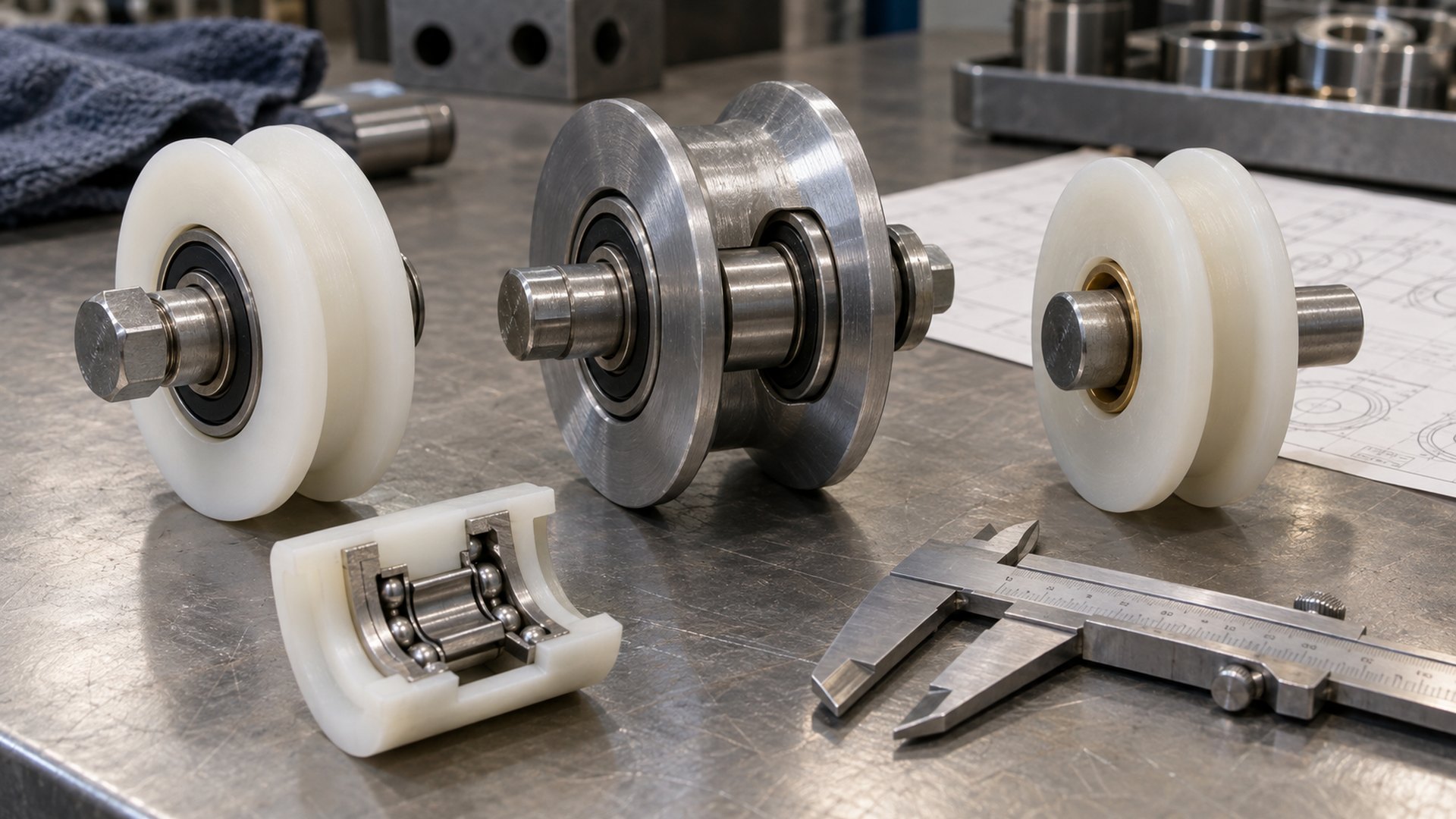 Integrated bearing pulleys, separate-bearing hubs and plain-bore pulleys use different fits, retention methods and load paths.
| Structure | Typical construction | Main advantages | Main design concerns |
|---|---|---|---|
| Integrated plastic bearing pulley | POM, nylon or PU molded around or assembled over a ball bearing | Compact, quiet, protects mating surface, efficient for volume production | Mold shrinkage, outer-ring distortion, tread concentricity, material creep |
| Machined pulley with one bearing | Metal or plastic pulley with a bearing pressed into the hub | Simple assembly, replaceable bearing possible | Hub fit, axial retention, moment capacity |
| Pulley with two bearings | Two bearings spaced inside a wider hub | Better tilt control and moment support | Spacer length, coaxial bores, inner-ring clamping, cost |
| Bearing outer ring used as pulley | Customized bearing with cylindrical or profiled outer ring | Compact, accurate, high stiffness | Contact stress, outer-ring deformation, specialized supply |
| Idler or tensioner pulley | Pulley bearing mounted on fixed stud or moving tensioner arm | Belt guidance and tension control | Belt pull, speed, heat, seal, alignment and arm stiffness |
| Plain-bore or bushed pulley | Polymer or metal pulley sliding on a pin or bushing | Low cost, simple, suitable for light or intermittent duty | Wear, lubrication, clearance, higher friction |
A single-bearing pulley is not automatically inferior to a double-bearing design. If the load acts close to the bearing center and the bracket controls alignment, one bearing may be sufficient. A wider pulley, offset belt line or cantilevered load can create a moment that justifies greater bearing spacing or a more rigid axle.
What Loads Act on Pulley Bearings?
Pulley bearings carry the resultant of belt, cable, track and assembly forces, not only the suspended mass.
In a belt drive, the bearing sees forces created by the tight-side and slack-side belt tensions. Their vector sum produces a radial load on the pulley and shaft. The Timken Engineering Manual discusses belt and chain pull as part of applied-load determination for bearing selection.
Other loads can include:
- belt or cable installation tension;
- transmitted torque and the difference between tight-side and slack-side tension;
- wrap angle around the pulley;
- weight carried by a guide pulley;
- radial contact force from a rail or tube;
- axial force from misalignment, flange contact or skewed tracking;
- moment load from an offset groove or cantilevered bracket;
- acceleration during starting and stopping;
- impact at joints, stops or debris; and
- vibration from the machine or moving assembly.
A pulley that redirects a cable can experience significant bearing load even if it transmits no drive torque. Likewise, an idler pulley may carry high radial load while simply guiding the return side of a belt.
The buyer should provide force direction as well as magnitude. A deep-groove ball bearing can accept radial load and a limited amount of axial load, but the permissible combination depends on bearing size, internal design, clearance, speed and lubrication. Persistent flange contact usually indicates that alignment or profile selection should be corrected rather than assigned entirely to the bearing.
How Is Pulley-Bearing Load Capacity Determined?
The complete pulley is limited by whichever component reaches its allowable condition first.
Bearing catalogues provide basic dynamic and static load ratings under standardized conditions. These values support fatigue-life and permanent-deformation calculations for the bearing. They do not rate the complete pulley.
The system limit may instead come from:
- bearing fatigue or permanent raceway indentation;
- polymer tread deformation, cracking or creep;
- pulley hub cracking around a press fit;
- axle bending or shear;
- bracket deflection;
- fastener pull-out or loosening;
- excessive groove contact stress;
- unacceptable running temperature;
- pulley runout or tilt; or
- belt, cable or rail wear.
The NSK customized pulley-bearing catalogue notes that when a pulley outer ring is supported by a flat contact surface, local contact and elastic outer-ring deformation can reduce load-bearing capacity compared with a bearing installed in a housing bore. This is a useful reminder that support geometry changes the effective rating.
For a plastic-coated bearing pulley, I would check the bearing calculation and the wheel contact separately, then validate the finished part. The bearing may have ample capacity while the polymer tread deforms under a sustained point or line contact.
How Should the Pulley Profile Match the Mating Surface?
The groove or tread must fit the belt, cable, rail or track without creating harmful edge contact.
 U-groove bearing pulleys are available in different diameters, widths, materials and bearing sizes for matched guide systems.
Common profiles serve different functions:
| Pulley profile | Typical mating element | Main geometry to confirm |
|---|---|---|
| Flat face | Flat belt, panel edge or flat rail | Face width, crown, belt width, edge clearance |
| U-groove or round groove | Round cable, rope, tube or round rail | Groove radius, width, depth and wrap/contact angle |
| V-groove guide wheel | V-rail or angle track | Included angle, root relief, contact position |
| V-belt sheave | Trapezoidal power-transmission belt | Standard belt section, pitch diameter and groove angle |
| Flanged pulley | Belt, cable or rail needing lateral retention | Flange height, side clearance and edge radius |
A V-groove guide wheel for a metal track is not the same as a V-belt sheave. They may look similar, but their contact surfaces, load transfer and dimensional standards differ.
For round guides, the groove should support stable tracking without pinching the cable or rail. A groove that is too small can concentrate load near the edges. A groove that is too large may provide insufficient lateral location. HUNE’s U-groove bearing pulley wheels and V-groove roller wheels with bearings illustrate two different guide relationships.
Where the application runs on a flat surface, flat plastic-coated bearing rollers provide another profile option. The functional drawing should identify the mating surface, not only the pulley outline.
Which Bearing Types Are Used in Pulleys?
Deep-groove ball bearings are common, but the correct type follows the actual load and arrangement.
Typical choices include:
- Deep-groove ball bearings: compact, low friction and suitable for many radial-load pulley systems with limited axial load.
- Double-row ball bearings: provide higher radial stiffness and can support greater moment in a compact width, depending on design.
- Angular-contact bearings: used where combined radial and axial loads or controlled axial location require them.
- Needle roller bearings: useful where radial space is limited and radial capacity is important, provided the shaft and housing surfaces meet requirements.
- Self-aligning bearings: considered where controlled misalignment or shaft deflection exists, although surrounding pulley geometry may restrict their useful alignment range.
- Bushings or plain bearings: suitable for lower-speed, intermittent or cost-sensitive systems when wear and lubrication are acceptable.
Two separate bearings can be arranged with a spacer so the inner rings are clamped without squeezing the rotating outer rings. If the spacer is too short, tightening the axle fastener can preload the bearings. If it is too long relative to the hub shoulders, the pulley may retain axial play.
The supplier needs to know which ring rotates, how the pulley is mounted and whether the load direction rotates relative to the ring. These conditions influence fit selection and risk of ring creep.
How Do Seals, Shields and Lubrication Affect a Pulley?
Protection and torque must be balanced against the operating environment.
Metal shields help exclude larger particles with little contact drag. Contact seals provide stronger protection against dust and moisture but can add torque and heat. Non-contact seals occupy a middle ground. The exact design and designation should be confirmed with the bearing manufacturer.
Grease viscosity, base oil, thickener, fill and temperature range affect starting torque, running temperature and life. A small pulley rotating at high speed can have a high bearing speed even when the machine seems compact. A slow guide roller may care more about low starting force than heat removal.
The NSK pulley catalogue distinguishes shielded and sealed versions and provides lubrication guidance for its specific products. HUNE’s guide to sealed versus shielded bearings explains the practical sourcing trade-off for plastic bearing rollers.
Do not specify “waterproof bearing” without defining exposure. Occasional humidity, direct spray, washdown, outdoor condensation and chemical cleaning require different materials and sealing arrangements. The axle, fasteners and bracket also need compatible corrosion resistance.
Why Do Fits and Internal Clearance Matter?
The bearing condition changes after it is pressed, molded or clamped into the pulley.
An interference fit between the pulley hub and bearing outer ring can reduce internal clearance. Injection overmolding adds pressure and thermal history. A tight axle fit can expand the inner ring. Temperature differences between steel, polymer and the surrounding structure can change both fits during operation.
Too little operating clearance can increase torque, heat and risk of damage. Too much can reduce pulley stiffness, increase noise and permit tread movement. Clearance class and precision class are separate specifications.
Our guide to bearing clearance and OEM roller performance explains the difference between initial, mounted and operating clearance. For pulley development, the relevant check is the finished pulley on its intended axle after the production molding or assembly process.
Axial retention also needs care. A bolt, washer or bracket face should clamp or locate the intended stationary ring without rubbing the rotating pulley. Shoulder diameter must support the ring face while clearing seals and cages.
Which Pulley Materials Should an OEM Consider?
Material selection controls stiffness, wear, noise, mass, corrosion and manufacturability.
Engineering plastics
POM is often selected for dimensional stability, low friction and good wear behavior. Nylon can provide toughness and fatigue resistance, but moisture response must be considered. Polyurethane offers damping and surface protection across a range of hardnesses, with creep and heat behavior dependent on the formulation.
Plastic pulleys can reduce noise and protect aluminium, coated metal, cable and track surfaces. Injection molding supports volume production and complex profiles. Machining may suit prototypes, lower volume or profiles needing secondary accuracy.
Metals
Steel and stainless steel provide stiffness and temperature capability. Aluminium reduces mass and can be machined accurately, but contact wear and surface treatment need review. Metal pulleys may require a bearing press fit, retained hub or two-bearing arrangement.
Hybrid structures
A steel bearing with a molded polymer tread combines rolling accuracy with a quieter external contact. Its performance depends on adhesion or mechanical retention, wall thickness, molding shrinkage and concentricity. HUNE’s material and process capabilities cover injection molding, bearing overmolding, machining and metal-part production for these assemblies.
How Do Diameter and Speed Affect Selection?
Pulley diameter influences bearing speed, belt bending, contact pressure and available bearing size.
For a given linear belt or cable speed, a smaller pulley rotates faster. It can also bend the belt or cable more sharply. Increasing diameter reduces rotational speed and bending severity, but adds space, mass and cost.
The groove’s effective or pitch diameter may differ from the outside diameter. A belt or cable contacts the profile at a defined region, so speed and travel calculations should use the functional diameter rather than a convenient external measurement.
The bearing must operate below its applicable speed limit with suitable lubrication, fit, load and heat dissipation. Polymer tread temperature may be affected by hysteresis, slip and nearby machinery. Continuous duty and intermittent duty can produce different equilibrium temperatures even at the same nominal speed.
The Gates preventive-maintenance manual emphasizes pulley alignment because misalignment increases belt, pulley and bearing wear, noise and vibration. Its numerical limits apply to the belt systems covered by that manual; OEMs should use the relevant specification for their own belt or guide system.
Which Functional Dimensions Should the Drawing Control?
Control the surfaces that connect the bearing axis to the pulley’s working profile.
| Drawing characteristic | Why it matters | Useful reference condition |
|---|---|---|
| Bearing bore, OD and width | Defines shaft and pulley-hub interfaces | Bearing designation and tolerance class |
| Pulley functional diameter | Controls speed ratio, travel and contact | Pitch, root or tread diameter as applicable |
| Groove radius, angle, width and depth | Controls guidance and contact stress | Mating belt, cable, rail or tube geometry |
| Tread or groove runout | Controls vibration and force variation | Relative to bearing or shaft axis |
| Pulley face width | Controls support and edge clearance | Actual mating-element width |
| Bearing-seat diameter and roundness | Controls fit and outer-ring distortion | Material and inspection temperature |
| Axle diameter and shoulder | Controls inner-ring location and support | Include fit, radius and surface finish |
| Spacer length | Controls bearing clamping in two-bearing hubs | Fully tightened assembly |
| Bracket hole position and squareness | Controls alignment and belt or track plane | Functional mounting datums |
| Axial end clearance | Prevents rubbing while limiting movement | Complete installed stack |
Avoid using one general tolerance for the entire pulley. Tread-to-bearing concentricity can be critical even when a cosmetic surface is not. A supplier needs a clear datum scheme and an agreed inspection fixture.
How Should an OEM Validate a Pulley-Bearing System?
Validation should progress from the bearing to the loaded, aligned pulley assembly.
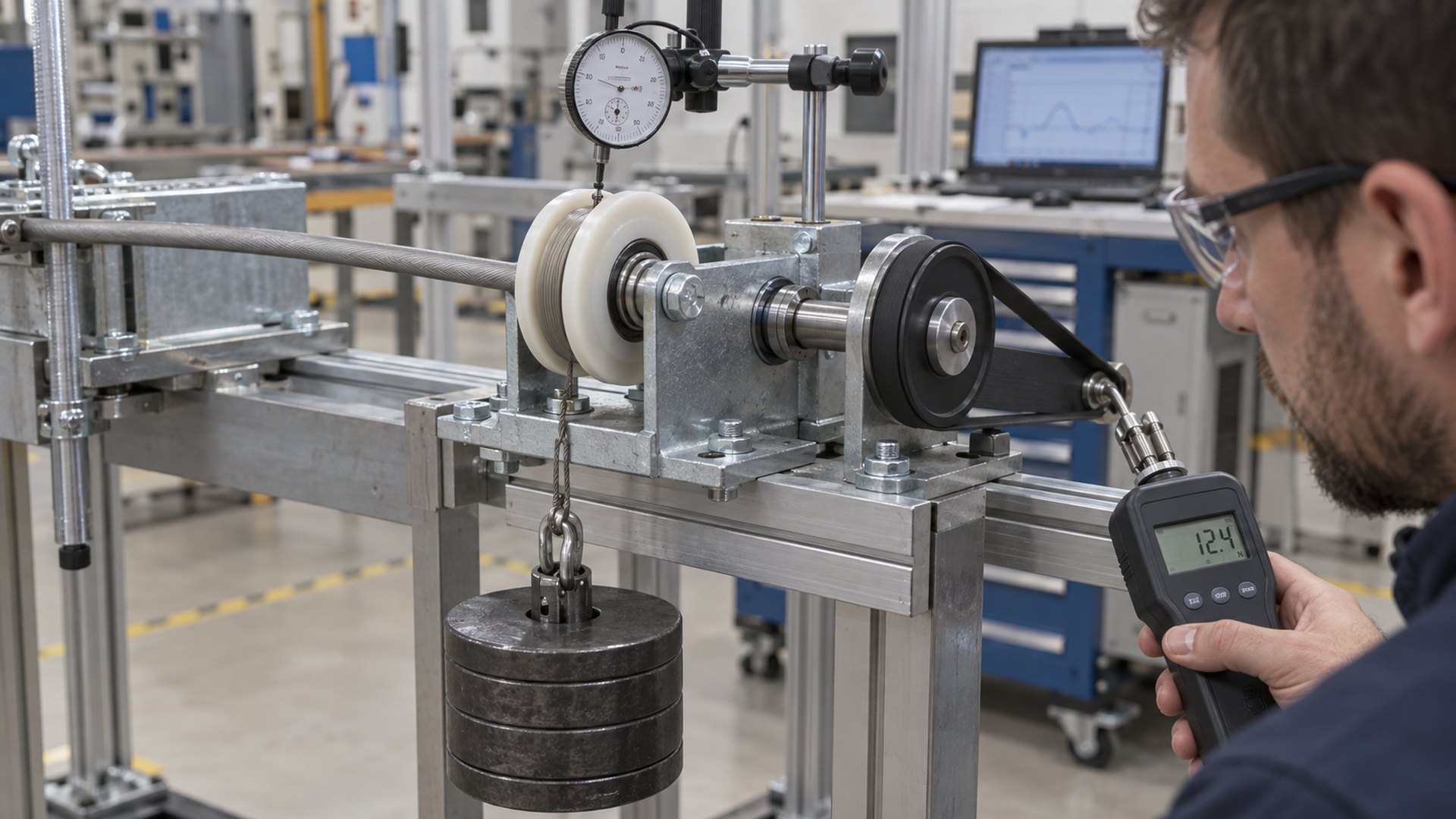
 The finished pulley should be tested with its axle, bracket and representative belt, cable or rail load.
A practical validation sequence includes:
- Incoming bearing checks: verify designation, supplier, dimensions, clearance or torque requirement, seals and lubricant.
- Finished-pulley checks: measure functional diameter, groove geometry, tread runout, axial play and rotating torque.
- Mounted checks: tighten the production axle, spacers and bracket, then confirm free rotation and alignment.
- Loaded bench test: apply representative radial, axial and moment loads with the actual belt, cable, rail or track geometry.
- Speed and temperature test: run through the intended speed and duty cycle while monitoring noise, vibration and temperature.
- Cycle or endurance test: include starts, stops, tension variation, contamination and environmental conditions relevant to service.
- Post-test inspection: examine tread wear, groove marking, bearing smoothness, fit movement, axle looseness and bracket deformation.
Acceptance criteria should state the measurement method. “Low runout” or “quiet operation” is not enough for repeat purchasing. Define the datum, load, speed, temperature, measurement location and allowable change after testing.
SKF describes its auxiliary idler pulleys through coordinated features such as bearing clearance, pulley shape, runout, sealing, grease and load capacity. Although automotive requirements differ from furniture or industrial guide rollers, the system-level principle is the same.
What Should a Buyer Send the Pulley Supplier?
A useful inquiry describes the complete interface and duty, not only the pulley diameter.
Send:
- assembly drawing or 3D model;
- pulley function: drive, idler, tensioner, guide or load-carrying wheel;
- belt, cable, rope, tube, rail or track profile and material;
- required functional diameter, face width and groove dimensions;
- radial, axial and moment loads, including tension and shock;
- rotational speed, linear speed and duty cycle;
- shaft or axle dimensions, fit, shoulder and fastening method;
- bracket geometry and allowable misalignment;
- operating temperature and expected heat sources;
- dust, moisture, chemicals and corrosion exposure;
- noise, torque, runout and service-life targets;
- pulley material and colour requirements;
- bearing type, seals, clearance or approved brands if specified;
- prototype quantity, annual demand and target production process; and
- inspection reports, traceability or regulatory requirements.
If exact bearing details are not known, provide the application values and allow the supplier to propose alternatives. HUNE’s OEM development process can move from requirement review and drawings through tooling, samples and production control.
Frequently Asked Questions
Is a pulley bearing the same as a bearing roller?
The terms overlap. A small pulley with an integrated bearing is a type of bearing roller. “Pulley” usually emphasizes guidance or force transfer through a belt, cable, rope or shaped track, while “bearing roller” can also describe a wheel supporting a door, drawer, carriage or machine component.
Are two bearings always better than one in a pulley?
No. Two spaced bearings can improve tilt control and moment capacity, but they need accurate coaxial seats, correct spacers and proper clamping. A compact single-bearing pulley may be more suitable when the load acts close to the bearing center and space is limited.
Should a pulley bearing use seals or shields?
Choose according to contamination, moisture, torque, speed and temperature. Shields usually have low drag and suit cleaner conditions. Contact seals improve exclusion but can add torque and heat. Confirm the manufacturer’s exact construction and lubricant.
Can the bearing’s load rating be used as the pulley load rating?
No. The bearing rating applies to the bearing under defined conditions. The pulley may be limited by tread deformation, groove contact, hub fit, axle bending, bracket stiffness, fasteners or alignment. Validate the finished pulley assembly under the real load and duty cycle.
Discuss Your OEM Pulley Bearing with HUNE
HUNE manufactures custom plastic-coated bearing pulleys, flat rollers, U-groove and V-groove guide wheels, threaded-stud rollers, shafts and stamped brackets for furniture, doors, appliances, automation and other mechanical equipment. We review the pulley, bearing, axle, bracket and mating belt, cable or track as one system.
Send the drawing, mating profile, load, speed, axle design, environment, quantity and validation target. Our engineers can then evaluate wheel material, groove geometry, bearing structure, sealing, fits and production method. Contact HUNE for an OEM pulley-bearing review and quotation.
The practical recommendation is to specify the complete loaded assembly. Select the pulley profile for the mating element, calculate the bearing from the actual resultant load, then verify the finished pulley on its production axle and bracket before approving mass production.