
Bearing clearance is the total distance one bearing ring can move relative to the other before the rolling elements make contact in the opposite direction. It can be measured radially, across the bearing, or axially, along its axis. The clearance supplied in an unmounted bearing is not necessarily the clearance available after assembly or during operation.
Clearance matters because it influences load distribution, rotational torque, noise, vibration, heat generation and bearing life. A press fit can reduce it; a temperature difference between the inner and outer rings can reduce or increase it further. Too little operating clearance may create preload, heat and seizure risk. Too much can reduce stiffness and running accuracy. For a plastic-coated bearing roller, the bearing, wheel fit, axle clamp and operating temperature must therefore be reviewed as one system rather than selected from the clearance code alone.
What Is Bearing Internal Clearance?
Bearing internal clearance is the available relative movement between the inner and outer rings before mounting.
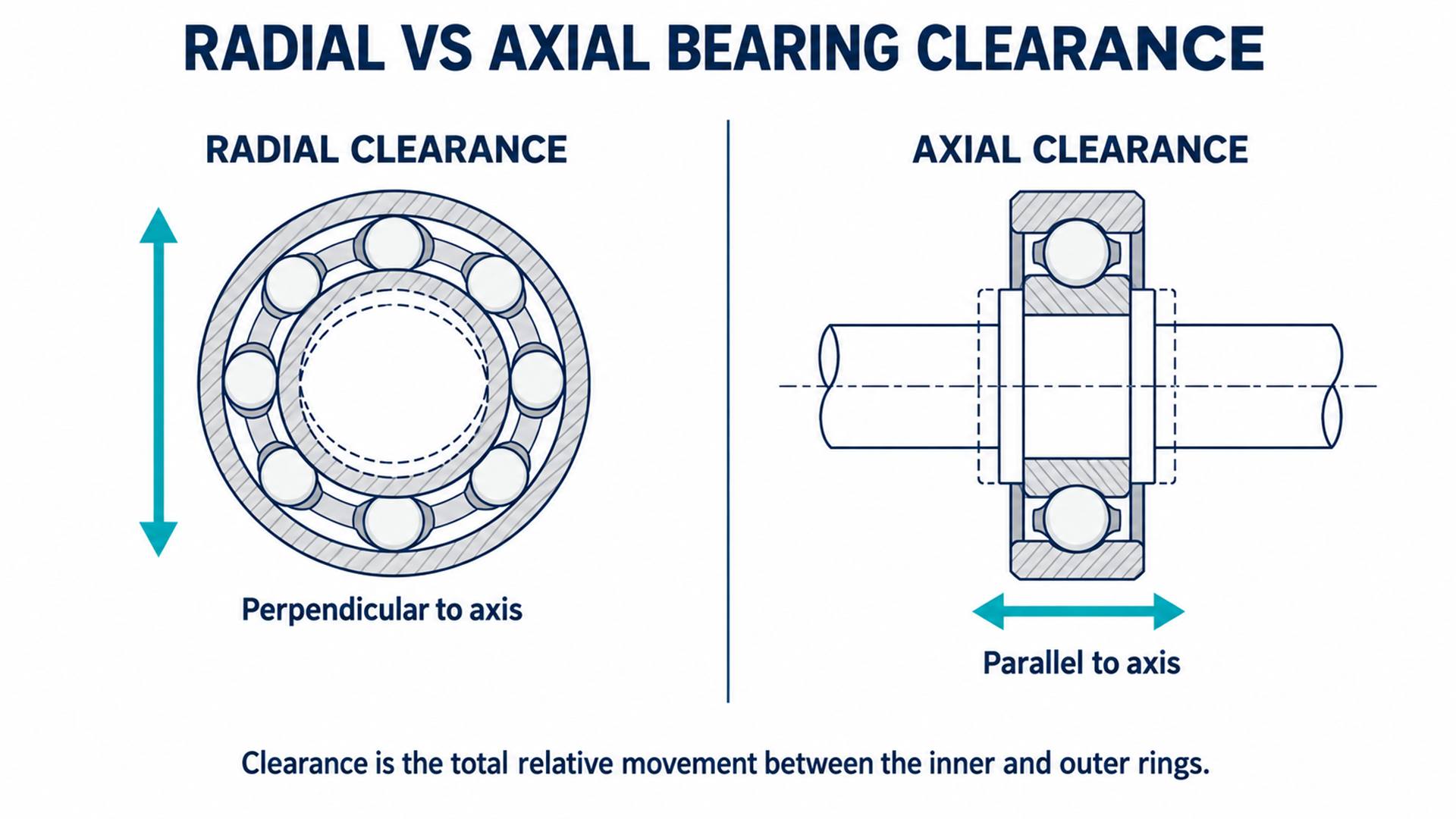 Radial clearance is measured across the bearing; axial clearance is measured along the bearing axis.
For a radial ball bearing, internal clearance exists because the rolling elements do not fill the raceway space without any play. If one ring is held stationary, the other can move a small total distance from one limiting position to the opposite position.
The NSK guide to fits and internal clearance defines clearance as the play between the inner and outer rings and the rolling elements. It also notes that clearance affects fatigue life, vibration, noise and heat generation.
There are two main directions:
- Radial internal clearance: total movement perpendicular to the bearing axis.
- Axial internal clearance: total movement parallel to the bearing axis.
These values are related through the bearing's internal geometry, but they are not interchangeable dimensions. A buyer should not specify an axial end-play target and assume it directly defines the required radial clearance class.
Clearance is also not an empty physical gap visible at one fixed point. The rolling elements settle against the raceways under the specified measuring load, and the measured value represents the total relative ring movement. Measuring method and load therefore matter, especially for small ball bearings.
Is Bearing Clearance the Same as Fit or Assembly Play?
Internal clearance, mounting fit and complete-assembly play describe different interfaces.
These terms are often mixed together in roller inquiries:
| Term | Interface being described | Typical design question |
|---|---|---|
| Bearing internal clearance | Rolling elements relative to the inner and outer raceways | How much internal movement remains between the rings? |
| Shaft fit | Bearing bore relative to the shaft or axle | Is the inner ring located without creep or harmful interference? |
| Housing or wheel fit | Bearing outside diameter relative to the housing or molded wheel | Is the outer ring retained without excessive compression? |
| Axial assembly clearance | Roller, spacers, washers and bracket faces | Can the rotating member turn without rubbing adjacent parts? |
| Track clearance | Wheel profile relative to the rail | Does the roller guide correctly without flange or groove interference? |
A bearing can have the correct internal clearance and still be locked by the assembly. For example, a bolt stack that clamps both rings or a washer that contacts the rotating ring creates external friction. Increasing the bearing's C-class does not correct that geometry.
The reverse is also true. A roller may have visible side play at its bracket while the bearing itself has too little internal clearance after a tight wheel fit. I normally identify which interface is moving before changing the bearing specification.
Our article on how bearings reduce friction explains the separate contributions from rolling contact, lubrication, seals, fits and the external wheel-to-track interface.
What Do CN, C2, C3, C4 and C5 Mean?
The clearance code identifies a standardized range, not one universal clearance value.
For many radial bearings, commonly encountered clearance groups progress from smaller to larger as follows:
C2 → Normal or CN → C3 → C4 → C5
Some standards and manufacturers also use C1 or bearing-specific codes. Miniature bearings, electric-motor bearings and non-interchangeable cylindrical roller bearings may use different group markings. The actual minimum and maximum values depend on bearing type, series and bore-size range.
| Clearance group | Relative meaning | Selection implication |
|---|---|---|
| C2 | Less than Normal | May support stiffness or low-noise goals when assembly and temperature effects are controlled |
| Normal / CN | Standard range | Often the starting point under recommended fits and ordinary conditions |
| C3 | Greater than Normal | Provides additional initial clearance for conditions that will reduce clearance in assembly or operation |
| C4 / C5 | Progressively greater | Used only when the application requires and validates the larger range |
The code is not a quality grade. A C3 bearing is not “better” than CN, and C2 is not more precise simply because it has less clearance. Each group is intended to deliver suitable operating clearance after the effects of fitting and temperature are considered.
I would always confirm the bearing manufacturer's table for the exact designation. A C3 range for one bore and series cannot be copied to another bearing by assumption.
What Are Initial, Mounted and Operating Clearance?
The clearance in the supplier's box is only the starting condition.
Three stages should be separated:
- Initial internal clearance: the clearance of the unmounted bearing under the specified measuring condition.
- Mounted clearance: the clearance remaining after the rings are fitted to the shaft, wheel or housing at assembly temperature.
- Operating clearance: the clearance present when the assembly has reached its operating temperatures and loads.
Schaeffler's technical principles for bearing arrangements describe operating clearance as the clearance in the mounted bearing when warm from operation. The guide explains that it is derived from initial radial clearance after reductions caused by interference fits and thermal effects.
The engineering objective is suitable operating clearance. Ordering C3 without reviewing the fit or temperature only changes the starting range; it does not prove what remains in service.
Why Does Clearance Change After Installation?
Ring fits, clamping and temperature alter the bearing geometry after it leaves the inspection bench.
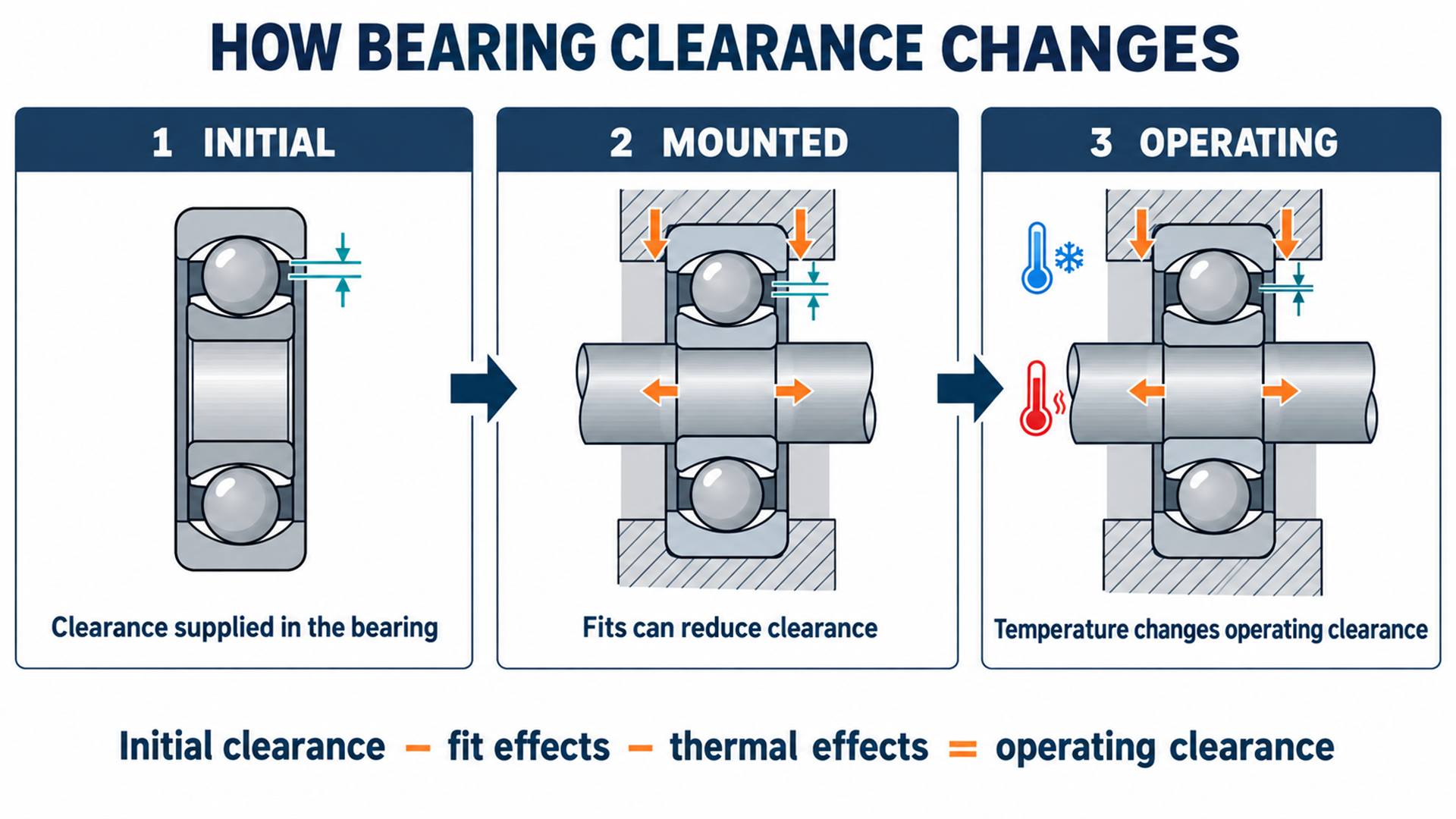 Interference fits and unequal ring temperatures can reduce the clearance available in operation.
Interference on the inner ring
When an inner ring is pressed onto an oversized shaft, the ring expands. That expansion reduces the space between the inner raceway and rolling elements. The amount depends on the fit, ring section, shaft construction, material and surface condition.
Interference on the outer ring
When an outer ring is pressed into an undersized housing, the ring contracts and internal clearance falls. In a plastic-coated roller, the housing may be the polymer wheel itself or an insert around the bearing. Molding shrinkage, press-fit dimensions and local wall thickness can all affect the pressure applied to the outer ring.
Temperature differences
If the inner ring becomes hotter than the outer ring, its greater expansion commonly reduces radial operating clearance. If the surrounding wheel or housing expands differently from bearing steel, its fit on the outer ring can also change. Material coefficients, geometry and heat flow all matter, so a generic room-temperature hand test is insufficient.
Axial clamping and adjacent parts
Internal clearance is mainly an internal bearing property, but incorrect external clamping can create a similar symptom. A shoulder, washer or bracket face that contacts the wrong ring may add preload or rubbing even when the bearing clearance class is correct.
Timken's bearing-clearance calculation tool specifically evaluates how mounting fits, temperature differences and shaft or housing materials affect internal clearance. This reinforces why the shaft, housing and operating temperatures belong in the selection data.
What Happens When Operating Clearance Is Too Small?
Too little clearance can turn normal rolling contact into unintended preload.
As radial clearance approaches zero, a larger share of the rolling elements can enter the loaded zone. A small controlled preload can be useful in bearing arrangements designed for it, but accidental preload in a miniature roller bearing can increase rotational torque and internal heat.
Possible consequences include:
- high starting or running resistance;
- temperature rise and further clearance reduction;
- increased noise or a rough feel after mounting;
- excessive contact stress;
- lubricant distress;
- shortened bearing life;
- seizure in severe cases.
The self-reinforcing risk is important: reduced clearance raises frictional heat, while a hotter inner ring may reduce clearance further. That does not mean every warm bearing lacks clearance; heat also comes from seals, lubricant, speed and external rubbing. The complete system must be checked.
For a bearing roller, I compare the loose bearing, the bearing pressed into the wheel, and the fully mounted roller. If resistance appears only after one assembly stage, that stage is a strong candidate for the added constraint.
What Happens When Operating Clearance Is Too Large?
Excessive clearance can reduce stiffness and make rotation less stable, even if the bearing turns freely by hand.
Potential effects include:
- increased shaft or wheel displacement under reversing load;
- reduced running accuracy;
- vibration and impact as load transfers between rolling elements;
- more audible mechanical noise;
- uneven load distribution;
- poorer guidance of the complete roller;
- ball skidding or unstable motion under unsuitable light-load and speed conditions.
The largest clearance group is therefore not a safe default for avoiding tight fits. A system that requires C4 or C5 should have a documented reason based on its fits, temperature, speed, load or alignment.
There is also a practical sourcing trap: external looseness can be misdiagnosed as internal bearing clearance. A loose axle fit, flexible bracket or oversized mounting hole may create much more visible movement than the bearing itself. Inspect the load path before changing the clearance group.
Does Smaller Clearance Always Reduce Noise?
Smaller clearance can improve stiffness and vibration behavior in suitable conditions, but only if enough clearance remains after fitting and heating.
The unloaded noise of a bearing on a test spindle does not fully predict noise in a door, printer, elevator mechanism or conveyor guide. System noise can come from:
- wheel tread runout;
- track joints or surface texture;
- bracket resonance;
- seals and lubricant;
- external rubbing;
- poor load sharing among rollers;
- bearing clearance and fit.
A smaller clearance group may reduce internal movement, but it also leaves less margin for an interference fit or a hotter inner ring. For a quiet OEM mechanism, I would define the operating condition and test the assembled product instead of choosing C2 solely because “tight means quiet.”
Why Does Clearance Matter in a Plastic-Coated Bearing Roller?
The wheel manufacturing method and bearing retention can change the clearance that the bearing actually operates with.
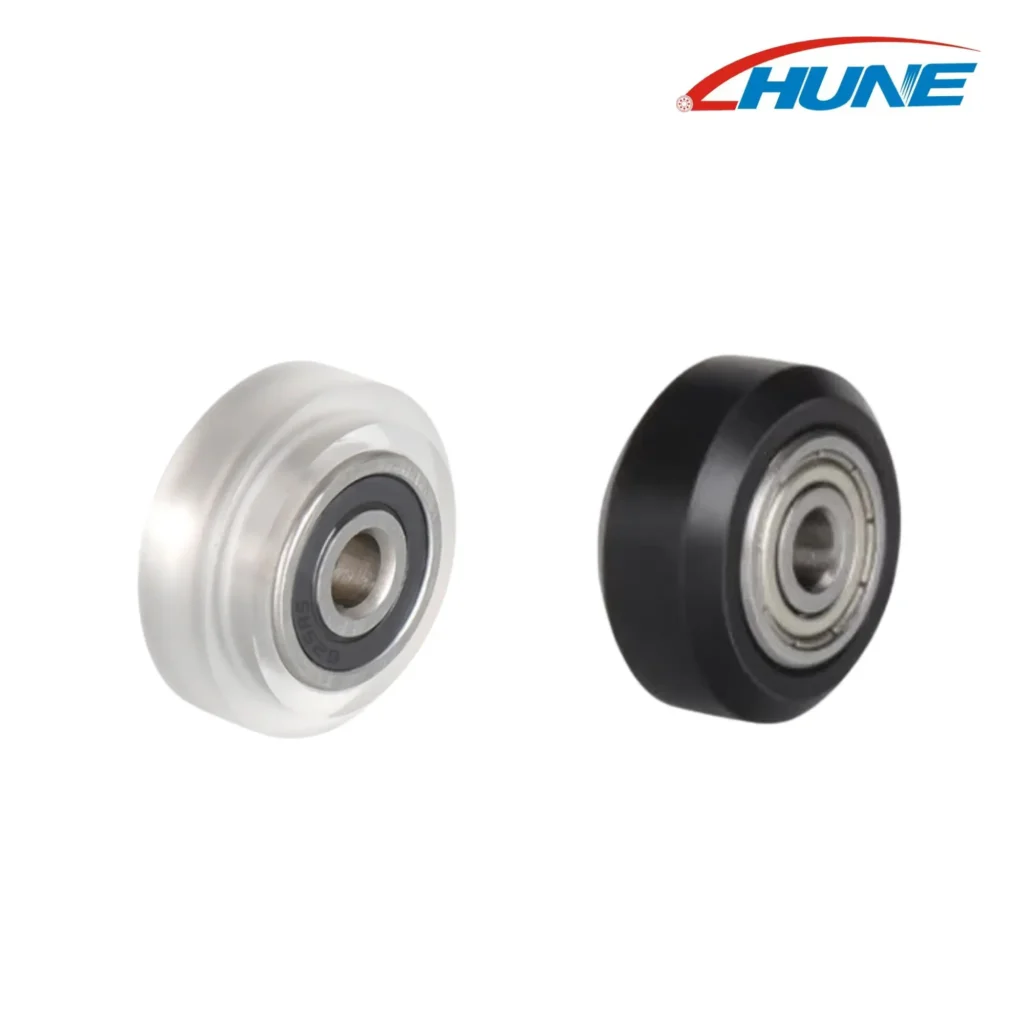 Existing HUNE bearing rollers. The plastic wheel profile and the internal bearing perform different functions and require separate controls.
In a typical bearing roller, the load path is:
Track or moving surface → plastic wheel → bearing outer ring → rolling elements → bearing inner ring → axle → bracket.
The wheel provides the external running surface. The bearing provides controlled rotation around the axle. The interface between them must retain the bearing without reducing its internal clearance beyond the intended operating range.
Relevant production factors include:
- press-fit diameter and roundness;
- polymer molding shrinkage;
- overmolding pressure and cooling history;
- wheel wall thickness around the bearing;
- material stiffness, temperature response and creep;
- bearing insertion force and support method;
- adhesive or mechanical retention where used;
- concentricity of the tread to the bearing bore.
HUNE's sliding rollers with bearings show the complete wheel-and-bearing construction used in doors, furniture and equipment. Our guide to what a bearing roller is explains why the wheel profile, bearing, axle and track must be specified as one assembly.
For a grooved application, clearance inside the bearing does not correct a mismatch outside it. A U-groove bearing roller still needs its groove radius, depth and side clearance matched to the rail or cable.
Can Hand-Spinning Confirm the Correct Clearance?
Hand-spinning is a useful comparison check, but it cannot establish operating clearance or bearing suitability.
A bearing may spin for a long time because it has light seals and low lubricant drag, yet have the wrong fit, load capacity or contamination protection for the application. Another suitable sealed bearing may stop sooner by hand because seal contact adds torque.
Hand feel also lacks the real radial load, speed, temperature, bracket stiffness and wheel-to-track contact. It may reveal a severe assembly bind, roughness or rubbing, but it does not measure internal clearance reliably.
Useful checks should be separated:
| Check | What it can indicate | What it cannot prove |
|---|---|---|
| Loose-bearing hand rotation | Gross roughness or comparative seal drag | Correct mounted or operating clearance |
| Rotation after wheel insertion | Whether the wheel fit added obvious constraint | Performance at operating temperature and load |
| Mounted roller rotation | External clamping or rubbing | Complete track-system behavior |
| Installed mechanism test | Combined movement, noise and load sharing | Exact root cause without further measurement |
| Specified clearance measurement | Bearing internal movement under defined conditions | Correct track, wheel or bracket geometry |
Which Dimensions and Data Matter Most?
Clearance selection depends on the dimensions and conditions that change the two bearing rings.
An OEM drawing or specification should identify:
- full bearing designation, manufacturer or approved equivalent;
- required internal-clearance group;
- shaft diameter, tolerance, material and surface condition;
- housing or wheel bore before assembly;
- finished fit after molding, machining or coating;
- which ring rotates relative to the load;
- shoulders, spacers, washers and clamping faces;
- axial freedom of the rotating ring;
- expected radial, axial and moment loads;
- speed, reversing motion and duty cycle;
- inner-ring, outer-ring and ambient temperature expectations;
- wheel material, molding method and bearing-insertion process;
- inspection method and sample condition.
For a plastic wheel, the bearing seat is functional. Its diameter alone may not be enough; roundness, taper, local ribs and wall-thickness variation can change contact pressure around the outer ring.
How Should an OEM Select and Validate Bearing Clearance?
Start from required operating clearance, then work backward through temperature and fit effects to the initial bearing class.
A practical sequence is:
- Define the bearing arrangement. Confirm bearing type, which ring rotates, load direction and how the roller is mounted.
- Select preliminary fits. Base shaft and housing fits on load behavior, material, size and retention requirements.
- Estimate clearance reduction from fits. Include both rings and the actual wheel or housing construction.
- Review temperature differences. Consider steady running, intermittent duty and surrounding polymer or metal expansion.
- Choose a candidate clearance group. Use the exact bearing manufacturer's tables rather than a generic C-code assumption.
- Measure after assembly. Compare the loose bearing, wheel-inserted bearing and fully clamped roller where practical.
- Test the installed mechanism. Validate torque, noise, temperature, runout and movement under representative load and duty.
- Confirm repeat-production controls. Monitor the bearing seat, insertion process, wheel geometry and bearing designation that affect the approved result.
SKF's rolling-bearing catalogue treats clearance, fits, lubrication, accuracy and operating conditions as connected selection topics. That is the correct scope for an OEM approval.
What Should a Buyer Send to a Bearing Roller Supplier?
A useful inquiry describes both the bearing condition and the complete roller interface.
Send the supplier:
- The full bearing designation and clearance class, if already approved.
- The wheel drawing with bearing-seat diameter, geometry and retention method.
- Shaft or axle drawing, including shoulders, spacers, washers and fastener stack.
- Which bearing ring rotates and which ring is clamped.
- Wheel material, manufacturing process and expected temperature range.
- Radial and axial load directions, speed, duty cycle and reversals.
- Track or mating-surface drawing and required roller profile.
- Noise, torque, runout and service-behavior requirements.
- Current problem description and the assembly stage at which it appears.
- Sample quantity, validation plan and annual purchasing volume.
If the clearance class is not fixed, send the functional data and ask the supplier to review the bearing manufacturer information. Do not request “C3 for safety” without showing why mounted or operating clearance requires it.
FAQs
What is the difference between CN and C3 bearing clearance?
CN is the Normal internal-clearance range for the specified bearing type and size. C3 is a greater-than-Normal range. C3 provides more initial clearance for conditions such as tighter fits or temperature effects, but it is not automatically the better choice.
Can a bearing have zero operating clearance?
Some bearing arrangements are designed to operate near zero clearance or with controlled preload. That condition must be intentional and validated for the bearing type, load, speed, lubrication and temperature. Accidental zero clearance can raise torque and heat.
Does a press fit reduce bearing clearance?
Yes. Expanding the inner ring on a tight shaft or contracting the outer ring in a tight housing generally reduces radial internal clearance. The amount depends on the fit, materials, ring geometry and surrounding components.
Is bearing clearance the same as roller side play?
No. Roller side play may come from the axle, spacers, bracket, mounting holes or axial assembly clearance. Bearing internal clearance is the relative movement between the bearing rings and rolling elements. The interfaces should be checked separately.
Discuss Your Bearing Roller Application with HUNE
Correct clearance must survive the wheel fit, axle clamp and real operating temperature.
HUNE manufactures plastic-coated bearing rollers, sliding wheels and customized hardware assemblies for doors, furniture, printers, conveyors and mechanical equipment. We can review the bearing, molded or machined wheel, bearing seat, axle stack and mating track together.
Send your drawing, bearing designation, clearance requirement, shaft and wheel fits, load direction, operating conditions, quantity and target behavior through the HUNE contact page. Our practical recommendation is to approve the bearing in the finished roller and installed mechanism, not only as a loose component.