A steel sleeve is usually the better starting point when a roller hub needs high stiffness, a stable bore, impact resistance or a metal interface that can be machined accurately and lubricated. A polymer bushing is usually better when dry running, corrosion resistance, lower noise, low weight or a replaceable sacrificial wear surface matters more. Neither option has a universal load or life advantage.
The most important question is where sliding occurs. A steel sleeve pressed into a wheel is not automatically a bearing; if it rotates directly on a steel pin, material pairing, lubrication, hardness and surface finish control friction and wear. A polymer bushing is also not defined by the word “plastic.” Its exact compound, pressure–velocity range, temperature, running clearance and shaft surface determine whether it works in the roller assembly.
What Is the Structural Difference?
A steel sleeve reinforces or defines the wheel bore with metal, while a polymer bushing is a designed sliding-bearing element between the wheel and shaft.
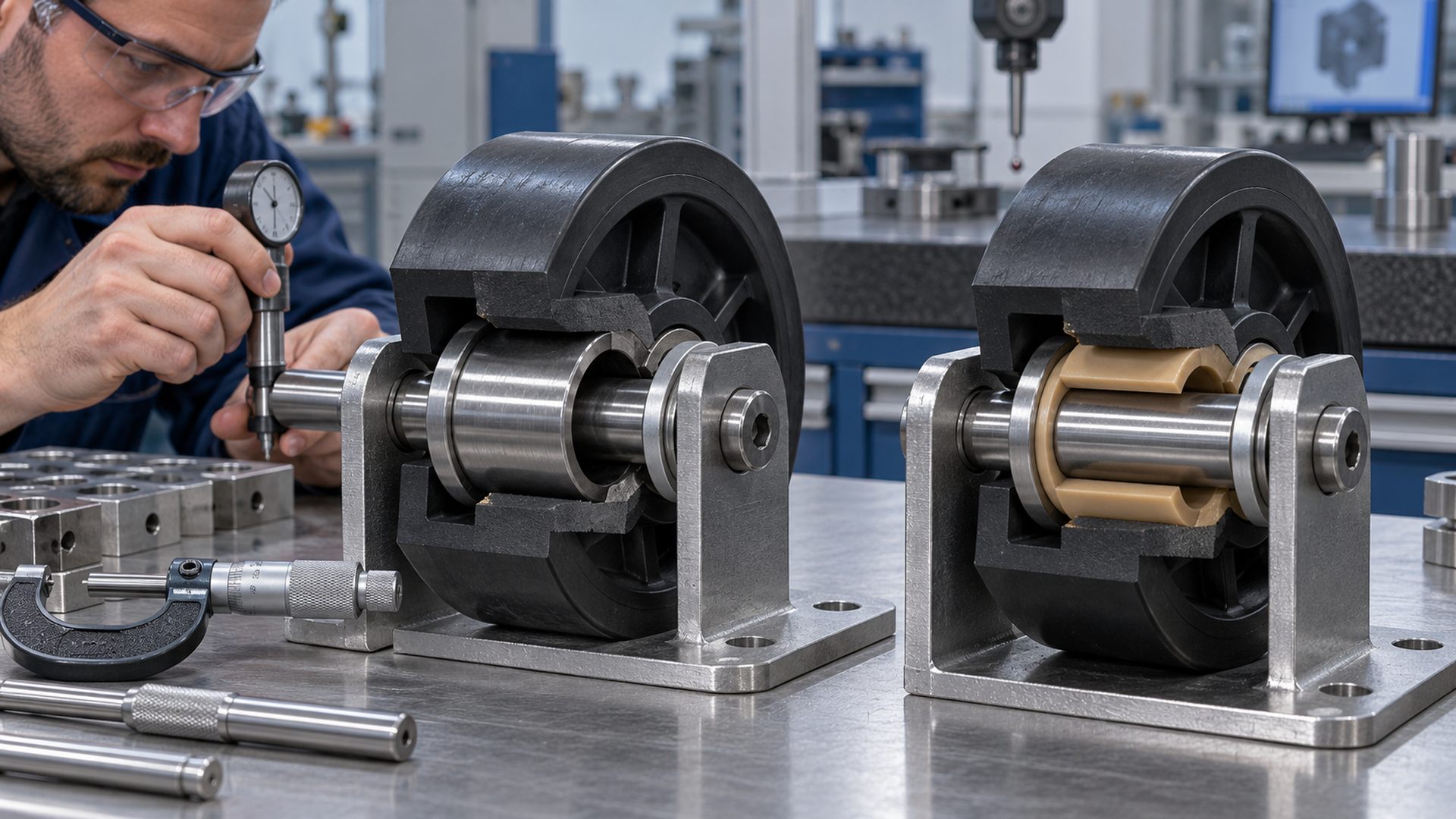
In the comparison used in this article, both parts are fixed in the wheel hub and rotate around a stationary axle or pin:
- Steel-sleeve roller: track → wheel tread → wheel hub → steel sleeve → sliding interface → axle → bracket.
- Polymer-bushing roller: track → wheel tread → wheel hub → polymer bushing → sliding interface → axle → bracket.
This definition should appear on the assembly drawing. A steel sleeve can also be used only as a compression spacer clamped between bracket plates, with rotation occurring at another interface. In that arrangement, comparing the sleeve bore with a polymer bushing bore would be misleading.
A polymer bushing can be a homogeneous engineered-plastic sleeve, a fibre-reinforced compound or a metal-backed composite with a polymer sliding layer. GGB's metal-polymer plain-bearing construction shows why “steel” and “polymer” are not always mutually exclusive categories. The actual construction and sliding layer must be specified.
Which Option Is Usually Better?
Choose from the duty and sliding interface, not from a general assumption that metal is stronger or polymer is lower friction.
| Decision factor | Steel sleeve in roller hub | Polymer bushing in roller hub |
|---|---|---|
| Hub stiffness | High and dimensionally stable | Depends on grade, wall thickness and fit |
| Dry-running friction | Often unsuitable without a designed material pair | Many engineered grades are designed for dry running |
| Lubrication | Frequently required for steel-on-steel sliding | Often unnecessary for self-lubricating grades |
| Corrosion | Requires suitable steel, finish and protection | Polymer sliding element does not rust; shaft still matters |
| Noise and damping | Stiff contact can transmit structure-borne noise | Polymer can damp vibration and reduce contact noise |
| Impact and edge loading | Metal resists deformation but may damage the shaft or concentrate stress | Some compliance is useful, but excess edge stress can creep or wear the bushing |
| Temperature stability | Usually lower thermal expansion and higher stiffness at heat | Strongly grade-dependent; clearance changes must be calculated |
| Moisture sensitivity | Steel corrosion depends on material and coating | Moisture effect depends on polymer family and formulation |
| Replaceable wear element | Sleeve can be replaceable, but shaft may also wear | Bushing can be designed as the sacrificial replaceable part |
| Manufacturing | Machined, drawn, stamped or insert-moulded sleeve | Moulded or machined bushing, normally press-fitted or retained |
| Best typical duty | Lubricated, stiff, impact-tolerant or temperature-stable hub | Dry, quiet, corrosive, dirty, light-to-moderate sliding duty |
This table is a screening tool. The correct choice still depends on pressure, speed, motion type, shaft, environment and required life. For frequent high-speed rotation with very low torque, a rolling bearing may be a better architecture than either plain sliding option. HUNE's bearing pulley versus plain-bore comparison explains that wider decision.
When Is a Steel Sleeve the Better Choice?
A steel sleeve makes sense when the roller needs a rigid, precise hub insert and the sliding pair can be lubricated or otherwise engineered for metal contact.
Practical reasons to use a steel sleeve include:
- reinforcing a moulded wheel hub against bolt or axle pressure;
- maintaining a consistent bore through moulding and assembly;
- providing a machined shoulder, flange or spacer face;
- resisting local impact and edge damage;
- operating where a selected polymer would lose stiffness;
- handling repeated assembly around a removable pin;
- providing an insert suitable for overmoulding or press fitting;
- transferring clamping load without crushing the wheel hub.
The main limitation is that a plain steel sleeve does not supply low friction by itself. Steel sliding on a steel pin can gall, fret, corrode or seize if the contact pair, lubricant and surface condition are unsuitable. A hard sleeve against a soft, replaceable pin produces a different wear pattern from a hardened shaft against a softer sleeve.
I normally specify both sides of the pair:
- sleeve material and heat treatment where relevant;
- shaft or pin material, hardness and coating;
- running clearance after assembly;
- bore and shaft surface condition;
- lubricant type, supply method and interval if used;
- corrosion protection and compatibility;
- thrust-face or washer arrangement;
- acceptable wear and replacement route.
“Steel sleeve” without these details describes a shape, not a finished bearing system.
When Is a Polymer Bushing the Better Choice?
A polymer bushing is attractive for dry-running, quiet or corrosion-prone mechanisms where a controlled sacrificial wear element is useful.
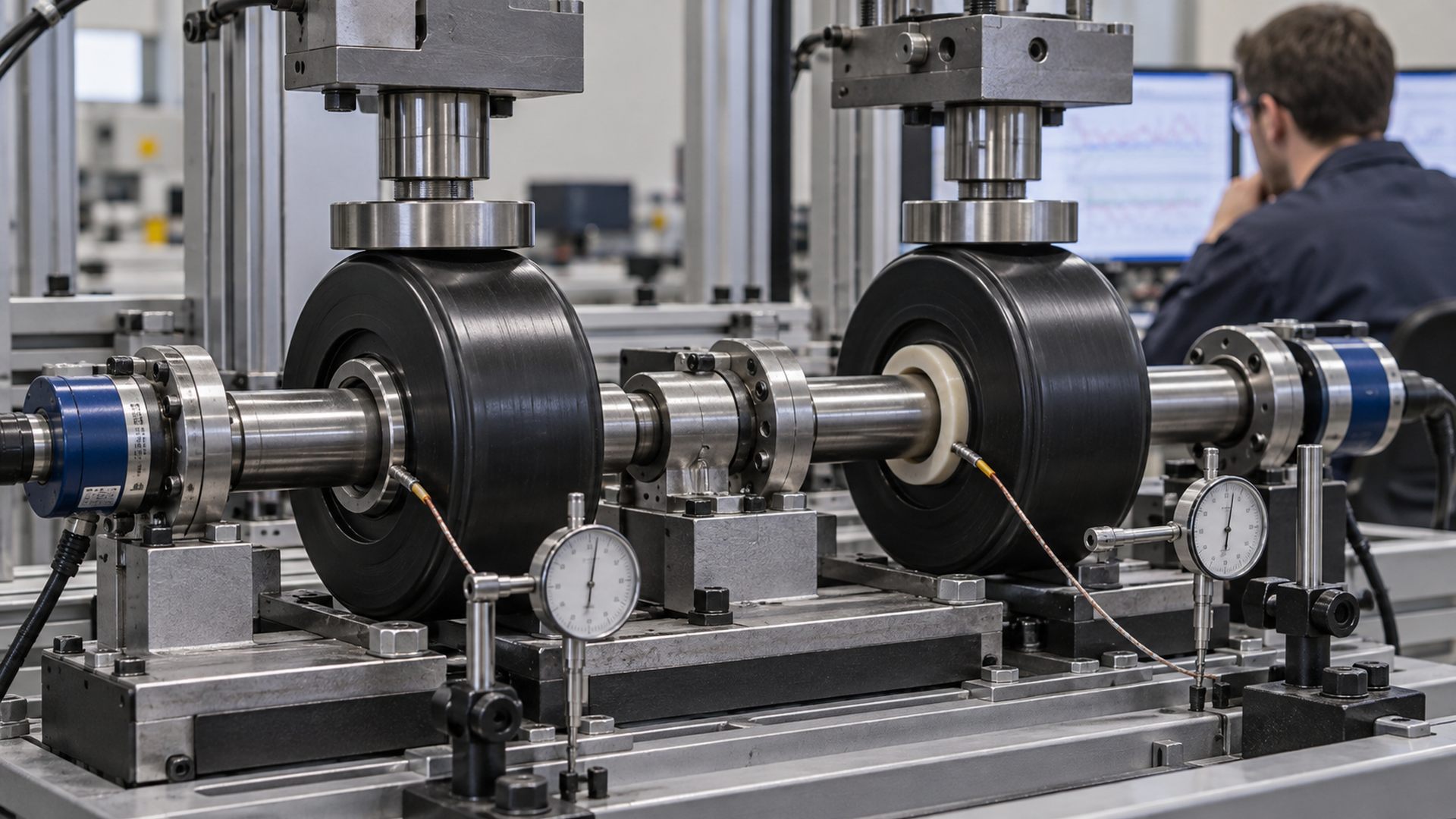
The HUNE bearing-free plastic positioning roller is one example of a light-duty wheel using an inner plastic interface rather than a steel rolling bearing. It is a construction reference, not a universal substitute for a specified sleeve bushing.
Engineered polymer bushings may offer:
- dry operation without external grease;
- resistance to rust at the sliding element;
- lower mass;
- vibration damping;
- reduced stick-slip with an appropriate compound and shaft;
- tolerance of small embedded particles in some materials;
- a replaceable wear component that protects the wheel hub;
- simple press-fit assembly;
- electrical isolation where required.
The igus overview of dry-running sleeve bearings explains that self-lubricating compounds incorporate lubricant in the material rather than relying on an exposed external grease film. That statement applies to purpose-designed compounds, not every nylon, POM or generic moulding resin.
I would be cautious with a polymer bushing when continuous pressure and surface speed create excessive heat, when temperature reduces stiffness, when the housing fit closes the bore too far, or when creep would change alignment. Exact performance must come from the selected grade and supplier data.
How Do Pressure and Sliding Speed Affect the Choice?
Plain-bearing selection depends on pressure and relative surface speed together; wheel load alone is not enough.
For a cylindrical sleeve carrying radial load, projected pressure is commonly screened as:
p = F / (d × L)
Where:
- F is the radial load at the bushing;
- d is shaft diameter;
- L is effective bearing length.
For continuous rotation, shaft-surface speed is:
v = πdn / 60
when d is in metres and n is revolutions per minute. The product p × v is used as a screening measure for frictional heat and material suitability.
The igus explanation of p×v design limits for plastic bushings notes that the allowable condition depends on shaft material, ambient temperature and operating time. Intermittent motion and cooling pauses can behave differently from continuous rotation.
Do not compare a calculated p×v value with a limit taken from another material family or test condition. Supplier limits may assume defined shaft finish, temperature, duty and lubrication. A steel sleeve also needs a tribological check, but there is no universal “steel sleeve p×v limit” independent of alloy, counterface and lubricant.
How Do Running Clearance and Press Fit Affect Performance?
The installed bore is the functional dimension; a correct loose part can bind after pressing or moulding.
A bushing normally relies on interference with the wheel hub so it remains stationary. That interference can reduce its inside diameter. Polymer thermal expansion, moisture uptake and creep can change the operating clearance further. A steel sleeve is less compliant but can still distort if thin-walled, poorly supported or overmoulded under uneven pressure.
Too little running clearance can cause:
- high starting torque;
- heat generation;
- stick-slip or seizure;
- loss of lubricant film;
- rapid wear at high spots;
- shaft scoring.
Too much clearance can cause:
- wheel wobble;
- impact at direction reversals;
- uneven track contact;
- noise;
- edge wear;
- poor positioning accuracy.
I specify and inspect the installed bore after the sleeve or bushing is assembled into the production-intent wheel. The free-state bushing drawing alone does not prove the final running clearance.
Which Functional Dimensions Should the Drawing Control?
Control the sliding pair, hub retention and wheel-to-bore alignment as separate interfaces.
| Feature | Why it matters | Recommended drawing focus |
|---|---|---|
| Shaft or pin diameter | Establishes running clearance and pressure | Diameter, roundness and material |
| Installed sleeve or bushing bore | Controls torque and play | Measure after press fit or moulding |
| Effective bushing length | Sets projected pressure | Exclude chamfers and unsupported length |
| Housing or wheel-seat diameter | Controls retention and bore closure | Process-specific fit and datum |
| Sleeve or bushing wall thickness | Affects deformation and heat path | Minimum section after finishing |
| Wheel running diameter | Controls speed and installed height | Measure relative to bore datum |
| Bore-to-tread concentricity | Controls cyclic load and runout | Functional datum from installed bore |
| Axial faces and thrust washers | Carry side load without hub rubbing | Material, clearance and contact diameter |
| Lead-in chamfer | Prevents installation damage | Compatible with bushing edge and shaft |
| Bracket gap and axle support | Controls side clearance and bending | Assembly stack and cantilever distance |
The SKF guide to composite dry sliding bearings emphasizes associated-component design, including shaft counterface width, installation chamfers and alignment to avoid edge stress. Those interfaces should be shown on the roller assembly drawing.
How Do Shaft Finish and Alignment Affect Wear?
The shaft is half of the sliding bearing and can determine whether either sleeve option wears evenly.
A surface that is too rough can abrade the sleeve or bushing. A surface that is extremely smooth but incompatible with the material and lubricant may not provide the intended film or transfer behaviour. Hardness, coating, corrosion and runout also affect wear.
Misalignment concentrates contact near one end of the sleeve. A longer bushing does not automatically solve this; it can increase binding if the axle bends or the bracket bores are not coaxial. Edge relief, compliant mounting or a different bearing architecture may be required.
I normally review:
- shaft material and hardness;
- roughness and direction of machining marks;
- coating thickness and edge condition;
- pin straightness and support span;
- bracket-hole coaxiality;
- thrust-washer flatness;
- lubricant compatibility;
- whether the shaft or bushing is the intended replaceable part.
The wear strategy should be deliberate. A low-cost bushing that protects an expensive shaft can be sensible; a hard sleeve that slowly cuts a non-replaceable pin is usually not.
How Do Temperature, Moisture and Chemicals Change the Decision?
Steel and polymer fail for different environmental reasons, so the complete material pair must be checked.
Steel can corrode in humidity, washdown or chemical exposure unless alloy and surface protection are appropriate. Corrosion products increase roughness and can become abrasive debris. Lubricant can also wash out or attract contamination.
Polymer does not rust, but its dimensions and mechanical properties change with grade, temperature and fluid exposure. Thermal expansion can reduce clearance when the bushing heats faster than the surrounding wheel or shaft. Some polymer families absorb more moisture than others. Chemicals can swell, soften or embrittle an unsuitable compound.
Generic labels are insufficient. “Nylon bushing,” “POM sleeve” and “stainless sleeve” do not define grade, filler, lubricant additive, heat treatment or corrosion condition. Request the actual material specification and validate it in the intended environment.
Which Option Is Quieter and Smoother?
Polymer often provides better damping, while steel can provide more stable geometry; installed noise depends on the whole roller system.
A polymer bushing can reduce metal-to-metal contact and absorb small vibration. A steel sleeve can maintain a round, stiff bore but may transmit shaft roughness, impact and bracket resonance more directly. Lubrication can reduce steel-interface noise, while contamination or dried lubricant can make it less consistent.
Wheel tread material, track texture, bore clearance, tread runout and bracket stiffness may dominate the sound. A quiet bushing will not correct a hard wheel striking track joints, and a precise steel sleeve will not correct an eccentric tread.
Evaluate starting torque, running torque, noise and play together. Very low clearance can feel precise when new yet run hot; generous clearance can turn easily but wobble and rattle under reversal.
How Do Manufacturing Route and Volume Affect Cost?
Compare the finished assembly and repeat-production controls, not only the sleeve purchase price.
A steel sleeve may require cutting, turning, deburring, plating, heat treatment or washing before press fitting or insert moulding. It can simplify bore control but adds metal-part supply and corrosion management. A polymer bushing may be purchased as a standard part, moulded separately or integrated into a multi-material wheel, but its installed bore and retention still require control.
Relevant cost elements include:
- sleeve or bushing component price;
- tooling and machining;
- wheel-hub geometry and material volume;
- insertion or overmoulding labour;
- lubrication and contamination control;
- inspection of installed bore and runout;
- shaft finish and coating;
- scrap from fit variation;
- replacement route;
- expected cycle count and downtime consequence.
HUNE's roller material and process overview explains how bearing or bushing selection, outer material, moulding and secondary machining can be coordinated. The wider rubber and plastic roller-parts range provides reference structures for wheel materials and hub designs.
How Should an OEM Validate the Two Options?
Test production-intent assemblies at the real pressure, speed, alignment, temperature and contamination condition.
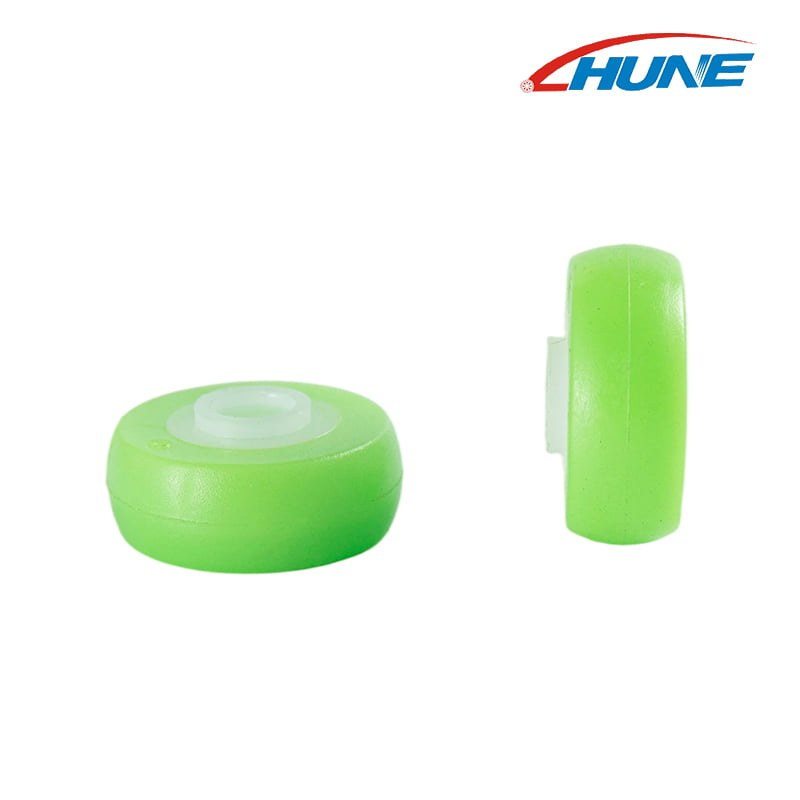
A useful comparison plan is:
- Define the moving interface. Confirm which part rotates and which is fixed.
- Calculate pressure and speed. Include normal load, peaks, duty and dwell.
- Specify both mating surfaces. Record sleeve or bushing grade, shaft material, finish and lubrication.
- Measure installed geometry. Check bore, clearance, concentricity, runout and axial side clearance.
- Test the complete roller. Use the intended wheel, axle, washers, bracket and track.
- Monitor torque and temperature. Record breakaway torque, steady running and change over time.
- Include environment. Apply relevant dust, moisture, cleaning fluid or temperature cycles.
- Inspect wear. Measure bore growth, shaft wear, debris, scoring, creep and wheel-hub movement.
- Recheck function. Evaluate wobble, noise, tracking and required drive force.
- Approve production controls. Freeze materials, fits, assembly method, lubricant and inspection plan.
Do not force both designs through a test that suits only one architecture. Compare them against the same application requirement, including maintenance policy and replacement strategy. HUNE's OEM development process can be used to organise drawing review, sampling, installed testing and repeat-production approval.
What Should a Buyer Send to the Supplier?
A useful roller-wheel inquiry defines the sliding interface and duty, not only wheel diameter and bore.
Send:
- equipment function and roller position;
- wheel and bracket assembly drawing;
- normal, peak and side loads;
- rotational speed, motion type and duty cycle;
- starts, stops, oscillation and dwell under load;
- shaft material, diameter, hardness, coating and surface requirement;
- available lubrication and maintenance policy;
- temperature, moisture, dust and chemical exposure;
- wheel material, tread profile and running diameter;
- sleeve or bushing seat diameter and retention method;
- installed running-clearance target;
- allowed torque, temperature, wear, play, noise and runout;
- required life endpoint;
- sample-validation method and forecast annual quantity.
If no material is selected, state the application conditions rather than requesting a generic “steel sleeve” or “plastic bushing.” The supplier needs pressure, speed, shaft and environment to screen a specific construction.
Discuss a Bushed Roller Project with HUNE
HUNE manufactures plastic and rubber roller wheels, bearing-integrated rollers, plain-bore wheels, metal inserts and related OEM hardware. We can review the wheel, sleeve or bushing, axle, washers, bracket and track as one motion system.
Send the assembly drawing, load, speed, shaft specification, environment, maintenance plan, critical dimensions and expected quantity through the HUNE contact page. These details allow a steel sleeve, polymer bushing, direct plain bore or rolling-bearing structure to be compared against the same requirement.
Frequently Asked Questions
Is a steel sleeve stronger than a polymer bushing?
Steel is generally stiffer and resists local deformation, but “stronger” does not settle the roller choice. A sliding steel sleeve can wear or seize on an unsuitable pin, while a selected polymer compound may run dry with controlled wear. Compare pressure, speed, temperature, alignment and the complete shaft pair.
Can a steel sleeve run directly on a steel axle?
It can in a properly engineered sliding pair, but it should not be assumed suitable. Material compatibility, hardness, surface finish, running clearance, lubrication, corrosion and duty all matter. An unlubricated, poorly matched steel-on-steel interface can gall or fret.
Does every polymer bushing run without lubrication?
No. Some engineered compounds are designed for dry running, while generic plastics may have unsuitable friction, wear or heat performance. Use the exact supplier grade and its pressure, speed, temperature and shaft guidance. Added lubricant must also be compatible with the polymer and environment.
Which option is better for dusty equipment?
A dry-running polymer bushing can be useful because it avoids exposed grease that captures dust, but abrasive particles can still wear the bushing and shaft. A protected lubricated steel sleeve may work in another duty. HUNE's oil-free bushing versus sealed bearing guide explains the wider contamination decision.
Can a polymer bushing replace a steel sleeve without changing the wheel?
Not automatically. Wall thickness, housing interference, installed bore, thermal expansion, thrust faces and shaft finish may differ. Replacing the sleeve can also change wheel-hub stiffness and contact position. Update the assembly drawing and validate the production-intent wheel before release.
Practical Engineering Recommendation
Choose the sliding pair before choosing the insert material. Use a steel sleeve when the hub needs a rigid, precise metal interface and lubrication, surface engineering and corrosion control are acceptable. Use a specified polymer bushing when dry running, damping, corrosion resistance or a sacrificial wear element is more valuable. In both cases, calculate pressure and speed, control installed clearance, and approve the complete wheel–sleeve–shaft–bracket assembly under representative duty before mass production.