An oil-free bushing is usually the better starting point for a slow pivot or oscillating joint exposed to dust, especially when grease would collect abrasive particles. A sealed bearing is usually better for a roller that must rotate continuously with low resistance, accurate guidance and higher speed. Dust alone does not decide the choice.
I first separate the motion: limited-angle pivoting, reciprocation or full rotation. Then I compare load direction, speed, starting torque, shaft alignment, dust type and acceptable wear. A dry-running bushing eliminates external grease, but abrasive particles can still wear the bushing and shaft. A sealed bearing protects precision raceways, but seal lips, grease and external dust paths still have limits. The complete shaft, housing, wheel and protective geometry determine which solution is more reliable.
What Is the Basic Difference Between the Two Designs?
A bushing supports sliding contact over a surface; a sealed ball bearing supports rolling contact inside precision raceways.
An oil-free bushing is a plain bearing. Its bore runs directly against a shaft. Polymer, fibre-reinforced composite, PTFE-lined metal and solid-lubricant metal constructions are all available, but they do not behave identically. “Oil-free” normally means the bearing material can operate without periodic oil or grease at the sliding interface. It does not mean zero friction, zero wear or independence from shaft condition.
A sealed ball bearing contains inner and outer rings, rolling elements, a cage, lubricant and integral closures. In a bearing roller, the outer ring commonly turns with the wheel while the inner ring is located on a stationary axle. The balls roll between the rings, and the seals retain grease while limiting contamination.
The two load paths are therefore different:
Bushing pivot: linkage or wheel hub → bushing surface → shaft → bracket or frame
Bearing roller: track → wheel → bearing outer ring → balls → inner ring → axle → bracket
This distinction affects friction, clearance, stiffness, wear location and the dimensions an OEM must control.
Which Motion Usually Favors a Bushing or a Bearing?
Limited-angle and intermittent motion often favours a bushing; continuous full rotation usually favours a rolling bearing.
A dry-running bushing can work well in hinges, linkages, tension arms, adjustment pivots and oscillating joints. These positions often move through a small angle, stop frequently and experience shock, edge load or contamination. A simple sleeve can distribute load over a relatively large projected area and tolerate motion that never completes a full revolution.
A sealed bearing is normally the stronger starting point for guide wheels, conveyor rollers, printer rollers, pulleys and continuously rotating equipment. Its rolling contacts reduce the friction associated with sustained rotation and can provide more consistent radial guidance when the rings and fits are controlled.
The decision becomes less obvious when a wheel turns slowly for short distances or a pivot moves frequently at high speed. In those cases I calculate and test the real duty rather than classify the part by its appearance.
| Motion requirement | Oil-free bushing | Sealed bearing |
|---|---|---|
| Limited-angle oscillation | Often well suited | Can work, but rolling elements may repeatedly load the same raceway region |
| Slow intermittent pivot | Simple and compact | May add unnecessary cost or seal torque |
| Continuous full rotation | Limited by material PV, heat and wear | Usually the stronger starting point |
| Very low running resistance | Sliding friction remains | Rolling contact generally offers lower resistance |
| Shock and edge loading | Some bushing materials tolerate it well | Requires suitable bearing, alignment and support |
| Accurate radial guidance | Depends on running clearance and wear | Usually easier to control with precision rings |
| High speed | Material and heat limits can become restrictive | Suitable series can support higher speed, subject to seal and grease limits |
HUNE’s article on how bearings reduce friction explains the rolling, sliding, seal and lubricant losses inside a bearing system.
How Does Dust Affect Each Design?
A bushing avoids grease that can hold particles, while a sealed bearing places a barrier around sensitive rolling contacts; neither design is immune to abrasive dust.
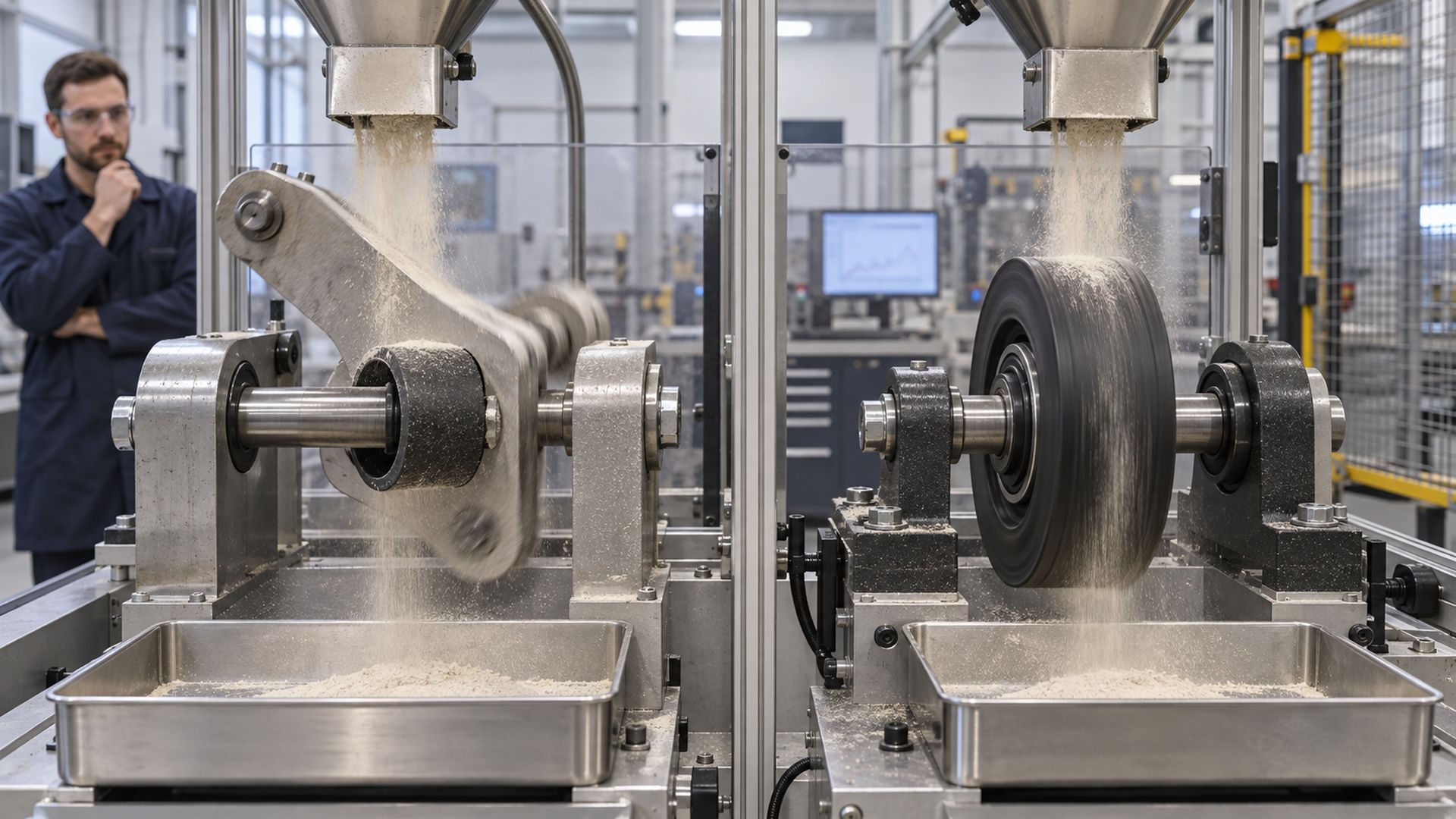
Dry-running polymer bushings are often selected because there is no exposed grease film for dust to adhere to. igus notes that its dry-running sleeve bearings do not require external oil or grease and therefore do not attract or trap abrasive particles in the same way as a lubricated sliding joint.
However, dust can still enter the running clearance. Hard particles can score the shaft, become embedded in a softer bushing, increase wear or create a three-body abrasive interface. Fibres may wrap around a shaft shoulder. Fine powder may pack into an enclosed joint and restrict movement. The result depends on particle hardness, size, shape, concentration and whether motion can push contamination out of the contact.
A sealed bearing keeps its rolling contacts and grease inside a controlled cavity. Contact seals normally exclude fine dust more effectively than metal shields. Yet dust can wear the seal lip or shaft-side counterface, accumulate around the bearing face, or enter through a damaged seal. Once abrasive particles reach the grease, the lubricant can carry them repeatedly through the raceway contacts.
SKF’s guidance on bearing contamination describes dirt, lint, polishing residue and industrial dust as sources of raceway damage and notes that contacting seals provide a stronger barrier to small contaminants than shields. The best defence still begins with the surrounding equipment geometry.
Which Option Performs Better in Dusty Equipment?
Choose from the motion and load first, then engineer contamination control around that choice.
| Selection factor | Oil-free bushing | Sealed bearing | Engineering implication |
|---|---|---|---|
| Friction during rotation | Higher sliding friction | Usually lower rolling friction | Bearing often suits freely rotating rollers |
| Starting motion | Material-dependent breakaway friction | Seal and grease torque matter | Test at minimum drive force and temperature |
| Dust attraction | No external grease required | Grease is enclosed behind seals | Both need cleanable or self-shedding geometry |
| Abrasive particle path | Dust can enter shaft-to-bore clearance | Dust attacks seal before reaching raceway | Consider wipers, flingers or covers |
| Shaft requirement | Shaft is the running surface | Shaft locates the inner ring | Bushing wear depends strongly on shaft finish and hardness |
| Housing requirement | Pressed bore sets final bushing geometry | Housing or wheel fit controls outer ring | Measure after assembly, not only loose parts |
| Misalignment | Some materials tolerate moderate edge loading | Rigid ball bearings tolerate limited misalignment | Correct bracket geometry in either design |
| Wear pattern | Bore and shaft clearance grow gradually | Seal or raceway damage can raise noise and torque | Define inspection and rejection criteria |
| Speed capability | Limited by pressure-velocity and heat | Often higher, subject to seal and grease | Use real speed and duty cycle |
| Maintenance | No relubrication for suitable material | Often greased for life in small sizes | “Maintenance-free” still requires condition validation |
| Dimensional envelope | Thin, simple radial package | Larger section for rings and balls | Available radial and axial space may decide the architecture |
I would not score this table and declare a universal winner. A loader linkage and a conveyor guide wheel can experience the same dust but require different motion technology.
What Must Be Checked for an Oil-Free Bushing?
The shaft is part of the bearing system, so its material, hardness, roughness, diameter and alignment are functional specifications.
The bushing supplier normally provides limits for projected pressure, sliding speed, pressure-velocity value, temperature, shaft finish and permissible wear. These limits are material-specific. A general phrase such as “self-lubricating plastic” is not enough for approval.
I normally check:
- Projected pressure. Load divided by the nominal projected area gives a starting point, but edge loading can concentrate pressure.
- Sliding speed and duty. Oscillation frequency, angle and dwell influence heat and wear.
- PV limit. Pressure multiplied by surface velocity is a screening value; catalogue limits still require application correction and testing.
- Shaft surface. A rough shaft can abrade the bushing, while an unsuitable very smooth surface can also affect friction for some materials.
- Shaft hardness and coating. Hard abrasive dust can damage a soft shaft even when the bushing itself survives.
- Installed bore. A press fit reduces the bushing bore, so the running clearance must be checked after installation.
- Length and alignment. A long bushing on a bent or misaligned shaft can develop edge contact.
- Flange and thrust load. A radial sleeve should not carry axial load unless the flange or thrust surface is designed for it.
- Thermal and moisture effects. Polymer dimensions and clearance change with material, temperature and humidity.
GGB’s data for its EP engineered-plastic bearing specifies shaft surface roughness along with pressure, speed and temperature limits. The values for that product should not be copied to another bushing material; the point is that the mating shaft belongs in the approved specification.
What Does a Sealed Bearing Need in Dust?
A suitable sealed bearing needs the correct closure, grease, fits and protection around its side faces.
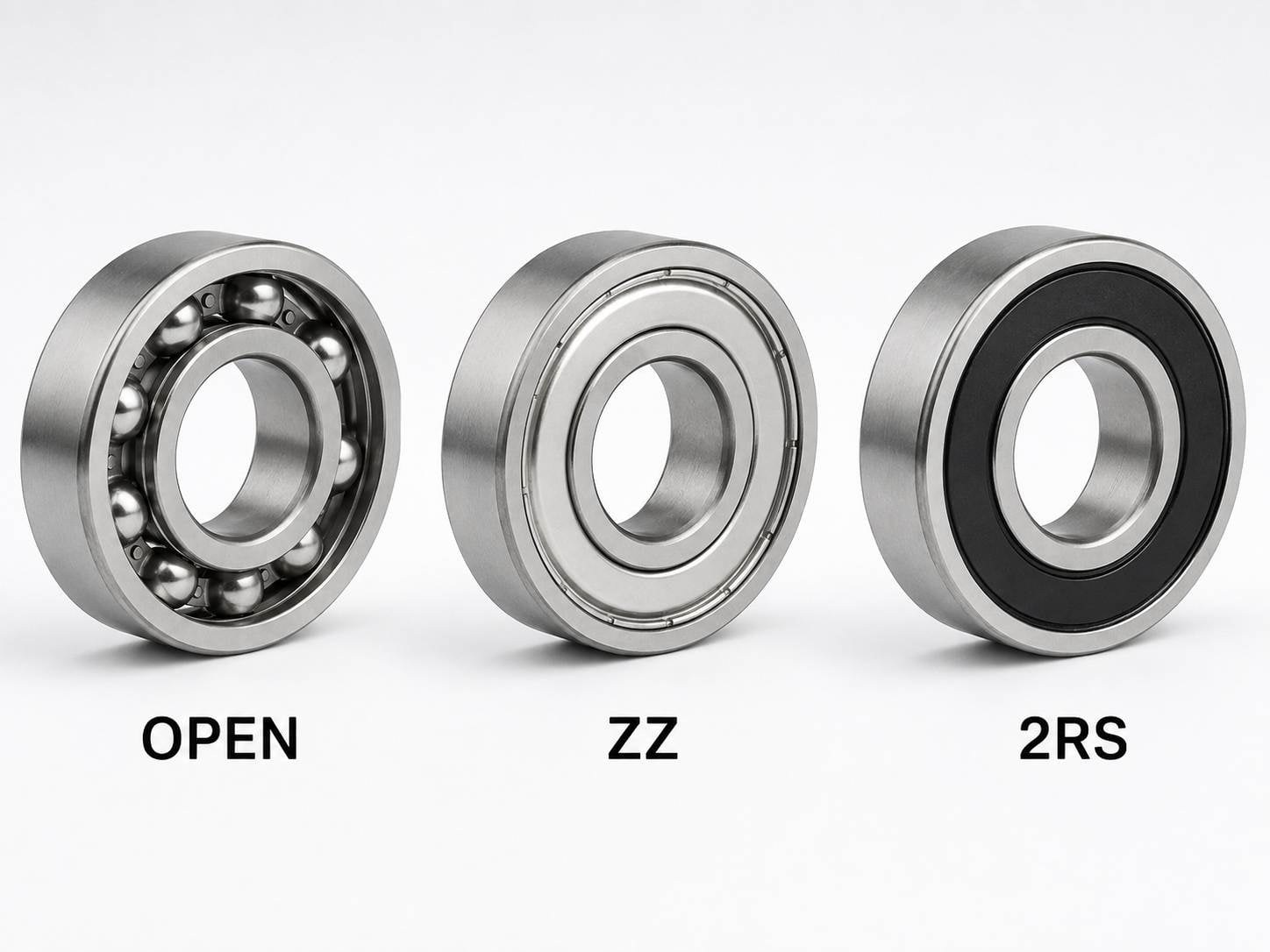
An open bearing leaves the rolling elements exposed. A metal shield uses a non-contact gap and adds little friction, but fine dust can migrate through the gap. A contact seal creates a more restrictive path and normally provides stronger dust exclusion, with additional torque and speed limitations.
The SKF bearing maintenance handbook distinguishes shields, contact seals, low-friction seals and non-contact seals. It recommends contact-sealed arrangements where contamination resistance is needed and notes the balance among sealing performance, friction and speed.
For a dusty roller I confirm:
- Full manufacturer designation and exact closure type.
- Seals on one or both sides.
- Seal material and temperature range.
- Factory grease and fill appropriate to speed and load.
- Installed internal clearance after wheel and axle fits.
- Spacer contact only on the ring intended to be clamped.
- Clearance between the wheel or bracket and the seal face.
- External flinger, cap, labyrinth or wiper where dust loading is severe.
- A path for shed dust to leave instead of packing around the seal.
HUNE’s comparison of sealed and shielded bearings provides more detail on closure suffixes and selection. Internal bearing clearance in an OEM roller should also be reviewed when the outer ring is pressed or moulded into a wheel.
Why Can External Protection Matter More Than the Bearing Type?
Keeping most dust away from the contact is usually more effective than asking one seal or one bushing material to process unlimited contamination.
Useful system features include:
- a flinger that throws dust away from a rotating bearing face;
- a labyrinth path that makes particle entry more difficult without adding lip friction;
- a flexible wiper ahead of a sliding shaft or guide surface;
- a cover that blocks falling dust while remaining open below for discharge;
- shield orientation that prevents direct particle impact;
- generous relief spaces where displaced dust can collect without jamming the joint;
- purge arrangements in serviceable heavy equipment;
- smooth external surfaces that can be vacuumed or cleaned without forcing dust inward.
SKF’s brochure on deep-groove ball bearings for highly contaminated environments explains that foreign particles can create abrasive wear, increased friction and accelerated damage, and that robust sealing and surrounding protective measures are needed. The same system principle applies to small bearing rollers.
What Functional Dimensions Should an OEM Control?
The two designs require different drawings: the bushing drawing controls a sliding pair, while the bearing drawing controls ring fits and an assembled load path.
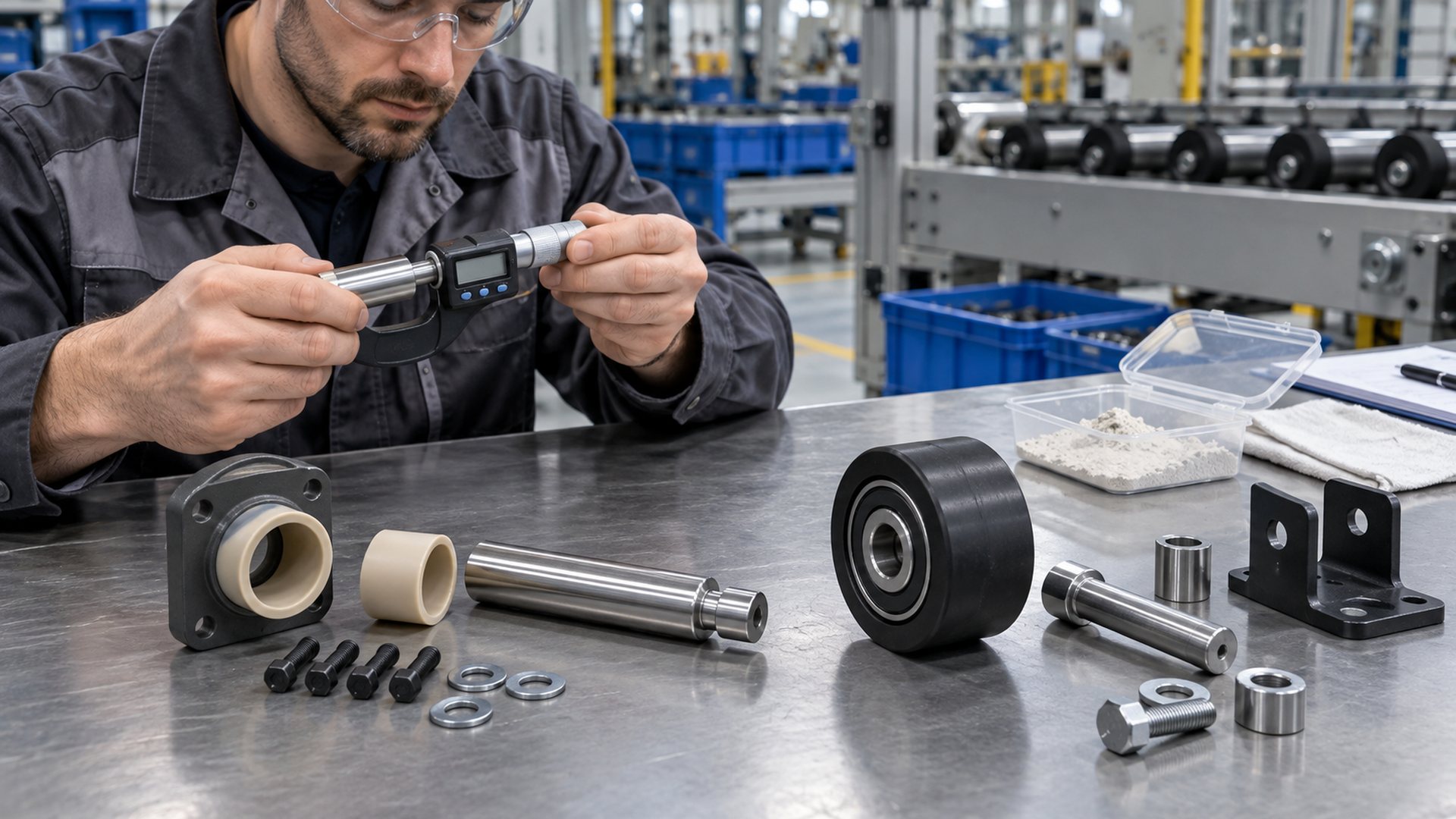
For an oil-free bushing, control:
- housing bore before pressing;
- bushing outside diameter and wall thickness;
- installed bore or calculated running clearance;
- shaft diameter, roundness, hardness and surface finish;
- bushing length, flange thickness and edge chamfers;
- shaft-to-housing alignment;
- axial retention and thrust surfaces.
For a sealed bearing roller, control:
- bearing bore, outside diameter and width;
- shaft or axle diameter and shoulder geometry;
- wheel bearing-seat diameter and width;
- spacer length and bracket gap;
- fit on the rotating and stationary rings;
- seal-face clearance;
- wheel running diameter, groove and runout;
- fastener tightening method and final free rotation.
A catalogue part number defines only part of the system. I prefer one assembly drawing that identifies the controlled interfaces and a separate bill of materials that prevents unapproved substitution of the bushing compound, bearing suffix, grease or shaft treatment.
How Do the Choices Fit Complete Roller Systems?
Use a bushing when the wheel or linkage can accept sliding friction; use a sealed bearing when rolling performance is a core function of the product.
A bushing-mounted wheel can be simple and compact, but the wheel bore and shaft become wear surfaces. As clearance grows, the wheel may wobble, move laterally or change track contact. A sealed bearing roller moves wear control into the precision bearing while the external wheel provides the track interface.
For customer-facing doors, printers, packaging equipment and guide systems, low starting resistance and stable tracking often make the sealed bearing architecture valuable. In slow agricultural pivots, guards, tension links and adjustment arms, an oil-free bushing may reduce maintenance and avoid grease mixed with dirt.
HUNE’s sliding rollers with bearings combine the rolling bearing with an external wheel profile for doors, equipment, tracks and guide mechanisms. A polyurethane-coated bearing roller adds a compliant running surface, but the wheel material, bearing closure and external dust protection still require application review.
Which Applications Usually Favor Each Option?
The application table should follow the motion, not the industry name alone.
| Dusty equipment position | First option to assess | Reason | Critical confirmation |
|---|---|---|---|
| Agricultural linkage pivot | Oil-free bushing | Oscillation, shock and no exposed grease | Shaft wear and edge loading |
| Hopper-gate hinge | Oil-free bushing | Intermittent low-speed movement | Powder packing and installed clearance |
| Conveyor guide roller | Sealed bearing | Continuous full rotation and low drag | Seal type, flinger and dust discharge |
| Packaging-machine idler | Sealed bearing | Stable speed and alignment | Fine powder path and starting torque |
| Tension-arm pivot | Oil-free bushing or sealed bearing | Depends on whether motion is oscillation or continuous rotation | Angle, frequency, speed and load direction |
| Sliding-panel wheel in a dusty plant | Sealed bearing roller | Repeated wheel rotation and track guidance | Wheel profile, seal faces and track debris |
| Slow cable-guide sheave | Application-specific comparison | Rotation may be intermittent but low drag matters | Cable load, wrap angle and speed |
| High-speed fan or motor position | Sealed bearing selected by manufacturer data | Speed and precise guidance dominate | Seal friction, temperature and balance |
How Should an OEM Validate the Choice?
Test both candidates in the real motion mode and with the actual dust; a hand-spin comparison cannot predict wear or contamination life.
Define the contaminant first:
- particle material and hardness;
- approximate particle-size distribution;
- dry powder, fibres, chips or mixed debris;
- airborne concentration and deposition rate;
- whether dust compacts, absorbs moisture or becomes sticky;
- cleaning method and frequency.
Then build the test around service:
- Assemble the production-intent shaft, housing, wheel, spacer and bracket.
- Apply representative radial, axial, shock and edge loads.
- Run the actual oscillation angle or rotational speed and duty cycle.
- Introduce dust from the service direction at a controlled rate.
- Include starts, stops and idle periods where dust can settle.
- Measure starting torque, running torque, temperature, noise and motion accuracy.
- Track bushing clearance or bearing runout at planned intervals.
- Inspect the shaft, bushing bore, seal lip, grease leakage and raceways where appropriate.
- Repeat the test across multiple samples and production-intent lots.
- Define acceptance limits before testing rather than judging parts only by appearance.
For an A/B study, do not force both parts through identical motion if that motion suits only one architecture. Apply the same application requirement: the bushing receives the real oscillation and the bearing receives the real roller rotation, with equal loads and contamination where those conditions are genuinely common.
What Should a Buyer Include in an RFQ?
A useful inquiry identifies the motion and contamination before naming the component.
Send the supplier:
- equipment function and component position;
- full rotation, oscillation angle or reciprocating stroke;
- speed, cycle rate, dwell time and service hours;
- radial, axial, shock and edge loads;
- dust source, composition, particle size and concentration if known;
- exposure direction and cleaning method;
- shaft, housing, wheel, spacer and bracket drawings;
- available bore, outside diameter, width and axial space;
- temperature, humidity and chemical exposure;
- starting-torque, noise, runout and allowable-wear limits;
- maintenance and relubrication policy;
- required bushing material or bearing closure where already approved;
- sample validation plan and forecast quantity.
For a sealed bearing roller, also specify the track or mating surface and which bearing ring rotates. HUNE’s OEM development process explains how requirements, drawings, samples and installed testing can be converted into a controlled roller specification.
Discuss a Dust-Resistant Bearing Roller with HUNE
HUNE, Zhejiang Huaneng Micro Bearing Co., Ltd., manufactures deep-groove ball bearings, plastic-coated bearing rollers, injection-moulded wheels and customised roller assemblies. If continuous rotation and low rolling resistance point to a sealed bearing roller, we can review the bearing, wheel profile, axle, spacers and bracket together.
Send the application drawing, motion, load, speed, dust description, test method and expected quantity through the HUNE contact page. We can assess an existing roller or develop a production-intent sample for the equipment manufacturer’s dust validation.
Frequently Asked Questions
Is an oil-free bushing always better in dust?
No. It avoids exposed grease, but hard particles can still abrade the bushing and shaft. Continuous rotation, low torque or precise guidance may make a sealed bearing more suitable.
Is a 2RS bearing dustproof?
No standard integral seal should be assumed completely dustproof. A contact seal improves exclusion, but performance depends on particle size, seal design, speed, wear and surrounding protection.
Can a bushing replace a ball bearing without changing the shaft?
Usually not without review. The bushing runs directly on the shaft and needs suitable diameter, hardness, surface finish and running clearance. The housing and axial retention may also require redesign.
Which option has lower starting torque?
It depends on bushing material, load, shaft finish, bearing seal, grease and temperature. A rolling bearing often has lower continuous running resistance, but a contact seal can contribute noticeable breakaway torque in small mechanisms.
Does adding grease help an oil-free bushing in dust?
Do not add grease unless the bushing manufacturer approves it. Grease can attract particles, change friction or affect the bearing material. A dry-running bushing is normally selected to operate with its intended solid-lubricant system and shaft pairing.
Practical Engineering Recommendation
Choose the motion technology before choosing the dust protection. Use an oil-free bushing as the first candidate for slow pivots and oscillating joints where exposed grease would hold abrasive particles. Use a sealed bearing for continuously rotating rollers that need low resistance and stable guidance. In both cases, specify the mating shaft or axle, provide an external dust path or barrier, and approve the complete assembly through a production-intent contamination test.