
Smooth and quiet elevator door movement depends on the whole door system. The operator must create a controlled acceleration, travel and deceleration profile, while the belt or linkage transfers motion without excessive play. Hanger rollers must run concentrically on a straight, clean track; bearings must rotate with consistent resistance; and upthrust rollers must stabilize the hanger without excessive preload. Bottom guides, couplers, interlocks and panel alignment must move without binding.
Noise often begins at one interface and travels through the hanger and door panel, which can amplify it. A new wheel alone cannot correct a bent track, misaligned panel, loose bracket or unstable drive. For OEM design and sourcing, roller material, bearing fit, running profile, track geometry, mounting stack and door-control settings should be evaluated as one motion system.
Which Parts Control Smooth and Quiet Door Movement?
Door quality comes from coordinated control, transmission, guidance and isolation.
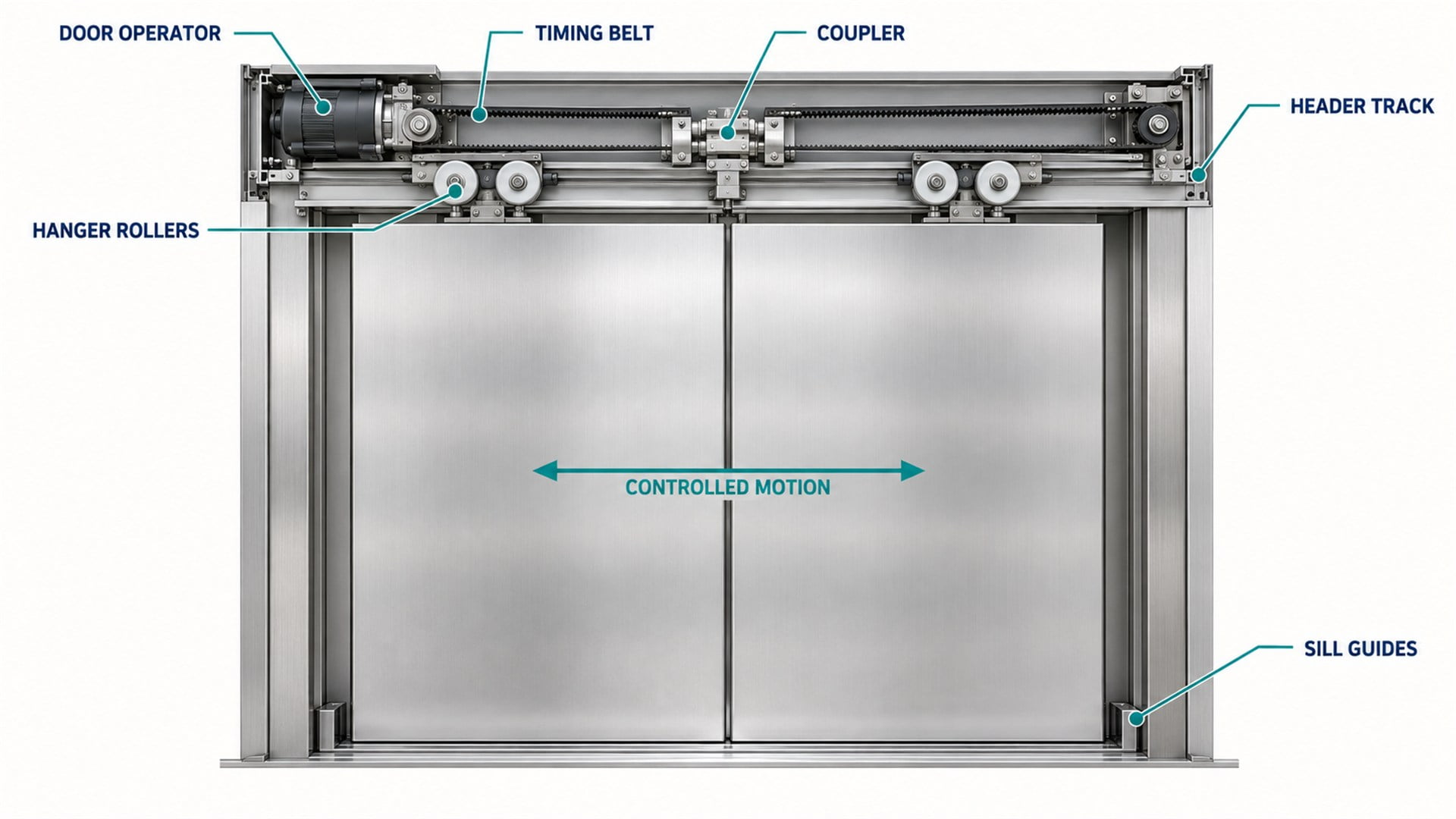 Conceptual center-opening elevator door system. Actual operator, coupling and guide arrangements vary by manufacturer.
| System element | Contribution to smooth movement | Typical noise or vibration path |
|---|---|---|
| Door operator and controller | Set speed, acceleration, deceleration and stopping behavior | Motor torque ripple, abrupt motion commands or control hunting |
| Belt, cable or linkage | Transfer operator motion to the car-door panels | Backlash, uneven tension, joint clearance or pulley runout |
| Hanger rollers and bearings | Support door mass and roll along the header track | Tread runout, bearing drag, defects or material hardening |
| Header track | Establish the primary horizontal running datum | Dents, joints, contamination, surface variation or poor alignment |
| Upthrust or eccentric rollers | Limit hanger lift and panel rocking | Excessive preload, intermittent contact or loose adjustment |
| Door panels and hangers | Carry mass and transmit operating forces | Low stiffness, loose fasteners or center-of-gravity offset |
| Coupler and landing-door rollers | Transfer movement from the car door to the landing door | Impact, clearance take-up, roller drag or vane misalignment |
| Interlocks and closing devices | Secure and return landing doors | Rubbing, latch impact, spring force or mechanical interference |
| Sill guides and shoes | Control the bottom of the panel | Side loading, debris, groove contact or panel twist |
| Isolation elements | Reduce vibration transmitted into panels and structure | Hardened, missing or incorrectly clamped isolators |
The system changes through the travel cycle. At the beginning, the operator overcomes static resistance and starts the panels. During travel, rollers, guides and the transmission determine running resistance. Near the end, the controller reduces speed while locks, couplers and closing elements reach their final positions. Different noises can therefore appear at different points in the same opening cycle.
Our explanation of how elevator doors work provides the full sequence between the operator, car doors and landing doors. Smoothness requires the parts in that sequence to remain geometrically compatible.
How Does the Door Operator Affect Smoothness?
The operator determines how gently the mechanical system is asked to move.
A door motor does not simply switch between stopped and full speed. Modern systems can command acceleration, running speed, deceleration and final approach. The desired motion profile must match panel mass, travel, transmission ratio and available traction.
An aggressive acceleration command can excite belt elasticity, bracket clearance and panel vibration. An abrupt deceleration can produce visible shudder or impact at the end of travel. A control loop that reacts poorly to changing resistance may continuously correct speed, which can be heard or felt as hunting.
KONE's door-modernization literature describes a mechanical system using a substantial track and large-diameter rollers to reduce friction and noise, together with a synchronous motor, inverter drive and closed-loop door-motion control. This illustrates the relationship between mechanical quality and control. Good control cannot remove mechanical binding, while precise hardware still needs a suitable motion command.
The operator must also recognize the final closed and open positions consistently. Sensor location, belt compliance, backlash and controller settings influence where deceleration begins. OEM validation should examine the complete motion trace rather than judging only peak speed.
How Do Rollers and Tracks Affect Noise?
The roller-track interface is the primary rolling datum and a frequent source of vibration.
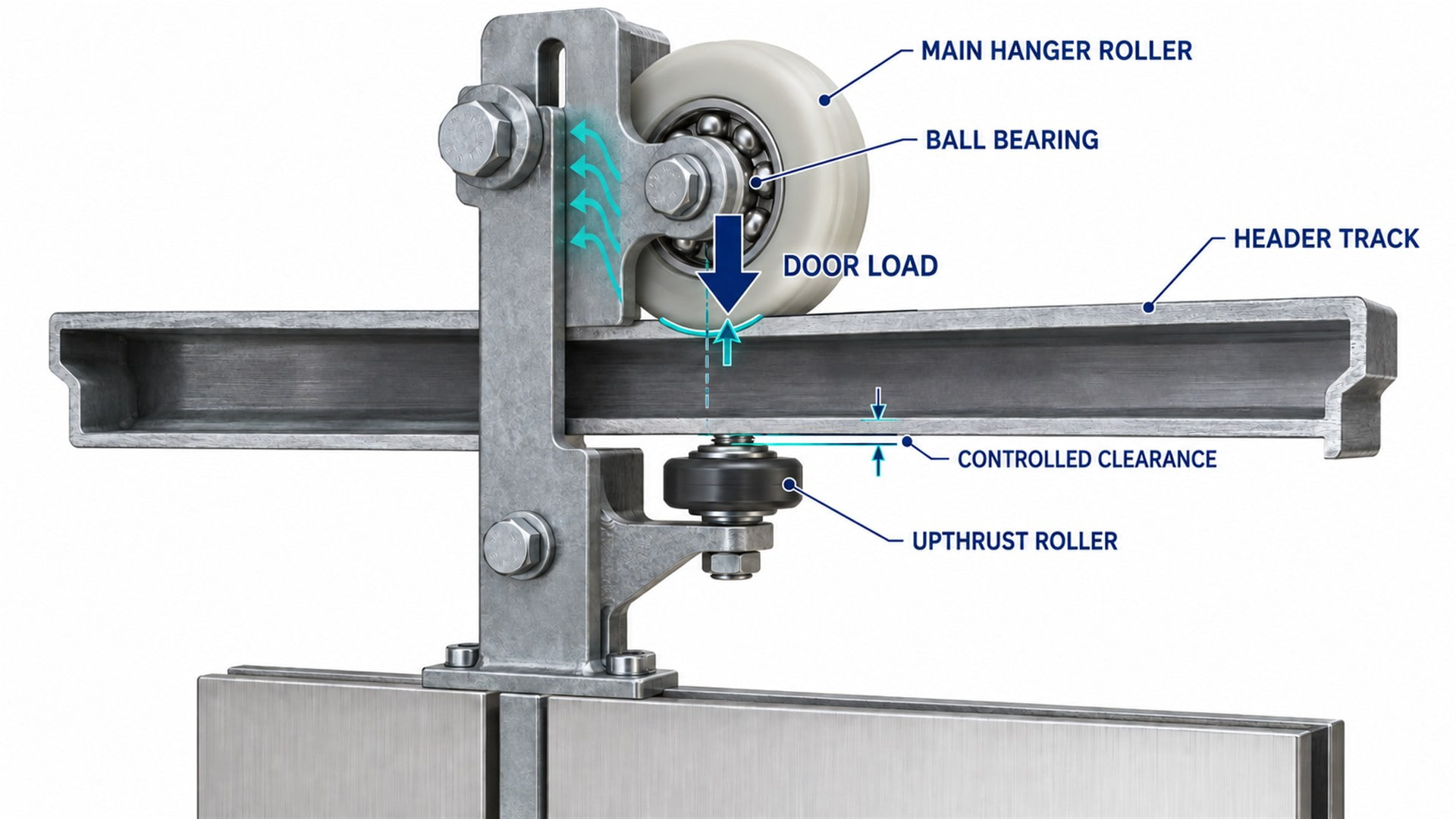 Simplified interface. Roller profile, track section and retention method must follow the approved door-system design.
Hanger rollers carry the door-panel load through their bearings and running surfaces into the track. Smooth motion requires stable rolling radius, low bearing resistance, appropriate contact geometry and a track without abrupt changes.
Roller outside-diameter variation or radial runout can create a repeating vertical input once per revolution. A bearing defect or incorrect fit can add roughness and noise. A tread with a flat area can create periodic thumping after the door has remained stationary. Hard surfaces generally transmit more high-frequency vibration, while more compliant treads can add damping but may be more sensitive to compression set, wear and debris.
The track is equally important. Straightness, joint condition, local dents, mounting support and running-surface finish all affect the roller. Patent documentation for a sliding elevator door guide roller discusses resilient elements, nonmetallic running surfaces and vibration damping as means to improve smoothness and reduce running noise. It also notes that foreign particles in a softer tread can impair smooth operation.
Track and roller profiles must be considered together. A flat, crowned, V-groove or U-groove wheel creates a different contact condition and ability to tolerate lateral variation. HUNE's U-groove bearing sliding rollers illustrate one shaped-wheel construction, but suitability for an elevator door requires review of the actual track section, load path and applicable approval requirements.
Why Do Bearing Selection and Fits Matter?
The bearing must rotate freely while remaining correctly supported and retained.
Bearing type and internal design influence starting resistance, running torque, stiffness, noise and life. The installed behavior also depends on shaft and housing fits. Excessive interference can reduce internal clearance and increase drag. A loose fit can allow creep, fretting or positional variation. Clamping through the wrong ring can damage the bearing or prevent free rotation.
The wheel-bearing assembly also needs controlled concentricity. A precise bearing cannot compensate for an eccentric molded bore or uneven running surface. Likewise, a concentric wheel can still run poorly on a damaged stud or misaligned hanger bracket.
Axial retention should hold the assembly without forcing unwanted side load into the bearing. Spacers, shoulders, washers, fasteners and bracket faces define the installed stack. Buyers should send this complete stack to the roller supplier rather than only the wheel outside diameter.
HUNE's sliding rollers with bearings combine a polymer running surface with a metal bearing in one compact component. For an elevator-door project, the supplier still needs the door load distribution, speed, duty, shaft fit, axial retention, track profile and environmental conditions.
How Do Roller Material and Hardness Change the Result?
The running material balances damping, rolling resistance, wear and dimensional stability.
Polymer and elastomer treads can reduce metal-to-metal noise and interrupt vibration transmission. More compliance can help accommodate small surface irregularities, but excessive deformation may increase rolling resistance or allow the panel to move vertically. A material that takes a compression set can develop a flat spot while stationary.
Harder plastics may hold geometry and resist deformation more effectively, while softer compounds may provide greater damping. Neither direction is automatically quieter. The result depends on wheel diameter, tread thickness, load, track finish, speed and time under static load.
Material specification should therefore include more than “nylon,” “POM” or “PU.” Grade, hardness method, conditioning, molding process, color, additives and surface finish can affect performance. The bond between tread and hub or bearing must also resist repeated rolling and environmental exposure.
Manufacturing route also affects geometry, tooling and production volume. Elevator door rollers additionally require validation within the approved system.
Why Are Upthrust Rollers and Hanger Stability Important?
A quiet hanger must remain engaged with the track without rocking or excessive constraint.
Main hanger rollers support the panel from above. Upthrust rollers, eccentric rollers or retainers act below the track to limit lift and control rocking. Their setting influences how the hanger responds to acceleration, coupling forces and panel imbalance.
Too much clearance can allow a door panel to rock before the lower roller engages. This creates impact and visible motion. Too little clearance or excessive preload can increase drag, bearing load and noise. The intended setting must come from the door-system design because track geometry, panel mass and hanger stiffness differ.
An elevator door mounting-system patent describes upthrust rollers used to stabilize guide roller engagement and suppress door rocking. It also explains how the attachment of the drive mechanism relative to the door's center of gravity affects the tendency to tilt or lift a roller from the track.
For OEM sourcing, show both main and upthrust roller positions on the hanger drawing. The supplier needs the contact direction and load path; outside dimensions alone do not reveal which roller carries weight and which roller restrains motion.
How Do Panel Alignment and Structural Stiffness Affect Movement?
A correctly made roller cannot run quietly if the panel and hanger force it out of alignment.
Door panels impose weight, inertia and coupling forces on their hangers. If the panel is twisted, the hanger brackets are not parallel or the load is unevenly distributed, one roller may carry more load than intended. This can increase deformation, bearing resistance and track contact variation.
The location where the drive belt or arm attaches also matters. A force applied away from a suitable line of action can rotate the panel or hanger. Bracket flexibility may then convert drive force into small oscillations instead of pure horizontal motion.
Loose fasteners and flexible panels can amplify vibration. The sound heard by a passenger may originate at the roller-track contact but radiate from the broad door skin. An elevator-door vibration and noise isolator patent identifies the roller and track as a source and describes the hanger-to-panel connection as a transmission path.
This is why noise control should consider source, path and radiating structure. Changing the roller material targets the source; an isolator targets the transmission path; panel and bracket design influence radiation.
What Roles Do Couplers, Interlocks and Landing Doors Play?
The car-door system can be smooth by itself and still become noisy when it engages the landing door.
The car-door coupler transfers motion to rollers or vanes on the landing-door mechanism. Clearances are needed so the car can travel when uncoupled, but those clearances must be taken up in a controlled way during engagement. Impact, vane misalignment, worn coupling rollers or stiff landing-door hardware can introduce noise at the start of motion.
Landing doors also include hangers, tracks, locks and closing devices. Their resistance adds to the car-door operator load when the two systems move together. The difference between elevator car doors and landing doors matters during diagnosis and component sourcing because the same symptom can originate on either side of the coupling interface.
Interlocks and closing devices must reach safe positions reliably. The objective is not to remove necessary engagement forces, but to control alignment, clearance and motion so that safety functions operate without avoidable impact or scraping. Adjustments and validation must follow the elevator manufacturer's procedures and applicable safety requirements.
How Do Bottom Guides and Sills Affect Door Quality?
Bottom guides prevent lateral movement, but they should not carry unintended horizontal load from a misaligned panel.
Guide shoes or guide rollers travel in the sill groove and stabilize the bottom of each panel. If the panel hangs squarely, the lower guide should control lateral position without binding. A twisted panel, displaced sill or incorrect guide position can force the guide against one wall of the groove.
Debris in the sill changes the contact and can produce scraping, vibration or intermittent resistance. The upper track and lower sill must therefore share a compatible alignment reference. Increasing operator force may move a binding door, but it does not correct the geometry and can increase stress elsewhere.
The guide material also influences friction and sound. A sliding polymer shoe, rolling guide and metal contact each produce different resistance and wear behavior. The designer should define whether the lower component is intended to slide, roll or merely limit exceptional lateral movement.
The main components of an elevator door system should be reviewed together because the upper hanger, coupling system and lower guide all constrain the same panel.
Which Functional Dimensions Matter Most?
Smooth motion depends on assembled datums and clearances, not isolated wheel dimensions.
For the hanger-roller system, review:
- roller running diameter and radial runout relative to the bearing bore;
- tread width, profile radius, groove geometry and edge condition;
- bearing bore, shaft or stud fit and clamping faces;
- axial spacers, shoulders, washers and retention method;
- distance between roller axes and hanger mounting datums;
- main-roller contact position on the track;
- upthrust-roller clearance or preload method;
- track straightness, rail profile, joints and mounting support;
- belt, cable, pulley or linkage alignment to the hanger;
- panel mounting points and lower-guide position.
There is no responsible universal tolerance for all elevator door rollers. Allowable runout, fits and clearances depend on the approved system, roller size, load, speed, material and inspection method. A supplier should not invent these values from a photograph or sample alone.
 Existing HUNE U-groove bearing roller. Its catalog dimensions are not a universal elevator-door specification.
How Can Engineers Separate Different Noise Sources?
Relate the sound to door position, motion phase and repetition pattern.
| Observation | Possible source category | Engineering check |
|---|---|---|
| Repeating thump at a regular travel interval | Roller flat spot, tread defect or radial runout | Compare repetition with wheel circumference and inspect concentricity |
| Rough sound across most of the travel | Bearing drag, track finish or distributed contamination | Isolate roller rotation and inspect the full running surface |
| Noise at one door position | Track joint, dent, bracket location or local sill interference | Check the same physical position during repeated cycles |
| Impact when motion begins | Coupler clearance, belt backlash or hanger rocking | Observe engagement and load take-up sequence |
| Noise near fully open or closed | Deceleration, stop, lock or final guide contact | Review motion profile and final mechanical engagement |
| Scraping that changes with panel pressure | Bottom guide, panel twist or lateral misalignment | Check upper and lower datums together |
| Hum or oscillation without clear mechanical impact | Motor, inverter, control loop or panel resonance | Compare command, feedback and structural response |
This table supports diagnosis but does not replace the elevator manufacturer's service procedure. Safety-critical inspection and adjustment should be performed by qualified elevator personnel.
What Should an OEM Buyer Send to a Roller Supplier?
A useful inquiry defines the wheel, track, bearing and mounting stack as one interface.
Send the supplier:
- A door-system drawing showing the roller's location and whether it supports, retains, couples or guides.
- Door-panel mass distribution and the approved load assigned to each roller position.
- Track cross-section, material, running-surface condition and mating profile.
- Roller diameter, width, tread profile and allowable runout referenced to a functional datum.
- Bearing type, shaft or stud dimensions, fit, axial retention and tightening method.
- Upthrust clearance, preload method or adjustment range where applicable.
- Door speed, acceleration pattern, operating frequency and time under static load.
- Temperature, humidity, dust, cleaning agents and other environmental exposures.
- Material, hardness, color, flammability or regulatory requirements already established by the system design.
- Prototype quantity, validation plan, annual demand and traceability expectations.
Include the complete assembly drawing even if the inquiry is for one wheel. HUNE's guide to what elevator door rollers do can help identify whether the requested component is a hanger, upthrust, coupling or lower-guide roller before quotation.
FAQs
Are elevator door rollers the main cause of noisy doors?
They are one common source, but they are not the only one. Track defects, bearing fits, hanger alignment, upthrust settings, couplers, interlocks, sill guides, the drive transmission and the motion-control profile can all create or transmit noise.
Does a softer elevator door roller always run more quietly?
No. Greater compliance can add damping, but it can also increase deformation, rolling resistance and the risk of compression set. Material, tread thickness, wheel diameter, load and track condition must be evaluated together.
Why does an elevator door make noise only at one point?
A location-specific sound often points to a track joint, dent, local contamination, bracket distortion or sill interference. A repeating sound based on roller rotation suggests a different source, such as tread runout or a flat area.
Can a standard bearing roller be used for an elevator door?
Only after the complete application is reviewed and approved. The roller must match the track profile, load, speed, mounting, bearing fit, retention, environment and applicable elevator safety requirements. A catalog size alone does not establish suitability.
Discuss Your Elevator Door Roller Application with HUNE
The practical sourcing decision begins with the roller-track and bearing-mounting interfaces.
HUNE develops custom sliding rollers, plastic-coated bearing rollers and precision hardware for OEM equipment. For elevator-door component projects, we can review the wheel material, bearing, tread profile, shaft fit, retention and mating track geometry as one assembly. Final use remains subject to the elevator manufacturer's system validation and applicable safety requirements.
Send your drawing, sample, track profile, mounting stack, functional load information, environment, quantity and validation requirements through the HUNE contact page. We recommend confirming the assembled datums and motion system before changing roller material or hardness to address noise.