

Printers use different roller materials because each roller performs a different mechanical job. A pickup or feed roller needs enough friction to move paper reliably. A pressure roller needs controlled compliance so it can maintain a stable nip. An idler or guide roller may need low rotational resistance, dimensional stability and minimal marking. Rollers near heat, toner, ink or cleaning chemicals require additional temperature, electrical or chemical properties.
No single material optimizes traction, wear, compression set, noise, precision, contamination resistance and cost at the same time. That is why a printer may combine rubber-coated drive rollers, polyurethane feed rollers, silicone rollers, rigid POM or nylon guides, metal shafts and plastic-coated miniature bearings. OEM selection should begin with the roller's function, mating geometry and operating environment—not with a familiar material name.
Which Roller Materials Are Common in Printers?
Printer roller materials fall into elastic traction surfaces, rigid engineering plastics and structural metals.
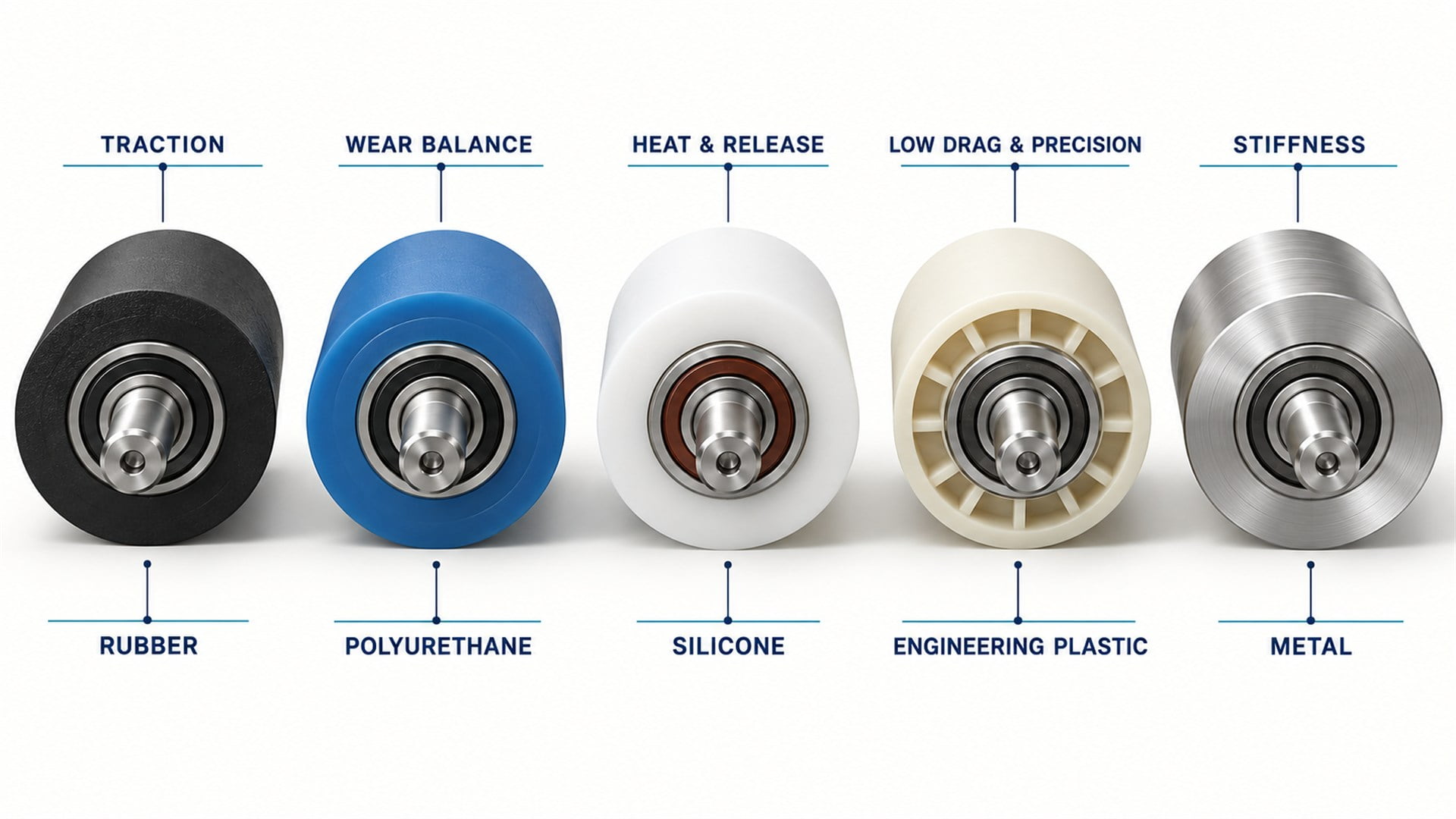 Conceptual material map. Actual formulations, hardness and surface finishes are application-specific.
| Material family | Typical reason for use | Common printer position | Main engineering caution |
|---|---|---|---|
| EPDM and other rubbers | Traction, resilience and compliant contact | Pickup, feed, transport and separation rollers | Friction changes with dust, aging and formulation |
| Polyurethane | Balance of traction, wear resistance and tunable hardness | Feed, transport, pressure and coated bearing rollers | Hydrolysis, compression set and surface chemistry depend on formulation |
| Silicone rubber | Temperature capability, release behavior and compliant grip | Feed, platen, pressure or heat-adjacent rollers | Tear strength, wear and cost must be checked |
| POM, nylon and other engineering plastics | Dimensional stability, low mass, moldability and controlled friction | Idlers, guides, hubs, gears and bearing-coated rollers | Moisture response, creep and contact marking vary by resin |
| Steel or aluminum | Shaft strength, stiffness, heat transfer and precision datum surfaces | Cores, shafts, drive rollers and heated assemblies | Weight, corrosion, surface treatment and paper marking |
| Foam elastomers | Low contact pressure, conformity and toner or ink-management functions | Specialized feed, cleaning or developer rollers | Cell structure and surface condition strongly affect function |
These categories are only the starting point. “Polyurethane” does not identify whether the material is thermoplastic or thermoset, polyester- or polyether-based, solid or cellular, soft or hard. “POM” does not define grade, filler, surface texture or molded tolerance. Roller performance comes from the complete material specification and geometry.
Why Do Feed Rollers Usually Use Elastomers?
Feed rollers need a surface that can create traction while conforming to paper and assembly variation.
Paper is not perfectly flat, clean or uniform. Its coating, moisture, thickness and dust level vary. A compliant elastomer deforms locally under nip load, increasing real contact and helping the roller tolerate small changes in the paper path.
This is why EPDM, polyurethane, silicone and related rubber compounds appear frequently in feed and transport positions. Patent literature for a paper-feed delivery roller identifies EPDM, chlorinated polyethylene rubber, silicone rubber and polyurethane rubber as materials used where transport force, mechanical strength and wear resistance are required.
High friction alone is not enough. The surface must retain useful traction after repeated contact with paper dust, coatings and environmental contaminants. It must also recover after compression. A roller that develops a flat area during storage or remains compressed in the nip can create periodic speed variation or feeding noise.
The elastomer layer works with the core and shaft. Coating thickness, hardness, crown, surface texture, bond strength and concentricity influence the installed result. A soft compound applied too thickly may deflect excessively, while a thin layer over an eccentric core cannot correct the underlying runout.
The printer paper-feed system explains how pickup, separation, transport and exit stages cooperate. Their rollers may look similar, but each contact has a different friction relationship.
Why Is Polyurethane Used for Some Printer Rollers?
Polyurethane can combine elastic contact with strong wear resistance, but its formulation must match the environment.
Polyurethane is attractive for feed, transport and compact coated rollers because manufacturers can adjust hardness, resilience, abrasion behavior and processing method over a broad range. BASF describes its cast polyurethane elastomers as suitable for rollers where low compression set and low abrasion support service life.
Printer-specific patent literature also discusses polyurethane for paper-feed rollers. One paper feed roller patent compares polyurethane, EPDM and silicone and identifies wear resistance and maintenance of friction as important selection concerns.
The word “polyurethane” still leaves major choices unresolved. Polyether and polyester chemistries do not behave identically in moisture, heat or chemicals. Thermoplastic polyurethane and cast thermoset polyurethane have different processing and property ranges. Additives, pigments and surface texture can also change paper interaction.
For an OEM project, I would specify the required function first and let the supplier propose a formulation with supporting material data. Copying a hardness number from another roller is not a complete material decision.
Why Do Some Printers Use Silicone Rollers?
Silicone is useful where temperature resistance, release behavior or stable elasticity matters.
Silicone rubber can remain flexible over a broad temperature range and can provide useful surface behavior around heat, toner, adhesive or ink-related processes. Depending on the formulation, it may be used for feed, pressure, platen or heat-adjacent rollers.
A silicone paper-feed roller patent describes a high-friction silicone rubber surface intended to combine paper-feeding ability with elasticity. This is an example of formulation being engineered for a specific contact rather than silicone being selected by name alone.
Silicone is not automatically the best feed material. Tear resistance, abrasion, contamination, bond to the core and production cost must be evaluated. A formulation optimized for release may not deliver the same traction as one designed for paper feeding. Surface finish after molding or grinding can be as important as the base polymer.
Temperature exposure must also be defined at the roller, not taken from the printer's highest component temperature. A paper-path roller located away from the fuser may see a much lower operating temperature and may benefit more from another material's wear or cost profile.
Why Are POM, Nylon and Other Plastics Used?
Rigid engineering plastics suit rollers that need accurate geometry, low mass or controlled sliding and rolling contact.
Plastic rollers are common in idler, guide, spacer, hub and gear-related functions. POM is frequently considered for molded precision parts because it can provide stiffness, dimensional consistency, a smooth surface and relatively low friction. Nylon may be useful where toughness and wear matter, although its moisture response must be considered.
Rigid plastic usually provides less compliant paper grip than a soft elastomer. That can be an advantage for a guide roller that should turn freely without aggressively marking the medium. It can be a disadvantage at a pickup position that needs high traction.
A plastic outer wheel molded around a miniature bearing creates a compact low-drag roller assembly. HUNE's sliding rollers with bearings show this architecture. It may suit idler, guide or transport-support positions after load, speed, shaft fit and media contact are confirmed.
Manufacturing method matters. Machining can be useful for prototypes and lower volumes, while injection molding can integrate ribs, hubs and retention features for repeat production. Our guide to POM roller machining versus injection moulding explains how volume, geometry and tooling affect the decision.
Why Are Metals Still Used in Printer Roller Assemblies?
Metal provides the stiffness, strength and datum control that softer roller surfaces cannot provide alone.
Many printer rollers are material systems rather than single-material parts. A steel shaft or aluminum core carries torque and maintains alignment, while an elastomer outer layer creates the required paper contact. Bearings, gears, retainers and coatings add further materials.
Steel is common for shafts because it supports bearing fits, gear interfaces and narrow diameters with useful stiffness. Stainless steel may be chosen where corrosion resistance is required. Aluminum reduces rotating mass and conducts heat, although surface hardness and wear interfaces need attention.
Bare metal can also form a roller surface where precise geometry, electrical behavior or heat transfer matters. It may mark or slip on paper if used in the wrong contact. Surface treatment, texture and the opposing roller therefore become part of the material decision.
The core-to-cover interface deserves explicit review. Rubber or polyurethane can separate from a core if surface preparation, adhesive, molding conditions or thermal expansion are poorly controlled. A material specification that omits the bond system leaves a critical failure mode undefined.
How Should Engineers Match Material to Roller Function?
Start with the contact function and failure risk, then select the material family.
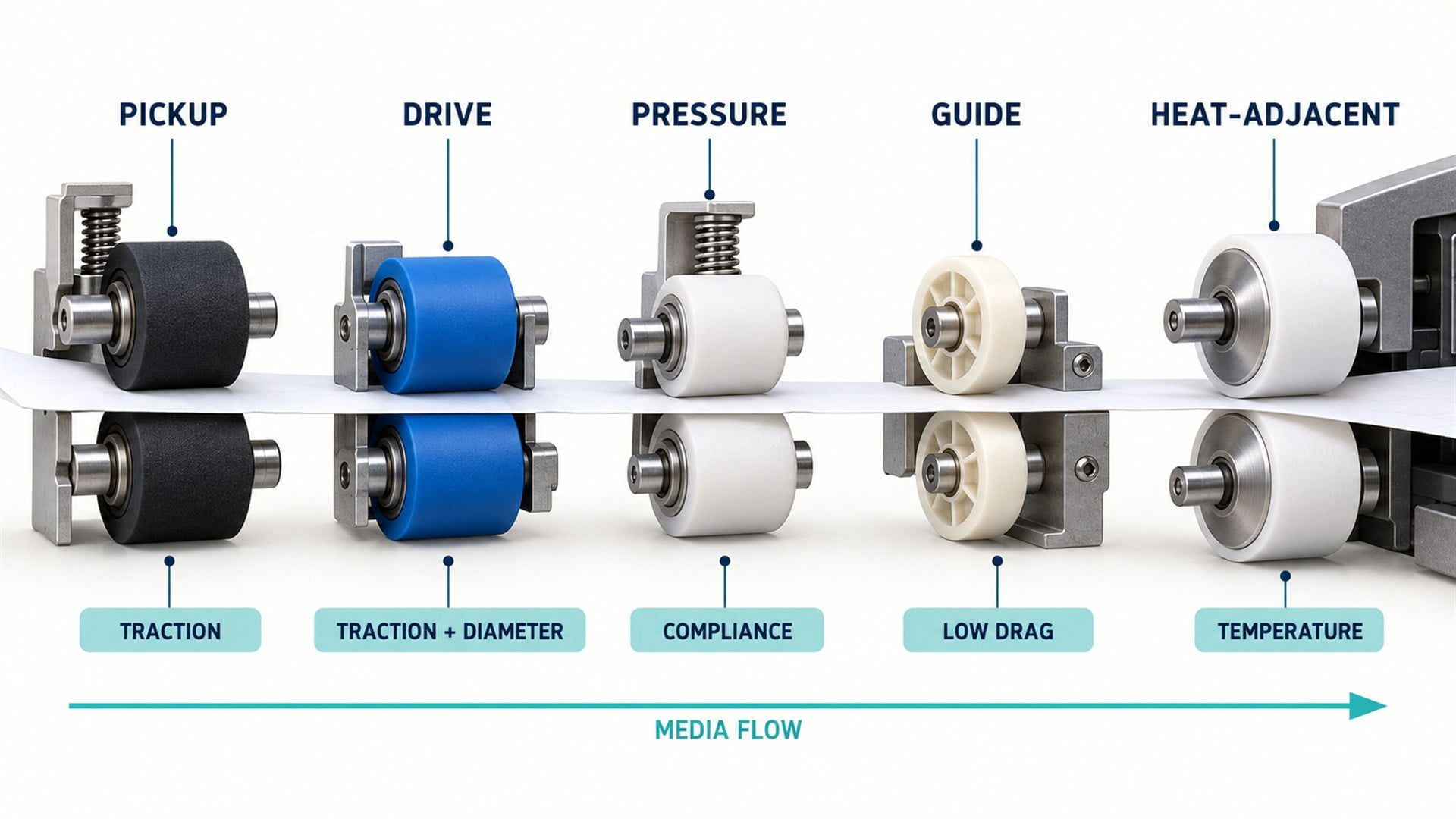 Material selection should follow the installed function rather than the roller's appearance.
| Roller function | Priority properties | Likely material direction | System interface to verify |
|---|---|---|---|
| Pickup roller | Initial traction, compliance, recovery | Formulated rubber, polyurethane or silicone | Stack force, separation element and paper range |
| Separation or retard roller | Controlled friction relationship, wear | Elastomer selected against pickup surface | Sheet-to-sheet friction and drive direction |
| Driven transport roller | Stable traction, diameter control, bond strength | Elastomer-coated shaft or engineered surface | Torque path, runout, nip force and speed |
| Pinch or pressure roller | Compliance, low marking, compression recovery | Elastomer, plastic-coated bearing or specialized surface | Spring force, center distance and axial alignment |
| Free idler or guide roller | Low drag, precision, wear and quiet running | POM, nylon, coated bearing or metal | Shaft fit, bearing resistance and edge contact |
| Belt-support roller | Dimensional stability, bearing life and surface compatibility | Plastic, metal or coated bearing | Belt tension, wrap angle and tracking |
| Heat-adjacent roller | Temperature stability and release | Formulated silicone, coated metal or other high-temperature system | Actual roller temperature and thermal expansion |
The table gives directions, not automatic selections. A printer that handles glossy labels has different surface and contamination needs from one that handles plain office paper. A thermal printer carrying pressure-sensitive labels must also consider adhesive transfer. A large-format roll printer may place greater emphasis on tracking, tension and long roller spans.
I recommend documenting the contact pair. A roller material cannot be evaluated without knowing what it touches, the normal load and whether the contact is intended to grip, release, guide or clean.
How Do Hardness and Surface Texture Affect Feeding?
Hardness and texture shape the contact patch, but neither predicts performance alone.
A softer roller can conform more readily and create a larger contact region under the same geometry. It may also deform more, generate heat or develop compression set. A harder roller holds geometry more accurately but may offer less conformity and transmit more vibration.
Surface texture can increase usable traction, provide paths for dust or reduce sticking. As the surface wears, its texture changes. Grinding direction, molded grain, pores and coating finish can therefore affect initial and aged performance.
Hardness readings must identify the test scale, method, temperature and part geometry. A thin elastomer layer over a rigid core can produce a different reading from a thick sample of the same compound. The drawing should not state only “60 hardness” without the scale and acceptance method.
The same caution applies to coefficient of friction. A value depends on the mating material, load, speed, surface condition and test method. Supplier data can help screen compounds, but validation should use the actual media and installed nip.
How Do Dust, Ink, Toner and Aging Change the Choice?
Printer roller materials must retain their function after the surface is no longer new.
Paper dust can fill surface texture and reduce traction. Ink mist, toner, release agents, label adhesive or cleaning residue may change friction or cause swelling. Heat and ozone can harden or crack some elastomers. Long periods under load can create flat spots or compression set.
European patent literature on paper-feed roller materials discusses how paper dust accumulation can reduce friction and lead to transport failure. This illustrates why initial friction is only one selection criterion.
For design validation, define the contamination and aging conditions that reflect the printer's use. Do not invent a universal cleaning chemical or life cycle. The printer manufacturer should identify allowed cleaners, operating temperature, duty pattern and media because these determine a meaningful test plan.
Material color can also be functional. It may help optical sensors, inspection or contamination detection. Carbon black and conductive fillers may be used where electrical properties matter, but their presence changes more than appearance. Conductivity, hardness, wear and marking must be considered together.
What Dimensions and Interfaces Matter with Material Selection?
Material properties become useful only when the roller geometry and mating parts are controlled.
Key information includes:
- finished outside diameter and allowable runout relative to the shaft or bearing bore;
- roller width, crown, grooves, edge radii and contact position;
- elastomer or plastic wall thickness over the core or bearing;
- shaft fit, torque feature, bearing fit and axial retention;
- installed center distance and available spring travel;
- target nip condition or known spring geometry;
- allowable marking, slip, noise and dimensional change;
- actual temperature, humidity, dust and chemical exposure.
Elastomers may shrink, swell or relax differently from rigid plastics. Injection-molded plastics may have draft, gate marks and anisotropic shrinkage. Bonded coatings add thickness variation and may require grinding to achieve final diameter. These manufacturing effects belong in the tolerance plan.
HUNE's flat roller wheels illustrate a bearing-centered roller format, but the correct outer material and dimensions still depend on the installed contact. A standard-looking wheel should not be approved before checking the shaft, spacers, retention and mating surface.
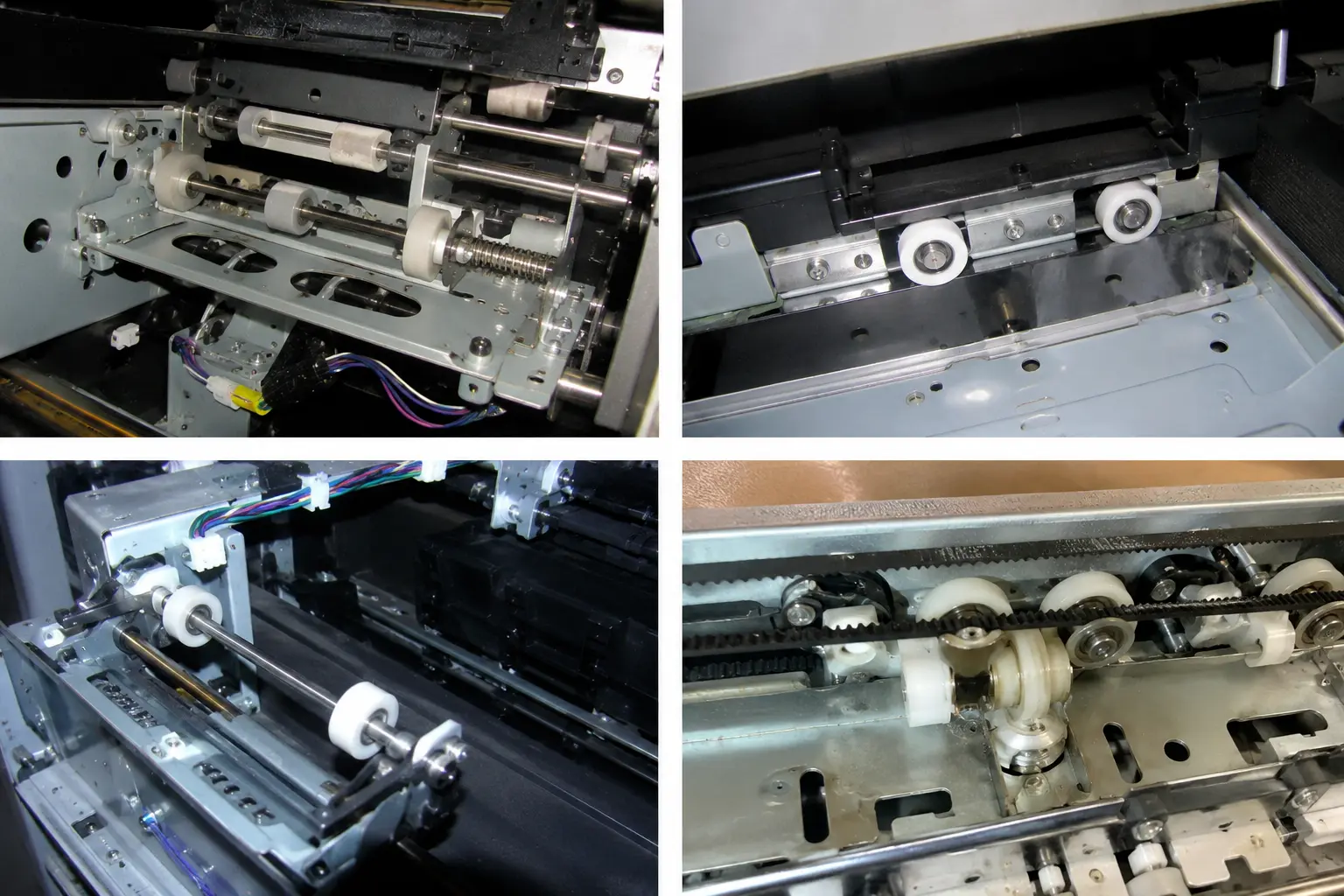 HUNE plastic-coated bearing roller concepts. Material and geometry should be selected for the actual printer position.
What Should an OEM Buyer Send to a Roller Supplier?
A useful inquiry describes the function and environment before requesting a material quotation.
Send the supplier:
- A drawing or paper-path sketch identifying pickup, drive, idler, pressure, guide or belt-support function.
- The mating paper, label, belt or opposing roller and its surface condition.
- Finished dimensions, datums, fits, runout, axial retention and allowable parting or gate locations.
- Media types, thickness range, coatings and sensitivity to marks.
- Operating speed, direction, duty pattern and expected storage condition.
- Temperature, humidity, paper dust, ink, toner, adhesive and approved cleaning-agent exposure.
- Known nip force, spring geometry, torque or load requirements without estimating unsupported values.
- Required hardness scale, color, electrical behavior and regulatory conditions.
- Sample quantity, validation plan and annual production estimate.
- Existing samples and observed failure mode if the project is a replacement or redesign.
If the material is not fixed, state the required outcome and invite a proposal. If it is fixed, provide the exact grade or an approved equivalent process. “Black rubber,” “nylon” or “PU” is too broad for repeatable OEM sourcing.
FAQs
Which material is best for a printer feed roller?
There is no universal best material. EPDM, polyurethane and silicone are common directions, but the decision depends on traction, wear, compression recovery, media, temperature, contamination and cost. The installed nip and surface finish must be evaluated with the compound.
Are plastic printer rollers less durable than rubber rollers?
Not necessarily. A rigid plastic roller can be very durable in a guide or idler position, while it may lack the compliance needed for a pickup contact. Durability depends on whether the material matches the load, speed, bearing arrangement and mating surface.
Why do printer rollers become shiny and stop feeding paper?
Wear, polishing, paper dust and transferred contaminants can change the roller surface and reduce useful traction. Hardening or compression set may also contribute. The complete nip should be inspected before assuming that surface shine is the only cause.
Can a plastic-coated bearing roller replace a rubber feed roller?
Only after the function is reviewed. A plastic-coated bearing roller may suit a free-running idler, guide or pressure-support position. A powered feed position may require greater compliance, a defined friction surface and a positive torque connection.
Discuss Your Printer Roller Material with HUNE
Select the material after defining what the roller must do inside the complete mechanism.
HUNE develops custom sliding rollers, plastic-coated bearing rollers and related precision hardware for OEM equipment. For printer applications, we can review the outer wheel, bearing, shaft, coating and mounting geometry together rather than treating the wheel material as an isolated choice.
Send your drawing, sample, paper-path sketch, media range, mating geometry, environment, quantity and target function through the HUNE contact page. Our practical recommendation is to compare candidate materials in the installed contact and confirm the functional dimensions before releasing the roller for production.