Elevator door rollers let the door panels move along defined horizontal paths. Main hanger rollers support each panel on an upper rail, retention rollers help keep the hanger correctly engaged with that rail, and coupling rollers transfer motion between car and landing-door mechanisms. Some door transmissions also use pulley rollers to synchronize panels. The bearing inside a roller reduces rotational resistance, while the wheel profile controls contact with its mating rail, vane or belt.
These rollers are not interchangeable merely because their diameters look similar. Each position has its own load direction, contact geometry, axle support and acceptance requirements. OEM buyers should identify the roller's exact function before comparing materials or prices.
This article concerns common horizontally sliding automatic passenger elevator doors. Other door architectures can use different rolling and guiding arrangements.
Which Types of Elevator Door Rollers Should Buyers Distinguish?
Different rollers perform different mechanical jobs.
The term “elevator door roller” may refer to the wheel supporting a door, a smaller roller retaining the hanger, or a roller inside the car-to-landing coupling. Those components can sit close together in the header while experiencing very different forces.
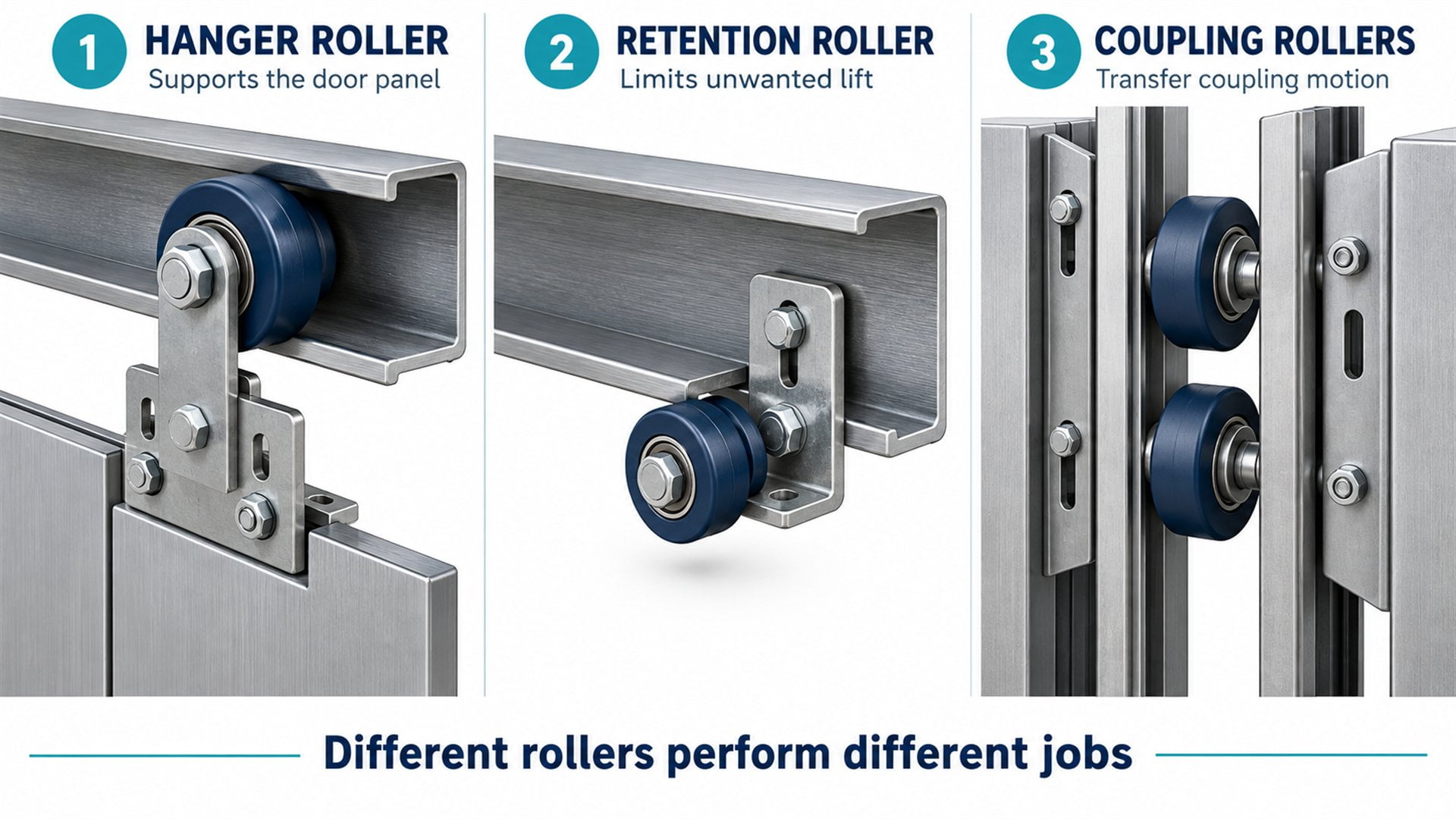 Hanger, retention and coupling rollers should be specified by function. The illustration is conceptual because rail and coupling designs vary.
| Roller type | Main function | Mating component | Typical load character |
|---|---|---|---|
| Hanger roller or hanger sheave | Supports a car or landing-door panel and enables horizontal travel | Upper header rail | Predominantly radial support load with repeated reversals |
| Retention, counter or upthrust roller | Limits unwanted hanger movement relative to the rail | Lower or designated retaining surface of the rail | Intermittent or continuous restraining contact, depending on design |
| Coupling or pickup roller | Transfers contact within the car-to-landing door coupling and may participate in lock actuation | Coupler vane, cam or gripping element | Repeated contact load determined by coupling geometry |
| Synchronizing pulley or roller | Coordinates motion between door panels | Cable, rope, belt or coupling track | Tension-driven radial load and repeated direction changes |
| Lower roller guide, where used | Guides the lower portion of a panel in a particular design | Sill or lower guide track | Lateral guidance rather than the main panel-support load |
A car guide roller is another component entirely. It guides the elevator cabin along vertical guide rails in the shaft. It should not be grouped with the door rollers discussed here.
How Does a Hanger Roller Carry the Door Panel?
The hanger roller forms the main rolling support between the panel and header rail.
In a common top-hung door, the panel attaches to a steel hanger plate. An axle on the hanger supports the bearing inner ring. The bearing outer ring rotates with the surrounding wheel or sheave, and the wheel tread rolls along the rail.
The load path is:
Door panel → hanger plate → axle → bearing → wheel body → tread contact → rail → header structure
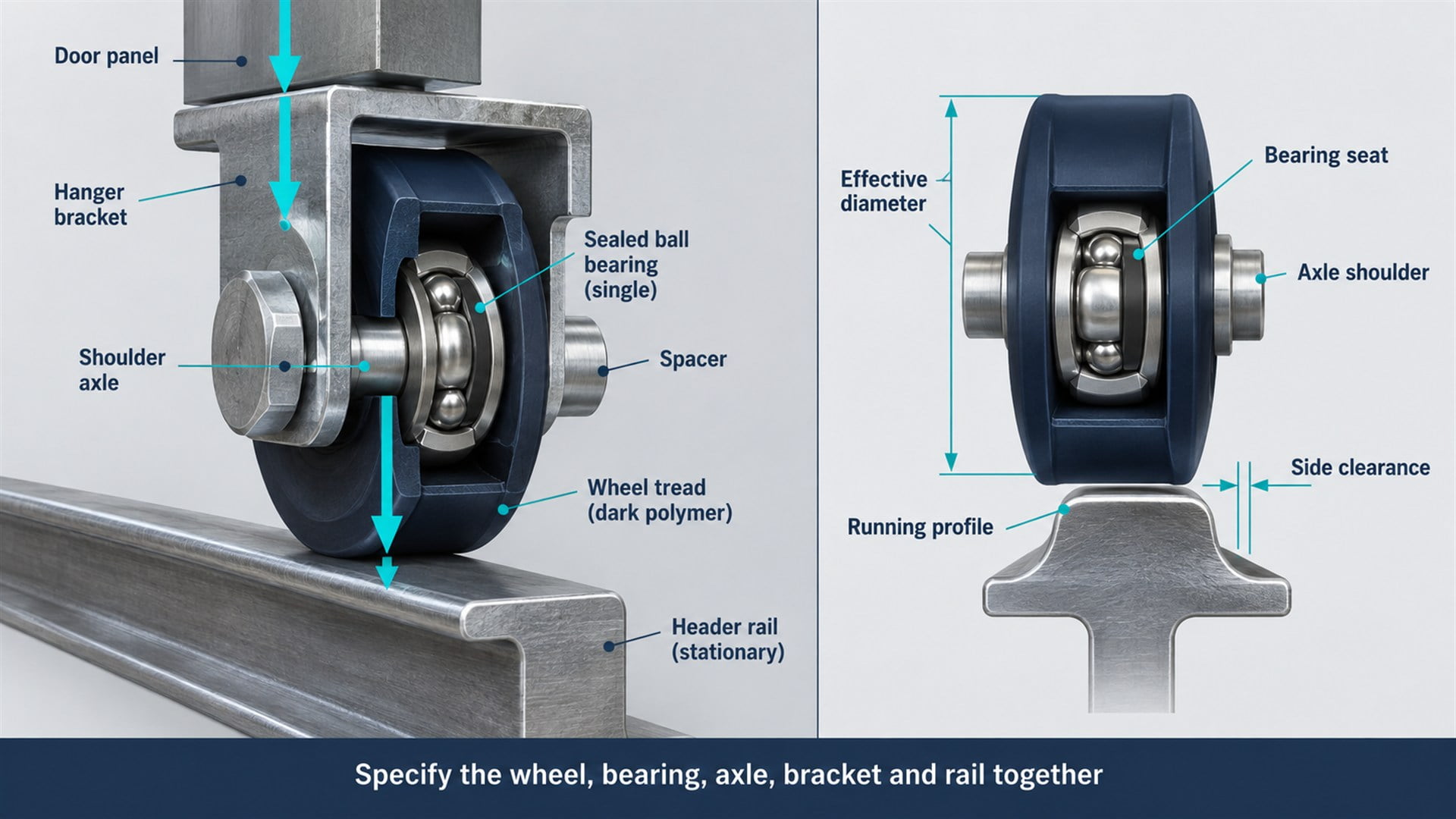 A roller should be evaluated as a mounted assembly. The diagram shows functional interfaces, not universal elevator dimensions.
The wheel's effective running diameter helps establish the vertical position of the hanger and panel. Its width and hub offset place the tread relative to the rail. The bearing seat supports the outer ring, while the axle shoulder, spacer and fastener locate the inner ring.
Published elevator-door designs show this relationship clearly. One elevator sliding-door assembly patent describes a hanger sheave mounted to the door hanger and rolling on a supported track. Another elevator door-device reference describes a hanger roller running on the upper face of a door rail while the sill guides the lower end of the door.
I would not treat the bearing as the complete load rating for the roller. The polymer tread, wheel-to-bearing seat, axle, bracket and rail contact can each govern assembly performance.
What Does a Retention or Upthrust Roller Do?
A retention roller helps prevent unwanted displacement of the hanger relative to its track.
The main hanger wheel normally runs on the load-carrying surface of the rail. A smaller retention, counter or upthrust roller is positioned against or near another rail surface. Its purpose is to limit vertical or lateral movement that could allow the hanger to lift, oscillate or lose its intended track relationship.
Designs differ. In one arrangement, the retention roller normally has clearance and contacts the rail only when the door is jolted. In another, stabilizing rollers remain in contact with an underside surface. The engineering drawing must therefore say whether the roller is continuously loaded, intermittently loaded or intended primarily as a retaining element.
This affects material and bearing selection. A small roller that rarely turns under normal movement can see brief contact at an unfavorable load point. A continuously contacting roller sees repeated cycles and contributes to running resistance. One cannot be specified from the duty of the other.
The upper rail, primary roller and retention roller should be reviewed in section. Their relative diameters and center positions determine the usable engagement and clearances. The relevant values come from the approved door design; they should not be copied from a patent example or a different elevator entrance.
What Do Coupling Rollers Do?
Coupling rollers help the car doors engage and move the landing doors at the served floor.
The elevator car carries its own doors, while every landing has a separate entrance. A common coupler uses vertical vanes on the car-door mechanism and pickup rollers on the landing-door mechanism. When the car stops in the intended zone, the vanes interact with the rollers so the landing door can unlock and move with the car door.
The elevator landing-door coupler patent describes car-mounted gripping elements engaging roller counterparts on the landing door. It also explains why relative alignment matters to joint movement. The specific mechanism is one example rather than a universal geometry.
Coupling rollers do not support the door panel in the same way as hanger rollers. Their critical features can include:
- Roller outside diameter and tread contour at the vane contact.
- Fixed or pivoting axle position.
- Center distance between pickup rollers.
- Axial projection from the mounting plate.
- Vane approach clearance and engagement range.
- Relationship to the landing-door lock and electrical contact.
A coupling roller that spins smoothly on a bench may still be unsuitable if its center position or contact profile changes the lock sequence. For this component, mechanism geometry usually matters more than free-running feel alone.
Do Lower Sill Guides Count as Elevator Door Rollers?
Most common sill guides slide rather than roll, although some designs use rolling elements.
The lower edge of a top-hung door is commonly fitted with guide shoes or gibs that travel in a sill groove. They constrain movement transverse to the opening direction and help keep the panel aligned. The upper hanger rollers carry the main vertical support load in this arrangement.
Calling every lower guide a roller can confuse the load path. A sliding shoe needs a material and clearance appropriate to the sill groove. A rolling lower guide needs its own axle, bearing or bushing and mating track definition. The bill of materials should use the name and function shown on the approved assembly drawing.
The upper and lower interfaces remain connected through the panel. Changes in running diameter, hanger position or rail alignment can change how the guide shoes sit in the sill. That is one reason to evaluate the complete door system rather than approve the top wheel alone.
Why Do Many Door Rollers Use a Polymer Tread and Metal Bearing?
The outer tread and inner bearing solve different problems.
The bearing provides internal rolling contact around the axle. The polymer tread creates the external running surface against the rail or vane. A polymer can change contact compliance, surface marking and transmission of vibration compared with direct metal-to-metal contact.
Material selection still requires a defined grade and operating condition. POM, nylon, polyurethane and other constructions differ in moisture response, stiffness, creep, wear and manufacturing behavior. A generic material name or wheel color does not establish those properties.
The bearing specification should be separate from the wheel material. It includes bearing type, internal clearance where relevant, shields or seals, lubricant and material requirements. ISO 281 provides a method for rolling-bearing dynamic load ratings and rating life. Its calculation does not rate the surrounding polymer wheel, axle, bracket or complete elevator-door assembly.
 Existing HUNE media-library product image. The dimensions belong to this catalog wheel and are not recommended elevator-door dimensions or evidence of elevator approval.
HUNE's sliding rollers with bearings show how different outer profiles can be combined with metal bearings. These products are useful component references; any elevator application still requires a drawing-based suitability and qualification review.
Which Dimensions and Mating Surfaces Matter Most?
Specify the contact and mounting stack, not only the bore and outside diameter.
When I review a roller inquiry, the rail or vane section is one of the first items I request. The same nominal outside diameter can produce a different installed position when the running profile changes.
| Functional feature | What it controls | What the supplier needs |
|---|---|---|
| Running profile | Contact location on a rail, vane or cam | Dimensioned mating section and intended contact surface |
| Effective running diameter | Hanger height and rolling geometry | Defined measurement location on the tread |
| Wheel and hub width | Bracket clearance and axial position | Hanger section, spacers and side-clearance requirement |
| Bearing seat | Support and retention of the outer ring | Seat geometry, wheel material and assembly process |
| Bearing bore and axle | Fit and force transfer through the inner ring | Axle diameter, shoulder, retention and surface specification |
| Axial projection | Coupling or rail alignment | Assembly datum and allowable offset |
| Runout | Variation at the running surface | Datum and agreed inspection method |
For a grooved wheel, the largest outside diameter may not be the operating diameter. The useful diameter occurs where the mating surface actually contacts the groove. Our U-groove bearing wheel range illustrates why groove radius, depth and clearance must be compared with the mating profile.
There is no responsible universal tolerance for all elevator door rollers. The door designer should define limits from the assembly stack-up, required engagement and validation results.
How Do Roller Choices Affect Door Movement?
Roller behavior influences resistance, alignment, vibration and repeatability.
A correct roller keeps the panel at its intended height and contact plane as the door reverses direction. Its tread runs on the designed surface without edge loading, and its bearing rotates without interference from the mounting stack.
Several component-level conditions can change system behavior:
- Tread wear changes effective diameter and panel position.
- Bearing drag increases the force required from the door operator.
- Rail-profile mismatch concentrates contact on an edge.
- Excessive runout creates cyclic motion at the hanger.
- Axial interference makes the wheel or seal rub the bracket.
- Unequal roller positioning changes load sharing between hangers.
These are engineering relationships, not a list of repair diagnoses. A door problem can also originate in the operator, coupling, sill guides, alignment, lock or control inputs. Qualified personnel must evaluate the equipment as a system.
For sourcing, an unloaded spin test is only a basic check. The buyer should define installed acceptance criteria for the intended rail, bracket, load, cycle profile and environment.
What Should OEM Buyers Send a Roller Supplier?
The supplier needs the component role and complete mating geometry.
A useful elevator-door roller inquiry includes:
- Exact function: car-door hanger, landing-door hanger, retention roller, coupling pickup roller, synchronizing pulley or another stated position.
- Component drawing and assembly section with functional datums.
- Rail, vane, cam, belt or other mating profile.
- Door arrangement and the load direction and magnitude established for that roller position.
- Movement frequency, speed, reversals, temperature, moisture and cleaning exposure.
- Wheel material grade, bearing construction, lubricant and restricted substances.
- Axle, shoulder, spacer, washer, bracket and fastener details.
- Required inspection, endurance validation, traceability and change control.
- Prototype, first-order and forecast production quantities.
The HUNE guide to selecting a sliding roller for an industrial door explains the same wheel-track principle in a broader door context. For custom polymer components, our comparison of machined and injection-moulded POM rollers helps plan prototypes and repeat production.
The elevator or entrance manufacturer must qualify the final component under the approved system design and applicable project requirements. Similar appearance, material or bearing number is not evidence of interchangeability.
Frequently Asked Questions
Do Elevator Door Rollers Carry the Weight of the Elevator Car?
No. Door hanger rollers support loads associated with their door panels and hanger assemblies. The elevator car's vertical suspension and guidance use separate equipment. Coupling and retention rollers have different duties again. A quotation should state the exact roller position rather than using total elevator capacity as the component load.
Are Elevator Door Rollers the Same as Elevator Guide Rollers?
No. Door rollers move or guide door panels horizontally at the entrance. Car guide rollers guide the elevator cabin vertically along guide rails in the shaft. They have different dimensions, operating paths, supports and validation requirements even if both use polymer-covered wheels with bearings.
Does a Larger Bearing Make an Elevator Door Roller Stronger?
Not automatically. A larger bearing may offer more internal capacity, but the roller can still be limited by its tread, bearing seat, axle, bracket or rail contact. The complete load path and installation geometry must be checked. Bearing rating alone does not establish the allowable load of the assembled door roller.
Can a Standard HUNE Roller Be Used in an Elevator Door?
Only after the specific part and application have been reviewed and qualified. Matching diameter and bore does not prove rail contact, retention, durability or system approval. HUNE can compare an existing structure with the drawing, but the elevator or entrance manufacturer must approve the roller within the complete door system.
Send Your Elevator Door Roller Requirement to HUNE
HUNE manufactures polymer-covered bearing rollers and related custom sliding hardware for OEM equipment. We can review the wheel profile, bearing, axle, bracket and mating surface as one assembly.
Use the HUNE contact form to send your elevator door roller inquiry. Identify whether the part supports, retains, couples or synchronizes the door and include the approved rail or mechanism geometry. The practical recommendation is to define the roller's exact duty first, then evaluate an existing wheel or develop a custom part around the verified interface.