Bearings in printer rollers support the roller or its shaft while allowing rotation with controlled resistance. They transfer operating loads into the axle or frame and help control unwanted movement. The roller surface handles contact with paper or a guide, while the drive system supplies motion. Bearings therefore contribute to consistent transport, but they cannot compensate for the wrong tread, poor alignment or unsuitable nip pressure.
The first question I would ask is whether the roller turns around a fixed axle or turns together with a driven shaft. Those arrangements put the bearings in different places and require different drawings.
This article focuses on paper and label printer mechanisms. It explains how bearing support relates to paper contact, mounting geometry and the selection of a complete roller assembly.
What Do Bearings Do in Printer Rollers During Operation?
Their main jobs are to support loads, permit rotation and help locate the rotating assembly.
A printer roller experiences more than the weight of the paper. Depending on the mechanism, its supports may carry forces from a spring-loaded opposing roller, belt tension, gears and the roller's own weight. Acceleration and repeated starts also affect the operating conditions.
These forces follow a physical path: from the roller surface or drive connection, through the roller and shaft, into the bearing supports and frame. A bearing must suit that load path and the space available.
Radial loads act across the shaft axis. Axial loads act along it. Bearing types differ in their ability to carry each. For example, Worcester Polytechnic Institute's bearing selection material distinguishes the load capabilities of deep-groove and angular-contact ball bearings. A compact bearing should therefore be selected from its actual specifications, not simply because its bore fits the shaft.
Bearings also influence the resistance the drive must overcome. However, the objective is controlled operation under load, not the longest possible free spin by hand. Lubrication, seals, internal clearance and mounting all affect how the installed assembly behaves.
Where Are the Bearings Located in a Printer Roller?
A bearing may sit inside the wheel or in the frame supporting a rotating shaft. Identify the arrangement before specifying a replacement or custom part.
A roller rotating around a fixed axle
In this arrangement, the axle remains stationary while the roller turns around it. Bearings fitted inside the roller connect the moving wheel to the fixed support. The bearing inner rings are located on the axle, while the outer rings rotate with the roller.
This architecture can be used for an idler or guide wheel when it meets the mechanism's load and contact requirements. The wheel, bearings, axle, spacers and retaining features need to work together. A retaining bolt must secure the intended stationary parts without trapping the rotating wheel against the bracket.
Our explanation of bearing roller assemblies and their main components gives useful background on this integrated construction.
A roller rotating together with its shaft
A driven roller may be fixed to a shaft that receives torque through a gear or pulley. Bearings in the frame support the rotating shaft, rather than sitting inside the roller body.
Here, the important interfaces include the shaft bearing seats, frame housings, roller-to-shaft connection and drive position. Buying a wheel with a bearing already inside it would not automatically reproduce this arrangement.
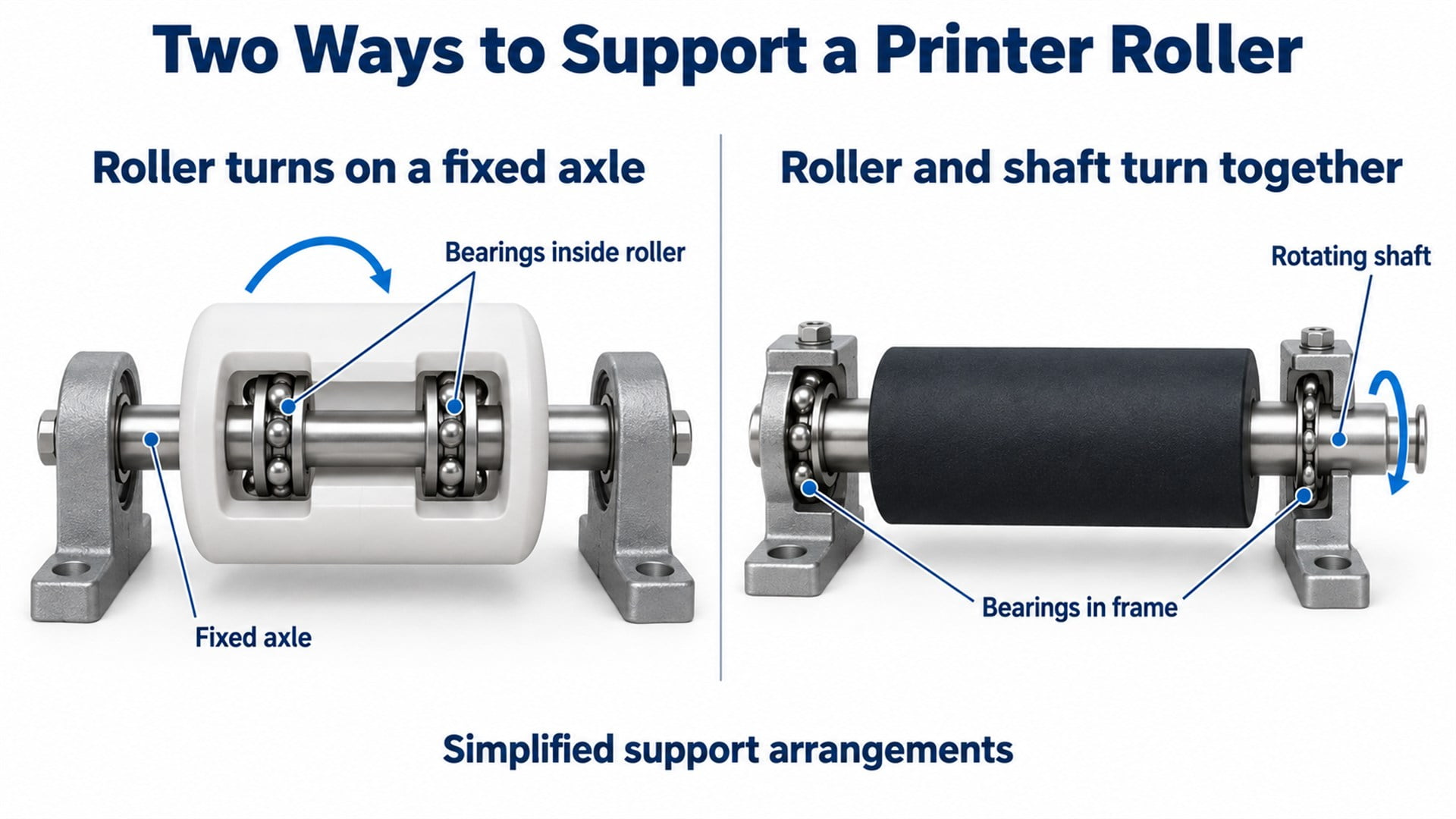
Figure 1. Two simplified support arrangements. Bearing position determines which surfaces rotate and which interfaces must locate the assembly.
How Is the Bearing's Job Different from the Roller Surface's Job?
The bearing supports rotation; the outer surface determines how the roller interacts with paper or a guide.
A paper-driving roller needs suitable traction against the specified media. Its tread material, surface condition, compliance and contact pressure affect whether the sheet moves as intended. Reducing bearing resistance does not create that traction.
A guide roller has a different contact task. It may run against a rail, support a moving component or maintain a path without acting as the main paper-driving surface. A hard polymer wheel can be relevant to this role even when it would be unsuitable as a replacement for a compliant pickup roller.
The contact region between opposing rollers is called the nip. Its behaviour depends on both rollers, their supports and the force bringing them together. A Toshiba Tec printer patent application describing transport and pinch rollers illustrates how drive arrangement and contact pressure are considered together. It describes a proposed mechanism, rather than providing performance evidence for every printer design.
I would therefore separate two requirements in a supplier enquiry: what the outer surface must do at the contact point, and how the bearing must support the assembly. Treating both as simply “a smooth roller” leaves too much undefined.
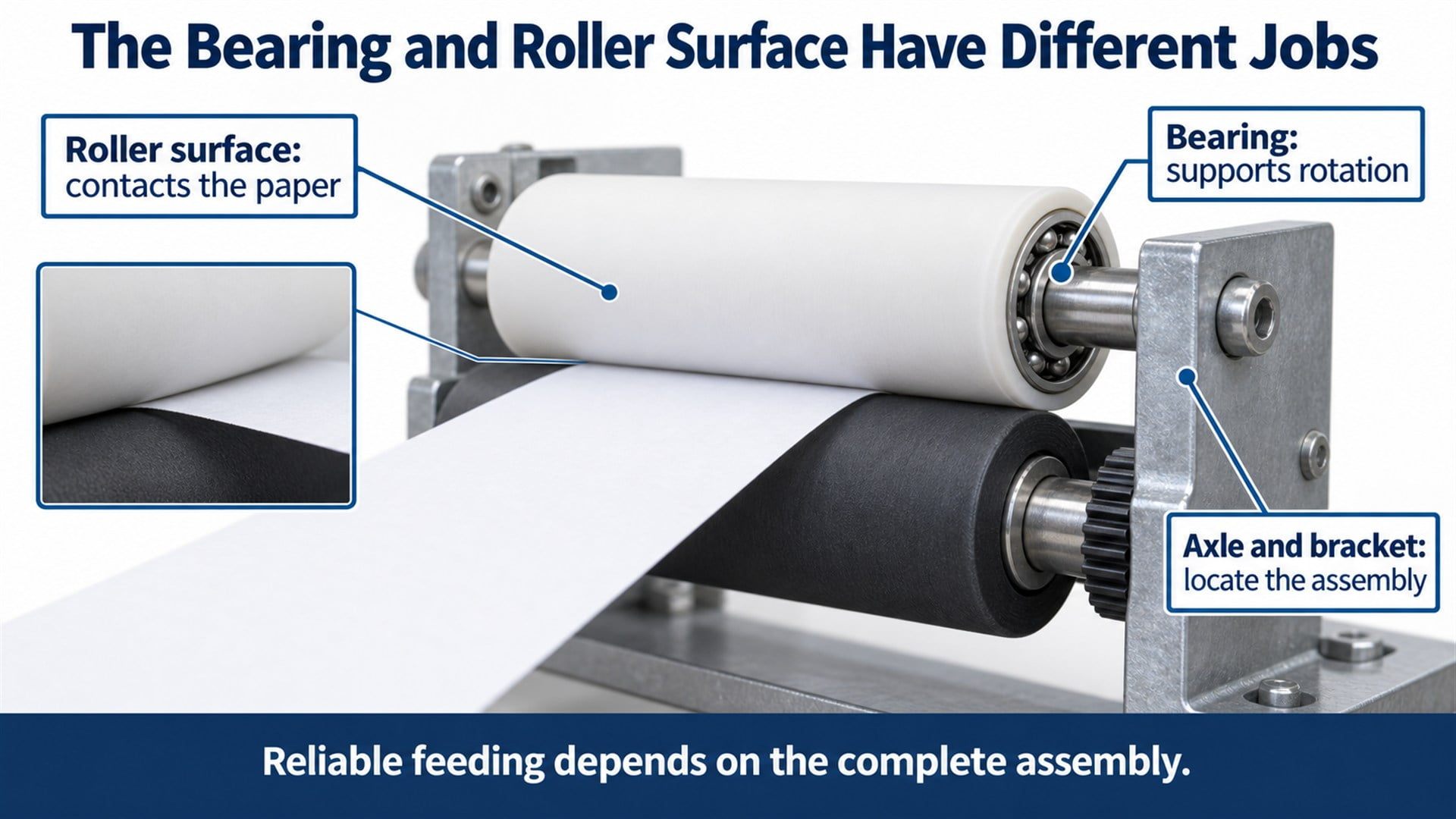 Figure 2. The surface, bearing and mounting structure perform different functions within the same paper transport assembly. Simplified illustration.
Which Dimensions and Mating Surfaces Matter Most?
The useful specification connects the running surface to the bearing seats and mounting datums. Outside diameter alone is insufficient.
A bearing can rotate correctly while the assembled tread runs eccentrically. Conversely, an accurately formed wheel can perform poorly if its axle bends, the brackets are misaligned or the bearing fit becomes too tight after assembly.
The drawing should identify the surfaces that control motion and explain how they will be inspected.
| Interface or dimension | Why it matters | What the buyer should define |
|---|---|---|
| Running diameter and contact width | Establish the contact geometry; effective rolling diameter also affects transport per revolution | Functional surface, measurement condition and allowable variation |
| Bearing seat and axle or shaft fit | Locate the bearing rings and influence retention and installed clearance | Bearing designation, mating dimensions, material and fit requirements |
| Tread runout relative to the rotation axis | Reveals eccentricity that can vary contact conditions during rotation | Datum axis, inspection fixture and acceptance limit |
| Axial location and side clearance | Prevent unintended side contact and excessive end movement | Shoulders, spacers, retaining features and the intended clamping path |
| Support spacing and alignment | Affect shaft deflection and the relationship between opposing rollers | Bracket geometry, shaft centre positions and assembly reference surfaces |
For a compliant tread, the measurement condition matters: an unloaded diameter does not fully describe contact under compression. For a guide wheel, include the mating rail or contact profile instead of assuming the maximum outside diameter is always the running surface.
Bearing clearance and mounting constraints also require attention. MIT's FUNdaMENTALS chapter on bearing design discusses how preload, fits and constraints affect bearing behaviour. A tight fit or an unsuitable spacer stack can change the installed condition, even when the bearing itself meets its specification.
Set tolerances from the functional requirement. Applying the same tight tolerance to a cosmetic side face and a bearing seat can add manufacturing cost without improving paper transport.
Does Every Printer Roller Need a Ball Bearing?
No. A suitable support may use rolling bearings or plain bushings, depending on the duty and design.
A ball bearing may be appropriate where rotational resistance, operating speed and controlled support justify its space and cost. A plain bushing may suit a compact mechanism where its friction, wear and shaft requirements are acceptable. Both need evaluation in the actual operating environment.
Specify the bearing construction rather than writing only “with bearing.” Relevant details include its dimensions, load capability, internal clearance, lubrication and shield or seal arrangement. Contact seals can add resistance; a shield should not be assumed to provide the same exclusion as a contact seal.
Paper dust, adhesive contamination, nearby heat and lubricant migration may influence the selection. An exposed bearing near the paper path presents different concerns from a support isolated behind the frame.
A one-way clutch serves another function: controlling torque transmission in a particular direction. It should not be treated as interchangeable with a general support bearing merely because both can sit around a shaft.
Where Do HUNE's Bearing Rollers Fit into Printer Equipment?
Integrated polymer wheels with bearings are relevant when the equipment needs a rolling guide or supported idler with compatible geometry.
HUNE's flat plastic-coated bearing roller wheels illustrate a construction that combines a polymer running surface with a steel bearing core. This is a useful architecture to review for a printer mechanism requiring a compact guide wheel.
Its suitability depends on the actual contact surface, load direction, axle, mounting width and environment. A flat polymer bearing wheel should not be specified as a direct substitute for a rubber paper pickup roller solely because their diameters match.
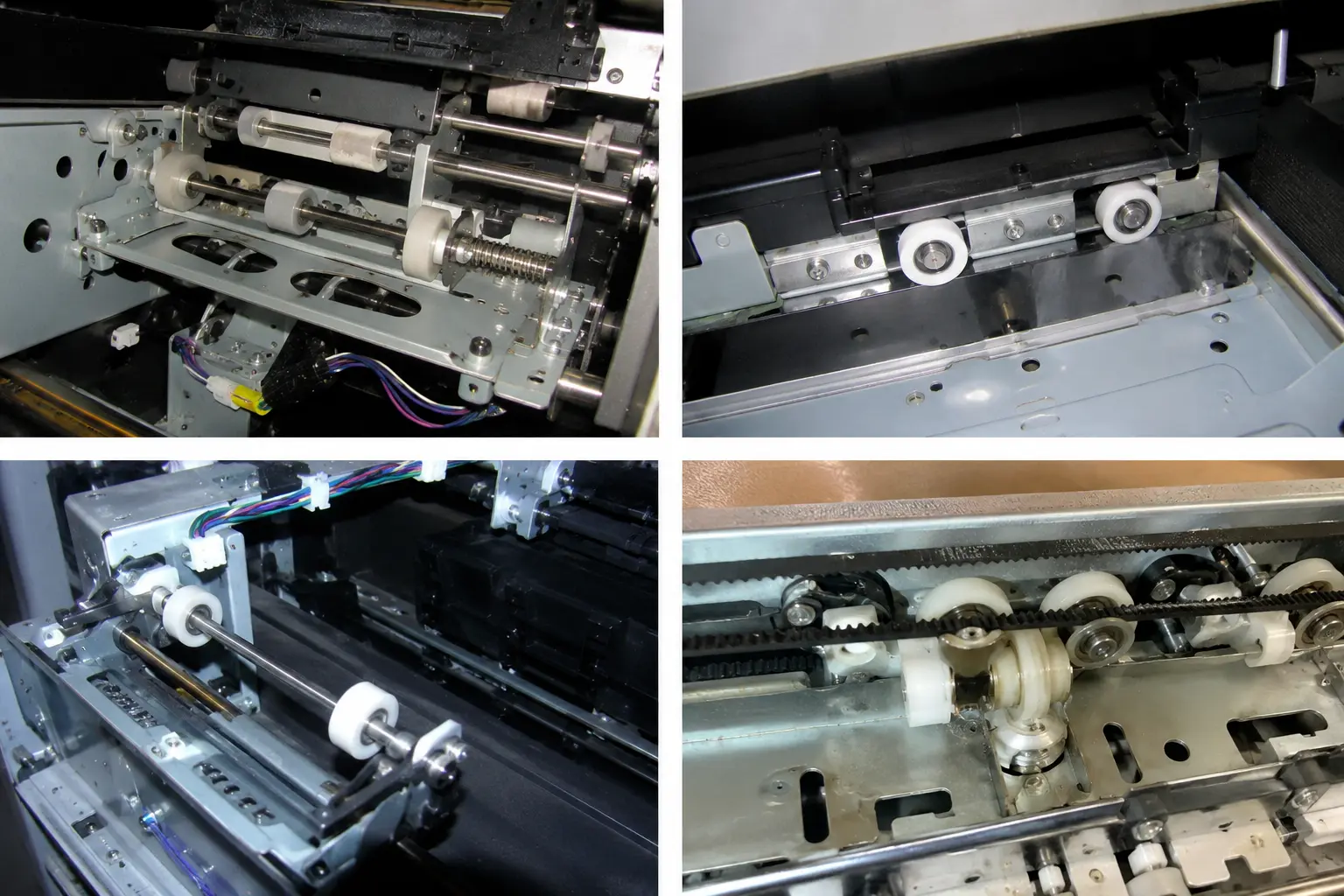
Figure 3. Printer mechanism examples from HUNE's existing media library, showing rollers alongside shafts, guides and mounting structures. The image illustrates component arrangements rather than a measured performance result.
For custom polymer geometry, the production route also matters. A machined sample can help check interfaces before committing to tooling, but a moulded production wheel may require separate confirmation of its bearing seat and running surface. The comparison of POM roller machining and injection moulding explains how geometry and order volume influence that decision.
What Should an OEM Buyer Send a Roller Supplier?
Send the assembly requirements together with the roller drawing so the supplier can assess function, manufacture and inspection.
A useful enquiry includes:
- Roller function: driven paper feed, opposing idler, guide wheel or another defined role; identify which parts rotate.
- Drawings and mating parts: roller, axle or shaft, bearing seats, spacers, bracket and opposing roller or guide profile, with revision references.
- Critical controls: running diameter, contact width, runout datum, side clearance, bearing retention and measurement conditions.
- Operating requirements: estimated loads and their directions, rotational speed, start-stop duty, reversals and expected service conditions.
- Contact and environment: paper or label types, required tread properties, marking restrictions, dust, heat and possible chemical exposure.
- Commercial scope: prototype quantity, expected annual demand, supply as a wheel or complete assembly, packaging and sample approval requirements.
If a value is unknown, identify it as an open requirement rather than inserting a guessed number. The equipment designer should confirm the acceptance criteria before sample approval.
Validate the assembly in stages. A geometry sample checks fit and access. A sample using the intended material and bearing checks the proposed construction. An installed trial checks transport, alignment, noise and contact behaviour under representative conditions. A production sample then confirms whether the selected manufacturing route can reproduce the approved requirements.
A successful free-spin check cannot replace an installed trial. Similarly, one machined prototype does not establish the consistency of future moulded production. Compare quotations on the same bearing specification, material, inspection scope and assembly content; otherwise, the lowest unit price may represent a different component.
Frequently Asked Questions
Is a bearing roller the same as a roller bearing?
The terms describe different things. A bearing roller usually means a wheel or roller assembly supported by a bearing. A roller bearing is a bearing type that uses cylindrical, tapered or other roller-shaped rolling elements. A printer guide wheel described as a bearing roller may actually contain ball bearings. Specify both the complete assembly and the internal bearing type to avoid confusion.
Can changing the bearing alone correct paper skew?
It may help if excessive bearing play or abnormal resistance is contributing to the problem. Paper skew can also originate from roller alignment, uneven nip pressure, tread condition, guide settings or the media itself. Before changing the bearing specification, assess the complete transport assembly and determine which condition is causing unequal motion or contact across the sheet.
Should printer roller bearings be lubricated with oil?
Follow the specified bearing and equipment maintenance requirements. Some bearings contain lubricant intended to remain in place, while other support types require a different approach. Adding oil without identifying the construction can be inappropriate and may introduce contamination near the paper path. For OEM sourcing, define lubrication and maintenance expectations before selecting the bearing, seal arrangement and assembly process.
Can one roller design work with both ordinary paper and labels?
Possibly, but approval should cover both media types. Labels can introduce different thickness, backing materials, surface properties and potential adhesive exposure. These conditions affect the contact surface and contamination risk as well as the bearing environment. Test the complete roller arrangement with representative media and operating conditions before treating a shared diameter or bearing size as proof of compatibility.
Discuss a Custom Bearing Roller with HUNE
HUNE manufactures sliding rollers and hardware components for OEM applications. Its sliding rollers with bearing range provides construction examples for projects that require a wheel, bearing and mounting interface to function together.
For printer equipment, start by identifying whether the component drives the paper, follows an opposing roller or guides another moving part. That decision establishes the contact requirements and bearing arrangement before material or price comparisons begin.
To discuss a suitable structure, send HUNE your printer roller enquiry with the roller and mating-part drawings, load direction, speed, media or guide details, critical dimensions and expected quantity. Use those requirements to agree on a sample and installed validation plan before committing to production.