
Elevator car doors are mounted on the moving cabin and travel between floors with it. Landing doors are fixed at each floor and close the openings to the elevator shaft. At a normal stop, a coupling connects the car-side mechanism to the selected landing-door mechanism so both sets open and close together. The car doors usually receive power from the door operator; the landing doors have their own hangers, guides and locks but commonly receive opening motion through the car doors.
For OEM sourcing, the two assemblies must be identified separately. A car-door hanger roller, landing-door hanger roller and coupling pickup roller can look similar while having different contact surfaces, mountings and load cases.
This comparison covers common horizontally sliding automatic passenger elevator doors. Manual, vertical freight and independently powered landing-door systems can differ.
Elevator Car Doors vs Landing Doors at a Glance
The main difference is where each door belongs and what it protects.
Car doors close the cabin entrance. Landing doors close the shaft entrance at a particular floor. Passengers normally see both as one doorway because they align closely and move at the same time, but there are two separate panel assemblies in parallel planes.
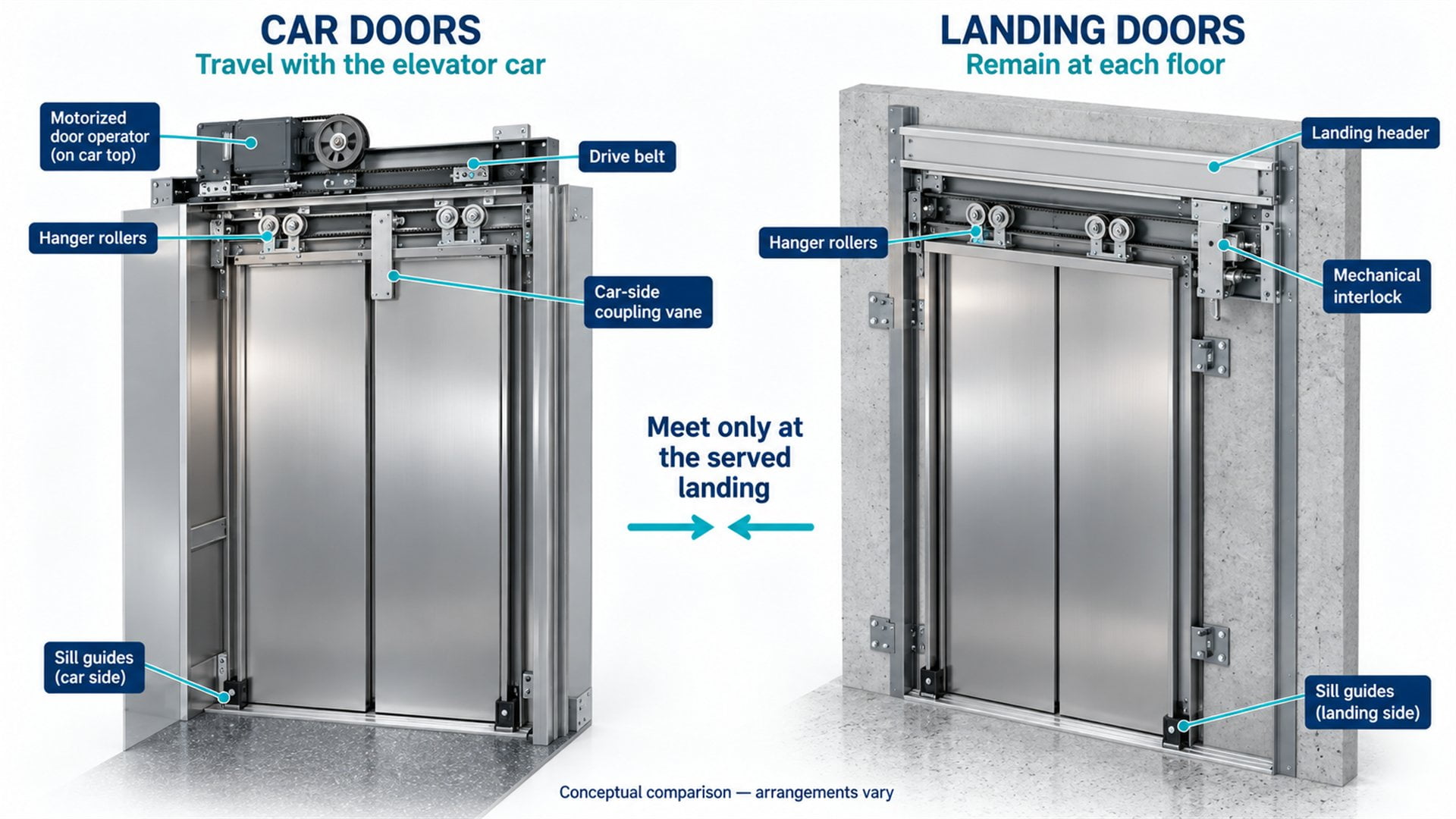 The operator travels with the car, while each landing retains its own entrance and locking hardware. The illustration is conceptual because actual layouts vary.
| Comparison point | Car doors | Landing doors |
|---|---|---|
| Location | Mounted on the elevator car | Mounted at each floor opening |
| Movement through the building | Travel vertically with the car | Remain at one landing |
| Main access function | Close the cabin entrance | Close the opening to the shaft |
| Normal opening power | Usually driven directly by the car-door operator | Commonly driven through the car-to-landing coupling |
| Upper running parts | Car-door hangers, rollers and rail | Landing-door hangers, rollers and rail |
| Lower guidance | Guides in the car sill | Guides in the landing sill |
| Coupling hardware | Commonly carries vanes or a clutch | Commonly carries pickup rollers or counterpart parts |
| Locking and monitoring | Car-door closed and locking or monitoring provisions | Mechanical landing lock with electrical interlock verification |
| Quantity in one installation | One set per entrance side of each car | One set at every landing served on that side |
The exact hardware depends on the manufacturer and door arrangement. The table explains functions rather than defining a universal bill of materials.
What Are Elevator Car Doors?
Car doors are part of the moving elevator-car assembly.
The panels, hangers and car-side header move with the cabin. The door operator is normally mounted on or above the car and applies opening and closing force to the panels through a belt, cable, chain, arm or other transmission.
A car-door assembly commonly includes:
- One or more door panels.
- Hanger plates attached to the top of the panels.
- Bearing rollers running on a car-door rail.
- Retention or upthrust rollers where the design requires them.
- A motorized door operator and motion transmission.
- Position feedback and car-door condition monitoring.
- A car-side coupling device that engages the landing-door hardware.
- Lower guide shoes running in the car sill.
The operator controls more than simply open and close. Feedback allows the controller to manage acceleration, travel speed, deceleration and endpoint position. The HD-LM door operator technical manual provides one example containing a motor, encoder, belts, sheaves, arms, sensors and controller. Those details describe that product architecture, not every elevator door.
Car doors are also exposed to cabin movement, vibration and repeated passenger cycles. Their coupling equipment must pass the landing hardware as the car travels and then interact correctly at the selected floor. That makes the relative position of the car door, coupler and landing pickup parts a functional design condition.
What Are Elevator Landing Doors?
Landing doors stay in the building and secure each shaft entrance.
Every served landing needs its own door panels and supporting hardware. The assembly attaches to the landing entrance structure rather than the elevator car. It commonly contains a header, rail, hangers, rollers, sill guides, closing device, pickup mechanism and lock with an electrical contact.
When the elevator car is elsewhere, the landing doors remain closed and locked during normal service. When the car reaches that floor, the coupling interacts with the landing mechanism so the door can unlock and move with the car doors.
The landing door therefore has two related responsibilities: it moves as part of the passenger access cycle, and it secures the shaft entrance when access is not permitted. Smooth movement alone does not demonstrate correct locking, and correct electrical contact alone does not prove that the panels run freely.
The EMSD explanation of common lift safety devices identifies car-door and landing-door locking devices as equipment intended to ensure the doors are closed and locked during elevator travel. Applicable designs and requirements depend on the jurisdiction and lift system.
How Do the Two Sets of Doors Move Together?
A coupler transfers car-door motion to the selected landing doors.
In a common arrangement, vertical vanes on the car door enter the space around counterpart or pickup rollers on the landing-door mechanism. When the elevator is properly positioned at the served floor, controlled movement of the vanes and rollers coordinates unlocking and transfers horizontal motion.
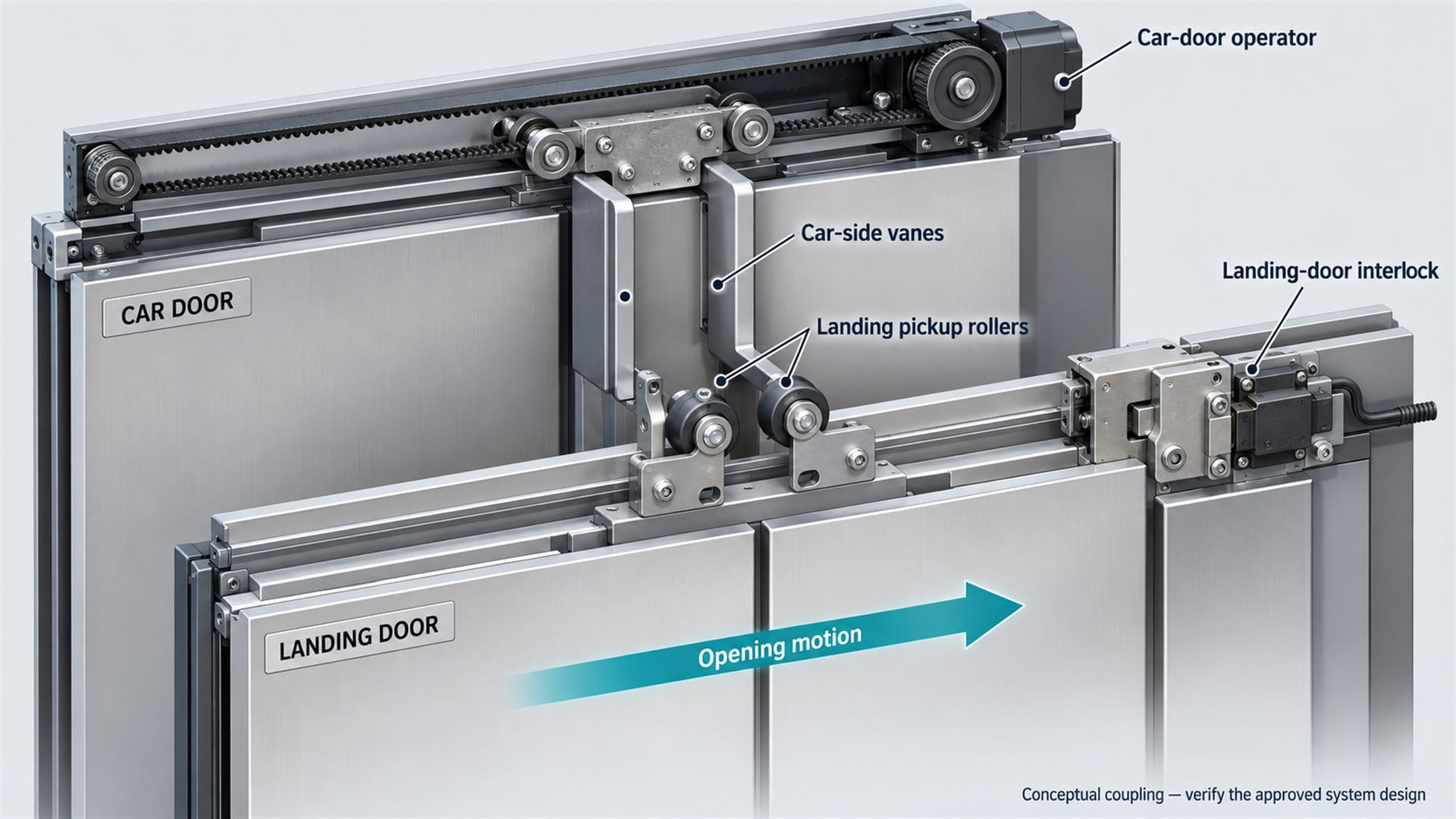 Car and landing panels remain separate assemblies. The coupling provides temporary mechanical engagement at the served landing; the exact vane, roller and lock geometry varies.
The general sequence is:
- The car reaches and aligns with the landing under the elevator control system.
- The car-side operator begins the approved door sequence.
- The coupling vanes contact or capture the landing-door pickup parts.
- The landing lock is released according to the designed mechanism.
- Operator motion moves the car and landing doors together.
- During closing, both assemblies return to their closed positions and the landing mechanism relocks.
A technical description of one design is available in the elevator landing-door coupler patent. It describes car-mounted gripping elements engaging landing-mounted roller counterparts. This is useful evidence for the basic relationship, but buyers should not copy its dimensions or sequence into a different system.
Coupling alignment is especially important. The car stops within a controlled zone, but the coupler still needs defined clearance and engagement geometry. Too little usable clearance can cause contact before the intended point. Too much can prevent full engagement or alter lock operation. The approved drawing should define the interface in the relevant positions rather than treating two roller center dimensions as a complete specification.
How Do Their Rollers and Guides Differ?
Both doors roll horizontally, but similar-looking components can have different duties.
Car and landing door panels are commonly top-hung. Hanger rollers carry the panel through hanger plates and run along separate rails. Lower guide shoes or gibs travel in separate sill grooves to control the bottom edge.
One published elevator door system description identifies the header, track, rollers, hangers, sill and lower guide shoes as coordinated parts. It also shows why the upper rolling interface and lower guidance must be considered together.
The roller categories should remain distinct:
| Roller or guide | Main contact | Typical role |
|---|---|---|
| Car-door hanger roller | Car-door header rail | Supports and moves a car-door panel |
| Landing-door hanger roller | Landing-door header rail | Supports and moves a landing-door panel |
| Coupling pickup roller | Car-side vane or cam | Transfers contact within the coupling and may participate in lock actuation |
| Retention or upthrust roller | Designated retaining side of the rail | Limits unwanted hanger movement relative to the rail |
| Sill guide or gib | Sill groove | Restrains transverse motion at the panel's lower edge |
I would never approve interchangeability from appearance alone. The load direction, running surface, bearing, axle support and bracket geometry need to match the component's actual position.
Which Roller Dimensions Matter for Each Door Assembly?
The mating rail or vane defines the useful geometry.
For hanger rollers, the wheel profile must contact the correct portion of the header rail. The drawing should establish the running diameter at that contact, wheel width, hub position, bearing bore, axle shoulder, bracket clearance and permissible runout.
For coupling rollers, specify the contact profile against the vane, the roller center position, pivot or fixed mounting, axial projection and the mechanism states in which contact occurs. Their useful geometry is defined by the coupling, not by a generic door track.
The axle stack is equally important. A supplier needs to know which bearing ring is clamped, where spacers and shoulders locate the roller, and which surfaces must remain free to rotate. An incorrect washer position can interfere with the bearing seal or rotating wheel even when the nominal bore is correct.
The HUNE bearing roller guide explains the load path through the wheel, bearing, axle, bracket and track. This component-level method applies to both door sets, while the elevator-door manufacturer defines the required geometry and qualification.
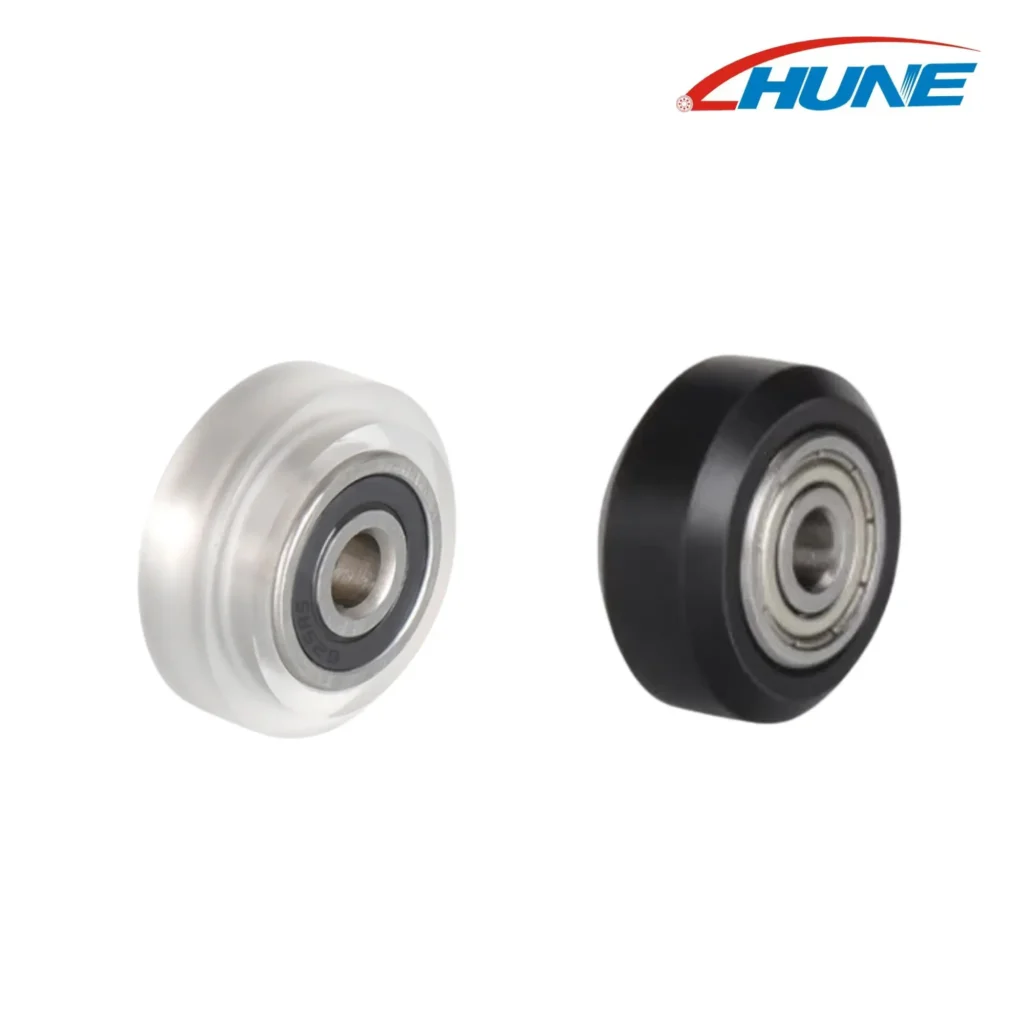 Existing HUNE media-library image showing two bearing-wheel constructions. It does not indicate approval for an elevator car door, landing door or coupling position.
HUNE's sliding rollers with bearings show several outer profiles and mounting styles. A catalog wheel is a starting point for discussion. It becomes a candidate for an elevator-related project only after its complete interface and acceptance requirements have been reviewed.
Do Car Doors and Landing Doors Use the Same Safety Devices?
They share a safety objective, but their locks, contacts and sensors perform different functions.
Landing-door locks mechanically secure individual shaft entrances and provide electrical verification. Car-door monitoring and locking arrangements establish the required car-door condition. The control system uses the relevant inputs to determine whether normal travel may proceed.
Passenger-detection devices serve another purpose. A light curtain detects an interruption across the entrance, while a contact safety edge responds when its edge is actuated. During normal closing, these inputs can cause reopening according to the control logic. They do not replace the mechanical landing-door lock.
This distinction matters during diagnosis and procurement. A reopening command can come from a protective input even when the rollers move freely. A door can move smoothly while a lock contact fails to establish the required state. Mechanical movement, passenger detection and lock verification need separate acceptance checks.
What Are the OEM Sourcing Implications?
Name the door side and component function before requesting a quotation.
“Elevator door roller” is incomplete because it could refer to at least three different interfaces. A useful inquiry begins with the assembly position: car-door hanger, landing-door hanger, coupling pickup, retention roller or transmission pulley.
For a replacement or new project, send the supplier:
- The exact door side and roller function.
- A drawing or sample plus the mating rail, vane, cam or belt geometry.
- Door arrangement, panel mass, component load direction and expected load at the roller position.
- Operating frequency, speed, reversals, temperature, moisture and cleaning exposure.
- Wheel material grade, bearing construction, lubrication and axle specification.
- Bracket, spacer, shoulder and fastener section with functional datums.
- Required dimensional checks, endurance validation, traceability and change-control documents.
- Prototype quantity, first order and forecast annual volume.
Track shape should be verified rather than inferred from a name such as flat, U-groove or V-groove. Our guide to selecting a sliding roller with a bearing for an industrial door explains how wheel and track geometry work as one interface. Where a rounded mating surface is actually specified, HUNE U-groove bearing wheels provide examples for comparison.
For a custom polymer wheel, prototype and production methods may differ. The article on machined versus injection-moulded POM rollers outlines the tradeoffs between geometry trials, tooling and repeat production.
The elevator or entrance manufacturer remains responsible for approving the component within the complete system and applicable project requirements. Similar size or material does not demonstrate interchangeability.
Frequently Asked Questions
Can Landing Doors Open When the Elevator Is Not at That Floor?
During normal automatic service, a landing door remains closed and locked when the elevator car is not at that entrance. Authorized emergency and service procedures are separate matters for qualified personnel and the applicable equipment. A component supplier should focus on the approved lock, coupling and monitoring requirements rather than assume that a movable panel alone defines safe operation.
Does Every Landing Door Have Its Own Door Motor?
No. In a common passenger elevator, the motorized operator travels with the car, and a mechanical coupling transfers motion to the selected landing doors. Some systems use other architectures, including independently powered landing doors. The buyer should identify the installed design before specifying a motor, pulley, coupling roller or control interface.
Are Car-Door and Landing-Door Hanger Rollers Interchangeable?
They may share a general construction, but interchangeability must be demonstrated. Compare the rail profile, running diameter, bearing, axle, bracket clearance, load direction and approved validation requirements. Even a small difference in wheel position can affect panel height, coupling alignment or lock engagement, so matching outside diameter and bore is insufficient.
Is a Coupling Pickup Roller a Door-Support Roller?
Usually no. A pickup roller contacts the car-side coupling vane or cam and transfers force within the coupling or lock mechanism. A hanger roller supports a door panel on a rail. Their bearings, mountings and contact loads may be different, so the procurement drawing should state the roller's exact function.
Send Your Elevator Door Roller Requirement to HUNE
HUNE manufactures polymer-covered bearing rollers and related custom sliding hardware for OEM projects. We can review a drawing or sample together with the wheel profile, bearing, axle, bracket and mating surface.
Use the HUNE contact form to send your elevator door roller inquiry. State whether the part belongs to a car door, landing door or coupling, and include the approved interface and qualification requirements. The practical sourcing decision is to establish the component's exact duty first, then assess an existing wheel or develop a custom design around that verified assembly.