
A belt conveyor moves products on a continuous belt that wraps around pulleys. A roller conveyor moves products across a series of rotating rollers, so the load’s base contacts the rollers directly. That difference changes how each system supports products, handles gaps and transfers motion. Belts provide a nearly continuous carrying surface; rollers create a line of contact points. The better choice depends on the product’s underside, size and stability, the required flow, and the machine layout. Powered roller conveyors can move individual loads and support accumulation or controlled zones, while gravity roller conveyors rely on a suitable slope and load. Neither type is universally better, and many facilities use both for different sections of one material-handling route.
How Does a Belt Conveyor Move Products?
The belt carries the product; pulleys drive and redirect the belt, while a bed or support rollers carry the belt and its load.
A typical belt conveyor uses a motor and drive pulley to move an endless belt. Products sit on the upper belt run. At the opposite end, the belt turns around a tail pulley and returns underneath. Depending on the design, the loaded belt is supported by a slider bed, carrying idlers or another support arrangement.
Because the product rests on the belt rather than on exposed carrying rollers, the belt can support small items, irregular bottoms and packages that might catch in gaps between rollers. It also gives the designer a continuous surface for controlled transfers. Inclines and declines are possible when the belt surface, product stability and operating conditions are suitable; the design still has to prevent sliding or tipping.
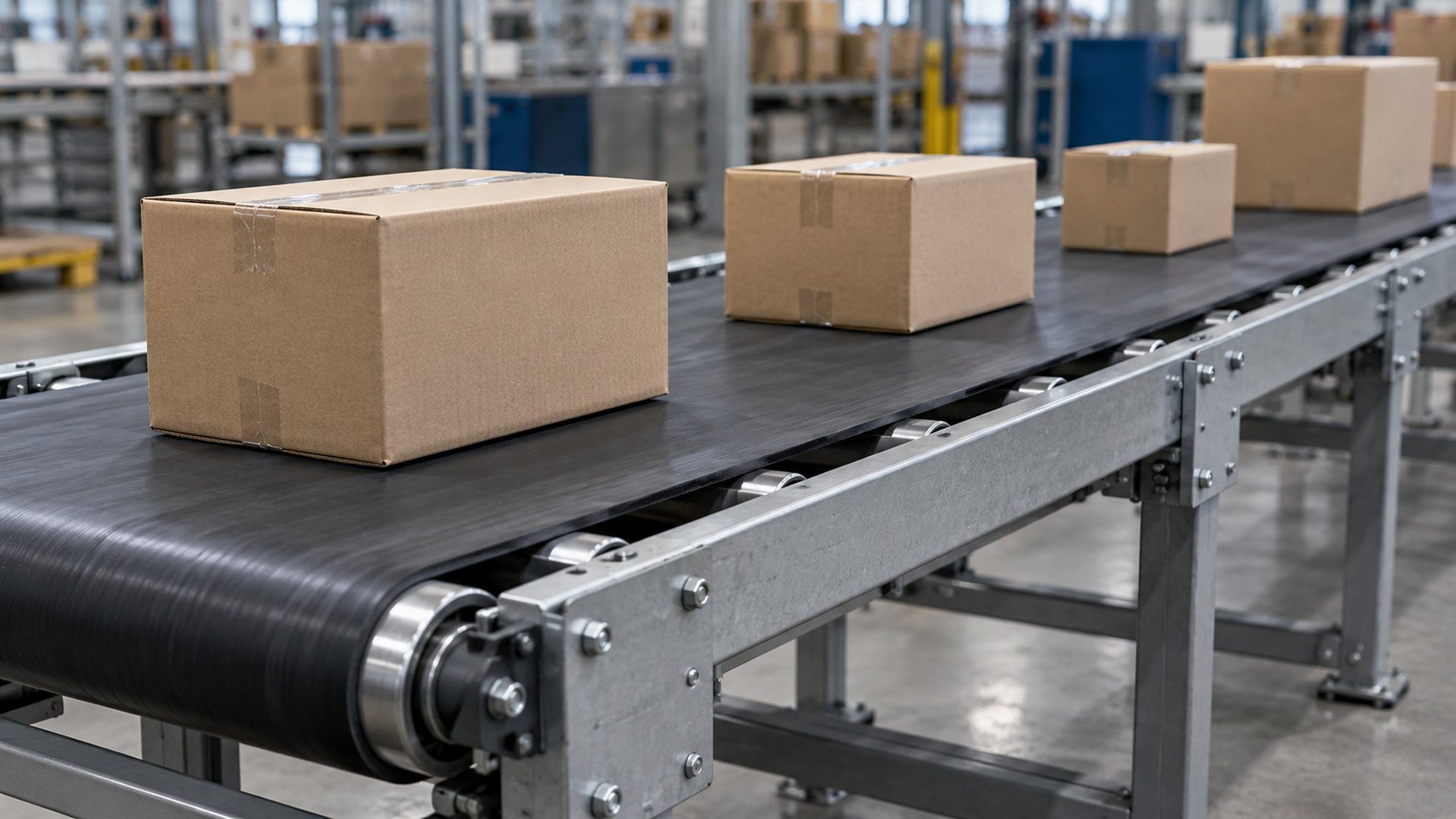 On a belt conveyor, cartons ride on the belt while the conveyor structure supports the belt from below.
The belt does not eliminate support components. Pulley shafts and bearings carry forces from belt tension and product load, while idlers or a slider bed support the belt along its route. Tracking, tension, belt splice, pulley alignment and frame stiffness all affect how the system runs. CEMA lists unit-handling belt conveyors as a distinct equipment category in its ANSI conveyor standards.
How Does a Roller Conveyor Move Products?
The product moves across the tops of separate rollers, which can turn freely or receive power from a drive system.
In a gravity roller conveyor, the rollers rotate as a person or an incline moves the load. A powered roller conveyor uses a motor, motorized rollers, belts, chains or another drive arrangement to move products along a level or controlled path. The product’s base contacts the roller crowns directly, so the load must bridge the spaces between rollers without sagging, snagging or becoming unstable.
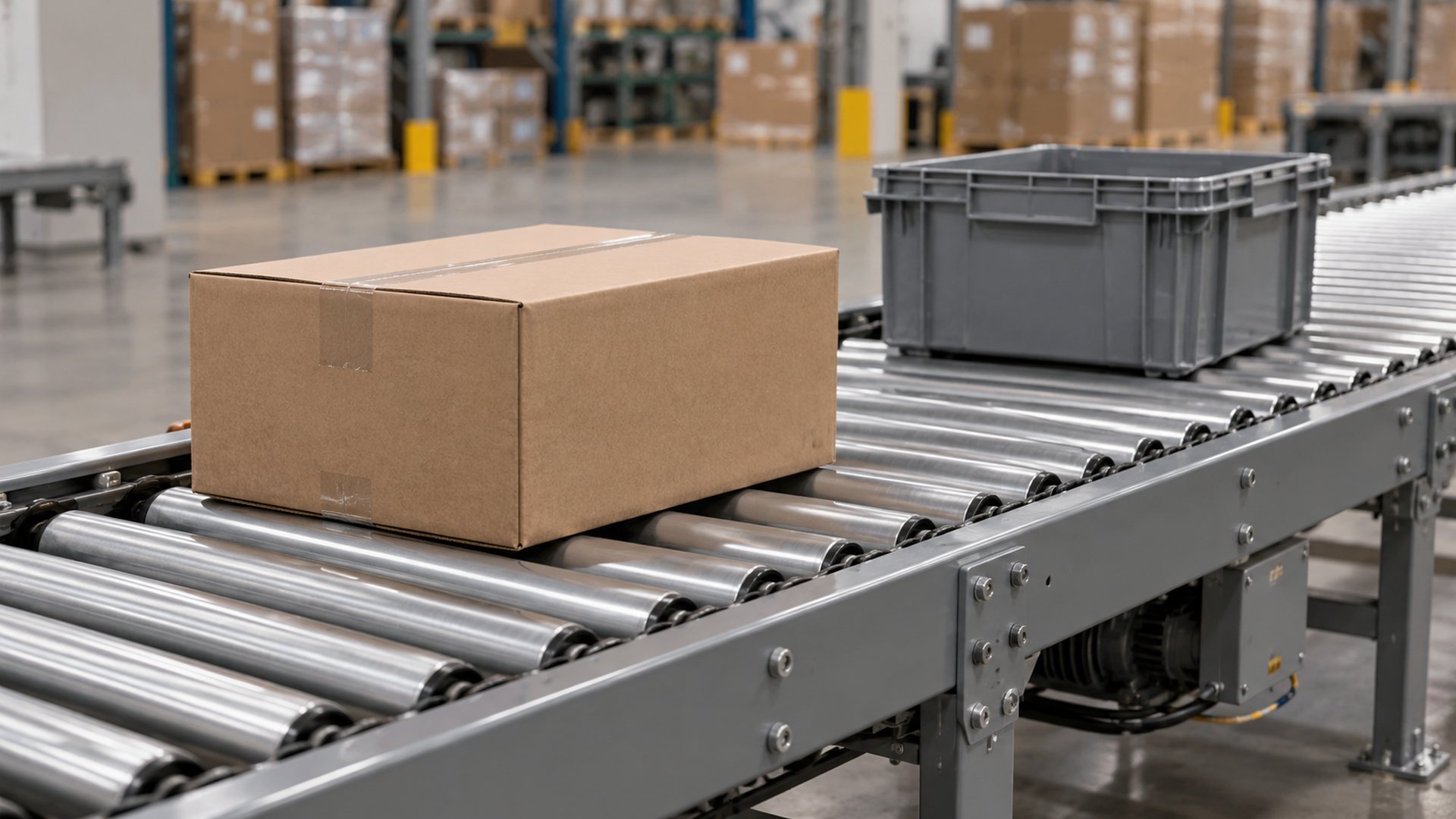 Here the carton and tote are supported directly by the conveyor rollers; the roller spacing has to suit their bases.
Roller conveyors can be arranged in straight sections, curves, merges and accumulation zones. The exact behavior depends on whether rollers are gravity-driven or powered, whether zones operate independently and how the conveyed unit is controlled. “Roller conveyor” therefore describes a family of layouts rather than one single drive method. Interroll’s modular conveyor platform shows both roller and belt conveyor modules within a broader material-handling system.
Roller pitch is a functional dimension. A common design check is to ensure the smallest or least stable conveyed unit remains supported by enough rollers throughout movement. The appropriate number and spacing depend on the unit’s length, bottom stiffness, weight distribution and transfer conditions; use the conveyor designer’s specification rather than a universal pitch value.
What Is the Main Difference Between Belt and Roller Conveyors?
The key distinction is the product-contact surface: a continuous moving belt versus separate rotating rollers.
| Design question | Belt conveyor | Roller conveyor |
|---|---|---|
| What touches the product? | The belt surface | The tops of the conveyor rollers |
| What supports the product? | The belt, supported by a bed or carrying idlers | Multiple rollers under the product base |
| Base geometry | Can accommodate many irregular or small footprints, subject to belt design | Needs a sufficiently rigid, stable base that bridges roller gaps |
| Typical motion | The belt carries the product continuously | Gravity or a drive turns the rollers and advances the product |
| Accumulation | Requires an appropriate belt and control strategy; contact and back-pressure need consideration | Can be designed with powered zones or other accumulation methods |
| Product interface | Belt material and surface texture matter | Roller diameter, pitch, surface and drive arrangement matter |
| Common design checks | Belt tracking, tension, splice, pulley alignment and support | Roller pitch, load distribution, drive zones, frame alignment and bearing condition |
CEMA maintains separate standards for non-powered roller conveyors and belt conveyors, reflecting that the equipment types have distinct design and application considerations. The standard listing also identifies belt-driven live roller conveyors as their own category. This is a useful reminder that hybrid or powered roller layouts should be described by their actual mechanism, not judged from the word “roller” alone.
Which Conveyor Is Better for Different Products?
Start with the product’s bottom surface and the way it must move, then choose the conveying surface and controls around that duty.
A belt is often worth evaluating when products have small feet, soft or uneven bottoms, or a footprint that cannot bridge the roller spacing reliably. It can also suit a transfer path where the product needs a continuous surface. Confirm that the belt material, width, friction, cleanliness requirements and transition geometry fit the item.
A roller conveyor is often worth evaluating for rigid-bottom cartons, totes, trays or pallets that can remain stable while supported at separated contact points. It may simplify certain accumulation or transfer layouts, but the designer must account for roller pitch, load distribution, drive zoning and gaps at transitions.
Neither generalization replaces a layout review. A soft package can deform on rollers; a high-friction belt may affect how a product is released; an unstable load can tip on a curve or during acceleration. Conveyed product dimensions, mass distribution, centre of gravity, bottom stiffness and the required orientation should be part of the conveyor specification.
How Do Layout, Transfers and Controls Affect the Choice?
The route between stations can matter as much as the straight conveyor section.
Review how products enter and leave the conveyor, where they stop, whether they queue, and how branches or merges work. A belt can provide continuous support across a transfer, while roller systems can be integrated with powered zones, pop-up transfers or other modules. Both types can be part of a larger line, and a facility may use a belt for one product-handling stage and rollers for another.
Also consider what happens during startup, stopping and accumulation. A powered belt may continue to slide beneath a stopped product if the control strategy allows it. A powered roller system may use independently controlled zones to reduce contact between accumulated products. Actual behavior depends on the selected drive and control design. Specify the required flow logic—singulation, buffering, metering, accumulation or continuous transport—rather than assuming the conveyor type alone determines it.
Where Do Bearings and Small Guide Rollers Fit?
Bearings support rotating shafts and rollers; compact plastic-coated bearing wheels usually guide or position a moving part rather than replace the main conveyor carrying surface.
Both belt and roller conveyors contain rotating components. Bearings may support drive pulleys, tail pulleys, idlers or powered rollers, but those bearing assemblies are selected as part of the conveyor manufacturer’s load, speed, sealing and mounting design. A small bearing roller has a different role when it contacts a belt edge, guides a carrier, locates a product against a rail or controls a moving fixture.
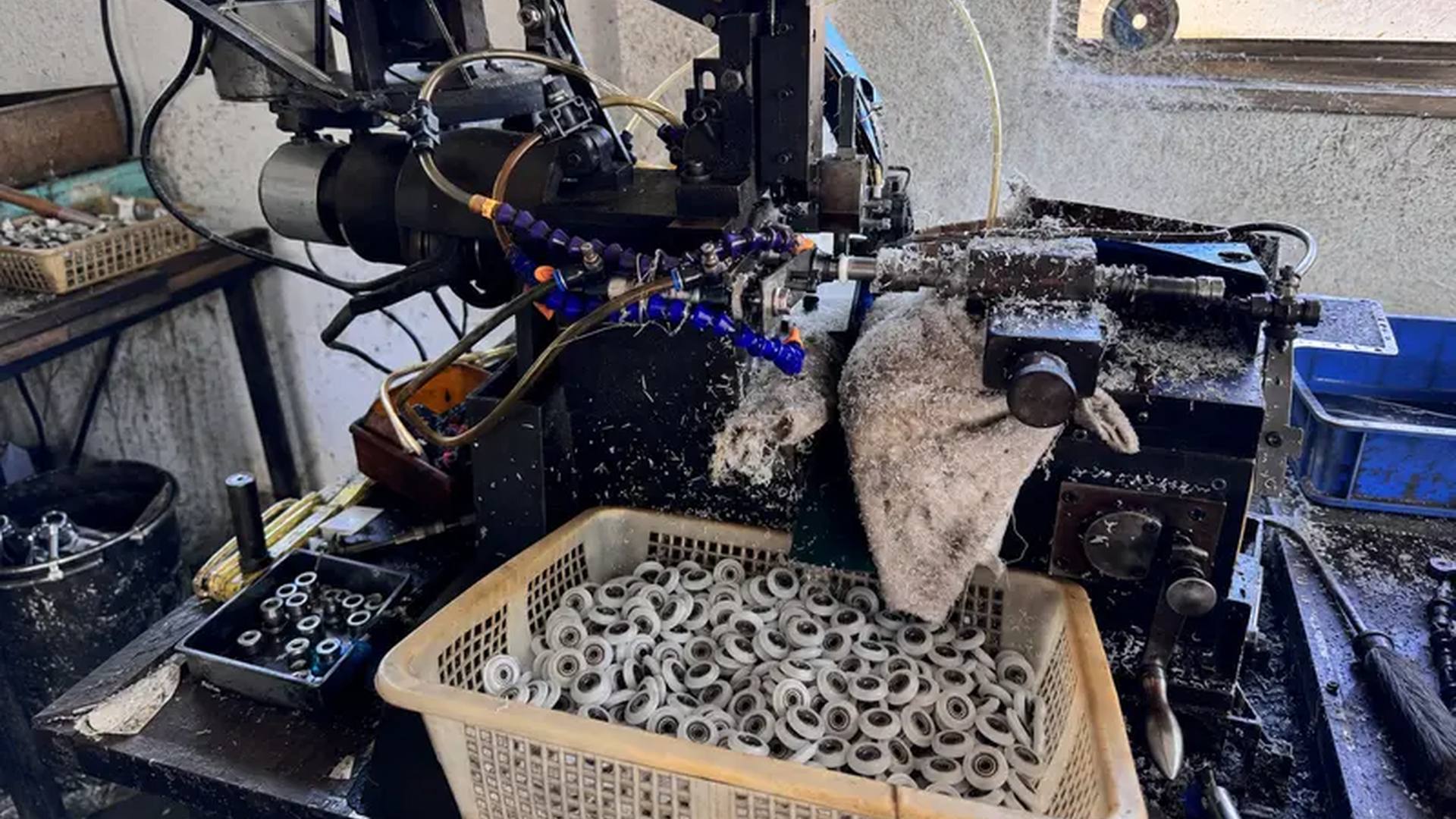 This HUNE media-library image shows plastic-coated bearing roller production. These compact wheels are application-specific guides, not general-purpose conveyor-bed rollers.
For a guide wheel, the wheel profile must match its mating rail, edge, cable or product surface. The bearing bore, outer diameter, width, groove or flange geometry, mounting shoulder, axle and installed clearance all influence whether the complete assembly rotates freely and follows the intended path. A plastic-coated bearing guide system for conveyors explains how to define contact duty and mating geometry. If the application uses a round rail or cord, a U-groove bearing roller may be relevant when its groove matches the mating part. For other carriage-guidance layouts, see how roller guide systems keep machine carriages moving straight.
Do not select a compact guide wheel as though it were a main support roller simply because both parts rotate. A side guide may see intermittent axial contact; a carrying roller sees product load through the conveyor structure. Continuous side contact can add friction, wear a belt edge and impose forces on the wheel, bearing, axle and bracket. Correct conveyor alignment and a clearly defined roller duty matter together.
What Should OEMs Specify Before Choosing a Conveyor?
A useful comparison starts with the conveyed unit, required flow and installed geometry—not just a conveyor name or a roller diameter.
Before requesting a system proposal, an OEM should prepare:
- Product length, width, height and mass, including minimum and maximum cases.
- Bottom-surface material, stiffness, flatness, feet or runners, and any fragile contact areas.
- Required throughput, operating speed, start-stop pattern and accumulation behavior.
- Conveyor route, elevation changes, curves, transfers, merges and available footprint.
- Required positioning, orientation, spacing and product release behavior.
- Ambient conditions such as dust, moisture, temperature, washdown or chemical exposure.
- Drive and control requirements, guarding interfaces and maintenance access.
- Acceptance criteria for noise, product marking, line stability and repeatability.
For any custom bearing roller or guide wheel included in the design, also send the assembly drawing, mating-track or product geometry, bearing designation if fixed, shaft or stud dimensions, intended load direction, duty cycle, material requirements, target quantity and sample requirements. Include datum references and functional tolerances for the working profile, bearing seat, runout and installed axial clearance where those features control motion. For a custom guide wheel or roller assembly, HUNE's OEM process starts with the drawing or sample, mating geometry, operating conditions and expected quantity.
A supplier can then compare standard components, custom rollers and process options against the actual assembly. The machine OEM remains responsible for validating the complete conveyor under representative product, speed, control and environment conditions.
Frequently Asked Questions
Can a belt conveyor carry products with an uneven bottom?
Often it can because the product rests on a continuous belt, but the product still needs to remain stable. The belt surface, incline, transitions, friction and product centre of gravity all affect suitability.
Do roller conveyors have to be inclined?
No. Gravity roller conveyors commonly use a slope or manual push, while powered roller conveyors can move products along a level path. The required drive method depends on the layout and flow-control needs.
Are roller conveyors suitable for small packages?
They can be when the package base is supported across the roller gaps and remains stable. Small or flexible items may require closer pitch, a tray or carrier, or a continuous belt surface.
Which conveyor is better for accumulation?
Neither type wins in every layout. Powered roller systems can use controlled zones, while belt conveyors can also be designed for buffering or metering. The correct choice depends on the product, acceptable contact or back-pressure, controls and transfer arrangement.
Are guide rollers the same as conveyor rollers?
No. A conveyor carrying roller supports the conveyed load as part of the bed. A compact guide roller usually limits lateral movement or guides a belt edge, carrier, rail or product. Their load path and functional dimensions differ.
A Practical Recommendation for OEM Buyers
Choose the conveyor from the product interface outward: confirm what surface will support the product, how the load behaves across gaps or transitions, and what motion and accumulation logic the line requires. Then verify the complete route with representative products. Specify bearings, guide wheels and mating geometry only after their role in the load path is clear.
HUNE, Zhejiang Huaneng Micro Bearing Co., Ltd., manufactures bearings, plastic-coated bearing rollers and customized roller assemblies. If your conveyor design includes a compact guide wheel or a custom roller-and-bearing assembly, send us the product or track drawing, mating dimensions, operating conditions, load direction and expected quantity through our contact page. We can review whether a standard profile or a customized assembly is worth evaluating for your equipment.


[…] edges, oil, heat, static control and washdown can change material and construction choices. The belt-versus-roller comparison explains how those two common systems support […]