A bearing suitable for a wet roller system needs more than a stainless-steel label or two rubber seals. The bearing rings and rolling elements must resist the actual water and cleaner chemistry, the closure must limit ingress under the real spray direction and pressure, and the lubricant must continue separating the raceways after moisture exposure. The wheel, axle, spacers, bracket and housing must also avoid trapping water around the bearing faces.
I do not approve a “waterproof bearing” as a complete specification. Humidity, occasional splash, outdoor rain, repeated washdown and immersion create different risks. Speed, load, idle wet time, temperature and cleaning chemicals change the answer again. The correct OEM approach is to define the exposure, select the bearing and complete roller assembly together, and validate them through representative wet operating cycles.
Why Does Water Change Bearing Selection?
Water attacks both the rolling surfaces and the lubrication system, while the roller assembly can hold moisture exactly where the bearing needs protection.
When water reaches the bearing interior, it can disturb the lubricant film, reduce grease consistency, promote corrosion and carry fine contaminants into the raceway. A bearing may still turn after one splash test yet develop rising torque, noise or surface damage after repeated wetting and drying.
The wet environment also creates risks outside the bearing:
- corrosion can roughen the axle or spacer surface;
- a corroded fastener can change clamping force;
- trapped water can remain in the wheel hub after the visible surface dries;
- cleaning residue can attack seal elastomers or wheel material;
- mixed metals can create localized corrosion at wet contact points;
- deposits on the track can change rolling contact and side load;
- dimensional change in the wheel can alter bearing fit or running clearance.
SKF’s guidance for bearings in wet and contaminated environments explains that moisture can degrade lubrication, increase wear and corrosion, and that high-pressure washdown can deflect integral bearing seals and wash grease out. This is why a standard 2RS designation should be treated as one layer of protection, not proof that the roller system is washdown-ready.
Which Wet Exposure Must the Bearing Survive?
The first engineering task is to describe the exposure precisely; “wet” is not a single operating condition.
I normally separate the environment into practical exposure classes before discussing bearing material or seal suffixes.
| Exposure condition | Typical example | Main bearing risk | System information needed |
|---|---|---|---|
| High humidity or condensation | Bathroom hardware, cold-room transitions | Moisture film and standstill corrosion | Condensation cycle, idle time and drainage |
| Occasional splash | Beverage equipment outside the direct wash zone | Intermittent ingress and grease contamination | Splash direction, frequency and fluid chemistry |
| Outdoor rain | Gates, doors and exposed guides | Repeated wet/dry cycles, dirt and corrosion | Orientation, shelter, temperature and runoff path |
| Routine low-pressure washdown | Packaging or food equipment | Seal exposure and lubricant washout | Flow, duration, temperature, detergent and cleaning frequency |
| High-pressure or hot washdown | Hygienic processing equipment | Seal deflection, chemical attack and forced ingress | Pressure at the component, nozzle distance, angle and fluid temperature |
| Intermittent immersion | Tank guides or flooded mechanisms | Sustained ingress and trapped moisture | Immersion depth, time, chemistry and pressure cycle |
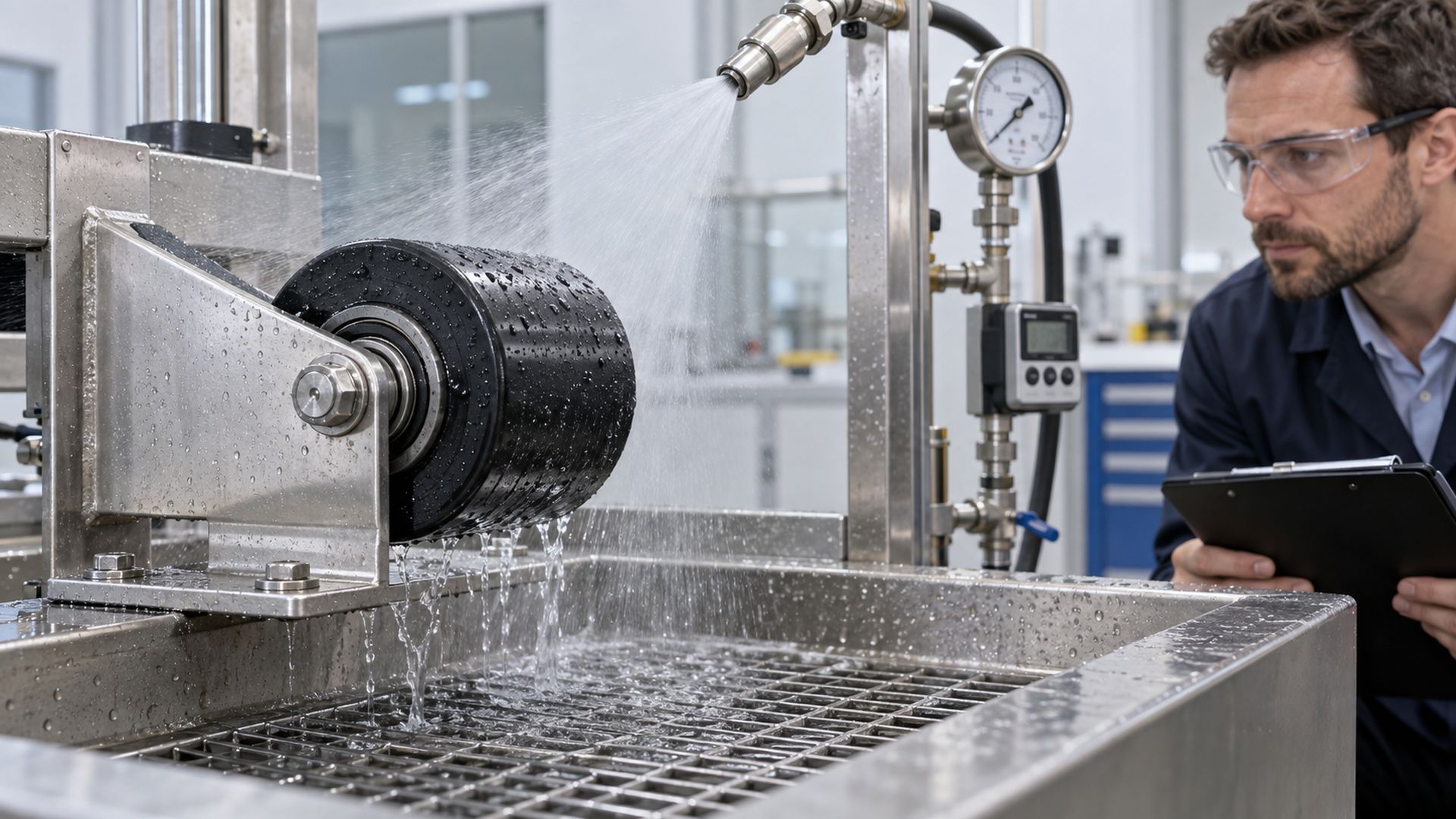
The table is a screening tool. Two systems described as “washdown” can still require different bearings because one uses cool water from a distant nozzle while another uses hot alkaline cleaner directed at the bearing face.
Which Bearing Materials Work in Wet Roller Systems?
Material choice is a trade-off between corrosion resistance, raceway hardness, load capacity, availability and the exact chemistry.
Standard chromium bearing steel provides high hardness and good rolling-contact performance, but exposed steel needs effective protection from moisture. In a well-sealed and sheltered roller, it may still be practical. In a directly sprayed assembly with long wet idle periods, its corrosion risk becomes more important.
Martensitic stainless bearing steels can combine useful corrosion resistance with the hardness required for raceways. However, “stainless bearing” is incomplete without the alloy, heat treatment, balls, cage, seal reinforcement and lubricant. Stainless steel can still pit or develop crevice corrosion in chloride-containing or aggressive cleaning environments.
Hybrid bearings use ceramic rolling elements with steel or stainless rings. Ceramic balls do not rust, but the raceways and other metal parts can still corrode. Polymer bearings can resist some chemicals and run without conventional grease, but they have different stiffness, load, temperature, dimensional and wear limits. Neither construction is an automatic substitute for a small deep-groove ball bearing.
Outokumpu’s overview of stainless-steel corrosion resistance explains that alloy composition, pH, temperature, design, fabrication and surface condition all influence corrosion behaviour. For roller sourcing, specify each component rather than writing “all stainless” on the purchase order.
HUNE’s comparison of carbon steel, bearing steel and stainless steel bearings provides more detail on where these materials fit within a roller assembly.
Are Sealed Bearings Waterproof?
No. A contacting seal improves the exclusion path, but a standard sealed bearing is not automatically suitable for pressure washing or immersion.
A metal shield forms a narrow non-contact gap. It can retain grease and block larger particles with low friction, but it offers limited resistance to water reaching the bearing face. A contact seal runs against a counterface on the inner ring and normally provides stronger moisture exclusion. Low-friction and non-contact polymer seals sit between those two behaviours.
For a wet roller, I confirm:
- whether both bearing faces are sealed;
- whether the seal is contact, low-friction or non-contact;
- seal-lip material and compatibility with detergent, oil and temperature;
- permitted rotational speed and seal torque;
- whether the wheel or spacer rubs the seal face;
- whether spray is directed toward the seal counterface;
- whether pressure differences can pull fluid inward;
- whether an external flinger, cap, labyrinth or housing seal is required.
The best solution may use several barriers: a roller cover or flinger interrupts the direct spray path, a labyrinth increases the path length, the bearing seal provides the next barrier, and the assembly drains any fluid that passes the first layer. HUNE’s guide to sealed versus shielded bearings explains the basic closure trade-off in more detail.
Why Does Lubricant Matter as Much as the Seal?
The bearing still needs a stable lubricant film after exposure; keeping some water out is only part of wet-duty performance.
Water can soften, emulsify or displace grease depending on the thickener, base oil, additives and exposure. A grease selected for dry indoor service may not provide the same protection after repeated spray or condensation. Corrosion inhibitors, water resistance, seal compatibility, speed and operating temperature all belong in the selection.
ASTM D1264-24 evaluates the resistance of lubricating grease to water washout from a ball bearing under prescribed laboratory conditions. ASTM also states that the method is not equivalent to a service evaluation and that field correlation has not been established. I therefore use a grease test result as comparative evidence, not as a prediction of roller service life.
Food, beverage or pharmaceutical machinery can add another requirement. If incidental food contact is possible, the lubricant specification may need an appropriate registration or certification. NSF explains that H1 lubricants are intended for incidental food contact and that ISO 21469 addresses hygienic requirements for such lubricants. This requirement must be stated by the equipment manufacturer; it should not be inferred from the phrase “stainless bearing.”
How Does the Complete Roller Assembly Keep Water Out?
The bearing survives only as well as the interfaces around it: wheel hub, axle, spacer, bracket, covers and drainage.
For a bearing roller, the normal load path is:
Track or belt → wheel tread → wheel hub → bearing outer ring → rolling elements → inner ring → axle → bracket → machine frame
The water path can follow a different route. Fluid may run along the axle, collect behind a washer, enter between the bearing outer ring and wheel, or remain in a recessed hub. A decorative cap can hide water instead of excluding it. A tight crevice can retain cleaner after the open surfaces have dried.
I check the following interfaces on the assembly drawing:
- Bearing seat. The wheel must retain the outer ring without crushing it or leaving a capillary path that stores fluid.
- Axle and inner-ring support. The axle surface and spacer stack must remain stable after wet exposure.
- Seal-face clearance. Spacers, moulded lips and press tools must not damage or rub the bearing closure.
- Drainage orientation. Water should leave the hub and bracket rather than pool against either bearing face.
- Material pairing. Rings, balls, axle, washers, bracket and fasteners need compatible corrosion performance.
- Wheel material. Moisture absorption, hydrolysis, swelling and chemical resistance can change the wheel-to-bearing fit.
- Track geometry. Misalignment or deposits can add axial load, forcing the seal and raceways to work under an unintended condition.
Internal clearance also matters because a tight wheel fit and moisture-related dimensional change can reduce the operating clearance. See HUNE’s guide to bearing clearance in OEM rollers when defining the wheel seat and axle fit.
Can a Standard Bearing Roller Be Used in a Wet System?
Possibly, but matching wheel dimensions does not establish wet-duty suitability.
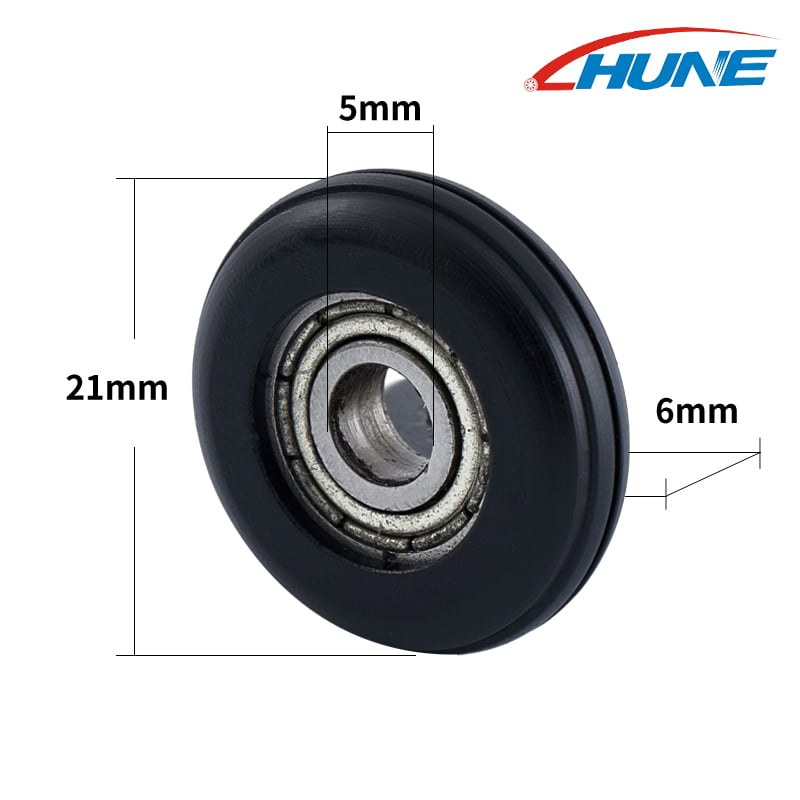
An existing roller can shorten development time when its outside diameter, groove, width, bore and load path fit the application. The buyer must still confirm the bearing closure, material, grease, axle, bracket and exposure protection. The media-library example above shows a round-groove roller with a visible metal-shielded bearing; it should not be interpreted as a washdown recommendation without an application review.
HUNE’s round-groove roller wheel with bearing can be supplied with different wheel and bearing options for OEM review. For a wet project, the approved drawing should record the full bearing designation and materials rather than leaving the internal bearing as a generic equivalent.
Which Bearing Approach Fits Common Wet Applications?
Start with the exposure mechanism and acceptable maintenance, then choose the lightest system that provides enough protection.
| Application | First approach to assess | Important limitation |
|---|---|---|
| Humid indoor door or furniture roller | Contact-sealed bearing, protected axle and drainage | Condensation can remain in concealed hubs |
| Outdoor guide roller | Sealed corrosion-resistant bearing plus rain shield or flinger | Wind-driven rain and dirt reach different faces |
| Shower enclosure roller | Corrosion-resistant bearing and hardware, sealed faces and open drainage | Chlorides, cleaners and crevices can still attack stainless parts |
| Beverage or packaging splash zone | Sealed stainless bearing with compatible grease and hygienic hardware | Product chemistry and cleaning frequency must be defined |
| Routine washdown conveyor guide | Multi-barrier sealing, washout-resistant grease and drainable housing | Integral seals alone may admit fluid under direct spray |
| High-pressure hygienic cleaning | Application-specific housed solution with external sealing | Standard miniature 2RS bearing may be the wrong architecture |
| Intermittently immersed guide | Purpose-designed submerged arrangement or alternative bearing technology | Trapped fluid and pressure cycling require dedicated validation |
These are starting points, not universal specifications. Load, speed, temperature, regulatory requirements and available installation space can change the preferred construction.
How Should an OEM Validate a Wet Roller System?
Test the installed assembly while it rotates under representative load, then inspect it after repeated wet and dry cycles.
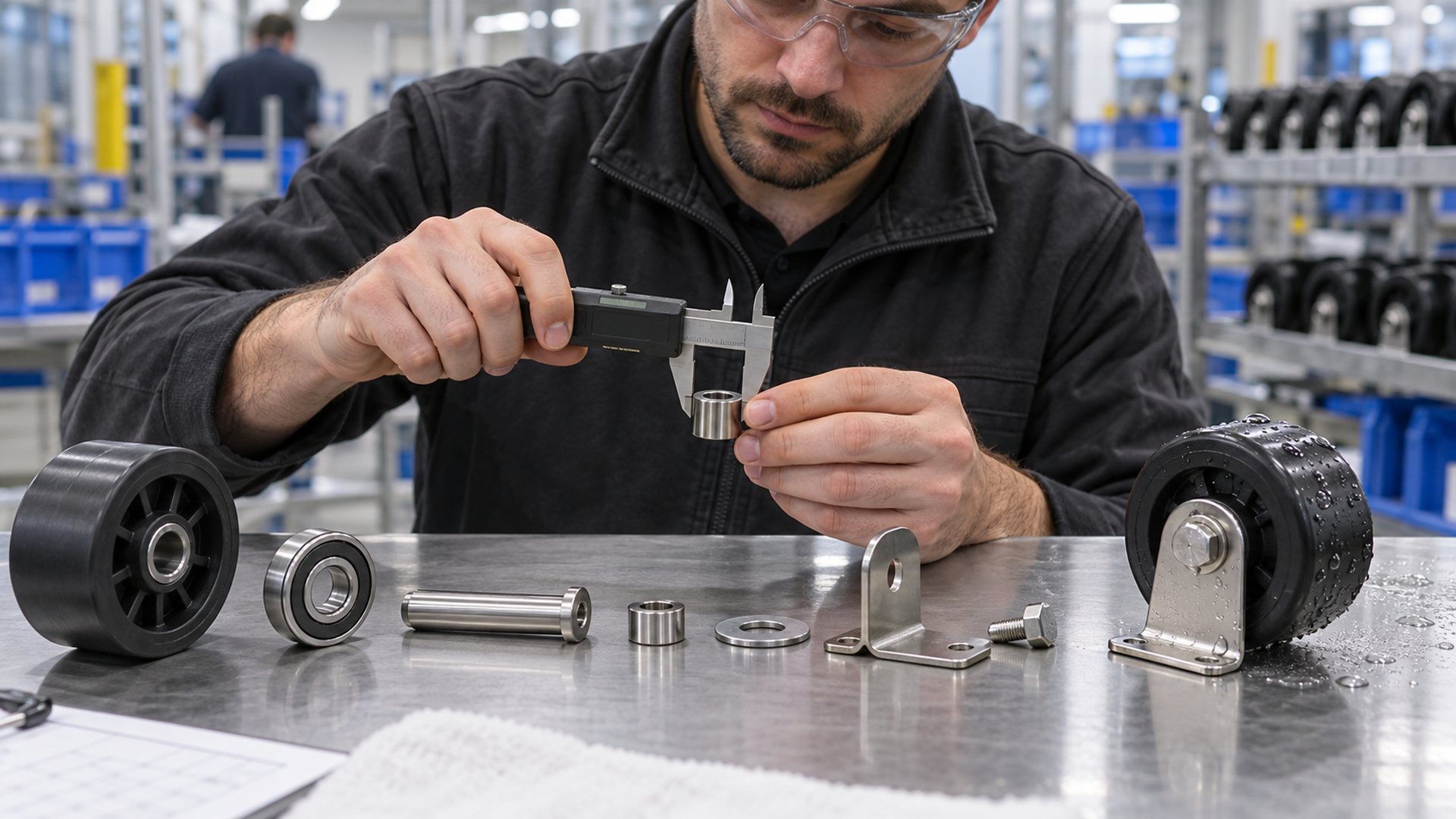
A useful validation plan includes:
- Record initial running torque, noise, runout and free rotation after final tightening.
- Use the actual wheel, bearing, axle, spacers, bracket, fastener and track geometry.
- Apply the specified water or cleaning fluid from the real direction, distance, temperature and pressure.
- Rotate and load the roller during exposure when that reflects service.
- Include wet dwell periods if the equipment normally stops before drying.
- Repeat the defined wash, run and dry sequence for the OEM’s required duration.
- Monitor torque, temperature, noise, tracking and visible lubricant leakage.
- Inspect seals, axle surfaces, fasteners, wheel fit and drainage after testing.
- Where justified, disassemble samples and inspect grease condition and raceway corrosion.
- Compare repeat samples and production lots against the approved baseline.
Salt-spray or grease washout data can compare materials and lubricants under standardized conditions. They do not reproduce the geometry, rotation, load and chemical retention of the finished roller. The final acceptance test should therefore be tied to the real machine and its cleaning process.
What Should a Buyer Include in an RFQ?
A wet-duty roller inquiry should define the fluid exposure and complete mounting system before asking for a bearing suffix.
Send the supplier:
- application and roller position;
- drawing or sample of the wheel, axle, spacers, bracket and track;
- required bore, outside diameter, width and wheel profile;
- radial and axial loads, speed, duty cycle and direction changes;
- water source, spray direction, pressure at the component and nozzle distance;
- exposure duration, cleaning frequency and wet idle time;
- fluid temperature, pH, chlorides, detergent and disinfectant information;
- bearing material, closure, grease and internal-clearance requirements already approved;
- wheel, axle, bracket, fastener and cover materials;
- food-contact, hygiene or other compliance requirements;
- maintenance and relubrication strategy;
- validation method and acceptance limits;
- prototype quantity and forecast production volume.
If some values are unknown, provide the cleaning procedure and an assembly drawing so the supplier can identify missing decisions. HUNE’s OEM development process explains how drawings, samples and validation move into controlled production.
Discuss a Wet-Duty Bearing Roller with HUNE
HUNE, Zhejiang Huaneng Micro Bearing Co., Ltd., manufactures bearings, plastic-coated bearing rollers, injection-moulded wheels and customised roller assemblies. For a wet application, we can review the bearing, external wheel, axle, spacers and bracket as one system and help define samples for installed testing.
Send the exposure details, assembly drawing, loads, speed, cleaning procedure and expected quantity through the HUNE contact page. We can then assess whether an existing roller can be adapted or a dedicated wet-duty assembly should be developed.
Frequently Asked Questions
Is a 2RS bearing waterproof?
No. Two contact seals usually provide stronger exclusion than metal shields, but pressure, immersion, seal wear and fluid chemistry can still allow water to enter. External protection and drainage may be required.
Is a stainless-steel bearing enough for a wet roller?
No. The alloy, heat treatment, seals, lubricant, axle, spacers, bracket and retained crevices all affect performance. Stainless steel also has corrosion limits, especially in chloride-containing or aggressive chemical environments.
Can a ZZ bearing be used in a humid environment?
It may work when the bearing is sheltered and the surrounding wheel or housing limits condensation and splash. A metal shield has a gap, so direct moisture exposure usually requires a stronger closure or external protection.
Does an ASTM D1264 result predict wet roller life?
No. The method compares grease water-washout resistance under prescribed laboratory conditions. It does not reproduce the roller’s seal geometry, load, speed, cleaner chemistry or wet/dry cycle, so installed validation remains necessary.
Which bearing is best for salt water?
There is no universal answer. Salt water increases pitting and crevice-corrosion risk, so the OEM must specify salinity, exposure time, temperature, load, maintenance and acceptable life. A purpose-designed corrosion-resistant or non-metallic arrangement may be required beyond a conventional stainless bearing.
Practical Engineering Recommendation
Define the water path before choosing the bearing. Specify the real spray, chemistry, temperature, pressure, wet dwell, load and speed. Then design the seal barriers, lubricant, wheel seat, axle materials and drainage as one assembly. Approve production only after the complete roller has operated through representative wet cycles and still meets the OEM’s torque, noise, corrosion and tracking requirements.