Corrosion resistance matters in shower door rollers because water reaches more than the visible bracket. Moisture, soap residue and cleaning chemicals can enter gaps around the axle, bearing seal, fastener and glass clamp. Corrosion can then increase bearing torque, roughen the shaft, reduce fastener reliability, stain visible hardware and change the roller clearance that keeps a heavy glass panel aligned.
I do not treat “stainless roller” or “sealed bearing” as a complete specification. The wheel, bearing rings and balls, axle, washers, screws, housing and decorative covers may use different materials and face different exposure. Drainage, crevice geometry, surface finish and assembly damage matter as much as the alloy name. For an OEM project, define the water and cleaner exposure, select each component for its function, and validate the complete roller–glass–rail assembly through wet cycling rather than approving it from appearance alone.
Why Is a Shower Enclosure a Corrosive Environment?
A shower roller experiences repeated wetting, drying, condensation and chemical residue in small gaps that may stay wet long after the visible surface dries.
The environment is more complex than clean tap water. A roller can be exposed to:
- warm water and high humidity;
- condensation during and after use;
- soap, shampoo and mineral deposits;
- household bathroom cleaners;
- chloride-containing water or residues;
- acidic or alkaline cleaning products;
- abrasive wiping;
- long idle periods while moisture remains trapped; and
- different metals connected through a thin water film.
Repeated wet/dry cycles can concentrate residues. Water evaporates from an exposed surface while remaining inside a bearing seal lip, threaded joint, bracket fold or glass-clamp interface. These sheltered zones may receive less oxygen and be harder to rinse.
Stainless steel resists corrosion through a thin passive surface film. Outokumpu’s explanation of stainless-steel corrosion resistance notes that alloy composition, chemical environment, pH, temperature, surface finish, product design, fabrication and maintenance all influence corrosion behavior. It also identifies pitting and crevice corrosion as important risks in chloride-containing environments.
This does not mean an ordinary shower has the same severity as seawater or an industrial chloride process. It means the buyer should state the actual water, cleaner and regional conditions rather than relying on the word “bathroom.”
What Does the Complete Shower Door Roller System Include?
The roller is a wet mechanical assembly, not only a visible stainless wheel cover.
 A complete roller includes wheels, bearings, axle or shaft and mounting features. Shower use requires the exact materials and exposure path to be reviewed.
A typical sliding shower-door roller system can include:
- plastic, rubber-coated or metal running wheel;
- one or two ball bearings;
- axle, shoulder bolt or riveted pin;
- washers, spacers and retaining features;
- bracket or hanger body;
- glass clamp, bushing and gasket;
- height or alignment adjustment;
- decorative cover;
- screws, nuts and thread-locking method;
- upper or lower track; and
- retention or anti-jump feature.
The load path may be:
glass panel → clamp or bracket → axle → bearing inner ring → rolling elements → outer ring → wheel tread → rail
Corrosion at any metal interface can disturb motion or retention. A clean-looking cover can hide a corroding bearing or carbon-steel axle. A stainless bracket can remain visually acceptable while a plated screw rusts and stains the surrounding surface.
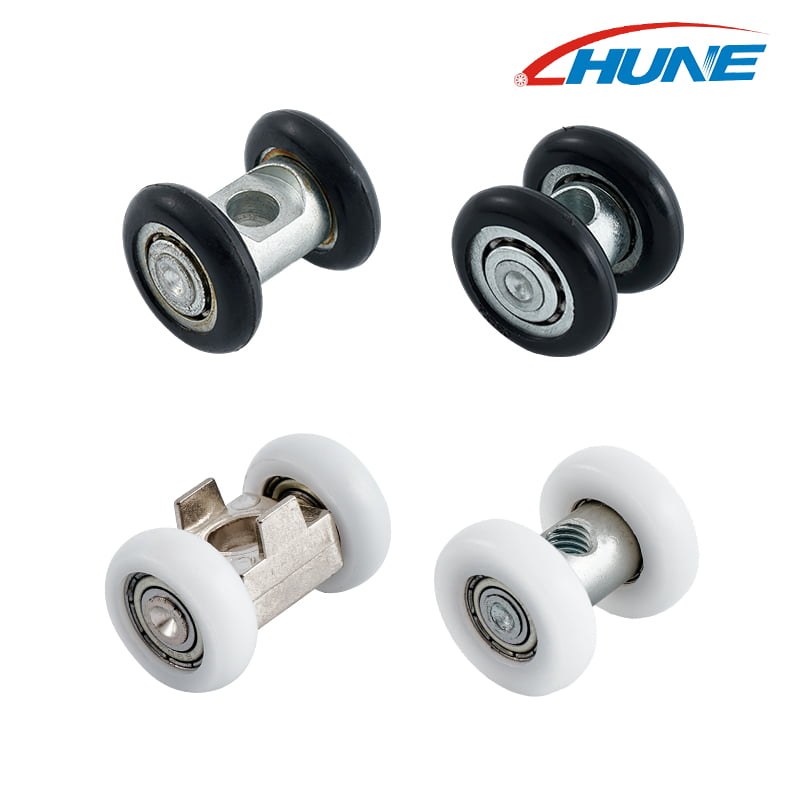
HUNE’s double-wheel sliding door roller with steel shaft is one example of a configurable wheel–bearing–shaft assembly whose application list includes shower door hardware. The published product options do not by themselves confirm wet-environment suitability; the bearing, shaft material, seals and hardware must follow the approved shower-door specification.
Where Does Corrosion Begin in a Shower Roller Assembly?
Corrosion often starts at hidden interfaces where moisture is retained, protective surfaces are damaged or dissimilar materials meet.
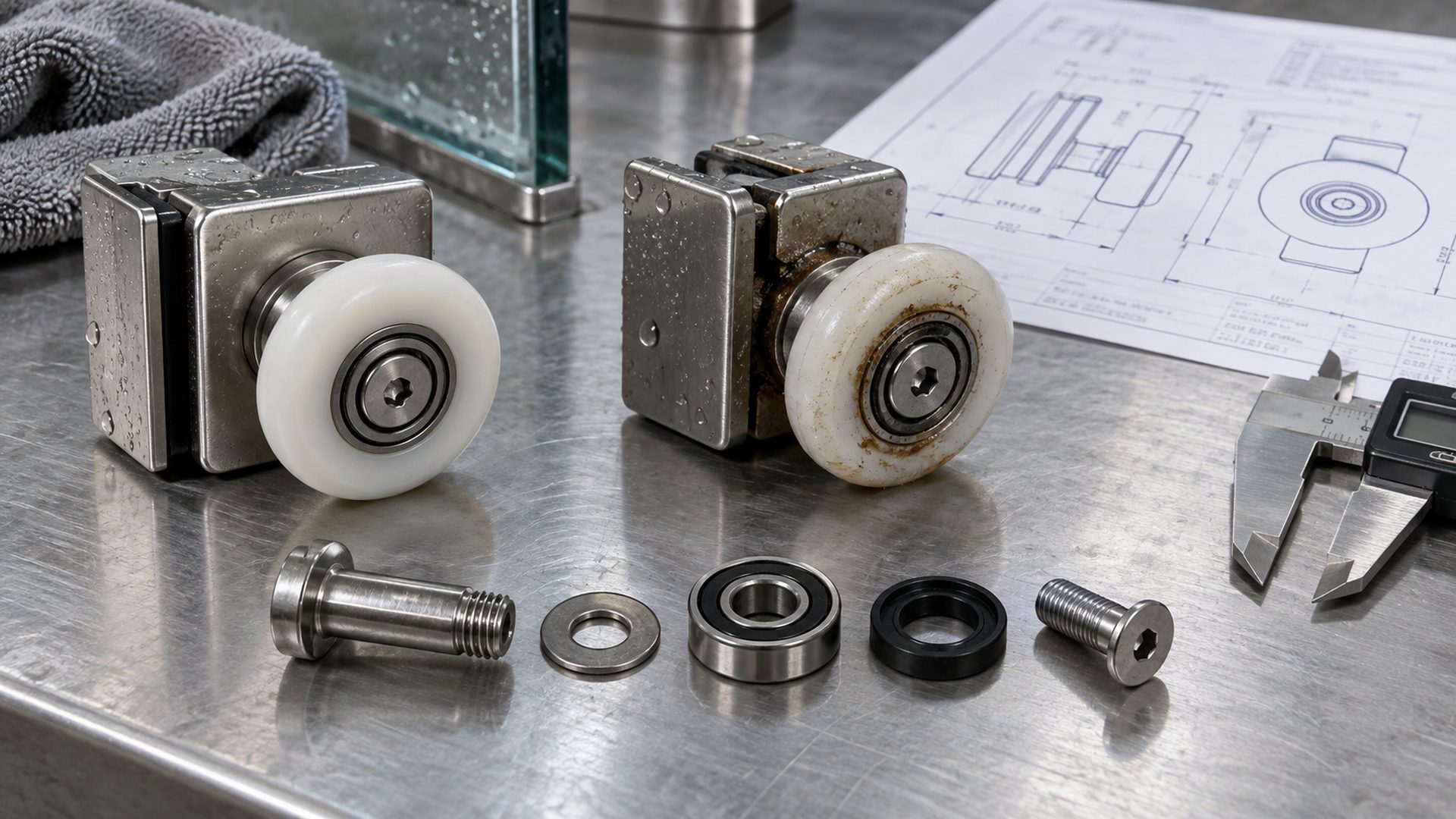
 The bearing edge, axle shoulder, washer contact, thread and bracket crevice deserve separate material and drainage review.
Likely initiation locations include:
- the gap between bearing inner ring and axle;
- the boundary between bearing outer ring and plastic wheel hub;
- seal lips and shield gaps;
- threads under a nut or decorative cap;
- washer faces and shaft shoulders;
- folded or overlapping bracket sections;
- glass-clamp plates and gaskets;
- scratches introduced during forming or assembly; and
- areas contaminated by carbon-steel tools or particles.
The visible flat face is often easier to rinse and dry than these interfaces. Crevice corrosion develops in confined wet gaps because the local environment differs from the exposed surface. The Nickel Institute’s stainless-steel piping guidance describes how oxygen limitation inside a chloride-containing crevice can hinder restoration of the passive film. A shower roller is a different product, but the mechanism explains why joint design matters.
Surface contamination also matters. Carbon-steel particles transferred during grinding, forming or handling can rust on a stainless surface and appear to the customer as stainless-steel failure. Fabrication, passivation requirements and tool control may therefore be part of the specification for visible hardware.
Which Corrosion Forms Matter Most?
Localized attack, crevice attack and galvanic effects can be more important than uniform surface rust.
| Corrosion form | Where it may occur | Functional consequence |
|---|---|---|
| Moisture corrosion in bearing | Raceway, balls or ring surfaces after water entry | Rough rotation, noise, torque increase and early damage |
| Pitting corrosion | Exposed stainless surface or local passive-film breakdown | Small visible pits, appearance loss and local section damage |
| Crevice corrosion | Threads, washers, clamp interfaces, seal zones | Hidden attack that can progress in retained moisture |
| Galvanic corrosion | Dissimilar metals electrically connected through water | Accelerated attack of the less resistant member under specific conditions |
| Fretting corrosion | Loose fitted surfaces with small relative motion | Wear debris, fit loss and staining |
| Coating failure | Plated carbon-steel shaft, screw or bracket edge | Red rust, blistering or underfilm attack |
The exact corrosion route depends on material pair, area ratio, water chemistry, temperature, surface condition and geometry. Do not diagnose every brown stain as base-metal penetration. Deposits, transferred contamination and actual corrosion products require different corrective actions.
For purchasing, define an acceptance method. “No rust” can refer to no red rust, no visible staining, no pits above an agreed limit or no loss of function. Those are different criteria.
How Does Corrosion Affect the Bearing?
Water inside the bearing can damage raceways, lubricant and seals, causing roughness long before the outside of the roller looks badly corroded.
Ball bearings rely on smooth hardened raceways and controlled lubrication. Corrosion pits create local surface damage. Rolling elements repeatedly passing over that damage can increase vibration and noise and can accelerate fatigue.
SKF’s bearing damage and failure guide states that moisture corrosion can occur quickly, penetrate deeply and lead to early bearing damage. The guide recommends protecting bearings from moisture, water, acids and aggressive chemicals through an appropriate sealing arrangement.
In a shower-door application, bearing problems can appear as:
- higher initial opening force;
- rough or notchy movement;
- squeal, grinding or intermittent noise;
- increased radial play;
- wheel wobble;
- grease discoloration or washout;
- a seized bearing that makes the wheel slide on the rail; or
- corrosion staining around the hub.
A seal is a barrier, not a guarantee of waterproof operation. Contact seals can improve protection but add torque. Shields leave a different gap structure and provide less protection against water entry. Our comparison of sealed and shielded bearings explains the distinction and why the complete environment matters.
The bearing material also requires trade-offs. High-hardness bearing steels offer strong rolling-contact performance but normally need protection against corrosion. Stainless bearing grades provide different balances of hardness and corrosion resistance. The phrase “stainless bearing” is incomplete without the grade, heat treatment, seal, lubricant and required load life.
Why Do the Axle, Fasteners and Bracket Matter?
Exposed structural hardware often receives more direct water than the bearing and can become the first visible or functional corrosion point.
The axle establishes bearing position and transfers load to the bracket. Corrosion on its seat can change fit, make disassembly difficult or create a rough surface under the inner ring. A plated carbon-steel axle may be adequate under one exposure and unacceptable under another, depending on coating system, edge coverage and damage during assembly.
Fasteners create tight crevices and can be scratched by tools. If a screw and bracket use different metals, the wet joint should be reviewed for galvanic behavior as well as strength. A decorative cap can retain water around the fastener head if drainage is poor.
The bracket or hanger body must maintain glass position. Severe corrosion, section loss or a loosened joint can alter alignment, increasing edge loading on the wheel and track. For visible shower hardware, much smaller surface defects can already be commercially unacceptable even before strength is affected.
Our bearing-steel material comparison explains why carbon steel, bearing steel and stainless options should be selected by component function rather than applying one material name to the complete roller.
Is Stainless Steel Always Corrosion-Proof?
No stainless grade is immune in every cleaner, crevice, chloride level and temperature.
Stainless steels rely on chromium-rich passivity. Alloying additions such as molybdenum and nitrogen can improve resistance to localized corrosion, but grade choice still depends on exposure and required properties.
For shower hardware, buyers commonly encounter terms such as 201, 304, 316, 420 and 440-series stainless steel. These designations do not describe interchangeable materials:
- austenitic grades are often used for brackets and fasteners because of formability and general corrosion resistance;
- molybdenum-bearing austenitic grades can offer better localized-corrosion resistance in certain chloride environments;
- martensitic stainless grades can provide hardness for bearing components but have a different corrosion-performance balance; and
- some low-cost stainless compositions may be selected for appearance and forming but need careful environmental review.
I would not write “use 316 everywhere” without checking bearing hardness, magnetic requirements, cost, forming process, availability and actual cleaner exposure. The correct assembly may combine a corrosion-resistant bracket and shaft with a protected high-hardness bearing, polymer wheel and compatible seals.
The buyer should request material documentation for the actual components instead of accepting a generic “stainless shower roller” label.
How Do Plastic Wheels, Seals and Gaskets Affect Corrosion Risk?
Nonmetallic components can protect metal contacts, but they can also retain water, change fit or degrade in cleaning chemicals.
A POM, nylon, PU or another engineered-plastic tread can separate the bearing from the rail and reduce metal-to-metal noise. The plastic hub may cover part of the bearing outer ring. However, a gap at that interface can trap water, and molding stress or dimensional change can affect bearing fit.
Material considerations include:
- water absorption and dimensional stability;
- resistance to cleaners and descaling products;
- creep under sustained glass load;
- impact and edge resistance;
- friction and noise on the rail;
- adhesion or mechanical retention around the bearing; and
- color change or surface appearance after exposure.
Elastomer seals and glass-clamp gaskets also need chemical compatibility. Swelling, hardening or compression set can reduce sealing or clamping performance. A gasket should cushion the glass and distribute pressure without creating an uncontrolled water pocket around the metal hardware.
HUNE’s roller materials and process overview provides a starting point for comparing plastic-coated bearing wheels and metal components. Final shower suitability still requires the exact material grade, cleaner exposure and assembly test.
How Can the Roller Design Reduce Water Retention?
Geometry can reduce corrosion risk by limiting stagnant crevices and giving water a path to drain and surfaces a path to dry.
Useful design questions include:
- Can water drain from the lowest point of the housing?
- Does a decorative cover trap water against a screw or bearing face?
- Are horizontal shelves or pockets unavoidable?
- Can the bearing seal face direct spray?
- Does the wheel hub shield the bearing without creating a closed wet crevice?
- Are dissimilar metals isolated or selected as a compatible pair?
- Can cleaning residue be rinsed from the assembly?
- Will the roller dry during normal idle time?
- Does the fastener installation scratch or remove protective finish?
Sealing every gap is not always the best answer. A partly sealed cavity that admits water but cannot release it may be worse than an open, drainable arrangement. The design should either exclude water reliably or manage entry, drainage and drying.
Surface finish affects both appearance and deposit retention. Rough, damaged or heat-tinted surfaces may behave differently from correctly finished material. Welds, stamped edges and machined shoulders deserve the same review as the broad decorative face.
Which Functional Dimensions and Specifications Matter?
The drawing should connect corrosion requirements with bearing fits, glass mounting and rail geometry.
For the wheel and bearing, define:
- finished running diameter and profile;
- bearing designation, material and seal configuration;
- tread runout relative to the bearing bore;
- hub fit and bearing retention;
- axle fit and shoulder contact;
- internal and installed clearance where functionally relevant; and
- approved grease or lubricant requirements.
For the metal hardware, define:
- exact material grade for axle, bracket, washers and fasteners;
- coating or passivation where required;
- visible-surface finish and acceptable appearance;
- prohibited material substitutions;
- thread and locking method;
- drainage features and crevice limits; and
- material documentation or inspection requirements.
For the glass and rail assembly, define:
- glass thickness and hole geometry;
- clamp or bushing stack;
- tightening condition and load distribution;
- roller spacing and load per assembly;
- rail material, profile and finish;
- alignment and adjustment range; and
- required axial and radial play.
Corrosion products or dimensional change can reduce clearance. Conversely, an excessively loose fit intended to “make room” can create wobble and uneven loading. Our guide to bearing clearance explains why fit, temperature and assembly affect the final rolling condition.
How Should an OEM Validate Corrosion Resistance?
Use exposure testing and functional cycling together, with acceptance criteria tied to the actual shower-door requirement.
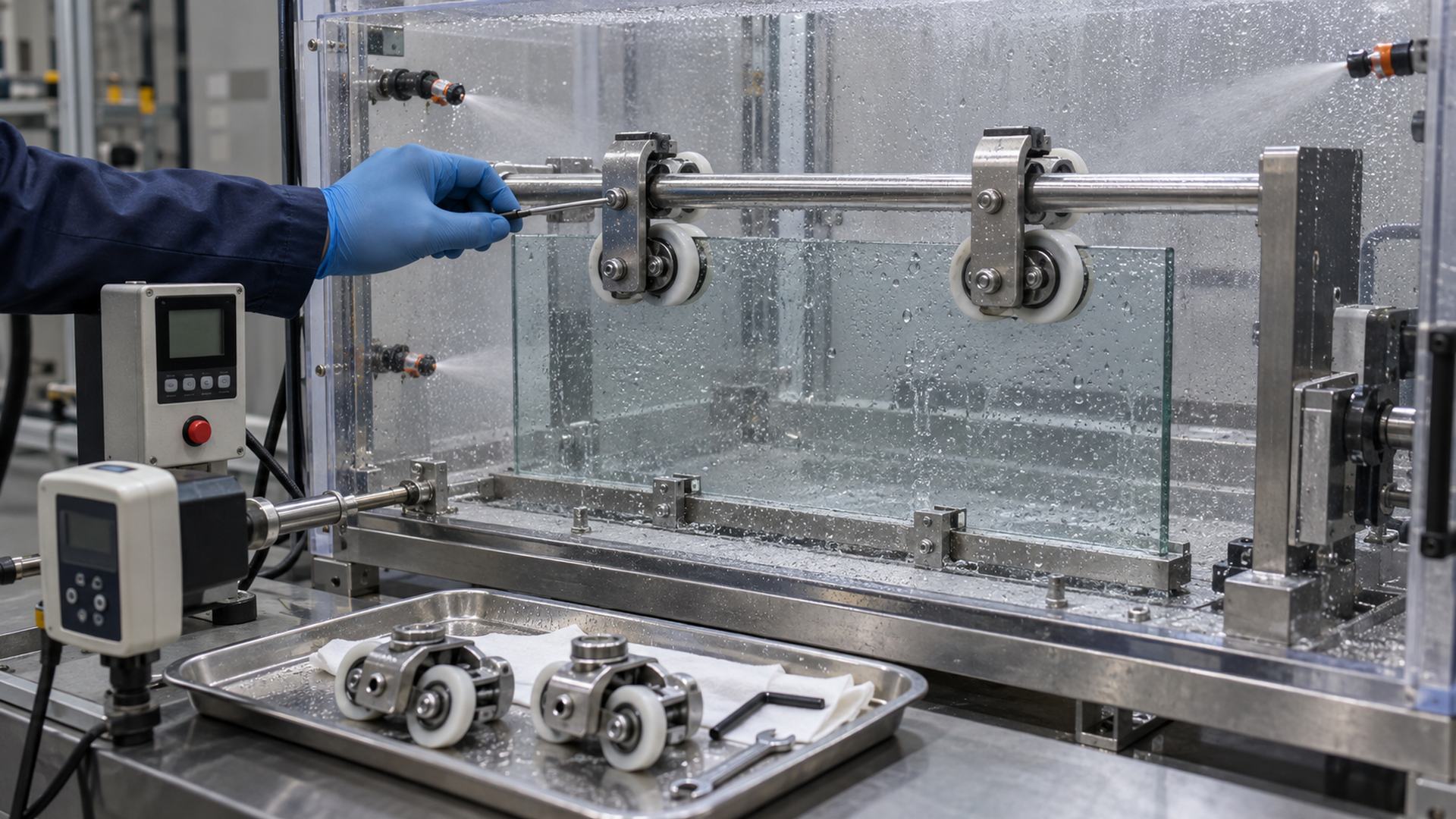
 A useful test exposes the complete roller, fasteners, glass interface and rail while monitoring movement and post-test condition.
A validation plan may include:
- initial dimensional, appearance and running-force measurements;
- wet/dry cycling with the approved water and cleaner conditions;
- movement cycles while wet and after drying;
- dwell periods that allow moisture to remain in crevices;
- inspection of bearings, axles, threads, brackets and covers;
- opening force, noise and wheel-play measurements;
- coating adhesion or visible-finish evaluation where applicable;
- disassembly to inspect hidden interfaces;
- glass clamp and fastener retention checks; and
- comparison with approved reference samples.
Salt-spray testing is often requested for metal hardware. ASTM’s current B117 salt-spray practice provides a controlled corrosive environment for relative comparison. ASTM also cautions that stand-alone salt-spray results do not reliably predict natural-environment performance. The OEM must define specimen preparation, exposure, evaluation criteria and how the result relates to the shower use case.
The Nickel Institute publishes test guidance for pitting and crevice corrosion. Material coupon tests can rank alloys under defined conditions, but they do not replace a complete roller test with formed edges, fasteners, seals and deposits.
I would avoid inventing a universal number of salt-spray hours for all shower rollers. The correct requirement depends on material route, customer standard, market, exposure and acceptance limit.
What Should a Buyer Send the Supplier?
A useful shower-roller inquiry defines every wet component and the required evidence, not only wheel diameter.
Send:
- shower-door type and roller position;
- glass thickness, mass and number of supporting rollers;
- complete roller, bracket and clamp drawing;
- rail profile, material and surface finish;
- wheel diameter, width, profile and material preference;
- bearing size, seal and material requirements;
- axle, fastener, bracket and cover material grades;
- expected water, humidity and temperature exposure;
- cleaning agents and cleaning frequency;
- regional chloride or coastal exposure where relevant;
- opening frequency and target cycle life;
- allowable running force, noise and play;
- appearance acceptance criteria;
- required corrosion or wet-cycle test method;
- material certificates or compliance documents; and
- prototype quantity, annual demand and tooling expectations.
If replacing a current roller, provide the complete used assembly rather than only the rusted part. Corrosion at one location may be caused by drainage, material pairing or a damaged coating elsewhere in the system.
HUNE manufactures plastic-coated bearing rollers, shafts, fasteners, stamped brackets and assembled sliding hardware for OEM door systems. We can review wet exposure, track contact, material selection and assembly geometry through the HUNE OEM development process. To discuss a shower-door roller project, send HUNE the drawing, sample and test requirements.
Frequently Asked Questions
Are stainless steel shower door rollers completely rust-proof?
No. Stainless steel provides corrosion resistance, but performance depends on the exact grade, surface condition, cleaner chemistry, chloride exposure, crevice design and connected materials. The bearing, axle, fasteners and bracket may also use different grades.
Is a sealed bearing waterproof?
Not automatically. A contact seal can improve resistance to water and contamination, but sealing effectiveness depends on the bearing design, shaft interface, pressure, exposure direction, speed and seal condition. Confirm the intended environment with the supplier and test the complete roller.
Is 316 stainless steel always required for shower rollers?
No universal grade fits every component or environment. A molybdenum-bearing grade can improve localized-corrosion resistance in some chloride conditions, but bearing hardness, forming, cost, appearance and actual exposure also matter. Specify by component and validate the assembly.
Can salt-spray hours predict shower roller service life?
Not by themselves. Salt spray can compare materials or finishes under a controlled method, but ASTM B117 does not provide a universal conversion to years of shower use. Wet cycling, cleaner exposure and functional movement provide additional evidence.
Practical Engineering Recommendation
Treat corrosion resistance as a system requirement covering every wet interface and every retained crevice.
Specify the bearing, axle, fasteners, bracket, wheel, seals and finish separately; provide drainage and drying paths; and test running force, play, appearance and retention after realistic wet exposure. A roller should not be approved because one visible part is stainless or because the bearing has a seal. Approve the complete roller–glass–rail assembly against the shower manufacturer’s functional and corrosion criteria before mass production.